How to Use dYdX: Complete Perpetual Trading Tutorial (2026)
— By Tony Rabbit in Tutorials
Learn how to trade perpetual futures on dYdX v4 with this step-by-step guide. From account setup to placing leveraged trades, manage risk and earn rewards on the leading decentralized perpetuals exchange.
To use dYdX for perpetual trading, connect your wallet to the leading decentralized perpetual exchange, which offers up to 20x leverage on numerous crypto assets. This allows trading without KYC or surrendering custody, leveraging its over $1.2B daily volume and 67+ trading pairs for advanced order strategies.
Intent check: This page is the step-by-step perpetual trading guide for dYdX. If you want the protocol explainer for the v4 appchain, validators, and market structure, read dYdX V4 Explained.
How to Use dYdX for Perpetual Trading - Complete Tutorial 2026
Learning how to use dYdX for perpetual trading is essential for any serious DeFi trader in 2026. As the leading decentralized perpetual exchange, dYdX offers up to 20x leverage on dozens of crypto assets - all without requiring KYC or surrendering custody of your funds. This comprehensive dYdX perpetual trading tutorial covers everything from initial setup to advanced order strategies, helping you trade with confidence on the most liquid decentralized derivatives platform available today.
What Is dYdX and Why Does It Matter for Perpetual Trading?
dYdX is a decentralized exchange (DEX) built specifically for perpetual contract trading. Unlike centralized platforms such as Binance or Bybit, dYdX operates on its own appchain built using the Cosmos SDK, giving traders full self-custody of their assets while accessing deep liquidity and institutional-grade execution speeds. The protocol has processed over $500 billion in cumulative trading volume since launch, establishing itself as the premier venue for decentralized derivatives.
Perpetual contracts - often called perpetual futures or perps - are derivative instruments that let you speculate on price movements without actually holding the underlying asset. They have no expiry date, unlike traditional futures, which makes them the most popular trading instrument in crypto. With dYdX, you can go long or short on assets like BTC, ETH, SOL, and dozens of altcoins with up to 20x leverage.
dYdX v4 runs on its own Cosmos-based blockchain, meaning every trade is settled on-chain with full transparency. The orderbook is fully decentralized, validators match orders, and governance is controlled by DYDX token holders. This is a major upgrade from the earlier StarkEx-based v3.
How dYdX Perpetual Trading Works - Technical Overview
Understanding the mechanics behind dYdX perpetual trading helps you make better decisions. The platform uses an on-chain orderbook model rather than an Automated Market Maker (AMM). This means you place limit and market orders just like on a centralized exchange, but the matching engine runs across dYdX Chain validators.
When you open a position, you deposit collateral (USDC) and select your leverage. The protocol calculates your margin requirements based on your position size. If the market moves against you beyond your maintenance margin, your position gets liquidated. The funding rate mechanism keeps perpetual prices aligned with spot markets - longs pay shorts when the perp trades above spot, and shorts pay longs when it trades below.
dYdX v4 achieves throughput of approximately 2,000 transactions per second with sub-second finality. This performance rivals centralized exchanges and eliminates the latency issues that plagued earlier DEX versions. The protocol also features a sophisticated risk engine that monitors positions in real-time and executes liquidations efficiently to protect the insurance fund.
Step-by-Step Guide to Getting Started on dYdX
Setting up your dYdX account and placing your first perpetual trade takes only a few minutes. Follow these steps to get started with dYdX perpetual trading in 2026.
Step 1 - Connect Your Wallet
Visit the official dYdX trading interface at trade.dydx.exchange. Click the "Connect Wallet" button in the top right corner. dYdX supports MetaMask, Coinbase Wallet, WalletConnect, Keplr, and several other popular wallets. Select your preferred wallet and approve the connection request. Since dYdX v4 runs on Cosmos, the platform will automatically generate a dYdX Chain address linked to your Ethereum wallet.
Step 2 - Deposit Funds
Click "Deposit" to fund your trading account. You can deposit USDC from Ethereum, Arbitrum, Optimism, Polygon, or directly via the Cosmos ecosystem through IBC transfers. Cross-chain deposits typically take 1-10 minutes depending on the source chain. The minimum deposit is just $10, making dYdX accessible to traders of all sizes.
Step 3 - Navigate the Trading Interface
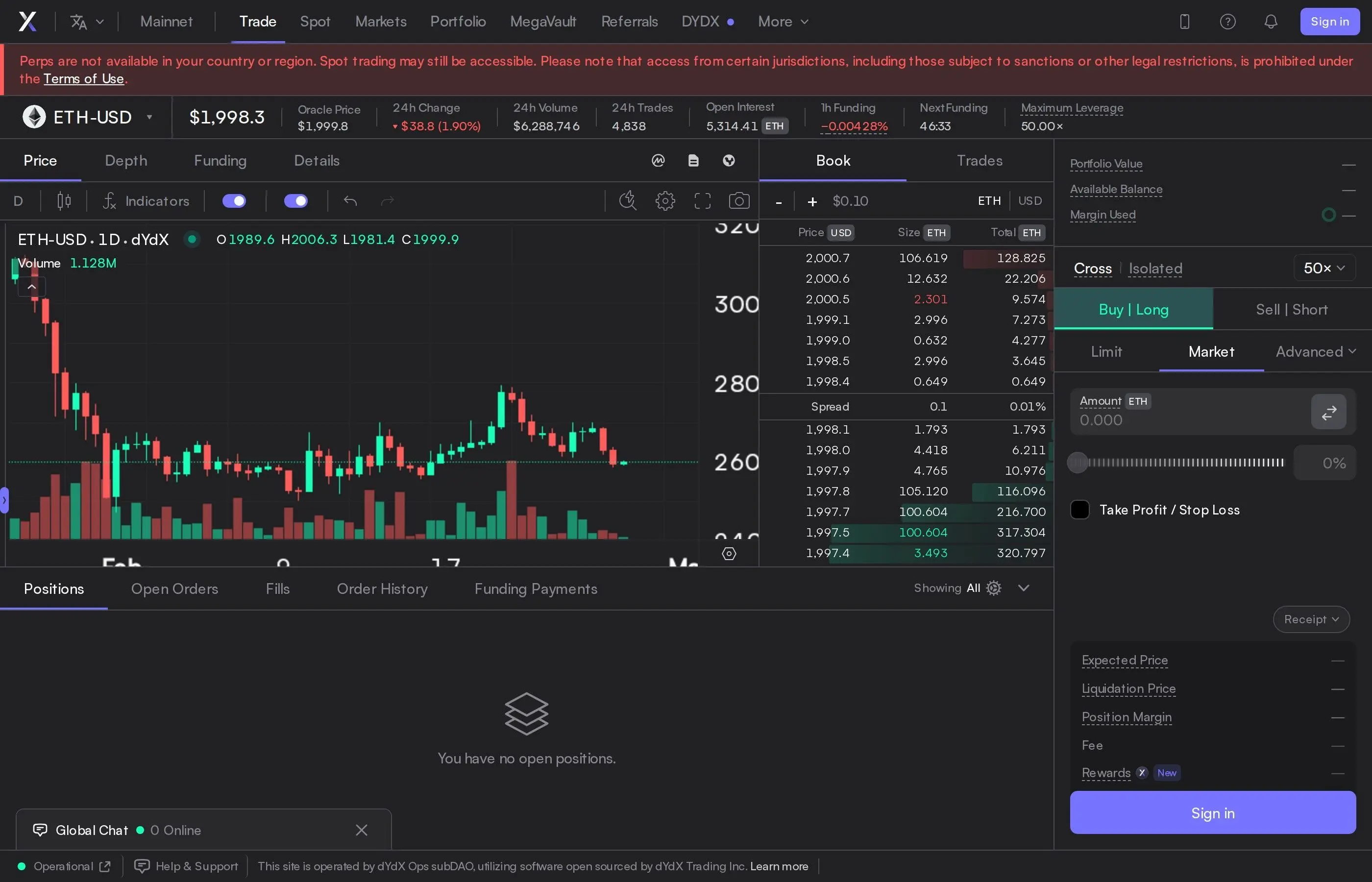
The dYdX trading interface features a professional layout with the orderbook on the left, price chart in the center, and trade entry panel on the right. Below the chart, you will find your open positions, orders, and trade history. Take a moment to familiarize yourself with the layout before placing your first trade.
Step 4 - Select a Market and Set Leverage
Choose your trading pair from the markets dropdown. Popular options include BTC-USD, ETH-USD, SOL-USD, and DOGE-USD. Click the leverage slider to set your desired leverage between 1x and 20x. Higher leverage amplifies both gains and losses, so beginners should start with 2-3x until they understand the risk dynamics.
Step 5 - Place Your First Trade
Select "Market" for instant execution or "Limit" to set a specific entry price. Enter your position size in USD. Review the estimated liquidation price and fees. Click "Place Order" and confirm the transaction. Your position will appear in the positions tab below the chart within seconds.
Step 6 - Set Stop Loss and Take Profit
After opening a position, immediately set protective orders. Click on your open position and select "Add Stop Loss" or "Add Take Profit." These conditional orders execute automatically when price reaches your specified levels, helping you manage risk without constant monitoring.
Pro Tip
Always set your stop loss before your take profit. The number one mistake new perpetual traders make is focusing on profit targets while ignoring downside risk. A good rule of thumb is to risk no more than 1-2% of your total account on any single trade.
Core Features of dYdX Perpetual Trading Platform
Advanced Order Types
dYdX supports market orders, limit orders, stop-limit orders, trailing stops, and take-profit orders. The limit order system uses a maker-taker model where limit orders that add liquidity to the book (makers) pay zero fees, while market orders that remove liquidity (takers) pay a small fee. This incentivizes deep orderbook liquidity.
Cross-Margin and Isolated Margin
Cross-margin mode uses your entire account balance as collateral for all positions, which reduces liquidation risk but means one bad trade can affect your whole portfolio. Isolated margin confines collateral to each individual position. Most experienced traders use isolated margin for higher-risk trades and cross-margin for core positions.
Real-Time Funding Rates
Funding rates on dYdX update every hour. When funding is positive, long positions pay short positions. When negative, shorts pay longs. Monitoring funding rates is crucial because they directly impact your holding costs. During strong bull markets, funding can become significantly positive, making it expensive to hold leveraged longs over extended periods.
MegaVault - Passive Liquidity Provision
dYdX MegaVault allows users to deposit USDC and earn yield by providing liquidity to the trading platform. The vault automatically market-makes across all trading pairs, generating returns from bid-ask spreads. This is an excellent option for users who want exposure to dYdX without actively trading.
Advanced dYdX Perpetual Trading Strategies
Once you are comfortable with the basics, these advanced strategies can help optimize your dYdX trading results.
Funding Rate Arbitrage
When funding rates are extremely positive, you can short the perpetual on dYdX while simultaneously buying the spot asset on a DEX. This delta-neutral strategy earns the funding rate without directional risk. The key is ensuring your funding income exceeds transaction costs across both venues.
Scaling Into Positions
Rather than entering a full position at once, use limit orders at multiple price levels to build your position gradually. This approach - called scaling in - gives you a better average entry price and reduces the impact of short-term volatility. For example, if you want to go long $10,000 of ETH, you might place five $2,000 limit orders at progressively lower prices.
Hedging DeFi Positions
If you hold significant spot crypto or DeFi positions, dYdX perpetuals can serve as an effective hedge. Opening a short perpetual position equal to your spot holdings protects you from downside risk while allowing you to maintain your DeFi yield farming or staking positions.
Best For Beginners
Start with 2-3x leverage on major pairs like BTC-USD or ETH-USD. Use isolated margin and always set stop losses. Focus on learning the interface before increasing position sizes.
Best For Advanced Traders
Leverage funding rate arbitrage, use cross-margin for portfolio efficiency, and explore altcoin perpetuals for higher volatility opportunities. Monitor open interest and liquidation levels for edge.
dYdX Fee Structure and Trading Costs
Understanding the fee structure on dYdX is essential for calculating your true trading profitability. The platform uses a tiered fee model based on your 30-day trading volume.
In addition to trading fees, you should account for funding rate payments when holding positions overnight. Gas fees on the dYdX Chain are minimal - typically less than $0.01 per transaction. Cross-chain deposit fees vary depending on the source network, with Ethereum being the most expensive and Layer 2 networks being significantly cheaper.
dYdX vs GMX vs Hyperliquid - Perpetual DEX Comparison
Choosing the right decentralized perpetual exchange depends on your trading style and priorities. Here is how dYdX compares to its main competitors.
Security Considerations for dYdX Perpetual Trading
Trading perpetual contracts on any platform involves both smart contract risk and financial risk. Here are the key security considerations for dYdX users in 2026.
dYdX v4 has undergone multiple security audits from firms including Trail of Bits, Informal Systems, and OtterSec. The protocol's open-source codebase has been reviewed by the community since its launch. The dYdX Chain uses a proof-of-stake consensus mechanism with over 60 active validators, providing robust decentralization and censorship resistance.
From a personal security perspective, always use a hardware wallet when trading significant amounts. Enable all available security features in your wallet software. Never share your seed phrase, and be cautious of phishing sites that impersonate the dYdX interface. Bookmark the official URL and always verify you are on the correct domain before connecting your wallet.
Warning
Leveraged trading carries substantial risk of loss. You can lose more than your initial deposit if your position is liquidated. Never trade with funds you cannot afford to lose. Start with small positions and low leverage until you fully understand the mechanics of perpetual contracts.
Common Mistakes to Avoid When Trading Perpetuals on dYdX
Even experienced traders make costly errors when transitioning to decentralized perpetual trading. Avoid these common pitfalls to protect your capital.
1. Over-leveraging on volatile assets. Using 20x leverage on a small-cap altcoin is a fast way to get liquidated. Higher leverage means a smaller price move triggers liquidation. Stick to 2-5x for most trades.
2. Ignoring funding rates. Holding a leveraged long position during a period of extremely positive funding can eat into your profits quickly. Check the funding rate before entering any position and factor it into your trade thesis.
3. Not setting stop losses. Without a stop loss, a sudden market crash can liquidate your entire position. Always protect your downside before focusing on profit targets.
4. Trading without a plan. Enter every trade with a clear entry, stop loss, take profit, and position size predetermined. Emotional trading on perpetual exchanges is the fastest path to blowing up your account.
5. Depositing from expensive networks. Bridging USDC from Ethereum mainnet can cost $5-20 in gas. Use Layer 2 networks like Arbitrum or Optimism to save on deposit fees.
6. Forgetting about partial liquidations. dYdX uses a gradual liquidation system. If your margin ratio drops below maintenance requirements, the protocol will partially close your position at unfavorable prices. Monitor your margin ratio and add collateral before reaching dangerous levels.
Frequently Asked Questions About dYdX Perpetual Trading
Is dYdX safe to use for perpetual trading in 2026?
dYdX is considered one of the safest decentralized perpetual exchanges. It has been audited by multiple security firms, runs on its own Cosmos-based blockchain with 60+ validators, and has processed over $500 billion in volume without a major security incident. However, all DeFi protocols carry smart contract risk, and leveraged trading itself is inherently risky.
Do I need to complete KYC to trade on dYdX?
No. dYdX does not require KYC verification. You only need a compatible wallet to connect and start trading. However, the platform may restrict access from certain jurisdictions through frontend geoblocking.
What is the minimum deposit for dYdX perpetual trading?
The minimum deposit on dYdX is approximately $10 worth of USDC. However, to trade effectively with proper position sizing and risk management, a starting balance of at least $100-500 is recommended.
How does dYdX make money if maker fees are so low?
dYdX generates revenue primarily through taker fees, which range from 0.025% to 0.05% depending on volume tier. The protocol also benefits from liquidation fees that flow to the insurance fund. Trading fees are distributed to DYDX stakers and validators.
Can I use dYdX on mobile?
Yes. dYdX has a mobile-responsive web interface and dedicated iOS and Android applications. The mobile experience supports all core trading features including market orders, limit orders, and position management.
What happens if dYdX gets hacked?
dYdX maintains an insurance fund to cover losses from unexpected events. The fund is built from liquidation fees and has grown to over $25 million. Additionally, the protocol's decentralized validator set makes it significantly harder to compromise compared to centralized exchanges.
How is dYdX different from trading perpetuals on Binance?
The main differences are custody and decentralization. On Binance, the exchange holds your funds. On dYdX, you maintain self-custody through your wallet. dYdX also does not require KYC, offers full transparency through on-chain settlement, and allows governance participation through the DYDX token. However, Binance offers higher leverage and more trading pairs.
Related Tutorials and Next Steps
Now that you understand how to use dYdX for perpetual trading, consider exploring these related protocols to build a complete DeFi trading toolkit.