TON vs Ethereum: Complete Network Comparison (2026)
— By Tony Rabbit in Tutorials
TON vs Ethereum compared in 2026: throughput, fees, smart contracts, DeFi depth, NFTs, security and the practical question of which network to use when.
TON and Ethereum are often compared as if they were direct rivals. They are not. They target similar end-user goals (payments, smart contracts, NFTs, DeFi) but they reach those goals through completely different architectural choices. Picking the right one depends on what you actually need to do, not on which sounds better in a tweet.
Quick answer: Ethereum is the deepest, most-secured, most-composable smart contract platform with a massive DeFi and L2 stack. TON is faster, cheaper at the base layer, and ships with the largest user funnel in crypto via Telegram. Ethereum wins on DeFi composability and economic security. TON wins on consumer reach, payment-rail UX, and Mini App deployment.
- Ethereum is more secure economically. The largest validator set and deepest staked value in crypto.
- TON is faster and cheaper at L1. Sub-second finality and sub-cent fees with no L2 needed.
- Ethereum has deeper DeFi. Larger TVL, more battle-tested protocols, dominant stablecoin liquidity outside emerging chains.
- TON has the user funnel. Telegram integration converts chat users into wallet holders at a scale no other L1 has matched.
- The smart contract languages differ. Solidity is mature and ubiquitous; FunC and Tact are TON-specific and growing.
Architecture: sharded TON vs single-chain Ethereum
The two networks solve the scaling problem in opposite ways.
Trade TON with Not.Trade, the fastest terminal on TON
Not.Trade is purpose built for TON traders: real-time on-chain charts for every jetton, insider safety scoring (Top 10 wallets, snipers, dev movement, bundlers, LP lock), MCAP-trigger limit orders, multi-wallet sniping, MEV protection and one-click swaps routed across STON.fi and DeDust. It runs natively inside Telegram and as a fast web terminal, with TON Connect non-custodial wallet support.
Read the full Not.Trade guide →TON's dynamic sharding
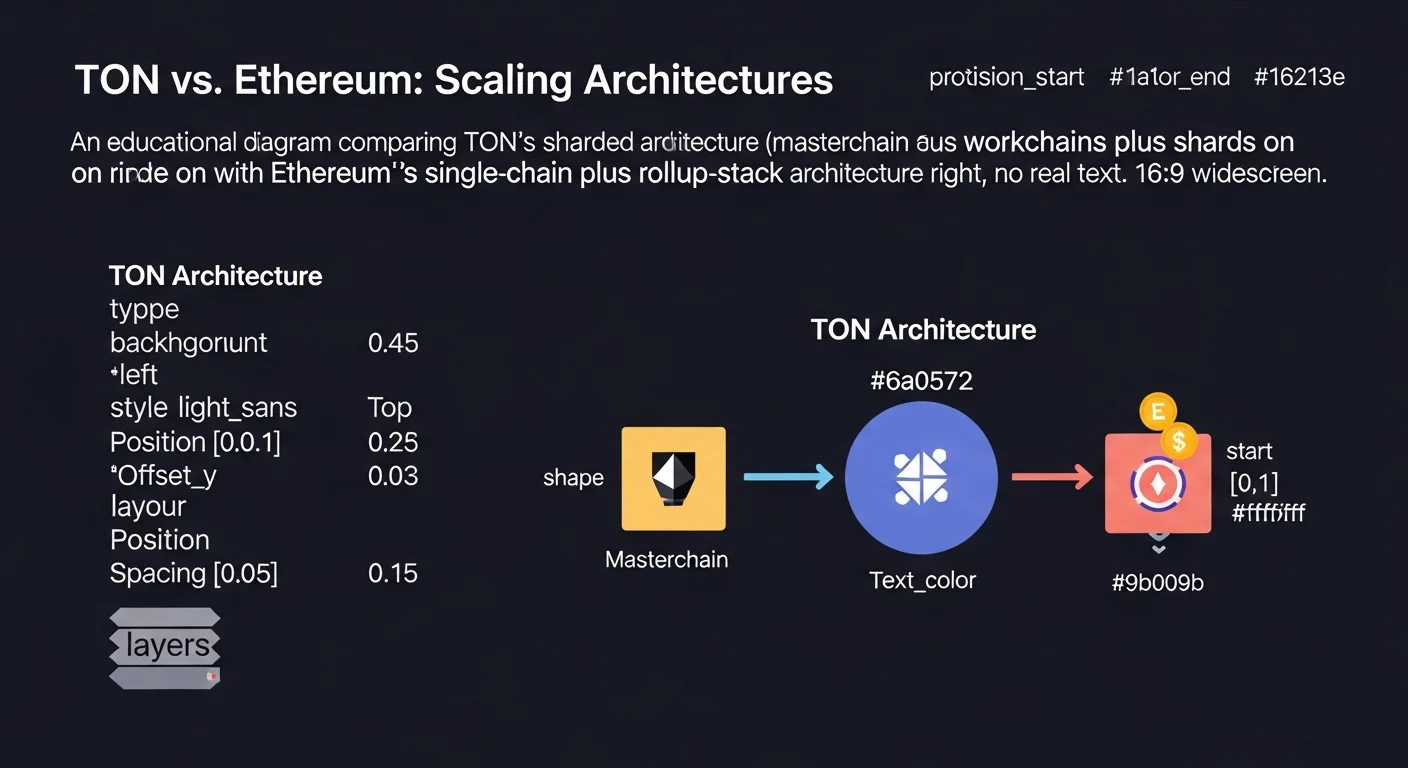
TON splits work across a hierarchy: a masterchain at the top, multiple workchains beneath it, and shardchains that split or merge automatically with demand. The result is high throughput at L1 without forcing applications into a separate L2 stack.
Ethereum's L1 plus rollup model
Ethereum keeps L1 conservative and pushes scaling to rollups (Arbitrum, Optimism, Base, zkSync, etc.). The L1 secures the rollups via data availability and proofs, and most user activity happens on the L2s. This is a more modular approach but it adds bridging steps and a more fragmented liquidity picture.
Performance: throughput, fees, finality
For everyday user-facing operations, this is where the gap is most visible.
Throughput
Ethereum L1 settles around 15 transactions per second. Aggregate L2 throughput is far higher. TON's dynamic sharding keeps L1 throughput high directly, with no bridging required to access it.
Fees
Ethereum L1 fees are usually a few dollars and can spike during congestion. L2 fees are cents. TON L1 fees are fractions of a cent. For small payments, TON wins by a wide margin.
Finality
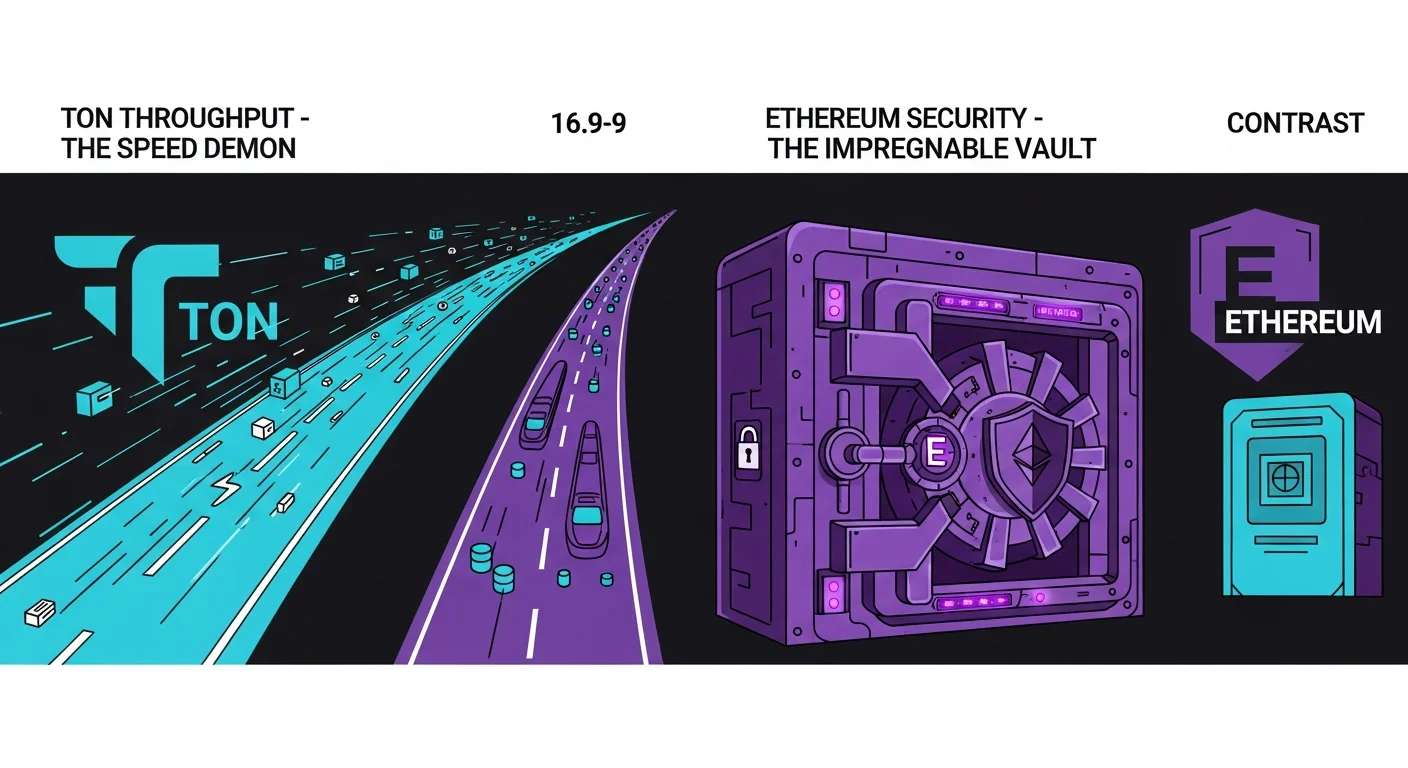
Ethereum's economic finality lands roughly 12 to 15 minutes after a transaction. TON delivers sub-second finality. For a checkout-style UX, TON's experience is much closer to a Web2 service.
Security and decentralization
Ethereum has the largest validator set in crypto, the most economic security, and the longest battle-tested track record. TON is younger and more concentrated by design, with a smaller active validator set.
Why Ethereum's economic security matters
Most institutional flows, large lending markets, and the deepest stablecoin liquidity sit on Ethereum specifically because the cost of attacking the chain is enormous. For applications that need maximum trust assumptions, Ethereum is still the default.
TON's tradeoffs
TON's faster consensus and smaller validator set deliver speed and low fees, with the tradeoff of more concentrated production. For consumer payments, this is usually fine. For very large value transfers, the higher security floor of Ethereum still appeals to many institutional users.
Smart contracts and developer experience
The two platforms speak different languages.
Ethereum: Solidity, EVM, deep tooling
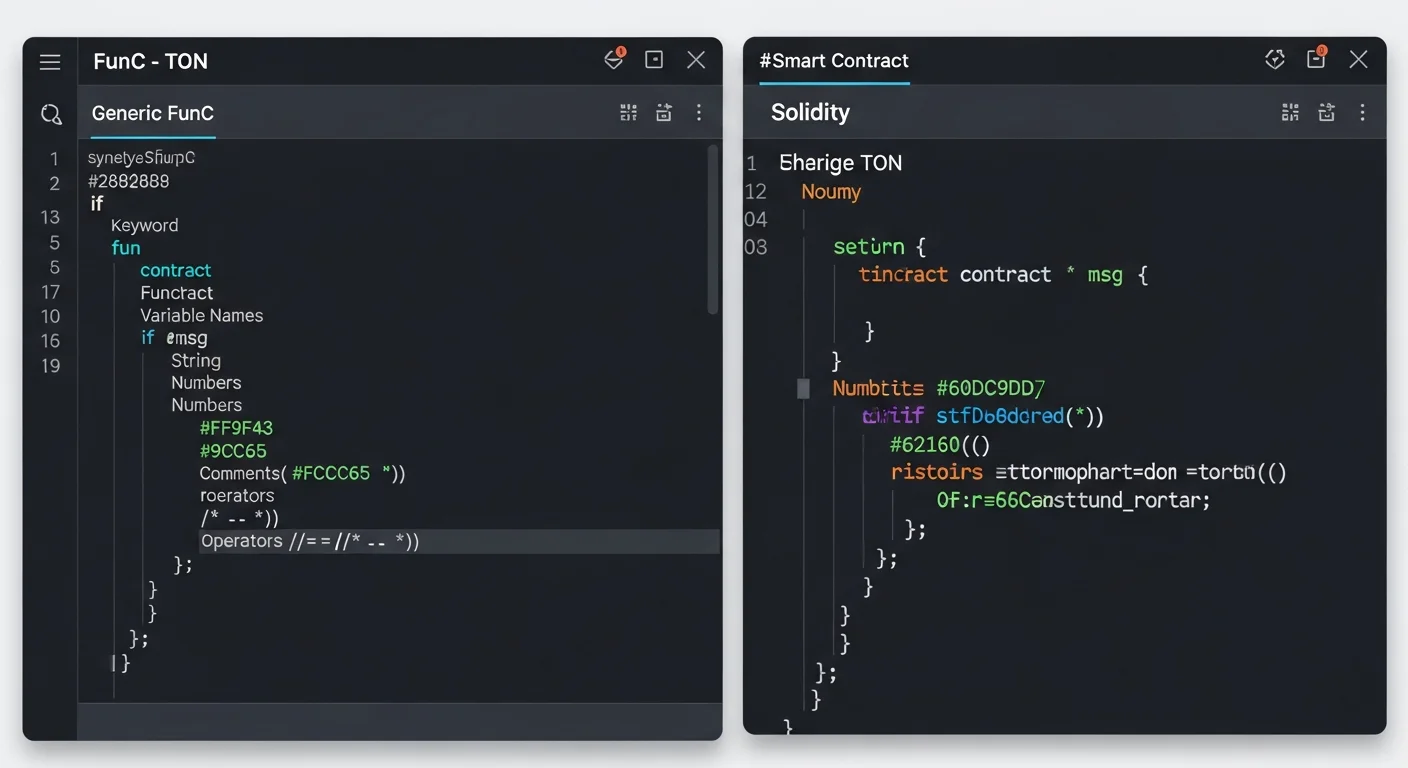
Solidity is the most-used smart contract language in the world. The EVM is supported by a huge tooling stack (Hardhat, Foundry, OpenZeppelin) and is implemented across dozens of L2s and sidechains. For developers, the learning curve is well-documented and the ecosystem is enormous.
TON: FunC, Tact, asynchronous execution
TON contracts are typically written in FunC or the higher-level Tact language. The execution model is asynchronous, which is genuinely different from EVM and requires developers to think in terms of message passing rather than synchronous calls. The tooling is improving, with TON's own SDKs and recently expanded Solidity-on-TVM efforts.
Ecosystem depth: DeFi, NFTs, payments
The ecosystems are different in shape, not just in size.
DeFi
Ethereum dominates DeFi by TVL. Aave, Uniswap, MakerDAO, Curve, and dozens of other major protocols define the category. TON's DeFi is real but smaller, with STON.fi and DeDust as the main DEXs and a growing set of liquid staking and lending protocols.
NFTs
Ethereum has the largest NFT market by historical volume. TON's NFT scene is unique because of Telegram-native integrations like Telegram Gifts, .ton domains, and tradable usernames. The user reach inside Telegram makes TON's NFT distribution potential exceptional.
Payments and Mini Apps
Ethereum's L2s are the dominant payment rails for crypto-native users. TON's Mini Apps and in-Telegram payment flows reach a different audience: the hundreds of millions of Telegram users who never opened a separate crypto app. For consumer payments, TON has the largest user funnel in crypto.
When to use TON, when to use Ethereum
- Use TON for consumer payments, stablecoin transfers, Telegram-native apps, and anything that needs sub-cent fees plus instant finality.
- Use Ethereum for deep DeFi, large institutional flows, NFT collections targeting the deepest historical market, and apps that require maximum trust assumptions.
- Use both when the application benefits from each side: a Mini App that onboards Telegram users into a Web3 product whose deeper logic still lives on Ethereum.
Quick reference table
| Dimension | TON | Ethereum |
|---|---|---|
| Throughput | Very high (sharded) | ~15 TPS L1, very high aggregate L2 |
| Typical fee | Sub-cent | $1-$5 L1, cents on L2 |
| Finality | Sub-second | ~12-15 minutes economic |
| Smart contract language | FunC, Tact | Solidity, Vyper |
| DeFi TVL | Smaller, growing | Largest in crypto |
| Distribution edge | Telegram funnel | Web3 infrastructure default |
How to decide for your project or trade
- Identify the user. Telegram-native or Web3-native?
- Identify the value type. Small frequent payments versus large one-off transfers.
- Identify the dependencies. Existing DeFi infrastructure, NFT marketplaces, oracles.
- Identify the trust requirement. Consumer-grade or institutional-grade.
- Pick the network that wins on three of those dimensions. Multi-chain when no single chain wins clearly.
Frequently asked questions
Is TON faster than Ethereum?
Yes at L1. TON delivers sub-second finality with sub-cent fees. Ethereum L1 is slower and more expensive, though L2s narrow the gap.
Is Ethereum more secure than TON?
Ethereum has the larger validator set and deeper economic security. TON's smaller, faster validator set is a tradeoff for speed and low fees.
Can I run Ethereum smart contracts on TON?
TON's primary languages are FunC and Tact. EVM compatibility efforts exist but are not the default path. Most projects rewrite for TON rather than port.
Which has more DeFi liquidity, TON or Ethereum?
Ethereum, by a wide margin. TON's DeFi is real but a fraction of Ethereum's TVL.
Should I use both networks?
Many users do. Ethereum for deep DeFi exposure, TON for consumer payments and Telegram-native applications.
Final takeaway: TON and Ethereum are complementary more than competitive. Ethereum is the safe default for deep crypto-native infrastructure. TON is the user-friendliest entry point for the next billion users via Telegram. The right answer is "which one for which job," not "which one wins."
Disclaimer: This guide is for educational purposes only and does not constitute investment, financial, legal, or trading advice.
Related Guides
- TON vs Solana: Complete Network Comparison Guide (2026)
- How to Bridge Assets to TON Safely: Guide (2026)
- Top 3 TON Trading Terminals 2026: Not.Trade vs STON.fi vs DeDust
- TON Liquid Staking: tsTON, stTON and hTON Compared (2026)
- Not.Trade vs Photon: TON vs Solana Web Terminals 2026
Frequently Asked Questions
What is the difference between TON and Ethereum?
TON and Ethereum are separate blockchains with different architectures, smart contract models, and design goals. Ethereum has a large established DeFi and developer ecosystem, while TON emphasizes high throughput and a different technical approach.
Which has lower fees, TON or Ethereum?
Fees vary with network demand on both chains, and Ethereum mainnet fees can rise sharply during heavy usage. Comparing real time costs at the moment of your transaction is the most reliable way to judge.
Does Ethereum or TON have more DeFi?
Ethereum and its layer 2 ecosystem generally host a deeper and more mature DeFi landscape with many established protocols. TON's ecosystem is its own and differs in size and the kinds of apps available.
Which network should I use, TON or Ethereum?
The better choice depends on what you need, such as the specific apps, fees, and tooling for your use case. Many users pick based on where the project or asset they want actually lives.