How XRP Ledger Powers Global Finance in 2026
Learn how XRP Ledger is used in global finance, payments and cross-border infrastructure in 2026.
As of Wednesday, April 8, 2026, the digital asset market has moved far beyond the "experimental" phase. With XRP currently trading at $1.36, it remains one of the most resilient and utilized assets in the space. But unlike Bitcoin (which acts like digital gold) or Ethereum (a global computer), XRP was built for one specific purpose: moving value across the world as fast as information.
To understand why XRP is a staple in a 2026 portfolio, we need to peel back the hood and look at the engine: the XRP Ledger (XRPL).
1. XRP ledger Architecture: The Global Shared Spreadsheet
At its core, the XRP Ledger is a decentralized, open-source cryptographic ledger. Think of it as a massive, shared spreadsheet that everyone can see but no one can forge.
Unlike many other blockchains, the XRPL doesn't rely on "mining." Instead, it uses a unique architecture designed for speed. It is a negative-latency system where the ledger reaches "consensus" (agreement) on all transactions every 3 to 5 seconds. In 2026, this remains significantly faster than the settlement times of traditional banking rails or even the main layers of older blockchains.
2. How it Works: Validation vs. Mining
If there are no miners (like Bitcoin) and no traditional stakers (like Ethereum 2.0), how does the network stay secure?
The Consensus Protocol
The XRPL uses the XRP Ledger Consensus Protocol. Here is the simplified version of the process:
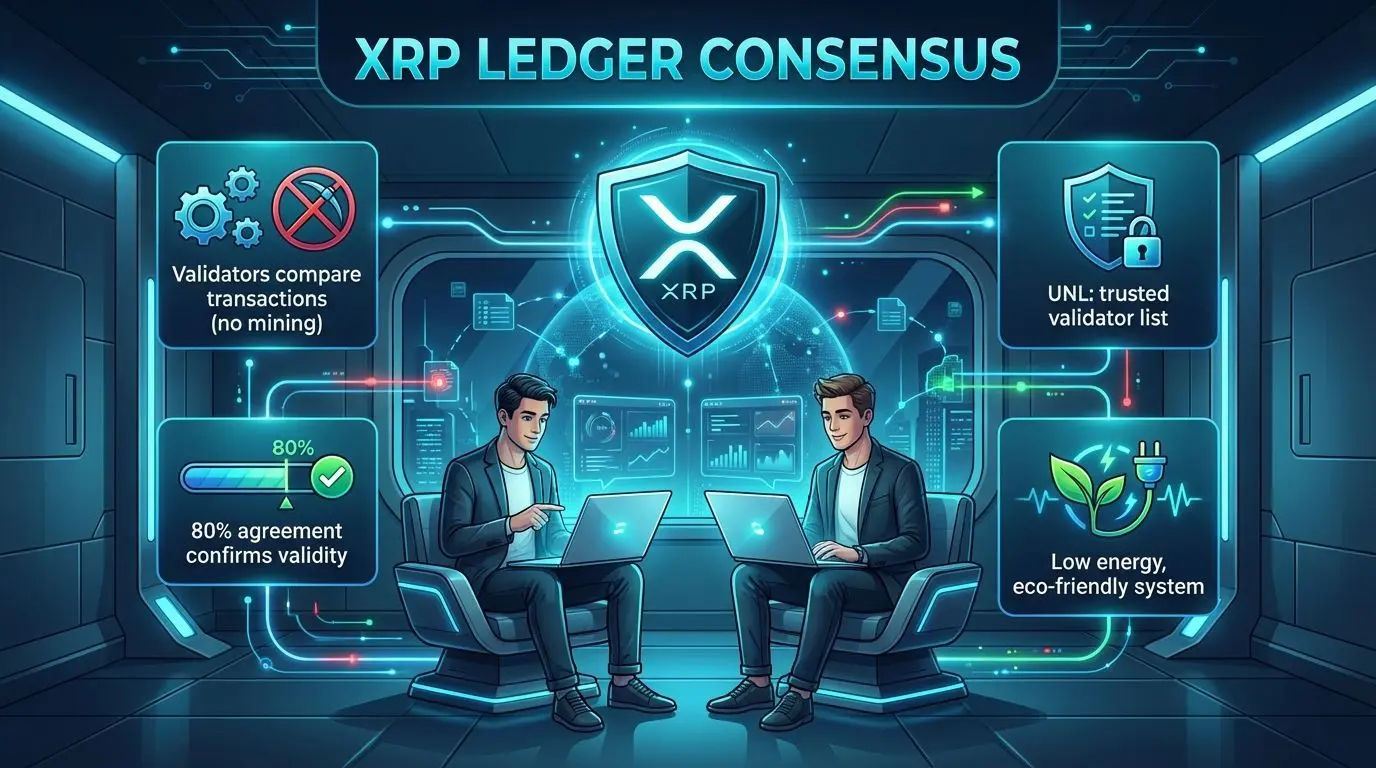
Validators: Instead of solving complex math problems to win coins, a group of independent servers (Validators) constantly compare their transaction records.
The Voting Process: For a transaction to be "cleared," at least 80% of these validators must agree that it is valid.
The UNL (Unique Node List): Users choose a list of validators they trust not to collude. This "trust-based" system removes the need for massive energy consumption, making XRP one of the most eco-friendly assets in the market today.
3. The Transfer Process: A Simple Example
Let’s look at how a transfer works in the real world on this April 8, 2026.
The Scenario: Alice in New York wants to send $1,000 to Bob in London.
Bridge Currency: Alice’s Dollars are converted into XRP.
The Ledger Jump: The XRP is sent across the XRPL.
Settlement: In roughly 3 seconds, the XRP arrives in London and is converted into British Pounds for Bob.
Cost: The transaction fee is a tiny fraction of a cent (typically 0.00001 XRP), which is "burned" (destroyed) to prevent network spam.
4. Advantages and Limits
Advantages
Speed: 3-5 second settlement vs. days for traditional banks.
Low Cost: Fees are virtually zero, regardless of the transaction size.
Scalability: The XRPL can handle 1,500 transactions per second-matching the capacity of major credit card networks.
Limits
Centralization Concerns: While the ledger is decentralized, critics often point to the influence of Ripple (the company) and their escrowed supply.
Specific Use Case: XRP is a "Specialized Tool." While Ethereum is a playground for everything from NFTs to complex apps, XRP is laser-focused on payments and liquidity.
5. How Do You Buy XRP?
Buying XRP in 2026 is simpler than ever. Because the legal clarity surrounding the asset was resolved years ago, it is available on almost every major platform.
Choose an Exchange: Sign up for a reputable exchange (like Coinbase, Binance, or Kraken).
Deposit Funds: Link your bank account or use a debit card to deposit USD, EUR, or other fiat.
Execute the Trade: Search for the XRP/USD or XRP/EUR pair and click "Buy."
Self-Custody (Recommended): Once bought, send your XRP to a private wallet (like Xaman or a hardware wallet) to truly "own" your keys.
Keypoints
Technology: XRP runs on the XRP Ledger (XRPL), a decentralized system that doesn't require mining.
Consensus: Security is maintained through a voting system among validators, reaching agreement in seconds.
Current Price: $1.36 (+1.90%) as of April 8, 2026.
Speed & Cost: Transactions settle in 3-5 seconds with fees that are nearly zero.
Bridge Asset: XRP acts as a "universal translator" for different currencies, facilitating instant global payments.
Scarcity: A small amount of XRP is "burned" with every transaction, making the total supply slightly deflationary over time.
Analyze XRPL Assets on DEXTools
The XRP Ledger isn't just for XRP; it hosts a growing ecosystem of tokens and decentralized exchanges. To see the "heartbeat" of the XRPL, use the DEXTools App dashboard.
Monitor the latest token launches on the ledger, track liquidity pools, and stay ahead of the curve by analyzing real-time volume. Whether you are holding XRP or looking for the next breakout project on its network, DEXTools provides the data you need to trade with confidence.
Start exploring the XRPL ecosystem on DEXTools!
Disclaimer: This article is for informational purposes only and does not constitute investment advice, financial advice, trading advice, or any other kind of advice. DEXTools does not recommend buying, selling, or holding any cryptocurrency or token. Users should conduct their own research and consult with a qualified financial advisor before making any investment decisions. Cryptocurrency investments are volatile and high-risk. DEXTools is not responsible for any losses incurred.
Related Guides
- XRP mining? The Truth behind the myth.
- What Is XRP Ledger? XRPL Explained for 2026
- Is XRP Centralized or Decentralized? How the XRP Ledger Works
- How to Buy Ethereum (ETH) in 2026: Global Beginner Guide
- What is Ronin Network? Axie L1 and Beyond
Frequently Asked Questions
What is the XRP Ledger and how does it work?
The XRP Ledger (XRPL) is a decentralized, open-source cryptographic ledger that facilitates fast and secure transactions without mining. It uses a consensus protocol where independent validators agree on transaction validity every 3 to 5 seconds.
How fast are transactions on the XRP Ledger?
Transactions on the XRP Ledger settle in approximately 3 to 5 seconds, significantly faster than traditional banking systems.
What are the advantages of using XRP for transactions?
XRP offers low transaction fees, typically a fraction of a cent, and can handle up to 1,500 transactions per second, making it a highly efficient option for moving value globally.
How can I buy XRP in 2026?
To buy XRP in 2026, sign up for a reputable exchange like Coinbase or Binance, deposit funds, and execute the trade for XRP. It's recommended to transfer your XRP to a private wallet for better security.
What are the limitations of XRP compared to other cryptocurrencies?
While XRP is designed specifically for payments and liquidity, it faces centralization concerns due to Ripple's influence and is not as versatile as platforms like Ethereum, which support a wider range of applications.