What Is XRP Ledger? XRPL Explained for 2026
Understand what XRP Ledger is, how XRPL works, and how it differs from Ethereum-style networks in 2026.
What Network Is XRP On? XRPL Explained in Plain English
- As of April 8, 2026, the digital asset landscape has undergone significant shifts. Following a year of intense regulatory clarity and the rollout of major infrastructure upgrades like the Pectra and Fusaka updates for Ethereum, investors are more focused than ever on the underlying plumbing of their favorite tokens.
- One question that continues to surface for newcomers and veterans alike is: "What network is XRP on?" Unlike many of its contemporaries that share similar architectures, XRP operates on a unique piece of technology known as the XRP Ledger (XRPL).
- Understanding the XRPL in 2026 requires looking past the simple price charts and examining how this blockchain actually functions. It is not an Ethereum clone, it does not use mining, and its approach to decentralization is fundamentally different from the Proof of Stake models that dominate the current market.
What Blockchain Is XRP On?
- XRP is the native digital asset of the XRP Ledger, or XRPL. This is a decentralized, public, open-source blockchain that was launched in 2012. Unlike Ethereum, where the network and the asset share a name (ETH), XRP and the XRPL are distinct entities. The ledger is the software and the network of servers, while XRP is the asset that lives on it.
- In 2026, the XRPL is recognized as one of the most carbon-efficient and high-performance blockchains in existence. While other networks have struggled with "gas wars" and skyrocketing fees during periods of high activity, the XRPL has maintained its reputation for settling transactions in roughly 3 to 5 seconds for a cost that is consistently a fraction of a penny. This is because the XRPL was built from the ground up for a specific purpose: the fast, low-cost movement of value.
What Is the XRP Ledger?
- To understand the XRP Ledger in plain English, think of it as a global, shared accounting book. Instead of having one bank control the book, thousands of independent computers (nodes) around the world keep a copy of it. These computers must agree on which transactions are valid before they are added to the book.
- The XRPL was the first blockchain to feature a built-in Decentralized Exchange (DEX). Long before "DeFi" was a buzzword on Ethereum, the XRPL allowed users to trade XRP for other currencies, such as tokenized gold, stablecoins like Ripple USD (RLUSD), or fiat-backed tokens, directly on the ledger without needing a middleman.
- By April 2026, the XRPL has expanded its utility significantly. While it remains a payment-focused chain at its core, recent updates have introduced native lending protocols and improved privacy features that allow for enterprise-grade financial services to operate with transparency and compliance.
How XRPL Differs from EVM Chains
One of the biggest mistakes a user can make is assuming the XRPL works just like an Ethereum Virtual Machine (EVM) chain, such as Polygon, Avalanche, or Base. While the 2025 launch of the XRPL EVM Sidechain has brought Ethereum-style smart contracts to the ecosystem, the "Mainnet" of the XRPL operates on a very different philosophy.
Consensus vs. Staking or Mining
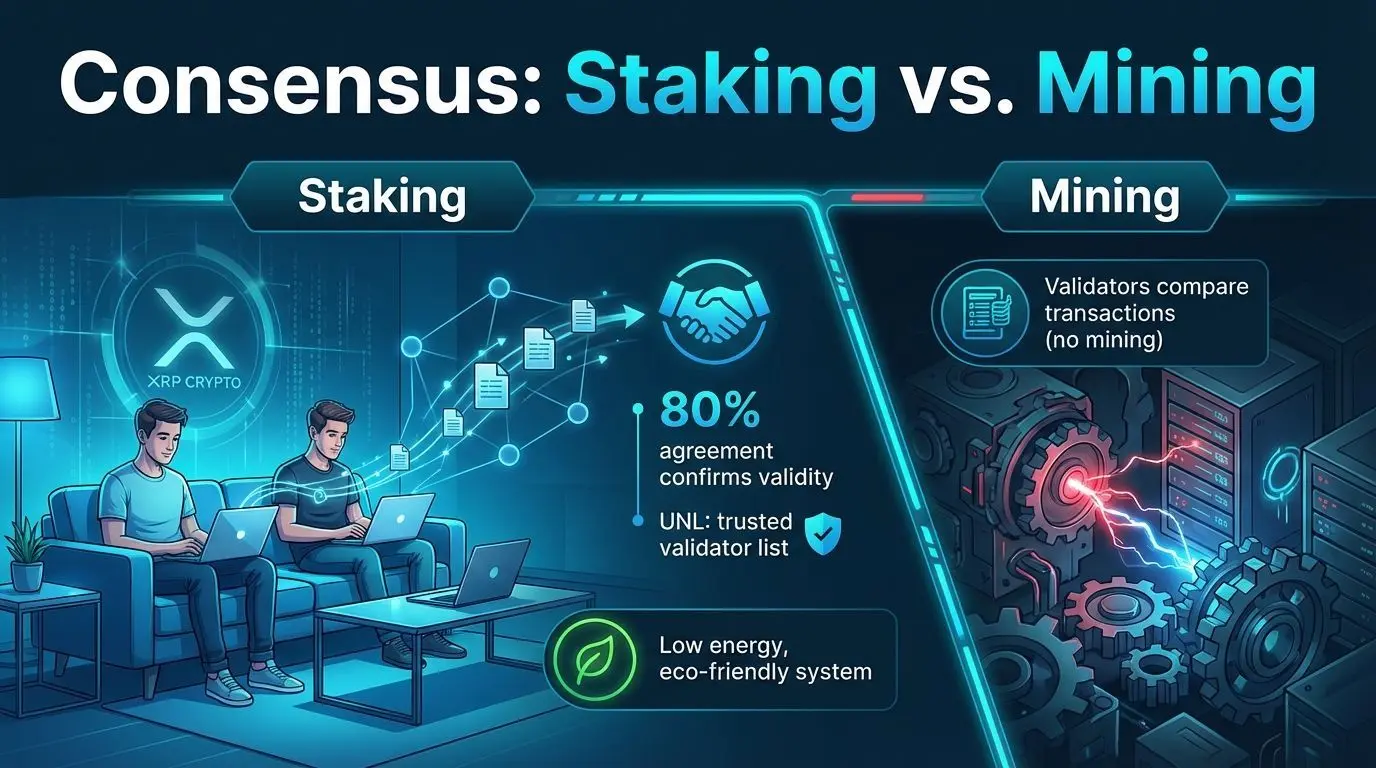
Most blockchains use Proof of Work (mining) or Proof of Stake (staking) to reach an agreement.
Ethereum (EVM): Uses Proof of Stake. Validators lock up ETH to earn the right to verify transactions. If they act badly, they lose their ETH.
XRP Ledger: Uses a Federated Byzantine Agreement (FBA). Instead of a financial "punishment" like slashing, the XRPL relies on a Unique Node List (UNL). Each server on the network chooses a list of other servers it trusts not to collude. If the network agrees by an 80% majority, the transaction is finalized.
Transaction Types vs. General Code
On an EVM chain, almost everything is a "smart contract." When you swap a token, you are interacting with a piece of custom code. This flexibility is powerful but can be risky and expensive in terms of gas fees.
On the XRPL, the most common functions are native. Swapping, creating an escrow, or setting up a trust line for a new token are built directly into the protocol. This makes the XRPL much more secure and predictable, as you aren't relying on a developer's potentially buggy code for every single move.
Fee Structure
In 2026, "gas" is a constant headache for many. On the XRPL, fees are not paid to anyone. Instead, a tiny amount of XRP is burned (destroyed) with every transaction. This makes the network resistant to spam while slowly reducing the total supply of XRP over time.
Where Is XRP Based?
- This is a two-part answer. Technically, as a decentralized blockchain, the XRP Ledger is not "based" in any single location. Its servers are spread across the globe, from data centers in Singapore to independent nodes in Switzerland. It is a global network that operates 24/7 without a central point of failure.
- However, many people ask this question in relation to Ripple Labs, the company most closely associated with the development of the XRPL. Ripple is a private company based in San Francisco, California. While Ripple is the largest holder of XRP and a major contributor to the ledger’s open-source code, they do not own or control the network. If Ripple were to disappear tomorrow, the XRP Ledger would continue to function as long as independent validators continued to run the software.
Example Scenario:
Imagine a global shipping company in 2026 that needs to pay a supplier in Japan. If they use a traditional bank, the transfer takes 3 days and costs $50 in fees. If they use the XRP Ledger, they can send XRP (or a stablecoin like RLUSD) across the XRPL. The transaction settles in 3 seconds, the fee is less than $0.01, and the shipping company has total certainty because the ledger is public and verifiable.
XRPL in 2026: The EVM Sidechain and Hooks
By April 2026, the XRPL has solved its biggest historical weakness: programmability. For years, the ledger was seen as "too simple" because it didn't support complex smart contracts. Today, the ecosystem uses a two-tier approach:
The EVM Sidechain: This is a separate but connected blockchain that allows developers to port their Ethereum apps directly to the XRP ecosystem. If you want to use a DEX that looks and feels like Uniswap, you do it here.
Native Hooks: This is a feature on the main ledger that allows for "smart-ish" logic. It allows accounts to set rules, such as "don't let me send more than 100 XRP per day" or "automatically send 5% of this payment to a savings wallet." This provides the safety of the native XRPL with the flexibility of modern finance.
Summary of Key Points
The Network: XRP lives on the XRP Ledger (XRPL), a decentralized, open-source blockchain.
Not an EVM Clone: The main XRPL is not an Ethereum-based network. It uses a unique consensus mechanism (FBA) rather than Proof of Stake.
Speed and Cost: Transactions settle in 3 to 5 seconds with fees that are nearly zero.
Native Features: The XRPL has a built-in DEX and supports tokens (IOUs) and escrows natively at the protocol level.
Decentralization: While Ripple Labs (based in San Francisco) is a major contributor, the ledger itself is maintained by a global network of independent nodes.
Advanced Tech: As of 2026, the XRPL supports an EVM sidechain for smart contracts and "Hooks" for native account logic.
Burn Mechanism: Transaction fees are not paid to validators; they are destroyed (burned), making the asset slightly deflationary.
Understanding the infrastructure behind XRP is the first step toward making informed decisions in the 2026 digital economy. Whether you are looking for fast cross-border payments or exploring the new DeFi capabilities of the XRPL sidechains, having the right data is essential.
To track the latest market movements and explore trading opportunities across different networks with maximum security, we invite you to use the dashboard on DEXTools. It provides the real-time insights and contract transparency you need to trade safely in a multi-chain world. Start your journey with confidence on DEXTools today.
Disclaimer: This article is for informational purposes only and does not constitute investment advice, financial advice, trading advice, or any other kind of advice. DEXTools does not recommend buying, selling, or holding any cryptocurrency or token. Users should conduct their own research and consult with a qualified financial advisor before making any investment decisions. Cryptocurrency investments are volatile and high-risk. DEXTools is not responsible for any losses incurred.