What Is a Rug Pull in Crypto: Complete Anatomy and Prevention Guide (2026)
— By Tony Rabbit in Tutorials
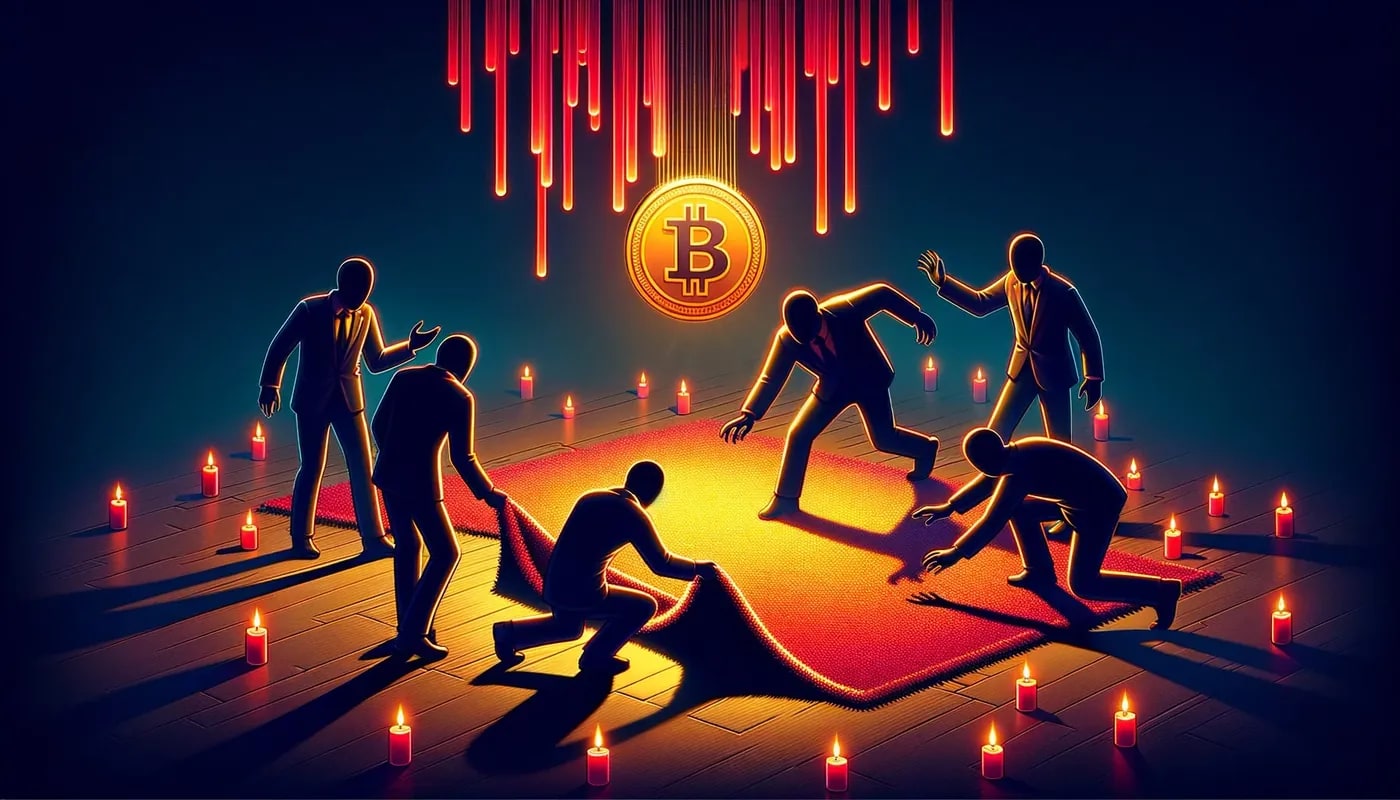
What is a rug pull in crypto? Complete guide to the 3 types (hard, soft, honeypot), 10-point on-chain detection checklist, famous cases and how to never get rugged (2026).
If you have spent more than a week in crypto, you have heard the phrase. A token launches, the chart goes vertical, every Telegram group is screaming about generational wealth, and then within minutes the price collapses to literal zero. The developers vanish. The website goes offline. The Discord disappears. Tens of thousands of wallets are left holding worthless tokens. That is a rug pull, and in 2026 it remains the single most expensive form of fraud in retail crypto, draining an estimated three to four billion dollars from buyers every single year according to on-chain analytics firms like Chainalysis and TRM Labs.
The good news is that rug pulls are not random acts of God. They follow a predictable forensic pattern. The developers leave fingerprints all over the blockchain before, during, and after the scam, and modern tools like DEXTools, GoPlus Security, TokenSniffer, and De.Fi Shield expose those fingerprints in seconds if you know what to look for. The traders who never get rugged are not lucky. They simply run a checklist on every token before they buy, and that checklist is built from a small number of repeatable on-chain signals that anyone can verify in under two minutes.
This guide is the one we wish existed when we lost our first bag in 2021. It goes far beyond the dictionary definitions you will find on Investopedia, Coinbase, or Binance Academy. We are going to dissect the three distinct types of rug pulls with full anatomy diagrams, walk through four of the most expensive rug pulls in crypto history, give you a ten-point on-chain detection checklist that has saved our community from countless scams, show you exactly how to verify a liquidity pool lock on Unicrypt and Team Finance, explain whether rug pulling is actually illegal in your jurisdiction, and tell you exactly what to do if you have already been rugged. By the end you will read a token page the way a forensic analyst reads a crime scene.
What Is a Rug Pull in Crypto?
A rug pull is a type of exit scam where the creators of a cryptocurrency project deliberately abandon the project after attracting investor money, taking the funds with them and leaving holders with tokens that are either worthless or impossible to sell. The phrase comes from the English expression "to pull the rug out from under someone," meaning to remove support suddenly and without warning. In a financial context, the rug is the liquidity pool that backs the token, and pulling it means draining that pool so that no buyer can ever sell their tokens for real value again.
The term entered the crypto vocabulary during the DeFi summer of 2020, when permissionless token creation on Uniswap V2 made it trivial for anyone to deploy an ERC-20 token, pair it with ETH in a liquidity pool, and start trading within minutes. There were no listing requirements, no KYC on developers, no audits, and no way for a buyer to know whether the address on the other side of their trade was a serious team or a scammer with a burner wallet. By the end of 2020, rug pulls had become so common that the term "rugged" entered everyday trader slang. By 2021, according to a Chainalysis crypto crime report, rug pulls accounted for thirty seven percent of all crypto scam revenue, surpassing every other category including Ponzi schemes and phishing.
What makes a rug pull different from a normal project failure is intent. A startup that runs out of money and shuts down is not a rug pull. A developer who builds a token, takes pre-sale money, dumps the supply, and disappears within forty eight hours of launch is. The difference lives in the on-chain evidence: wallet behavior, contract code, liquidity arrangements, and the timing of the developer's exit. Every one of those signals can be read by a regular trader with a free pair explorer checklist and ten minutes of practice.
The 3 Types of Rug Pulls You Need to Know
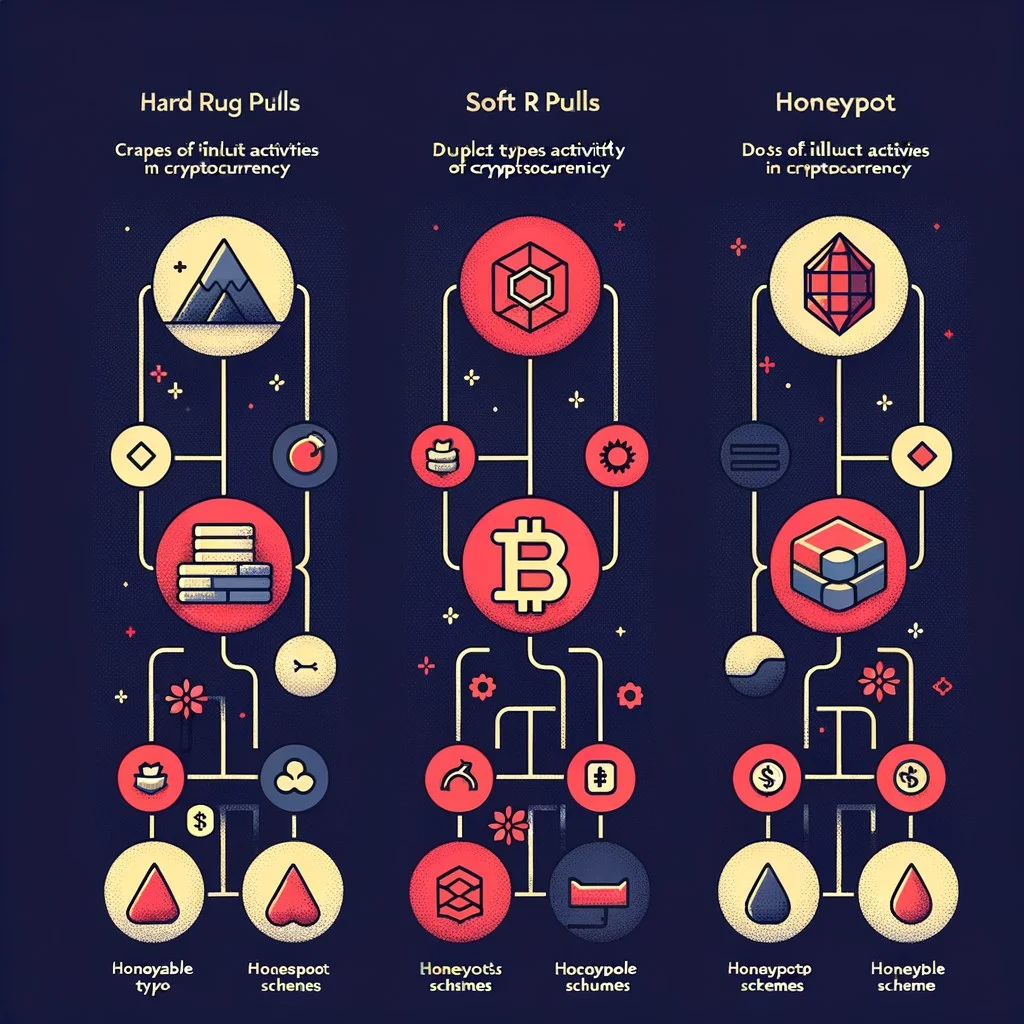
Not every rug pull looks the same. The crypto community broadly recognizes three distinct mechanical patterns, and each one has a different anatomy, a different timing profile, and a different set of on-chain signatures. If you can identify which type you are looking at, you can predict when it is most likely to trigger and decide whether the risk is worth taking. The grid below summarizes the three categories. We will dissect each one individually in the sections that follow.
Developers add liquidity, shill the token, then drain the entire LP in a single transaction. Price collapses to zero instantly. Most common form. Detection window: minutes to hours.
Team wallets slowly dump their massive token allocations over days or weeks while pretending the project is alive. Price bleeds out gradually. Harder to detect, often disguised as organic volatility.
The contract allows buys but blocks all sells via hidden code logic. Chart pumps forever because nobody can sell. Devs are the only wallets allowed to dump. The cruellest form of rug.
Anatomy of a Hard Rug Pull
The hard rug is the textbook version and accounts for the majority of rug pulls in 2026. The mechanics are brutally simple. The developer deploys an ERC-20 or SPL token contract with a fixed supply, often one billion or one trillion tokens. They retain a large percentage of the supply in a wallet they control, sometimes called the dev wallet. They then pair a small amount of their token (often forty to fifty percent of total supply) with a few ETH, BNB, or SOL of real value in a liquidity pool on Uniswap, PancakeSwap, or Raydium. This creates a tradeable market.
Next comes the marketing phase. The team buys Telegram groups with thousands of recycled members, pays influencers a flat fee or a percentage of supply to shill the token, hires shill bots to spam every relevant chat, and sometimes pays for a paid trending slot on DEXTools or DexScreener. Early buyers see a tiny market cap (often under one hundred thousand dollars), a fast-rising chart, and dozens of "wen lambo" messages flooding every channel. FOMO kicks in, real buyers pile in, the price doubles every few minutes, and the market cap climbs into the millions.
The rug itself is a single on-chain transaction. The developer calls the removeLiquidity function on the DEX router using the LP tokens they minted when they first added liquidity. That function withdraws all of the paired ETH or BNB from the pool and sends it to the dev wallet. The pool is now empty. Any holder who tries to sell their tokens encounters a price of effectively zero because there is nothing on the other side of the trade. Within seconds, the dev wallet bridges the proceeds to another chain, mixes them through Tornado Cash or a centralized exchange, and disappears. The chart shows the signature pattern: a vertical pump followed by a single red candle straight down to the floor. Total elapsed time from launch to drain: often under twelve hours, sometimes under thirty minutes.
Anatomy of a Soft Rug Pull
The soft rug is sneakier and emotionally more brutal because it lets you believe in the project for weeks before it dies. In a soft rug, the developers do not drain the LP in one shot. Instead, they slowly dump their team allocation, marketing wallet, treasury wallet, and any other wallets they control, distributing the selling pressure across multiple addresses to disguise it as organic profit-taking. To a casual observer the chart just looks weak. Holders rationalize the bleed as "market conditions" or "early FUD" while the team continues to post roadmap updates, fake partnerships, and recycled AMA announcements to keep retail buying the dip.
The on-chain forensics of a soft rug are easier to spot if you know where to look. Tools like Nansen, Arkham, and Bubblemaps cluster wallets that share funding sources, deployment patterns, or coordinated transaction timing. When you see a constellation of forty wallets that were all funded from the same exchange withdrawal in the same five minute window before launch, and those wallets are now all selling progressively into every green candle, you are watching a soft rug in real time. The DEXTools holder distribution panel will often show the same story: the top ten holders control sixty to ninety percent of supply, and their balances are shrinking week over week while the chart bleeds.
Soft rugs typically end in one of two ways. Either the team eventually drains whatever remains of the liquidity pool once their supply is mostly cashed out (effectively becoming a hard rug at the end), or they simply abandon the project, stop posting updates, mute the Telegram, and walk away while the token withers on life support. Either way, the holders who bought the dip lose everything. A useful adjacent read here is our breakdown of pump and dump schemes, since soft rugs and coordinated pump and dumps frequently overlap in tactics.
Anatomy of a Honeypot Token
The honeypot is arguably the most psychologically cruel rug pull variant because the victims watch the price go up for hours or days without realizing they are trapped. A honeypot token has a contract that permits buy transactions but reverts on any sell transaction made by a wallet that is not on a privileged whitelist. The whitelist usually contains only addresses controlled by the developer. Everyone else can buy as much as they want. Nobody else can ever sell.
The mechanism is implemented in the token's smart contract. There are several common variants. The simplest uses a blacklist mapping that flags any address other than the dev's as blocked from transferring tokens to the DEX pair address (which is the technical equivalent of selling). More sophisticated honeypots use a high sell tax (sometimes ninety nine percent) that confiscates almost the entire trade value, an unlimited sell slippage requirement that always reverts, a "max wallet" limit that triggers only on sells, or a conditional check that disables sells once the contract balance reaches a target threshold.
The chart of a honeypot looks deceptively bullish: continuous green candles, ever-increasing price, near-zero sell volume, and a steadily rising holder count. Inexperienced buyers see this as confirmation that the project is going to one hundred million dollar market cap. Experienced traders see it as a death trap. The dev eventually dumps their entire whitelisted supply into the artificially inflated pool, drains the ETH out, and disappears, leaving every buyer with tokens they could never have sold. If you want a hands-on test you can run in sixty seconds before buying any token, see our dedicated guide on the honeypot 60 second test and the deeper background in what is a honeypot token.
The 10-Point On-Chain Rug Pull Detection Checklist
This is the single most important section of this guide. If you internalize nothing else, internalize this checklist. We have refined it across hundreds of token investigations, and a token that passes all ten points is dramatically safer than a random launch from your Telegram alpha group. Run it on every token before you buy. The whole process takes under two minutes once you have done it a few times.
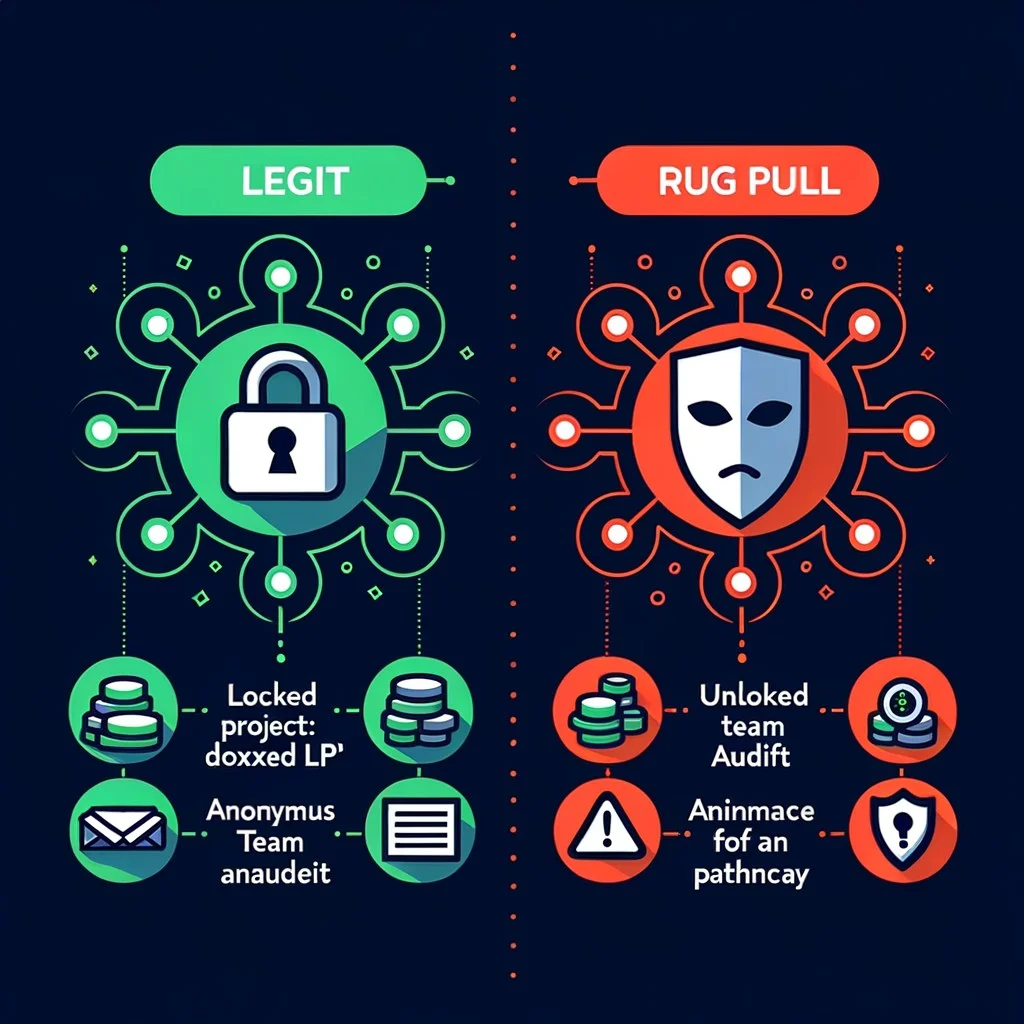
- Is the liquidity locked? Verify on Unicrypt, Team Finance, or PinkLock. A pool with unlocked LP can be drained at any moment. Demand a minimum 6-12 month lock for any serious holding.
- What percent of supply does the dev wallet hold? Use DEXTools holder distribution. Anything above 5% in a single non-LP wallet is a major red flag. The top 10 wallets should hold less than 25% combined.
- Is there a mint function? Check the contract source on Etherscan or BscScan. A live
mint functionmeans the dev can create infinite new tokens and dump them into the pool. Disqualifying unless ownership is renounced. - Is there a blacklist or pausable function? A dev who can blacklist your wallet can prevent you from ever selling. A pausable contract lets them freeze all trading at will. Both are honeypot weapons.
- Has the owner renounced ownership? Look for
renounceOwnershipin the transaction history, or check that the owner address is 0x000...000. Without renouncement, the dev keeps god-mode privileges. - Is the contract audited? Real audits come from CertiK, Hacken, OpenZeppelin, Trail of Bits, or PeckShield. A "self-audit" or a logo from a no-name firm is meaningless. Verify the audit on the auditor's official site.
- Is the team doxxed? Real names, real LinkedIn profiles, real prior projects with live track records. Anonymous teams are not automatically scams but the rug rate is 10x higher.
- How is the holder distribution shaped? A healthy token has hundreds or thousands of holders with no single non-exchange wallet above 3-5%. Use Bubblemaps to detect clusters of related wallets disguised as separate holders.
- How deep is the liquidity? A 50k market cap token with only 5k of liquidity has 10% effective float. The dev can dump and crash 80% with a single sell. Liquidity should be at least 25% of market cap for any serious entry.
- What does the social signal actually say? Read past the shill. Are buyers organic or scripted? Are mods deleting questions? Is every reply from a fresh account? A real community pushes back on bad questions. A scam community censors them.
For deeper guidance on applying this checklist across different chains, including Solana, Ethereum, and Base, see our companion piece on multi-chain rug pull checks. The mechanics differ slightly between SPL tokens on Solana and ERC-20s on EVM chains, but the underlying principles are identical.
How to Read a DEXTools, Etherscan, or Solscan Page for Red Flags
Knowing the checklist is one thing. Knowing exactly where to click in each tool to verify it is another. Here is the practical walkthrough we use every single day. Open the token in DEXTools first. Look at the top right corner where the DEXTools audit score sits. A score below 90 has at least one structural issue, and the panel will tell you what (honeypot risk, tax above 10%, missing source code, unlocked liquidity, ownership not renounced). Then scroll to the Holders tab. The first row should be the LP pair address, which is expected to hold a large share. The second row should be the burn address (0x000...dead) for any token that did a supply burn. If position three is a single externally-owned account holding fifteen percent of supply with no labeling, you have found your dev wallet.
Next click through to Etherscan or BscScan for EVM chains, or Solscan for Solana. Open the contract source code. If the contract is not verified, treat that as a hard disqualification. There is no excuse in 2026 for an unverified contract on a token asking for your money. If the contract is verified, search the code for the following strings: mint (can the dev create new tokens?), blacklist (can the dev block your wallet?), pause (can the dev freeze trading?), transferOwnership and renounceOwnership (who has admin control right now?), and "fee" or "tax" (what is the buy and sell tax, and can the dev change it?).
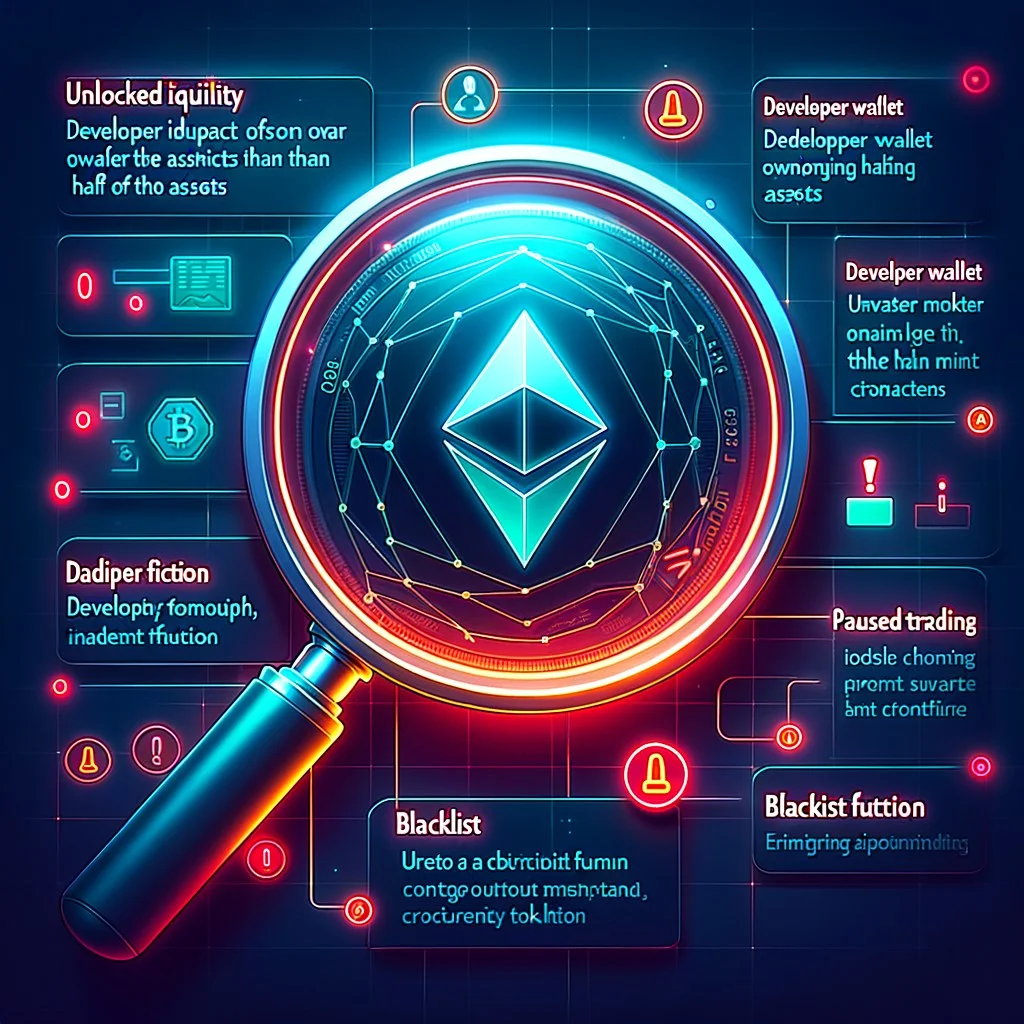
Finally, click through to the contract creator's address. Look at their transaction history. A serial rug puller will have deployed dozens of nearly-identical token contracts over the past few months. Tools like Bubblemaps and Arkham will surface those connections automatically. If the same wallet that just launched your moonshot also deployed twelve dead tokens in the last ninety days, walk away. Period. Our liquidity analysis walkthrough goes much deeper into reading pool depth, volume authenticity, and the difference between organic and bot-driven trading.
How to Verify Liquidity Locks on Unicrypt, Team Finance, and PinkSale
"Liquidity is locked for 12 months" is the most repeated promise in any token Telegram, and it is also one of the most frequently lied about. Verifying a liquidity lock takes thirty seconds and you should never skip it. A locked liquidity claim that cannot be independently verified on the locker's own dashboard is, by default, a lie.
The three locker services that dominate the market are Unicrypt (now branded UNCX Network), Team Finance, and PinkSale's PinkLock. Each of them has a public dashboard where anyone can look up a lock by token contract address. On Unicrypt, visit app.uncx.network, click "Services," then "Liquidity Lockers," then paste the token contract address into the search bar. The page will show you exactly how many LP tokens are locked, what percentage of total LP supply that represents, and the unlock date. If the lock covers less than ninety percent of total LP, the rest is still drainable. If the unlock date is two weeks from now, that is not a lock, that is a countdown timer to the rug.
Team Finance works the same way at app.team.finance. PinkLock is at www.pinksale.finance/pinklock. For deeper background on how lockers actually work under the hood and which ones to trust in 2026, see our dedicated article on token lockers. A few critical things to verify beyond just the lock existing. First, is the lock on the actual LP token, or on some random other token the dev is trying to pass off? The locked asset must be the LP token of the trading pair you care about. Second, is the unlock recipient address the same as the dev wallet? If so, on unlock day the dev can drain. Third, has the dev locked all of their LP, or only ten percent of it, while keeping ninety percent unlocked and drainable? This is the single most common rug pull trick in 2026.
4 Famous Rug Pulls and What They Teach Us
History is the cheapest tuition in crypto. The four rug pulls below each illustrate a different failure mode and each one continues to repeat in slightly different costumes every month. If you internalize the patterns from these case studies, you will recognize their modern descendants instantly.
Honeypot disguised as a Netflix-show fan token. Buyers could not sell. Devs dumped supply, drained LP, vanished. Whitepaper was riddled with typos. Lesson: a meme cannot substitute for contract verification.
OlympusDAO fork that raised 13,556 ETH in a liquidity bootstrapping event. Twenty hours later all funds were transferred out by an anonymous multisig. Lesson: anonymous teams with no whitepaper can still raise eight figures.
Centralized exchange rug. CEO Faruk Ozer halted withdrawals citing "external attack" and fled to Albania with 391,000 users' funds. Caught in 2022, sentenced to 11,196 years in prison. Lesson: CEX rugs exist too.
South African "investment platform" run by brothers Ameer and Raees Cajee. Reported a "hack," then disappeared with 69,000 BTC. Largest rug pull in crypto history by USD value. Lesson: returns above market rate are bait.
Squid Game Token (October 2021): Launched at the peak of the Netflix show's popularity, the token surged from one cent to over $2,800 within a week, driven entirely by retail FOMO and influencer shilling. The contract was a classic honeypot: buyers could acquire tokens, but the sell function reverted for any non-whitelisted wallet. When the dev wallet finally dumped its allocation, price collapsed from $2,861 to $0.0007 in five minutes. The whitepaper had grammar errors that any due-diligence pass would have caught.
AnubisDAO (October 2021): A fork of OlympusDAO that ran a liquidity bootstrapping pool and raised 13,556 ETH in twenty hours. Then a single transaction transferred everything to a fresh wallet and the team's pseudonymous lead "Beerus" disappeared. The team had no real social presence, no whitepaper, and no audit. Yet investors handed over sixty million dollars on hype alone. The lesson is simple: degens chasing the next 100x will fund literally anything if the marketing is good enough.
Thodex (April 2021): Not a DeFi token rug but a centralized exchange exit scam. The Turkish exchange Thodex had grown to nearly 400,000 users when its CEO Faruk Fatih Ozer suspended withdrawals citing a "hacking attack." He boarded a plane to Albania. Approximately two billion dollars in user funds vanished. He was extradited in 2022 and sentenced to a literally unbelievable 11,196 years and ten months in prison. The takeaway: rug pulls are not exclusive to anonymous shitcoin teams. Established-looking exchanges with offshore registrations can pull the same trick at much larger scale.
Africrypt (April 2021): Two young brothers in Cape Town, South Africa, ran a "Bitcoin investment platform" promising thirty percent monthly returns. When the platform claimed it had been "hacked," they instructed users not to file police reports because doing so might delay recovery. They then transferred 69,000 BTC out of company wallets and disappeared. At the time, that haul was worth roughly $3.6 billion, making it the single largest rug pull in crypto history by USD value. The brothers have never been found. The lesson is timeless: any platform promising returns above the actual yield available in DeFi is funding those returns out of new deposits, and that runs out eventually.
Is Rug Pulling Illegal?
This is one of the most-searched questions in the rug pull universe, and the answer is more nuanced than "yes" or "no." In most major jurisdictions in 2026, rug pulling is illegal under multiple existing legal frameworks even if there is no statute specifically named "rug pulling." The actual criminal charges typically pursued are wire fraud, securities fraud, money laundering, and conspiracy. The grey area is enforcement, not legality.
In the United States, the Department of Justice has successfully prosecuted multiple rug pull operators under 18 U.S. Code 1343 (wire fraud) and 18 U.S. Code 1956 (money laundering). The Frosties NFT case (2022) saw two defendants charged with conspiracy to commit wire fraud after rug pulling a 1.1 million dollar NFT project. The SEC has separately gone after token issuers under the Howey test, treating most rug pulled tokens as unregistered securities. The Baller Ape Club NFT rug pull resulted in DOJ charges and a guilty plea in 2024. Translation: yes, you can go to federal prison for rug pulling in the United States.
In the European Union, the Markets in Crypto-Assets regulation (MiCA), which entered full application in December 2024, classifies most rug-pull-style schemes as fraud under each member state's existing fraud statutes, plus market manipulation under MiCA itself. Article 91 of MiCA criminalizes market manipulation including artificial price inflation, which captures most pump-and-rug schemes. In the United Kingdom, the Fraud Act 2006 and the Financial Services and Markets Act 2023 cover the same ground.
The grey area is jurisdictional. A rug puller operating from a country with weak crypto enforcement, hiding behind a pseudonym, and routing proceeds through mixers and chain-hopping bridges is technically committing a crime in most countries but is practically very hard to extradite. Many rug pullers continue to operate from places like certain Eastern European countries, parts of the former Soviet Union, and crypto-friendly Caribbean states where local enforcement is minimal. That said, the success rate of identifying and charging rug pullers has improved dramatically since 2022 thanks to on-chain analytics from Chainalysis, TRM Labs, and Elliptic combined with FBI and Europol joint operations.
Tools and Bots That Detect Rug Pulls in 2026
You do not have to be a Solidity developer to read a contract for red flags. In 2026 there are at least half a dozen mainstream tools that automate the entire process and surface the answers in plain English within seconds. Here are the ones we actually use every day, what they do well, and where their limitations lie.
DEXTools Audit Score: The audit panel on every DEXTools token page runs a battery of checks for honeypot mechanics, contract verification, ownership renouncement, mint functions, tax levels, and liquidity lock status. A score below 95 means you need to manually verify what the panel flagged. A score below 75 should be treated as a near-automatic disqualification. DEXTools also exposes the holder distribution, the trading history of the deployer wallet, and the pool's liquidity depth, all of which feed into your manual checks.
GoPlus Security: The GoPlus token security API powers checks behind many wallet apps and aggregators. You can query it directly at gopluslabs.io. It returns a structured JSON report on any token including honeypot detection, anti-whale mechanisms, hidden owner, modifiable tax, and trading cooldown. It is the most comprehensive automated checker we have found in 2026.
TokenSniffer: A long-running scanner that ranks tokens by overall risk and surfaces specific red flags. It is particularly good at detecting contracts that are copies of known scam templates. If your token has a 30/100 score on TokenSniffer, the codebase is structurally identical to dozens of prior rugs.
De.Fi Shield: An on-chain security scanner that integrates with multiple chains and provides real-time risk assessments. Particularly strong on EVM L2s like Arbitrum, Optimism, and Base where some other tools have weaker coverage.
RugDoc: A community-driven review platform for newer DeFi protocols, particularly yield farms. Tags farms with risk levels from "low risk" through "high risk" and "do not invest." Especially useful for evaluating new chains where automated scanners have limited coverage.
The crucial caveat: no tool is infallible. We have seen tokens with perfect audit scores rug pull thirty minutes after launch because the rug mechanism was implemented through ownership privileges that the scanners did not parse correctly, or because the team simply dumped their non-LP team allocation without needing to drain the LP. Tools narrow the risk surface but do not eliminate it. Pair them with manual verification, especially of liquidity locks and holder distribution.
What to Do If You Got Rugged
If you are reading this section because you just got rugged, breathe. Most rugged funds are not recovered, but documenting and reporting the incident matters for three reasons: it strengthens prosecutions against serial rug pullers, it can support a theft loss deduction on your taxes (in the United States), and in a small but non-zero percentage of cases law enforcement does claw funds back from centralized exchanges where the rug puller eventually offramps. Here is the step-by-step playbook.
- Document everything immediately. Screenshot the token contract, the rug transaction, your buy transactions, Telegram chat logs, the project website, and any promotional material. Save it all to a folder. Evidence disappears within hours as Telegram groups are deleted.
- Trace the funds on-chain. Use Etherscan, BscScan, Solscan, or Arkham to follow the drained LP funds. Note every intermediate wallet and any centralized exchange deposits. CEX deposits are the recovery vector.
- Report to IC3 (US victims). File a report at ic3.gov, the FBI's Internet Crime Complaint Center. Include all on-chain evidence and CEX deposit addresses. IC3 aggregates reports across victims and forwards qualifying cases to the FBI Cyber Division.
- Submit tips to Chainalysis and TRM Labs. Both firms accept victim tips and share intelligence with law enforcement and exchanges. Funds frozen on exchanges have been clawed back in multiple prior cases.
- File with local police and your country's cybercrime unit. Even if local police cannot act, the report creates a paper trail. UK victims report to Action Fraud, EU victims to their national cybercrime hotline, AU victims to Scamwatch.
- Claim the theft loss on taxes. US taxpayers can in some circumstances claim a theft loss deduction under IRC Section 165, though the post-TCJA rules narrowed this considerably. Consult a crypto-savvy CPA before filing.
A realistic expectation: across all rug pulls in 2024-2025, less than five percent of stolen funds were recovered, and most recoveries came from cases where the rug puller made the mistake of offramping to a major centralized exchange that complied with a law enforcement freeze. If the funds were laundered through Tornado Cash, cross-chain bridges, and decentralized exchanges only, recovery is essentially impossible. Treat documentation as a civic duty rather than a recovery strategy.
How to Never Get Rugged Again
After enough investigations, the prevention rules become almost embarrassingly simple. They are not glamorous and they are not original, but they work. Run them as a hard rule set, not as suggestions. The traders we know who have never been rugged in five years of trading are not smarter than everyone else. They simply refuse to compromise on these rules.
Rule 1: Never YOLO more than five percent of your portfolio into a token that is under thirty days old. If the project is real, you can buy more in week five at a higher price. The opportunity cost of waiting is small. The cost of going to zero on twenty percent of your portfolio is enormous.
Rule 2: Never buy a token whose LP is not locked for at least six months on a verifiable locker. If a project will not lock its LP for six months, they are reserving the right to drain you. There is no other interpretation.
Rule 3: Never buy a token where the deployer wallet still holds more than five percent of supply. The dev should either burn their share, lock it, or have already distributed it through vesting. A live deployer wallet with whale-tier holdings is a loaded gun.
Rule 4: Never buy a token solely on a Telegram or X recommendation. Run the ten-point checklist yourself, every time, no exceptions. If you do not have ten minutes to verify a token, you do not have ten minutes worth of conviction to hold it through volatility either.
Rule 5: Never trust a CertiK or audit logo on the project website. Verify it on the auditor's site. Fake audit badges are one of the oldest tricks in the rug pull playbook. The real auditor's website is the only source of truth.
Rule 6: Always do your own slippage check. Try to simulate a sell of one percent of your intended buy size before you commit. If the simulated sell fails or returns nine percent of expected value due to a hidden tax, you found the honeypot before it found you. Our wash trading guide covers an adjacent issue worth understanding: fake volume that makes a rug look healthy until the moment it is not.
Frequently Asked Questions
Is a rug pull a scam?
Yes. A rug pull is a specific category of cryptocurrency scam where developers raise funds from investors and then abandon the project, taking the funds with them. It is criminal fraud in most jurisdictions, prosecutable as wire fraud in the United States and as fraud and market manipulation under MiCA in the European Union. The fact that it happens on a blockchain does not change the legal character of the act.
Can you recover from a rug pull?
Recovery of funds is rare. Industry data from 2024-2025 suggests less than five percent of rug pull losses are recovered, and almost all recoveries happen when the perpetrator deposits funds at a centralized exchange that complies with a law enforcement freeze request. If you got rugged, document everything, file an IC3 report, submit tips to Chainalysis, and report to local cybercrime authorities. Recovery is unlikely but documentation strengthens future prosecutions and may support a theft loss tax deduction.
How do I check if a token is a rug?
Run the ten-point checklist in this guide: verify liquidity is locked on Unicrypt or Team Finance, confirm the dev wallet holds less than five percent of supply, check for mint and blacklist functions in the contract source, confirm ownership has been renounced, verify any audit on the auditor's official site, evaluate team transparency, analyze holder distribution on DEXTools and Bubblemaps, measure liquidity depth versus market cap, and read the community for organic vs scripted engagement. Cross-check with automated tools like DEXTools Audit Score, GoPlus Security, and TokenSniffer.
Is rug pulling illegal in 2026?
Yes, in essentially every major jurisdiction. Rug pulling is prosecuted as wire fraud and money laundering in the United States, as fraud and market manipulation under MiCA in the European Union, and under equivalent fraud statutes in the United Kingdom, Canada, Australia, Japan, Singapore, and most other developed markets. Enforcement is uneven and many rug pullers operate from jurisdictions with weak crypto enforcement, but the act itself is illegal under existing law.
What is the biggest rug pull ever?
By USD value, the largest rug pull in crypto history is Africrypt (April 2021), where the Cajee brothers in South Africa disappeared with approximately 69,000 BTC, worth around 3.6 billion dollars at the time. Thodex (Turkey, April 2021) was the second largest at approximately two billion dollars. Among DeFi token rugs specifically, AnubisDAO (October 2021) at sixty million dollars remains one of the most cited examples because of how quickly investors funded a fully anonymous team with no whitepaper.
How do I report a rug pull?
US victims should file at ic3.gov (the FBI's Internet Crime Complaint Center) and submit tips to Chainalysis and TRM Labs. UK victims report to Action Fraud at actionfraud.police.uk. EU victims should contact their national cybercrime hotline or Europol. Australian victims report to Scamwatch. In all cases, document the contract address, the rug transaction hash, the deployer wallet, any centralized exchange deposit addresses you find on-chain, and screenshots of promotional material from Telegram, Discord, and the project website. The earlier you report, the better the chance any frozen exchange funds can be tied to your case.
Conclusion
Rug pulls are not going away. As long as anyone can deploy a token in five minutes for under a hundred dollars in gas, scammers will keep launching them, and as long as retail traders keep buying things they have not researched, scammers will keep getting rich. The cycle has been remarkably stable since 2020 and the structural conditions that enable it (permissionless token creation, anonymous developers, fast-moving social hype) are core features of crypto, not bugs that will be patched.
What can change is your behavior. Every single rug pull in this guide could have been avoided by a buyer who ran the ten-point checklist before committing capital. Squid Game Token had a contract that any honeypot scanner would have flagged in seconds. AnubisDAO had no whitepaper, no audit, and a fully anonymous team. Thodex had a Turkish corporate registration and no banking-grade controls. Africrypt promised thirty percent monthly returns. In each case, the on-chain or off-chain red flags were visible to anyone paying attention. The victims were not unlucky. They were untrained.
The training is short. The ten-point checklist takes ninety seconds per token once you have practiced it ten times. Verifying a liquidity lock takes thirty seconds. Reading the contract source on Etherscan takes another minute. Total cost: under three minutes per token. Compared to the expected value of avoiding a single rug across a year of active trading, three minutes per due-diligence pass is the highest-return habit you can build in crypto. Build the habit. Run the checklist. Demand verifiable proof, not promises. Treat every Telegram shill as adversarial until the on-chain evidence says otherwise. Do this consistently and your portfolio's biggest enemy is no longer the scammers. It is your own patience and conviction, and those are problems you can solve with practice rather than software.
Frequently Asked Questions
What is a rug pull in crypto?
A rug pull is a malicious maneuver in the crypto industry where developers abandon a project and steal investors' funds. This typically occurs after a token's value has been artificially inflated.
How do rug pulls typically happen?
Developers often create hype around a new token, then withdraw liquidity from decentralized exchanges, making it impossible for investors to sell. They may also dump their own large holdings, crashing the price.
What are common red flags of a potential rug pull?
Red flags include anonymous development teams, unaudited smart contracts, extremely high promised returns, and lack of a clear whitepaper or roadmap. Limited liquidity pools can also be a warning sign.
How can investors protect themselves from rug pulls?
Investors should research the project team, check for smart contract audits, and ensure sufficient liquidity is locked. Diversifying investments and starting with small amounts can also mitigate risk.
Are rug pulls illegal?
While specific regulations vary, many jurisdictions consider rug pulls a form of fraud or theft. Law enforcement agencies are increasingly pursuing legal action against perpetrators of these schemes.