What Is Polkadot (DOT)? Parachains Explained
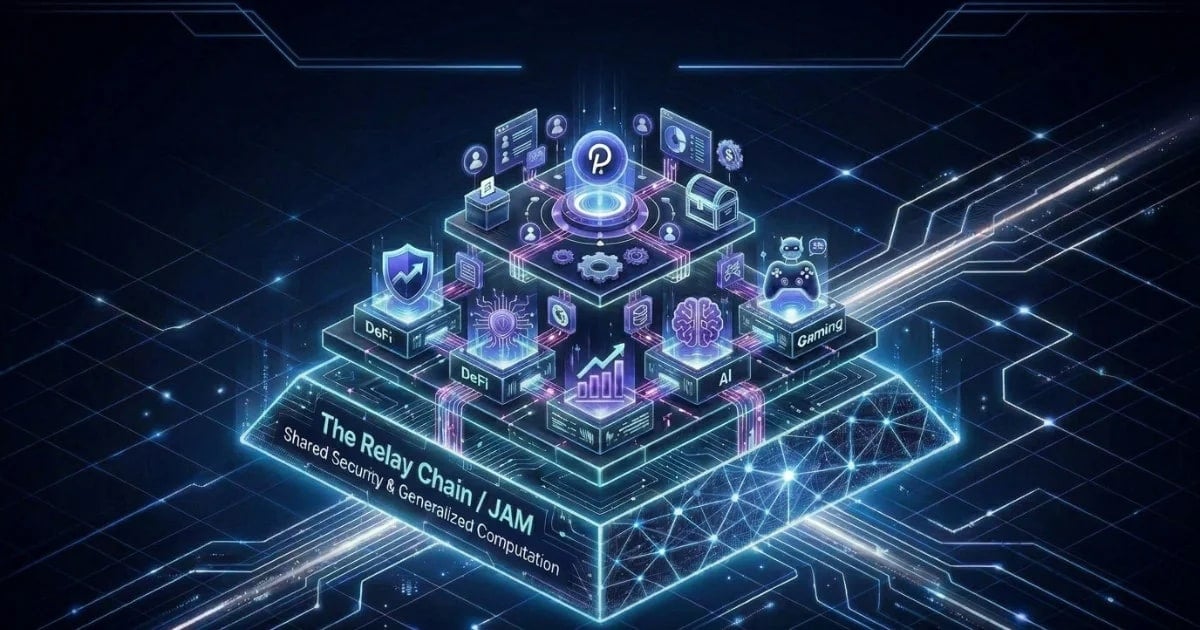
Polkadot (DOT) explained for beginners: how parachains work, and why JAM, OpenGov, and shared security keep DOT relevant in the multichain world in 2026.
This page answers what Polkadot is and how parachains plus JAM fit together. It is an interoperability architecture guide, not just a staking page.
What is Polkadot (DOT)?
- Polkadot (DOT) has successfully shed its reputation as a "complex academic experiment" and solidified its position as the Global Logic Layer. While the early 2020s were defined by individual blockchains competing for dominance, Polkadot's vision of an interconnected "Internet of Blockchains" is now the operational reality for hundreds of specialized networks.
- If you're trying to understand Polkadot today, think of it not as a single blockchain, but as a massive, secure motherboard into which different specialized "chips" (blockchains) can be plugged.
1. The Foundation: Relay Chain & Parachains
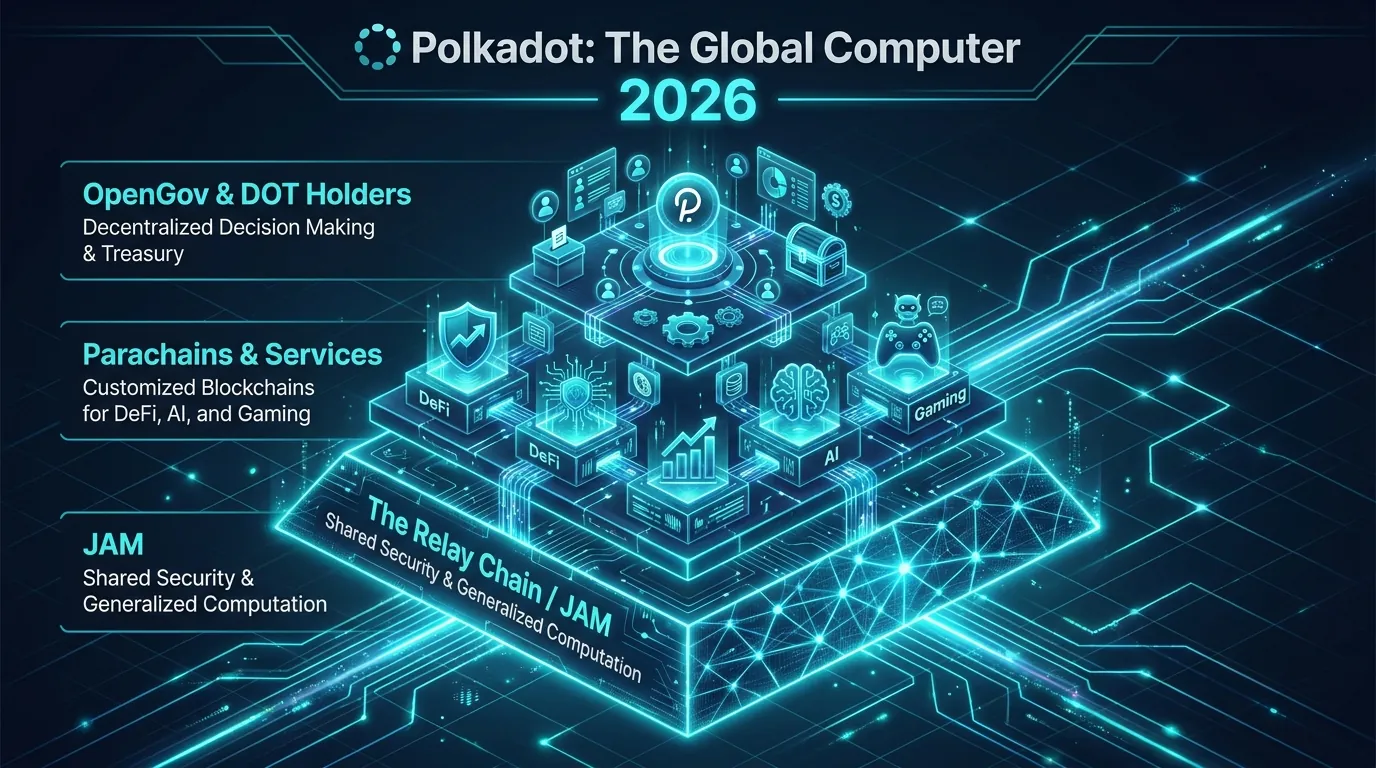
To understand Polkadot, you must understand its dual-layer architecture. This is the "Hub and Spoke" model that defined its first five years.
The Relay Chain: This is the heart of Polkadot. It doesn't support smart contracts or fancy apps itself. Its sole job is to provide Pooled Security and Interoperability. It ensures that every connected chain is safe and can talk to every other chain.
Parachains (Parallel Blockchains): These are specialized blockchains that "rent" a connection to the Relay Chain. In 2026, we have parachains dedicated to everything from DeFi and Privacy to Decentralized AI and Supply Chain.
Analogy: The Relay Chain is a high-end shopping mall providing security, electricity, and parking. The Parachains are the individual stores inside, each optimized for a specific product.
2. The 2026 Evolution: The JAM Upgrade
- In 2026, the biggest topic in the ecosystem is JAM (Join-Accumulate Machine). This upgrade marks Polkadot's transition from a "Parachain-centric" model to a "Work-centric" model.
- JAM is essentially a massive upgrade to the Relay Chain that turns Polkadot into a Generalized World Computer. Instead of just hosting blockchains (Parachains), Polkadot can now host "Services."
Why it matters: JAM allows Polkadot to perform complex computations (like AI training or heavy data processing) directly on the network, effectively competing with centralized cloud providers like AWS, but with the trustless security of blockchain.
The JAM Logic:
If J is the Join function (gathering data) and A is the Accumulate function (processing and storing), the output Y is:
Y = A(J(input)This simple but powerful loop allows Polkadot to scale indefinitely without losing security.
3. OpenGov: The World's Most Active DAO
Polkadot doesn't have a CEO; it has OpenGov. This is a decentralized governance system where DOT holders make every single decision, from technical upgrades to marketing spends.
No Councils: In 2026, there are no "benevolent dictators." If a proposal gets enough votes, it executes automatically on-chain.
Agile Fellowships: Technical experts (The Fellowship) can provide advice, but they have no power to override the community vote.
Criticism: while extremely transparent, OpenGov is often described as "chaotic democracy," where controversial treasury spends often spark intense debate on social media.
4. Staking for Everyone: Nomination Pools
In the early days, you needed thousands of DOT to participate in securing the network. In 2026, Nomination Pools have made staking accessible to the average person.
Low Barrier to Entry: You can start staking with as little as 1 DOT.
Safety in Numbers: By joining a pool, your DOT is combined with others to nominate "Validators" (the people running the hardware).
Current Yield: As of May 2026, the average staking yield for DOT is approximately 14-16%, providing a solid native return for long-term believers.
5. Tokenomics: The Utility of DOT
The DOT token serves three primary purposes in 2026:
Governance: Voting on the future of the network.
Staking: Securing the network and earning rewards.
Coretime: In the post-JAM era, DOT is used to buy "Coretime" (computational space) on the network, turning DOT into the "Gas" of the Global Computer.
Verification and Security via DEXTools
In the high-speed Polkadot 2.0 era, new projects and sub-tokens are launched daily across various parachains. DEXTools remains the essential standard for verifying these assets. Whether you are looking at a new DeFi token on HydraDX or an AI token on Phala, DEXTools provides the transparency needed to verify contract safety.
To monitor the DeFi market in an agile and secure way in real-time and trade assets with the help of the best crypto tools, you can access DEXTools here.
Disclaimer: This article is for informational purposes only and does not constitute investment advice, financial advice, trading advice, or any other kind of advice. DEXTools does not recommend buying, selling, or holding any cryptocurrency or token. Users should conduct their own research and consult with a qualified financial advisor before making any investment decisions. Cryptocurrency investments are volatile and high-risk. DEXTools is not responsible for any losses incurred.
Frequently Asked Questions
What is the JAM upgrade in Polkadot 2026?
JAM (Join-Accumulate Machine) is a major technical evolution that transforms Polkadot from a chain-hosting network into a generalized world computer capable of running any decentralized service or computation.
Can I stake DOT with a small amount?
Yes. With the introduction of Nomination Pools, users can participate in staking and earn rewards with as little as 1 DOT, making network security accessible to everyone.
How does Polkadot's OpenGov work?
OpenGov is a fully decentralized governance system where every decision, from treasury spends to protocol upgrades, is voted on directly by DOT holders on-chain, without any centralized council.
What is "Coretime" in Polkadot 2.0?
Coretime represents the computational resources of the network. Instead of the old auction model, developers can now purchase the exact amount of "processing power" they need, making it more flexible for new projects.
Is Polkadot still interoperable with other chains?
Absolutely. Through XCM (Cross-Consensus Messaging) and bridges like Snowbridge (to Ethereum) and Hyperbridge, Polkadot remains the primary hub for secure communication between different blockchain ecosystems.