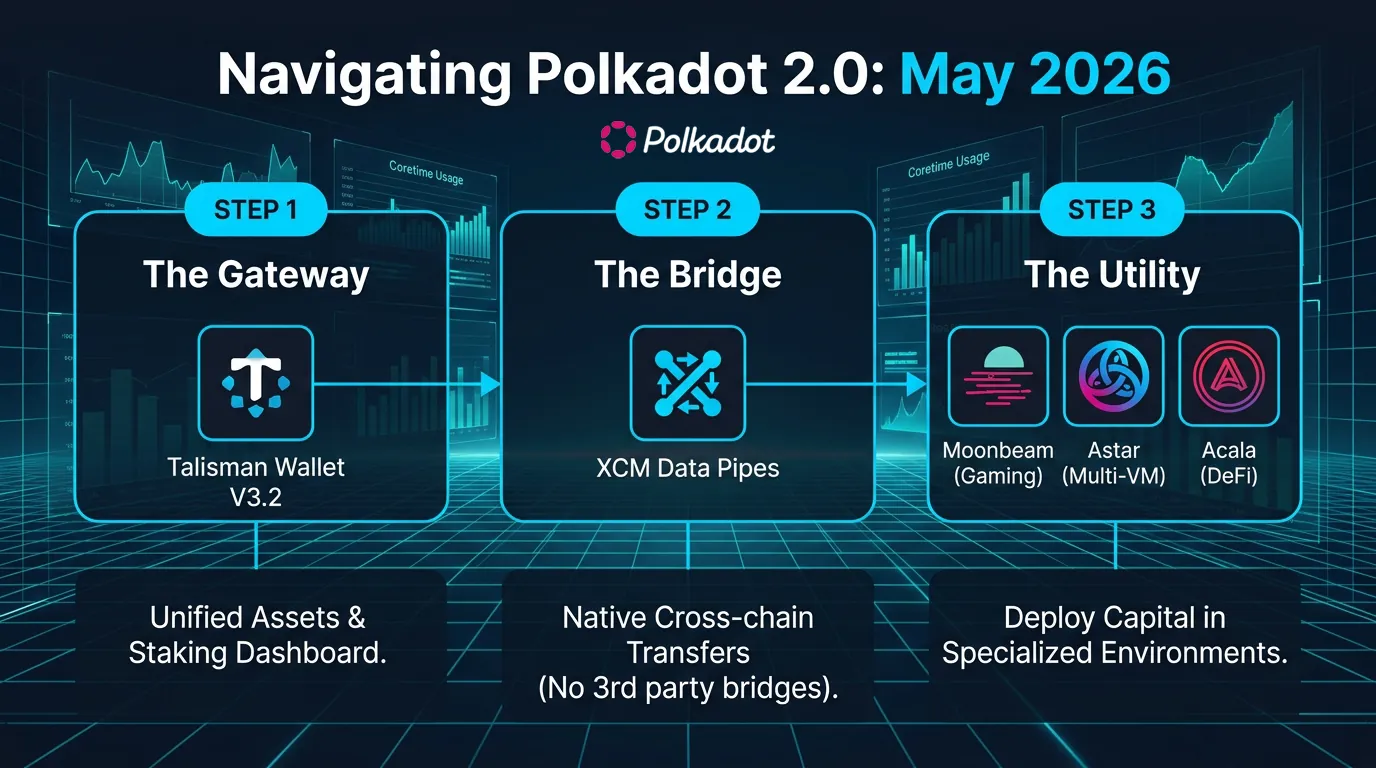
Polkadot 2.0 is live. We analyze how to use the Talisman wallet, execute XCM transfers, and navigate top parachains like Moonbeam and Astar in May 2026
Quick Answer
Polkadot parachains are specialized blockchains that connect to the Polkadot Relay Chain, benefiting from its shared security. As of May 2026, Polkadot transitioned to an Agile Coretime system, replacing parachain auctions to enhance accessibility. This allows parachains like Moonbeam and Astar to leverage Polkadot's multichain capabilities, with DOT serving as a Global Coretime utility.
As of May 6, 2026, the Polkadot ecosystem has successfully transitioned from the rigid "Parachain Auction" model to the flexible Agile Coretime system.This shift, part of the Polkadot 2.0 rollout, has made the network more accessible than ever.
Whether you are seeking the high-performance Ethereum-compatibility of Moonbeam, the multi-VM versatility of Astar, or the deep
With the launch of the JAM Gray Paper v0.8 last year and the recent March 2026 Tokenomics Revolution (slashing inflation to ~3.1%), the DOT token has evolved into a scarce "Global Coretime" utility. Here is how to master the multichain landscape using the most advanced tools of 2026.
1. The Gateway: Setting Up Talisman Wallet (V3.2.0)
In 2026, Talisman remains the "gold standard" for Polkadot and Ethereum interoperability. The latest V3.2.0 update (Feb 2026) introduced the "Earn" tab, allowing you to view yield opportunities across all parachains in a single dashboard.
Why Talisman in 2026?
Ledger Generic App Support: No more installing 50 different apps for 50 parachains. One app now manages your entire Polkadot portfolio.
Unified Asset View: See your DOT on the Relay Chain and your GLMR, ASTR, and ACA in one screen without switching networks manually.
Transaction Simulation: In May 2026, security is paramount. Talisman now simulates your transaction before you sign, showing exactly how your balance will change.
2. Mastering XCM: The "Transport Assets" Feature
The "Invisible Blockchain" dream of 2024 is reality in 2026. XCM (Cross-Consensus Messaging) is the protocol that allows assets to move between parachains instantly.
How to Transfer Assets via XCM:
Open the Talisman Portal: Click on the "Bridge" or "Transport Assets" button.
Select Source & Destination: For example, move DOT from the Relay Chain to Moonbeam to use in DeFi.
Confirm the Route: In 2026, XCM routes are optimized for the lowest "Coretime" cost.
Execute: The transfer usually completes in one block (approx. 6 seconds) thanks to the Asynchronous Backing upgrade implemented in late 2025.
3. Top Parachains: Where to Deploy Your Capital
Moonbeam (GLMR): The Ethereum Gateway
In May 2026, Moonbeam is the primary destination for on-chain gaming and competitive SocialFi.
The 2026 Edge: Support for EIP-7702 allows your standard Moonbeam account to act like a smart contract, enabling "gasless" gaming sessions.
Elastic Scaling: Moonbeam now utilizes parallel execution across multiple cores, targeting sub-2 second block times by the end of this year.
Astar (ASTR): The Multi-VM & Gaming Powerhouse
Astar has completed its Tokenomics 3.0 transition as of March 2026, moving to a fixed-supply model that has significantly reduced structural sell pressure.
Strategy: Use Astar for high-speed dApps that require interaction between EVM and WebAssembly (Wasm) environments. It is currently the top hub for Japanese enterprise Web3 projects.
Acala (ACA): The DeFi and RWA Hub
Acala remains the liquidity heart of Polkadot. In 2026, it has pivoted heavily toward Real-World Assets (RWAs).
The Opportunity: Stake your DOT for LDOT (Liquid Staking) and use it as collateral to mint stablecoins or participate in tokenized treasury yields directly on-chain.
4. Prototypical Navigation: 2024 vs. 2026
Feature
2024 Model (Legacy)
2026 Model (Agile)
Onboarding
Parachain Auctions (DOT lock-up)
Agile Coretime (Pay-as-you-go)
Unstaking
28-day waiting period
24 - 48 hour liquid unstaking
Bridging
Manual Bridges / Third-party
Native XCM / Hyperbridge
Governance
Governance V1 (Councils)
OpenGov (Direct DOT Voting)
5. Verification and Market Forensics via DEXTools
In 2026, the rise of "Elastic Scaling" has led to a flood of new sub-tokens and parachain-native assets. However, the recent April 2026 Hyperbridge incident (where a bug in an Ethereum gateway contract led to a brief bridge exploit) reminds us that technical diligence is mandatory.
Before providing liquidity to a new pair on HydraDX or swapping for a gaming token on Moonbeam, professional traders use DEXTools to verify:
The DEXTscore: High scores (95+) ensure the asset has verified liquidity and no hidden "Mint" functions.
Liquidity Depth: Ensure the pool can handle your volume without the "Proof Forgery" slippage risks seen in recent bridge exploits.
To monitor the DeFi market in an agile and secure way in real-time and trade assets with the help of the best crypto tools, you can access DEXTools here.
Disclaimer: This article is for informational purposes only and does not constitute investment advice, financial advice, trading advice, or any other kind of advice. DEXTools does not recommend buying, selling, or holding any cryptocurrency or token. Users should conduct their own research and consult with a qualified financial advisor before making any investment decisions. Cryptocurrency investments are volatile and high-risk. DEXTools is not responsible for any losses incurred.
How long does a cross-chain transfer (XCM) take in 2026?
With the "Asynchronous Backing" upgrade now active, most XCM transfers complete in approximately 6 seconds (one block), down from the 12-18 seconds required in earlier versions of the protocol.
Do I still need to bridge my DOT to use it on Moonbeam or Astar?
Technically, yes, but the process is now "invisible." When you use an app on Moonbeam, modern 2026 wallets like Talisman can perform a "Teleport" or XCM transfer in the background, making it feel like the DOT is natively there.
What happened to Parachain Auctions?
They have been replaced by Agile Coretime. Instead of locking DOT for 2 years, developers now buy "blockspace" on-demand or through monthly renewals. This has significantly lowered the barrier to entry for smaller projects.
Is my DOT safe in a parachain if the parachain gets hacked?
Because all parachains share the security of the Relay Chain, the network itself is secure. However, if a specific smart contract on a parachain like Moonbeam is hacked, your funds on that chain could be at risk. Always verify contract safety via DEXTools.
Can I use my Ethereum address on Polkadot parachains?
Yes! Parachains like Moonbeam and Astar are EVM-compatible, meaning you can use the same H160 address (0x...) that you use on Ethereum. Talisman manages both your Substrate and Ethereum addresses seamlessly.