What Is Lens Protocol? The Decentralized Social Graph by Aave Founders Explained in 2026
— By Tony Rabbit in Tutorials
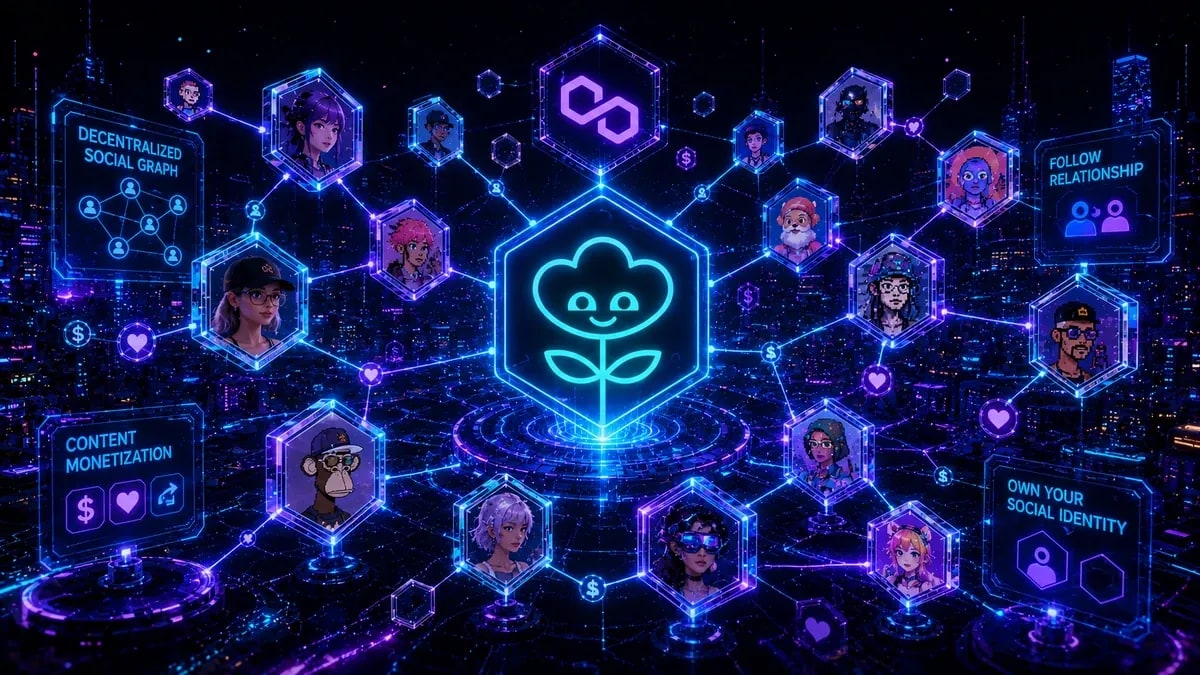
Lens Protocol turns your social graph into an NFT you actually own. Built by Aave founder Stani Kulechov on Polygon and now running on its own Lens Chain L2, Lens powers apps like Hey, Buttrfly, and Orb where your followers, posts, and identity travel with you across platforms. This 2026 guide explains how it works, how it compares to Farcaster and Bluesky, and what the LENS token launch means.
What Is Lens Protocol? The Decentralized Social Graph by Aave Founders Explained in 2026
Every account you have ever opened on a centralized social network is a rental contract. You did not build your audience on Twitter, Instagram, or TikTok. You built it inside their walled garden, and the moment the platform decides your face does not fit the new content guidelines, that audience evaporates. The followers, the conversations, the years of accumulated reputation, none of it belongs to you in any meaningful sense. The platform owns the database row that says who follows whom. You own nothing but the password to a username that can be revoked at will.
This is the structural problem that decentralized social protocols are trying to solve, and Lens Protocol is one of the most serious attempts to date. Where most projects in the space build yet another social app and call it Web3, Lens started from the opposite direction. The team built the social graph itself as a public, composable primitive on a blockchain, then let any developer build any kind of app on top of that shared graph. Your profile, followers, posts, and reputation live in smart contracts that you control, not in a database owned by a corporation that can deprecate you tomorrow.
Lens is the work of Stani Kulechov, the same founder who built Aave into one of the largest lending protocols in DeFi. The protocol launched in 2022 on Polygon, shipped its v2 modular upgrade in 2024, migrated to its own dedicated Layer 2 called Lens Chain in 2025, and is scheduled to launch the LENS token in 2026. Along the way it has spawned an ecosystem of competing front-end applications including Hey (formerly Lenster), Buttrfly, and Orb, all sharing the same underlying user base. You log in once, your profile and followers come with you everywhere.
Featured Snippet
Lens Protocol is a decentralized social graph built by Aave founder Stani Kulechov and the Aave Companies team, originally launched on Polygon PoS in 2022 and now running on its own dedicated Layer 2 called Lens Chain since 2025. User profiles are minted as ERC-721 NFTs that the user owns directly in their wallet, meaning followers, posts, comments, and reputation are portable across every application built on the protocol. The Lens v2 upgrade introduced a modular architecture where developers can plug in custom reference, action, and open-action modules to extend any publication. Apps built on Lens include Hey (formerly Lenster), Buttrfly, Orb, and Tape, all of which share the same underlying user base. The LENS token is scheduled to launch in 2026 to govern the protocol and reward contributors.
What Is Lens Protocol in Plain English
Forget the blockchain jargon for a moment and think about what a social network actually is at the database level. There is a table of users, a table of relationships that says who follows whom, a table of posts, a table of comments and reactions, and some media storage. That is roughly it. Everything else is product design layered on top. Twitter has its own copy of these tables. Instagram has its own copy. Threads has its own copy. None of them talk to each other, which is why you have to rebuild your audience from scratch every time you join a new platform.
Lens Protocol replaces that proprietary database with a shared one that lives on a blockchain. Every Lens profile is a token in your wallet. Every follow relationship is a small NFT you mint when you follow somebody. Every post is a record anchored on chain with the actual content stored on decentralized storage. Because all of this data is public and standardized, any developer can read it and build a client that displays it differently. One developer might build a Twitter-style microblogging app, another might build a long-form publishing platform, a third might build a video-only client, a fourth might build a niche app for traders or musicians. All of them tap into the same underlying graph, and a user with one Lens profile can use all of them with the same identity, same followers, same history.
This is the bet Lens is making. If you separate the social graph from the application layer the way the web separated content from the browser, you unlock a kind of permissionless innovation in social that has been impossible under the Twitter and Meta model. Anyone can build a competing client tomorrow. If the existing apps moderate too aggressively, somebody builds a permissive one. If they moderate too loosely, somebody builds a stricter one. The user picks the client they like, takes their followers with them, and the underlying protocol does not care.
The Decentralized Social Vision
Decentralized social is not a new idea. People have been trying to build federated and peer-to-peer social networks for at least twenty years, from Diaspora to ActivityPub to Mastodon to Scuttlebutt. Most of those efforts succeeded technically but failed culturally. They produced working software that almost nobody used, because the network effects of the incumbent platforms were too strong and the user experience of the alternatives was too unpolished. Lens is one of a handful of newer projects that argues blockchain primitives can change this calculus by giving users genuine ownership of their identity and audience in a way that legacy decentralized systems could not.
The pitch is that ownership creates lock-in in the opposite direction from a platform. On Twitter, you are locked in because leaving means losing your followers. On Lens, your followers are an asset you carry with you, so leaving any particular client costs you nothing. That should in theory create a competitive market for clients where the platforms have to earn your usage every day rather than relying on switching costs to keep you trapped. Whether this theory holds up in practice depends on whether enough creators and audiences actually migrate, which is the open question every decentralized social project is trying to answer.
Lens and its main competitor Farcaster have taken different bets on how to make this happen. Lens went for full blockchain ownership of every primitive from day one, accepting the gas costs and user experience friction that comes with putting everything on chain. Farcaster took a hybrid approach with cheaper off-chain storage anchored by on-chain identity. Both approaches have tradeoffs, and the broader decentralized social experiment is still very much in progress. For a deeper dive into the alternative architecture, our guide to Farcaster and the sufficient decentralization model walks through the differences in detail.
Stani Kulechov: From Aave to Lens
Stani Kulechov is a Finnish entrepreneur and lawyer by training who first entered the crypto industry in 2017 when he launched ETHLend, an early peer-to-peer Ethereum lending protocol. ETHLend was rebranded to Aave in 2018, pivoted to a pool-based lending model rather than direct matching, and went on to become one of the three most important lending protocols in DeFi alongside Compound and MakerDAO. By the time Aave V2 launched in late 2020, Kulechov was widely regarded as one of the most respected technical founders in the space, with a deep understanding of how to ship working financial primitives onto Ethereum.
The decision to start Lens came from a recognition that financial primitives alone are not enough to make crypto matter to ordinary users. People do not wake up wanting to borrow stablecoins against ETH collateral. They wake up wanting to talk to friends, share photos, follow creators, build audiences, and find communities. If crypto was going to grow beyond the speculative and financial niches, it needed primitives for the things that occupy most of human attention online, and the social graph was the obvious place to start. Kulechov and the Aave Companies team began building Lens in 2021 and announced the protocol publicly in February 2022. You can read more about the founder's earlier work in our complete guide to Aave and on-chain lending.
The choice to deploy Lens on Polygon rather than Ethereum mainnet was deliberate and pragmatic. A social network generates orders of magnitude more transactions than a lending protocol. Every follow, every post, every like is potentially a transaction. Ethereum mainnet gas costs at the time would have made the user experience impossible, with people paying ten dollars to leave a comment. Polygon offered EVM compatibility, low fees, fast finality, and a developer ecosystem already familiar to anyone who had built on Ethereum, which made it the natural home for a high-frequency social protocol. The deeper context for that choice is covered in our explainer on Polygon, the POL token, the Chain Development Kit, and AggLayer.
Timeline: From Whitepaper to Lens Chain
Stani Kulechov and the Aave Companies team publicly announce Lens Protocol in February 2022 and deploy the first version on Polygon PoS mainnet in May. Early access is limited to whitelisted profiles, with handles distributed to artists, developers, and crypto-native users to seed the network. The first apps including Lenster, Phaver, and Buttrfly launch within weeks.
Lens V1 expands beyond the initial whitelist with a steady drip of new handles and a growing developer community. The protocol surpasses one hundred thousand profiles, and ecosystem partners begin building niche clients for music, video, long-form publishing, and creator monetization. Lenster rebrands to Hey after a dispute with the underlying domain.
Lens V2 ships as a major architectural upgrade. Profiles become modular, with separate reference modules, action modules, and open action modules that let any developer extend any publication with arbitrary on-chain logic. The Open Actions framework enables NFT mints, token swaps, governance votes, and tipping flows to be embedded directly inside posts, turning every publication into a potential mini-app.
Lens Chain launches as a dedicated Layer 2 built using the ZK Stack and tailored specifically for social workloads. The migration removes the friction of Polygon gas fluctuations, provides social-aware infrastructure, and gives the protocol full sovereignty over its execution environment. Existing Lens profiles bridge to the new chain, and all major clients update to support both environments during the transition.
The LENS token launches as the native asset of Lens Chain and the governance token for the protocol. Distribution rewards early users, builders, creators, and ecosystem participants who shaped the network during its first four years. The token unlocks new economic primitives across the application layer, from creator subscriptions to social staking experiments.

How NFT Profile Ownership Works
The foundational primitive of Lens is the profile, and every profile is an ERC-721 non-fungible token sitting in a user wallet. When you claim a handle on Lens, the protocol mints a new NFT to your address. That NFT is the profile. It carries the handle, links to associated metadata like display name, bio, and avatar URI, and holds the keys to every follow relationship and publication associated with that identity. Because it is a standard ERC-721, you can transfer it to another wallet, sell it on OpenSea or any NFT marketplace, set it as collateral in a lending protocol that accepts NFTs, or pass it to your heirs by handing them the private key.
Compare this to the alternative. On Twitter, your account is a row in a database that Twitter Inc. controls. If they ban you, the row gets a flag set and you lose access, with no court of appeal. On Lens, the protocol does not have the authority to take your profile away because the profile is your token. Even the Lens core team could not delete your account. They can deprecate the official clients, but the smart contracts and on-chain data persist indefinitely, and anyone could build a new client tomorrow that reads them. For more on the underlying standard, see our explainer on the ERC-721 NFT standard.
The trade-off is responsibility. Owning your identity means bearing the cost of securing it. If somebody phishes the private key to the wallet holding your Lens profile, they can transfer the profile away with no recourse. This is the same trade-off Web3 has always asked users to accept in exchange for sovereignty, and it remains one of the largest UX hurdles for mainstream adoption. The defensive patterns overlap heavily with the broader Web3 threat model covered in our guide to avoiding address poisoning and wallet drain scams.
Profile handles themselves carry value because they are scarce and ownable. Short or culturally significant handles can change hands for thousands of dollars on secondary markets like premium domain names do. Big brands wanting a presence on Lens have to either secure their handles early or pay a holder to release one, exactly as they do on the DNS system.
Composable Modules Architecture
If profiles are the foundation, modules are the floors built on top. The Lens V2 architecture introduced a clean separation between core data structures and the optional logic attached to them. Every publication on Lens can carry three kinds of modules. Reference modules control who is allowed to interact with a post, for example by gating comments to followers only. Action modules define what happens when a user takes a specific action. Open Action modules are the most flexible, letting developers attach arbitrary smart contract calls that anyone can trigger by tapping a button in the client.
Open Actions are where the architecture becomes genuinely interesting. A post can contain an Open Action that lets viewers mint an NFT, swap a token, vote on a DAO proposal, or tip the creator, all from inside the social feed. The Open Action is just a smart contract the client recognizes and renders as an interactive element. Because the framework is permissionless, any developer can write a new Open Action and any client can choose to render it.
This effectively turns every post into a potential mini-application. A musician can post a track with an Open Action to mint a limited NFT of that song. A trader can post chart commentary with a one-click swap button. A creator can run an on-chain poll where every vote is verifiably recorded. None of this requires the creator to build an app or the viewer to leave the feed. The interaction happens inline, settled on Lens Chain.
The publication types form a small taxonomy. A Post is top-level, equivalent to an original tweet. A Comment is a reply. A Mirror is a verbatim repost, equivalent to a retweet. A Quote is a repost with added commentary. Each can carry its own modules, so a Mirror can have different gating rules than the original Post. The simple type system gives client developers a stable surface to build on while leaving room for creative product design.
The Application Ecosystem: Hey, Buttrfly, Orb, and More
Because Lens separates the protocol from the client, multiple competing applications can serve the same underlying social graph with different product philosophies. The leading client through most of 2024 and 2025 was Hey, originally launched as Lenster by a small team that built a Twitter-style microblogging interface with a clean web design. After a trademark dispute over the Lenster name the project rebranded to Hey, but the product continued to dominate as the de facto desktop entry point to the network, with the highest daily active user count of any Lens client.
Buttrfly took a different angle, focusing on creators and aggregating Lens with other decentralized networks like Farcaster into a unified feed. Orb built a mobile-first community-oriented client that resembles Instagram or a private Telegram group more than it does Twitter, with strong support for niche communities and creator monetization. Phaver was an early mobile entrant that introduced curation and earnings mechanics, although it has faded somewhat in 2026 as the focus has shifted toward the new Lens Chain native experiences.
Beyond the general-purpose clients there is a long tail of niche applications. Tape is a video-focused client that resembles a decentralized YouTube. There are music clients, podcasting clients, writing-focused long-form publishing clients similar to Substack, and trading-focused clients that surface Lens posts from on-chain alpha hunters with their wallet history attached. The shared social graph means any developer can spin up a new client over a weekend, target a specific community, and immediately have access to the full user base. The cost of starting a competing app is whatever it takes to design and ship the UI, because the user acquisition is already done for you.
This is fundamentally different from how social media has historically worked. In the legacy model, every new social app starts with zero users and has to bootstrap a network from scratch, which is why the existing incumbents are so hard to dislodge. In the Lens model, the network already exists at the protocol level, and the apps compete on user experience, curation algorithms, content moderation policies, and creator tooling. Whether this leads to a healthy competitive ecosystem or just a graveyard of half-built clients depends on whether the underlying network can keep growing.

Lens Chain: The L2 Built for Social
For its first three years Lens lived on Polygon PoS, which served well during bootstrap. Polygon offered cheap transactions, EVM compatibility, and a mature toolchain. But as the network grew, the team bumped against the limits of running on a shared general-purpose chain. Gas fees on Polygon, while cheap in absolute terms, still fluctuated. A spike in unrelated activity could make Lens transactions briefly expensive, which is corrosive to a product that depends on lots of small interactions being effectively free.
The deeper issue was that Polygon was not optimized for social workloads. Posts are small, frequent, and bursty. Mirrors and quotes can fan out a single creator action into thousands of derivative transactions. The team wanted infrastructure tuned for these patterns, with features like sponsored transactions where the application pays gas on behalf of the user, batched signature aggregation, and identity primitives that did not have to be retrofitted onto generic EVM accounts.
Lens Chain launched in 2025 as a dedicated Layer 2 built on the ZK Stack, the open-source rollup framework also used by zkSync Era. The choice gave Lens a production-grade ZK rollup with Ethereum security guarantees, while letting the team customize fee markets, account abstraction, and storage models for social workloads. Existing profiles bridged through a coordinated migration. The result is a network where typical interactions cost fractions of a cent and confirm within seconds.
Having its own L2 also gives Lens sovereignty over its roadmap. Upgrades like efficient media storage, native subscription primitives, or social staking experiments can ship without coordinating with a shared chain's user base. The trade-off is maintaining its own security model and validator economics, but the protocol owns its execution environment in a way impossible while it was a tenant elsewhere. For broader context on L2 rollups, see our beginner guide to Ethereum and its scaling ecosystem.
Cross-Platform Portability in Practice
The portability story is the single most concrete benefit of Lens, and the easiest way to see it is to try it. Sign into Hey with your wallet, then open Buttrfly with the same wallet. Your feed, followers, and post history are all there. The two clients look nothing alike, but they surface the same underlying data. You did not have to rebuild anything because you have a Lens profile, not an account on either app, and the apps just render whatever your profile points at.
This portability extends to follow relationships, which are themselves on-chain assets. When you follow somebody, the protocol mints a Follow NFT representing that relationship. Because the follow is on chain, every client sees it. There is no possibility for one app to silently drop your follow the way platforms sometimes shadow ban or unfollow accounts behind the scenes. Either the follow exists on chain or it does not, and any client that respects the protocol has to honor it.
Clients can of course choose what to display and how to rank it. A client might not show posts from accounts it considers spam, and different clients will make different choices. But the underlying graph is the source of truth, and you can always switch to a client whose moderation policy you prefer. This is a meaningful improvement over the status quo where moderation is baked into the network itself with no exit option short of abandoning your audience.
Creating a Lens Profile: The Three-Step Flow
Get a Wallet on Lens Chain
Install MetaMask, Rabby, or another EVM wallet. Add the Lens Chain RPC settings to the network list and bridge a small amount of the gas token across using the official Lens bridge or a supported aggregator. You need only a few dollars to cover profile creation and gas for early interactions.
Mint a Handle
Open any Lens client like Hey or Orb and choose Create Profile. Pick an available handle, set a display name and avatar, and confirm the transaction. The wallet signs, the protocol mints an ERC-721 profile NFT to your address, and within seconds you have a Lens identity you fully own.
Start Posting and Following
Publish your first post, follow accounts you want in your feed, and try the same profile in two different clients to feel the portability for yourself. Bookmark your profile NFT contract address so you remember the asset that represents your social identity lives in your own wallet.
LENS Tokenomics and the 2026 Launch
For most of its existence Lens has operated without a native token, with the team funding development through Aave Companies and ecosystem grants. That changes in 2026 with the planned launch of LENS, the protocol's governance and economic asset. LENS will function as the gas token on Lens Chain, the governance token for protocol upgrades, and the staking asset that secures the network and aligns incentives across creators, developers, and users.
A meaningful portion of the initial supply is earmarked for the existing community, with allocations to early profile holders, active creators, ecosystem developers, and infrastructure contributors. This retroactive distribution pattern is familiar from other major crypto launches and serves the dual purpose of seeding broad ownership and rewarding people who took on the risk of using an unproven network. The remaining supply is split across the foundation, core team with multi-year vesting, ecosystem grants, and future incentive programs.
Beyond governance, the token unlocks new economic primitives across the application layer. Creator subscriptions can settle in LENS. Open Actions that involve payment can use it as the default unit of account. Curation experiments where users stake tokens to boost content become possible. The token gives the network a coordination mechanism it previously lacked.
As with any token launch, treating LENS as primarily speculative misses the point. The interesting question is not whether the price goes up in the first month but whether the token drives the behaviors the protocol needs to keep growing. A token that aligns creators, developers, and users around shared ownership is genuinely valuable. A token that mostly attracts mercenary capital becomes a drag. The first year of LENS will reveal which version Lens has built.

Lens vs Farcaster vs Bluesky vs X
The decentralized social space in 2026 is no longer empty. Lens has serious competition from Farcaster, which has its own architecture and a healthy ecosystem of clients led by Warpcast. Bluesky operates on the AT Protocol and has grown rapidly into a Twitter alternative with millions of users. And of course X (formerly Twitter), Threads, and the legacy social platforms still dominate by total user count. Understanding the differences clarifies what Lens is actually competing on and where it sits in the broader landscape.
Compared to Farcaster, Lens is more on-chain in every dimension. Farcaster anchors identity on Ethereum but stores most social data in off-chain Hubs operated by the community, treating the chain as a relatively light coordination layer. Lens puts profiles, follows, and publications directly on chain through smart contracts. This makes Lens more composable with other on-chain primitives, since any DeFi or NFT protocol can read Lens data trivially, but it also means Lens transactions cost real gas and the user experience has historically required more wallet interaction than Farcaster's. The Lens Chain L2 has closed much of that UX gap, but the philosophical difference remains.
Compared to Bluesky, Lens is genuinely decentralized at the data layer while Bluesky is federated in a way that resembles Mastodon. Bluesky users can in theory move their identity between servers using the AT Protocol, but in practice almost all data flows through Bluesky-operated infrastructure. There is no blockchain, no token, no native ownership of social assets. Bluesky has won on user count by being approachable, while Lens has won on architectural purity by giving users actual cryptographic ownership.
Compared to X and Threads, Lens operates at completely different scale. The big platforms count users in hundreds of millions. Lens counts in the hundreds of thousands. The question is whether decentralized social grows by orders of magnitude as users get tired of platform risk, or whether the network effects of incumbents prove too strong. Lens is one of the bets that says the future tilts toward open protocols, but nobody pretends the path to mass adoption is short or guaranteed.
For builders, the choice often comes down to application type. If the app deeply integrates with DeFi or NFTs, Lens is the natural choice because the entire social graph is already on chain and composable with everything else in the Ethereum ecosystem. If the app is a pure social product, Farcaster or Bluesky might be a faster path. Many ambitious products end up supporting multiple protocols.
Risks: Centralization Vectors and UX Reality
The strongest claim made about Lens is decentralization, and like every protocol that makes that claim it is worth examining honestly. The smart contracts are immutable in the sense that anyone could build alternative clients. But centralization vectors remain. The Lens Foundation and Aave Companies still coordinate protocol direction. The most-used clients are operated by specific teams with their own moderation policies that can functionally exclude users from dominant on-ramps. The Lens Chain validator set has its own centralization gradient that will evolve as the network matures.
User experience is the other persistent challenge. Asking users to manage a self-custody wallet, secure a seed phrase, pay gas fees in tokens acquired on a bridge, and understand which client speaks which version of the protocol is a tax legacy platforms do not charge. Account abstraction and social recovery wallets aim to hide this complexity, but in 2026 getting started on Lens is still meaningfully harder than signing up for Twitter, and that friction is reflected in adoption numbers.
Content moderation has no clean answer. Permissionless networks attract spam, scams, harassment, and worse. Lens delegates moderation to clients, which is philosophically defensible but practically means the most popular clients make most decisions for most users, which starts to resemble the centralized model the protocol was supposed to escape. Nobody has fully solved this trade-off.
Financially, Lens does not custody user funds, so there is no exchange-style hack risk at the protocol level. The risk is at the wallet level. Phishing, malicious Open Action modules, and the usual rogue Discord links are all present. The same defensive habits that protect a DeFi user also protect a Lens user, and the basics are covered in our general Web3 guide and the broader DeFi overview.
Pros and Cons of Building Your Social Presence on Lens
Pros
- Your profile, followers, and history are tokens in your own wallet, fully portable across every client built on the protocol.
- Composable with DeFi and NFTs in ways centralized social can never match, enabling embedded mints, swaps, and on-chain actions inside posts.
- Open Action modules turn every publication into a potential mini-application that any developer can extend.
- Multiple competing clients keep any single application from monopolizing the user experience or moderation policy.
- Backed by the credible team that built Aave, with multi-year track record and serious technical depth.
Cons
- Active user count remains small compared to legacy platforms and even some other decentralized social networks like Bluesky.
- Onboarding friction is real, with wallets, gas, bridges, and Web3 mental models all required to participate.
- Moderation decisions effectively concentrate at the dominant client layer, partially undermining the decentralization story.
- Losing the private key to your profile means losing the profile permanently with no support team to recover it.
- Token launch dynamics could attract short-term mercenary capital that distorts incentives if not carefully designed.
Best Practices for Lens Users in 2026
If you are setting up a Lens profile in 2026, a few habits go a long way toward making the experience smooth and safe. First, treat the wallet that holds your profile as a long-lived identity wallet, not a daily-driver hot wallet. Many serious Lens users hold their profile NFT in a hardware wallet or smart contract wallet, and grant a separate signing wallet limited permissions through the Lens dispatcher mechanism for routine posting. This keeps the high-value asset cold while letting day-to-day interactions stay fast.
Second, do not blindly approve Open Actions or sign transactions you do not understand. Open Actions are powerful because they can call arbitrary smart contracts, which means a malicious one can drain your wallet. Stick to actions from creators and projects you trust, and read what the transaction is doing before signing.
Third, get comfortable with the idea that no single client is the whole network. Try Hey for web microblogging, try Buttrfly or Orb for mobile, try the niche clients for music or video. The portability of the graph means you lose nothing by experimenting. The mental shift from "I have a Twitter account" to "I have a Lens profile usable through any compatible app" is the actual product of decentralized social.
Fourth, treat your handle like a domain name. Short handles are scarce and have real secondary market value. If you grab a desirable handle, secure it properly. If you are a brand, secure your handle before somebody else does. The trading patterns for Lens handles closely resemble premium domains, and the same playbook applies.
Finally, the same wallet that holds your profile can interact with the broader DeFi and NFT ecosystem. Our guide to using DEXTools walks through how on-chain analytics fits alongside the social signal you get from Lens, and the broader explainer on non-fungible tokens provides context for thinking about your profile as a digital asset.
Frequently Asked Questions
What is Lens Protocol in one sentence?
Lens Protocol is a decentralized social graph that stores profiles, follows, and posts as on-chain assets so users own their social identity and can use it across any compatible application.
Who founded Lens Protocol?
Lens was founded by Stani Kulechov and the Aave Companies team, the same group behind the Aave lending protocol, with public launch in May 2022 on Polygon PoS.
Why is Lens built on Polygon?
Lens originally launched on Polygon because the social workload required cheap, fast EVM-compatible transactions that Ethereum mainnet gas costs would have made impractical. In 2025 it migrated to its own dedicated Lens Chain L2.
How are profiles represented on Lens?
Every Lens profile is an ERC-721 non-fungible token held in a user wallet. The NFT carries the handle, metadata, and ownership of all associated publications and follow relationships.
What is Lens v2?
Lens v2 is the 2024 architectural upgrade that introduced modular profiles with separate reference modules, action modules, and open action modules, enabling any publication to be extended with arbitrary on-chain logic.
What is Lens Chain?
Lens Chain is the dedicated Layer 2 the protocol migrated to in 2025, built on the ZK Stack and customized for social workloads with sponsored transactions, social-aware account abstraction, and tuned fee markets.
How is Lens different from Farcaster?
Lens stores profiles, follows, and publications fully on chain, while Farcaster keeps identity on Ethereum but moves most data into off-chain Hubs. Lens is more composable with DeFi, Farcaster historically had lower user friction.
What apps are built on Lens?
Hey (formerly Lenster), Buttrfly, Orb, Tape, and dozens of niche clients targeting specific use cases like music, video, long-form writing, or trader communities, all sharing the same underlying user base.
Is there a LENS token?
The LENS token launches in 2026 as the native asset of Lens Chain and the governance token for the protocol, with allocations to early community members, creators, and ecosystem contributors.
How do I create a Lens profile?
Set up a wallet on Lens Chain, bridge a small amount of the gas token, open a client like Hey or Orb, choose Create Profile, pick an available handle, and confirm the transaction that mints the profile NFT to your address.
What are the main risks?
Wallet compromise that loses your profile NFT permanently, malicious Open Actions that drain funds, dominant clients setting de facto moderation policy, and ongoing user experience friction relative to centralized alternatives.
Will decentralized social replace X/Twitter?
Probably not in a winner-take-all sense, but Lens, Farcaster, and Bluesky are creating a real category of platform-independent social that will likely coexist with centralized incumbents as users diversify away from single-platform dependence.
Closing Thoughts: The Long Bet on Open Social
Lens Protocol is one of the most ambitious bets in crypto outside pure finance. The team is not building a slightly better Twitter. They are trying to rebuild the substrate of social networking from first principles, where the user owns the identity, the followers, and the content, and applications are thin clients reading and writing to a shared public graph. If they are right, the model wins because the alternative becomes obviously inferior over time. If they are wrong, the protocol becomes an interesting historical experiment.
What is undeniable is that the architecture is real, the team is serious, and the experiment is far enough along to evaluate honestly. Lens has shipped multiple major versions, migrated to its own L2, attracted real developer activity, and survived the bear market that killed countless lesser projects. It enters 2026 with a token launch on deck, a growing app ecosystem, and a clear roadmap. It has earned the right to be taken seriously as an attempt to fix something broken about how online identity works.
For users, the practical question is not whether Lens replaces your existing social presence overnight but whether it is worth claiming a profile, trying a few clients, and starting to build a parallel identity you actually own. The cost of trying is small. The cost of being unprepared if open social becomes the default is larger, especially if your livelihood depends on relationships that currently sit inside someone else's database. Owning your audience is the kind of asset that compounds over time, and Lens is one of the few places you can start building it today.
Related Guides
- What Is Farcaster? Decentralized Social Protocol Guide 2026
- What Is The Graph (GRT): Complete Decentralized Indexing Guide (2026)
- Aave Credit Markets Explained: Peer-to-Pool Lending, Collateral and GHO (2026)
- Aave Protocol Explained: V3, GHO, Risk Modes and How the Market Works (2026)
- What Is Walrus Protocol: WAL Decentralized Storage Guide 2026