What is Helium (HNT)? People-Powered Wireless Networks

Building global telecom networks no longer requires corporate monopolies. We break down Helium's decentralized wireless (DeWi) model, the return to HNT mining, and real-world carrier offloading.
The Telecom Paradigm Shift: Crowdsourcing Real-World Coverage
- Traditional telecommunications models require billions of dollars in upfront capital to lease properties, install massive cell towers, and manage expensive maintenance workforces. This capital-intensive, centralized structure creates localized monopolies, driving consumer mobile bills up while ignoring lower-density or rural infrastructure development.
- The Helium Network transforms this system through decentralized physical infrastructure networks (DePIN). Instead of a single corporation owning the entire wireless network, Helium enables ordinary individuals to buy, deploy, and operate hardware hotspots directly from their homes or businesses. By rewarding hardware operators with cryptocurrency, Helium has built a massive global network for the Internet of Things (IoT) and high-speed mobile data. This comprehensive guide details Helium’s structural shift to the Solana blockchain, the integration of Helium Mobile cellular carrier services, and the updated unified token economic models guiding the network.
What is Helium?
- Helium is an open-source, decentralized wireless network designed to provide low-power, long-range coverage for IoT devices and high-bandwidth data solutions for standard smartphones.
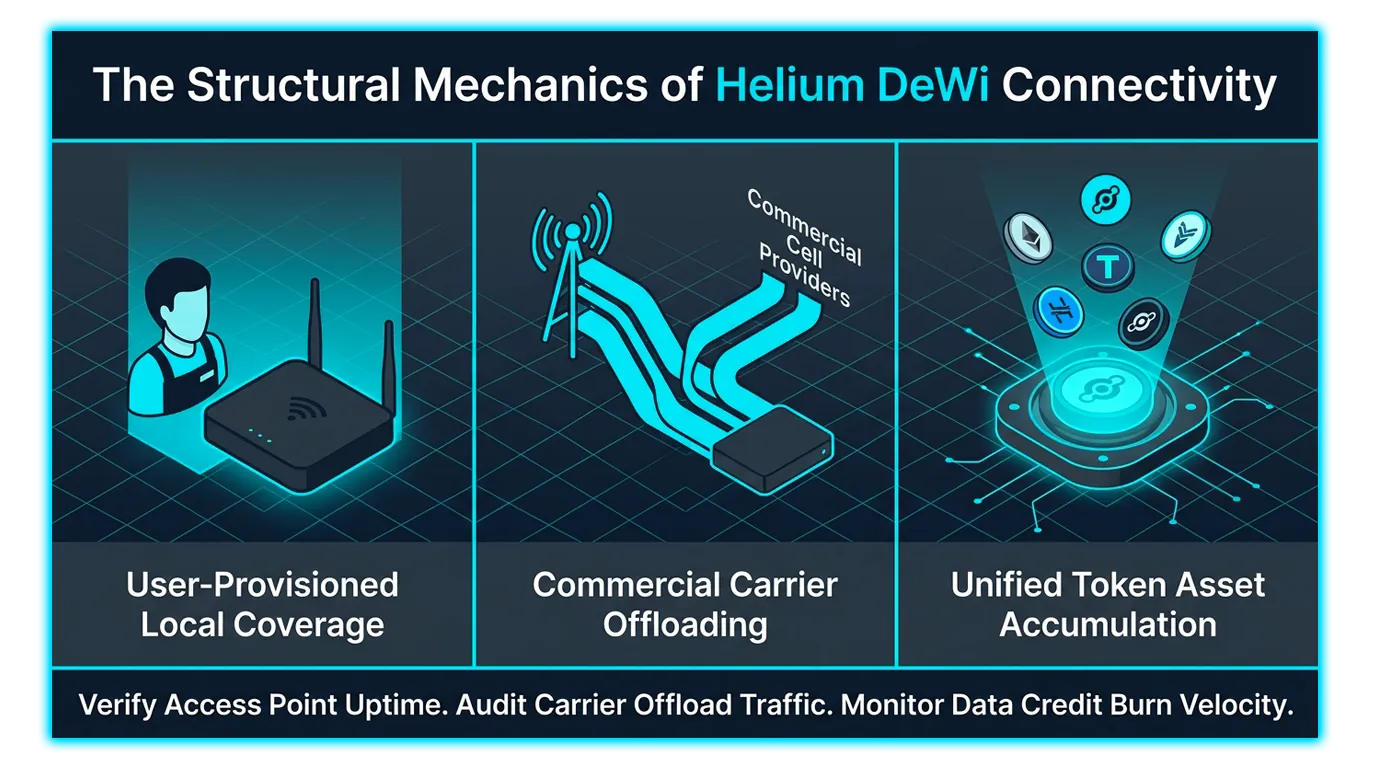
- The economic foundation of the entire system is the HNT token. To transmit data over the network, commercial enterprises and connected devices must purchase and destroy a fixed-value asset known as Data Credits (DC). These Data Credits are generated exclusively by burning HNT tokens out of circulation. This structure ties HNT's tokenomic scarcity directly to the real-world demand for wireless data transmission across the globe.
1. The Solana Migration: Scaling Through Ecosystem Integration
In April 2023, Helium executed a fundamental architectural upgrade by migrating its entire network infrastructure from its native, standalone Layer 1 blockchain onto the Solana blockchain.
This migration eliminated massive technological bottlenecks for the network:
Offloading Consensus Complexity: Managing a native layer required immense development resources just to handle transaction validation and node consensus. Moving to Solana allowed Helium's core developers to focus purely on wireless routing technologies.
Frictionless DeFi Composability: By transforming HNT into a standard Solana token asset, operators and market participants can instantly swap rewards, trade liquidity pools, and leverage ecosystem decentralized finance tools without passing through complex cross-chain bridges.
2. The Token Consolidation and the Return to HNT
- To understand what is Helium, you have to comprehend that helium’s underlying token architecture underwent a comprehensive optimization following the implementation of HIP-138 (implemented January 2025).
- Historically, Helium operated a complex three-token model where hardware mining directly emitted secondary tokens: IOT for the internet-of-things subnetwork and MOBILE for the 5G cellular subnetwork. HIP-138 stopped the programmatic emission of these secondary sub-tokens entirely, simplifying the network architecture back into a single, unified reward system.
- Today, all hardware mining rewards, data transfer payouts, and proof-of-coverage checks are distributed directly in HNT. Legacy sub-tokens can be converted back to HNT via the official Helium Wallet or open Solana decentralized aggregators at a permanent treasury exchange rate. This change consolidates the entire ecosystem's economic weight behind the primary HNT asset. Furthermore, following the August 2025 halving cycle, annual HNT issuance was cut to 7.5 million, significantly increasing token scarcity while prioritizing operators that drive active data transfer.
3. Helium Mobile: Disruption in the Cellular Carrier Space
- Helium has expanded aggressively beyond basic IoT sensors into consumer cellular services through Helium Mobile, a hybrid Mobile Virtual Network Operator (MVNO).
- Helium Mobile provides nationwide cellular phone plans by combining community-built wireless infrastructure with standard legacy provider networks. When a subscriber is within range of a community-deployed Helium Wi-Fi or CBRS cellular hotspot, their phone automatically offloads data through the cheaper, decentralized network. When they step out of range, the connection smoothly transitions onto T-Mobile's commercial infrastructure.
Massive Subscriber Adoption: Helium Mobile's accessible pricing model drove rapid growth, surpassing 250,000 active mobile signups and processing over 1.6 million daily users.
The "Helium Plus" Expansion: Launched to open the onboarding funnel, the Helium Plus initiative allows public commercial venues and local businesses to monetize their existing enterprise Wi-Fi routers by integrating them directly into the Helium wireless data grid, eliminating traditional specialized hardware entry costs.
Helium Infrastructure Comparison Matrix
| Subnetwork | Hardware Core | Primary Data Use | Main Asset |
| IoT Subnet | LoRaWAN Gateways | Sensors & Tracking | HNT Unified |
| Mobile Subnet | Wi-Fi / CBRS Cells | Cellular Offload | HNT Unified |
Analyzing Helium Market Metrics via DEXTools Telemetry
- Reviewing live token reallocations, tracking network burn speeds, and inspecting liquidity pools across open Solana trading hubs requires robust data clarity. Utilizing advanced decentralized charting architectures like DEXTools gives market participants an essential universal platform to monitor live token behaviors, evaluate pool depths, and inspect contract parameters across all public execution networks.
- By leveraging core features like the Pair Explorer, Live New Pairs dashboard, and the integrated Trade Story or Top Traders diagnostic tools, technical traders can seamlessly audit localized volume trends, track large whale wallet capital reallocations via the Big Swap Explorer, and check automated contract safety scores before initiating any on-chain interactions, ensuring your hardened hardware setup interacts safely with verified market venues.
Disclaimer: This article is for informational purposes only and does not constitute investment advice, financial advice, trading advice, or any other kind of advice. DEXTools does not recommend buying, selling, or holding any cryptocurrency or token. Users should conduct their own research and consult with a qualified financial advisor before making any investment decisions. Cryptocurrency investments are volatile and high-risk. DEXTools is not responsible for any losses incurred.
Beyond the Hotspot: Helium's Broader DeWi Vision
While the iconic Helium Hotspot often takes center stage, focusing solely on it risks missing the profound shift Helium is attempting across the entire decentralized wireless (DeWi) landscape. Helium isn't just about providing a consumer-grade device for individuals to earn tokens; it's a foundational protocol aiming to democratize network infrastructure deployment and operation on a global scale, moving far beyond just LoRaWAN.
The true innovation lies in its "Network of Networks" approach, allowing for the permissionless deployment of various wireless protocols on a single blockchain-governed incentive layer. This vision extends to 5G, Wi-Fi, and other emerging standards, each with its own specific hardware requirements and economic models, all unified under the Helium brand and its tokenomics. This modularity is key to its long-term scalability and adaptability.
The Real-World Implications of DeWi Modularity
- Enabling open-source hardware development for diverse network types, fostering innovation beyond proprietary solutions.
- Allowing communities to self-organize and deploy networks where traditional carriers see no immediate profit.
- Creating competition in telecom services, potentially leading to lower costs and better coverage for end-users.
- Providing a framework for "proof of coverage" for any wireless technology, not just LoRaWAN, to earn rewards.
- Facilitating the integration of existing infrastructure into a decentralized model, leveraging dormant assets.
Related Guides
- What Is Zcash (ZEC)? The Privacy Cryptocurrency Powered by zk-SNARKs Explained in 2026
- What Is Matcha? The 0x-Powered DEX Aggregator Explained (2026 Guide)
- What Is Helium Mobile? The DePIN Cellular Network That Pays You in Crypto (2026 Guide)
- DePIN Tokens Compared: Helium, IoTeX, Render and More 2026
- What Is DePIN: Complete Decentralized Physical Infrastructure Networks Guide (2026)
Frequently Asked Questions
What is Helium (HNT)?
Helium is a decentralized wireless network where individuals deploy hardware to provide coverage and earn token rewards. HNT is the network's token associated with this decentralized wireless model.
How does the Helium network work?
Participants run hotspots or compatible hardware that provide wireless coverage, and the network rewards useful contributions. The goal is to build connectivity from many independent operators rather than a single carrier.
What is carrier offloading in Helium?
Carrier offloading refers to routing some mobile data traffic through the decentralized network instead of a traditional carrier's infrastructure. This can extend coverage and create demand for the network's service.
What are the risks of mining HNT?
Risks include token price volatility, variable reward rates, hardware and setup costs, and dependence on local coverage demand. Returns are not guaranteed and vary by location and network conditions.