What is BNB Chain? Smart Chain vs opBNB vs Greenfield
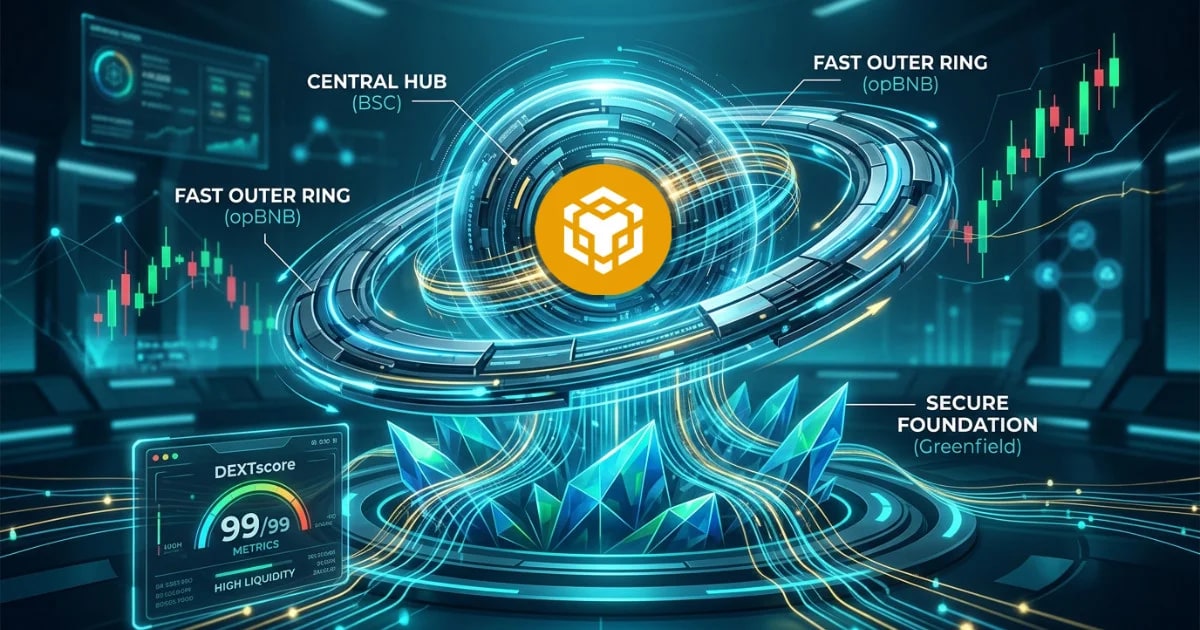
BNB Chain has evolved into a multi-chain stack. We analyze the 2026 roadmap, the opBNB rollup performance, and the role of Greenfield storage in the data economy.
The BNB Chain Ecosystem in 2026: Analyzing the Trio Architecture and its Evolution
What is BNB Chain?
- BNB Chain is a blockchain ecosystem powered by the BNB token, originally launched by Binance and now positioned as a more community-driven network, though still closely tied to its origins. It includes the BNB Smart Chain (BSC), which is EVM-compatible, and opBNB, a Layer 2 scaling solution.
- Known for its relatively low fees and fast transaction speeds, BNB Chain has become a major hub for dApps, NFTs, and DeFi, offering Ethereum-like functionality with lower costs, albeit with a more centralized validator model.
- As of May 6, 2026, the BNB Chain has transitioned from being a single high-performance blockchain into a multi-layered ecosystem defined by its "One BNB" strategy. This "Trio Architecture" -comprising the BNB Smart Chain (BSC), opBNB, and BNB Greenfield- is designed to handle various industrial needs, from high-frequency DeFi to decentralized data storage.
- Following the Lorentz and Maxwell upgrades in late 2025, the network has achieved significant technical benchmarks, including a reduction in block time to 0.45 seconds and the implementation of a dual-client strategy. However, the ecosystem continues to navigate the complex trade-offs between extreme performance and network decentralization.
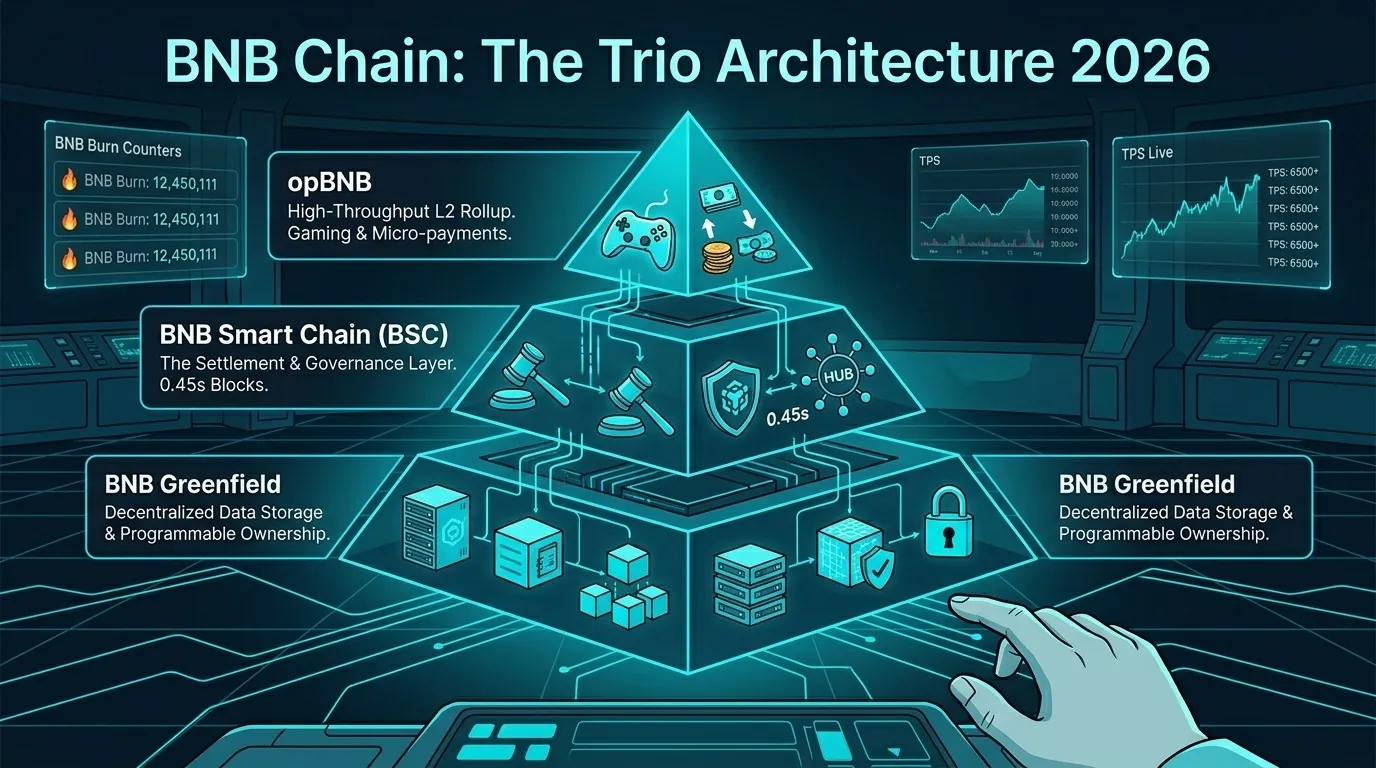
1. The Trio Architecture: Smart Chain vs. opBNB vs. Greenfield
The 2026 BNB ecosystem operates as a specialized stack, where each component serves a specific functional role:
BNB Smart Chain (BSC): The "Settlement Layer." It remains the primary hub for DeFi and governance. In 2026, it utilizes a Reth-based execution engine and "Scalable DB" to handle state growth, targeting a capacity of 20,000 TPS.
opBNB (Layer 2): The "High-Frequency Layer." Built on the OP Stack, opBNB uses optimistic rollups to offload execution from the mainnet. With a 100M block size, it is the preferred environment for gaming and micro-transactions, offering fees that are consistently lower than the already-affordable BSC.
BNB Greenfield: The "Storage Layer." This is a sovereign blockchain focused on data ownership and assetization. It allows users to manage data permissions via smart contracts on BSC, effectively turning data into a tradable financial asset.
2. BNB Tokenomics: The Path to 100 Million
As of May 2026, the BNB token remains the central utility and governance asset across all three layers. Its economic model is defined by a persistent deflationary mechanism.
Circulating Supply: Approximately 136.36 million BNB (following the 34th quarterly burn in Q1 2026).
Auto-Burn Mechanism: The network continues its objective to reduce the total supply to 100 million BNB. Quarterly burns are now calculated using a transparent formula based on price and block production rates.
Real-Time Burn (BEP-95): A portion of every transaction fee on BSC is permanently destroyed. To date, this mechanism has eliminated over 281,000 BNB, supplementing the quarterly scheduled burns.
3. Popular dApps: The Shift to AI and Web3 Gaming
The 2026 dApp landscape on BNB Chain is dominated by platforms that fuse Web3 infrastructure with Artificial Intelligence and competitive gaming.
The Landlord: A dominant Web3 real estate and management platform that currently leads the chain in monthly active users (~3.9M).
ads3.ai: A decentralized advertising protocol that utilizes AI for optimized ad delivery, reflecting the ecosystem's push into the "Agentic Economy."
PancakeSwap: The legacy DeFi giant remains a core liquidity pillar, though it has evolved into a multi-chain hub with specialized vaults for RWA (Real-World Asset) yield.
4. Technical Realities: opBNB and Greenfield Performance
The maturity of the L2 and storage layers has provided new options for developers, though each comes with specific technical considerations.
opBNB Rollup Efficiency
opBNB has proven effective for high-volume scenarios. By processing transactions off-chain and only posting batches to BSC, it maintains sub-cent fees even during peak traffic. However, as an Optimistic Rollup, it still inherits the standard 7-day challenge period for native withdrawals, a friction point for users requiring instant liquidity back to the mainnet.
Greenfield Storage Adoption
BNB Greenfield is increasingly used for DataDAOs and AI model training datasets. Its primary advantage is "Programmable Ownership": the ability to use BSC smart contracts to grant or revoke access to files stored on Greenfield. The challenge remains the competition from centralized providers (AWS) and other decentralized peers like Filecoin, as Greenfield requires a more complex interaction with Storage Providers (SPs).
5. Main Features: Pros and Cons
| Feature | Pros (The Upside) | Cons (The Risks) |
| Performance | 0.45s block times and 20k TPS target. | High hardware requirements for full node operators. |
| Costs | Some of the lowest fees in the L1/L2 landscape. | Lower fees can lead to "spam" transactions and state bloat. |
| Ecosystem | Deep liquidity and massive user base. | Perceived as more centralized compared to Ethereum. |
| Utility | BNB is used for gas, storage, and governance. | Ecosystem depends heavily on the continued growth of Binance-related services. |
Verification and Security via DEXTools
In the 2026 "One BNB" era, where assets move between BSC and opBNB frequently, verifying contract authenticity is vital. DEXTools is the optimal tool for analyzing the market, finding early crypto gems, and avoiding scams.
Professional traders verify:
The DEXTscore: Ensuring that new tokens have verified liquidity and no malicious "backdoors."
Cross-Chain Integrity: Verifying that tokens bridged from Greenfield or other L2s match the official contract addresses.
Liquidity Depth: Checking the Pool Explorer to ensure that high-volume gaming tokens have enough depth to handle sudden exits.
To monitor the DeFi market in an agile and secure way in real-time and trade BNB Chain assets with the help of the best crypto tools, you can access DEXTools here.
Disclaimer: This article is for informational purposes only and does not constitute investment advice, financial advice, trading advice, or any other kind of advice. DEXTools does not recommend buying, selling, or holding any cryptocurrency or token. Users should conduct their own research and consult with a qualified financial advisor before making any investment decisions. Cryptocurrency investments are volatile and high-risk. DEXTools is not responsible for any losses incurred.
https://www.dextools.io/tutorials/l1-and-l2-ecosystems-2026-solana-bnb-ethereum-and-base
https://www.dextools.io/news/xstocks-on-bnb-chain-the-reality-of-245-trading
Related Guides
- What Is NodeReal: BNB Chain Infrastructure, RPC and Data APIs (2026)
- How to Use BscScan: Track BNB Chain Transactions, Tokens and Contracts (2026)
- Best Telegram Bots for BNB Chain in 2026: Top 5 Compared
- L1 and L2 Ecosystems 2026: Solana, BNB, Ethereum, and Base.
- DEX Volume Race 2026: Solana, Ethereum, BNB, and Base
Frequently Asked Questions
What is the difference between BSC and opBNB?
BSC is the main Layer 1 where most DeFi and governance happen. opBNB is a Layer 2 scaling solution built on the OP Stack, designed for even lower fees and higher speed, ideal for games and small daily payments.
How does BNB Greenfield handle data differently from Google Drive?
Greenfield is decentralized; no single entity controls your files. It allows you to use smart contracts on BSC to sell, share, or monetize your data as if it were an NFT or a financial asset.
Is the BNB burn mechanism still active in 2026?
Yes. The "Auto-Burn" continues quarterly until the total supply reaches 100 million BNB. Additionally, a real-time burn (BEP-95) destroys a portion of the gas fees from every transaction on the network.
Can I use the same address for BSC, opBNB, and Greenfield?
Yes. The BNB Chain ecosystem is designed for "One BNB" compatibility. You can use the same EVM-compatible address and wallet (like Trust Wallet or MetaMask) across all three layers.
Is BNB Chain decentralized?
While BNB Chain has significantly expanded its validator set to improve decentralization, it remains more centralized than networks like Ethereum. Its design prioritizes high performance and low costs, which requires a more managed validator model.