What Is an Atomic Swap? Cross-Chain Trading Guide 2026
— By Tony Rabbit in Tutorials
What is an atomic swap and how does cross-chain trading work without intermediaries? A 2026 guide to how atomic swaps work and their pros and cons.
Top results for what is an atomic swap focus on direct cross-chain exchange, HTLC mechanics, and the trade-offs versus centralized intermediaries. This guide now targets that exact explanatory intent.
For most of crypto's history, swapping a coin from one blockchain for a coin on another has been a surprisingly hard problem. Bitcoin lives on Bitcoin. Ether lives on Ethereum. Litecoin lives on Litecoin. They do not speak the same language, share the same ledger, or trust the same validators. If you wanted to trade BTC for ETH in 2014, your only realistic option was to send your coins to a centralized exchange, let them custody your funds, hope they did not get hacked, and then withdraw the new asset back to your own wallet. Every step required trust in a third party that could fail, freeze, or steal.
An atomic swap is a cryptographic protocol that fixes exactly that problem. Two people on two different blockchains can exchange their coins directly, peer to peer, without ever handing custody to an exchange, a bridge, or a custodian. The trade either happens completely or it does not happen at all. If one side tries to cheat, the protocol mathematically returns both parties' funds. There is no escrow agent, no signature aggregator, no wrapped token, and no off-chain promise. Just two locked transactions joined by a shared secret.
This guide explains what an atomic swap is in plain language, how the underlying cryptography works, the exact 4-step interactive protocol used in production, how atomic swaps compare to centralized exchanges, cross-chain bridges, and wrapped tokens, the historical implementations that shaped the technology (Decred, Komodo, Liquality, COMIT), and where atomic swaps fit into the 2026 crypto stack. By the end you will understand why atomic swaps are still considered the gold standard for trustless cross-chain trading, even as bridges and intent-based DEXs have stolen most of the spotlight.
What Is an Atomic Swap?
An atomic swap is a smart-contract-based protocol that lets two parties exchange cryptocurrencies running on two independent blockchains, in such a way that either both transfers complete or neither does. The word "atomic" comes from computer science and means indivisible: the operation cannot be partially executed. You either get the asset you were promised or you get a full refund of the asset you put up. There is no in-between state where one side has paid and the other has not.
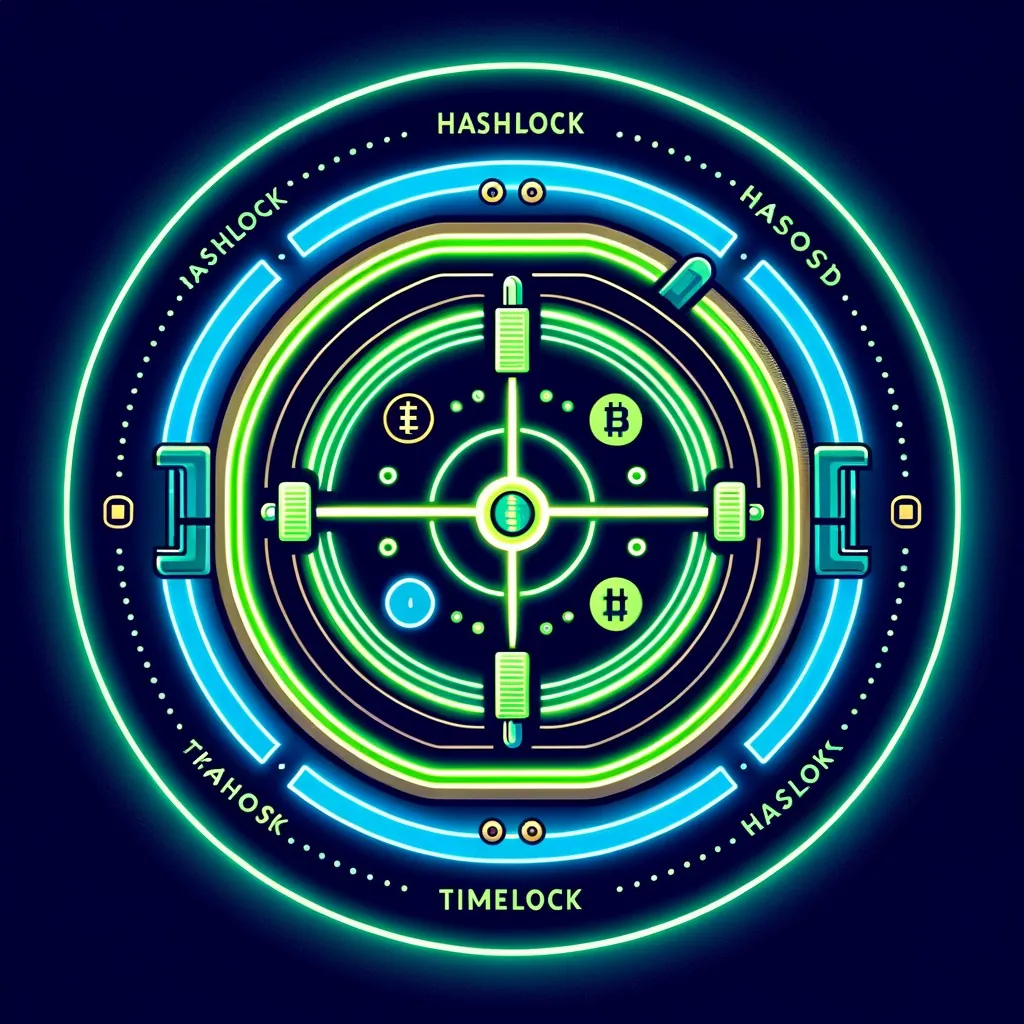
The mechanism that makes this possible is a small, clever cryptographic primitive called a Hashed Time-Locked Contract, almost always abbreviated as HTLC. Each party locks their funds in an HTLC on their own chain. The HTLC has two unlock conditions. The first condition (the hashlock) says: "Whoever can reveal a secret that hashes to this value gets the funds." The second condition (the timelock) says: "If nobody reveals the secret before time T, the original owner can take the funds back." Because the same secret is used on both chains, the moment one party reveals the secret to claim their side of the trade, the other party can see that secret on-chain and use it to claim their side. The trade settles atomically, even though it spans two separate ledgers.
An easy analogy: imagine two safety deposit boxes in two different banks. Alice's box in Bank A contains 1 BTC. Bob's box in Bank B contains 30 ETH. Each box has a clever lock: it opens if you whisper the magic word, but if nobody whispers the magic word within 24 hours, the original owner gets their stuff back. Alice picks a secret word and tells nobody. She locks her BTC in Box A with a lock that opens for that word. She tells Bob only the hash of the word. Bob, seeing Alice committed first, locks his ETH in Box B with a lock that opens for the same hash. Alice walks up to Box B, whispers the word, and takes the 30 ETH. The moment she does, the word is public. Bob walks up to Box A, whispers the same word, and takes the 1 BTC. Trade complete. Neither bank had to know about the other. Neither bank could steal anything. And if Alice had cold feet and never whispered, both boxes would unlock automatically and return the original contents.
That is an atomic swap. The "banks" are two independent blockchains. The "boxes" are HTLCs. The "magic word" is a cryptographic preimage. And the "clever locks" are scripts written in Bitcoin Script, Solidity, or whatever scripting language the host chain supports.
How Atomic Swaps Work Technically
To actually implement an atomic swap, you need two things on each blockchain: a way to lock funds against a cryptographic hash, and a way to enforce a refund after a deadline. Bitcoin gets both from its scripting language: OP_SHA256 for the hashlock and OP_CHECKLOCKTIMEVERIFY (CLTV) or OP_CHECKSEQUENCEVERIFY (CSV) for the timelock. Ethereum gets both through a Solidity contract that stores a hash and a deadline timestamp. Litecoin, Bitcoin Cash, Dogecoin, Zcash, Decred, and other UTXO chains inherit the Bitcoin Script approach. Any chain that can express "release funds if you reveal preimage X before time T, else refund sender" can participate.
The cryptographic primitive at the heart of everything is a one-way hash function, almost always SHA-256. Alice picks a random 32-byte secret s, which is called the preimage. She computes h = SHA256(s), which is the hashlock. Anyone can verify that a candidate preimage matches the hashlock by hashing it themselves. But nobody can derive the preimage from the hash, because SHA-256 is computationally one-way. This asymmetry is what allows Alice to commit publicly to a value without revealing it, then reveal it later in a way that everyone on both chains can independently verify.
The timelock is the second leg of the contract and it is what prevents funds from being stuck forever if the counterparty disappears. Crucially, the two timelocks in an atomic swap are not equal. Alice's lock (on her own coin) has a longer timeout than Bob's lock. If Alice locked BTC with a 48-hour refund and Bob locked ETH with a 24-hour refund, Alice always has time to react: she sees Bob lock his ETH, claims it by revealing the secret, and Bob then has the remaining window to use that secret on the BTC contract. The asymmetric timelocks are essential. If both timeouts were identical, a malicious party could wait until the last second, claim, and leave the other party without enough time to react. This pattern (longer lock for the initiator, shorter lock for the responder) is sometimes called the "T1 > T2" rule and it is what closes the only real footgun in the protocol.
One more subtlety worth understanding: atomic swaps are an interactive protocol. They are not "set it and forget it" the way an AMM swap on Uniswap is. Both parties need to be online (or have an agent representing them) for the duration of the swap. If Alice locks her BTC and then her laptop dies before she claims Bob's ETH, the timelock will trigger and both parties will get refunds, but the swap fails. This is one of the major UX limitations and a big part of why atomic swaps lost mindshare to bridges in the 2021-2024 era.
The 4-Step Atomic Swap Process
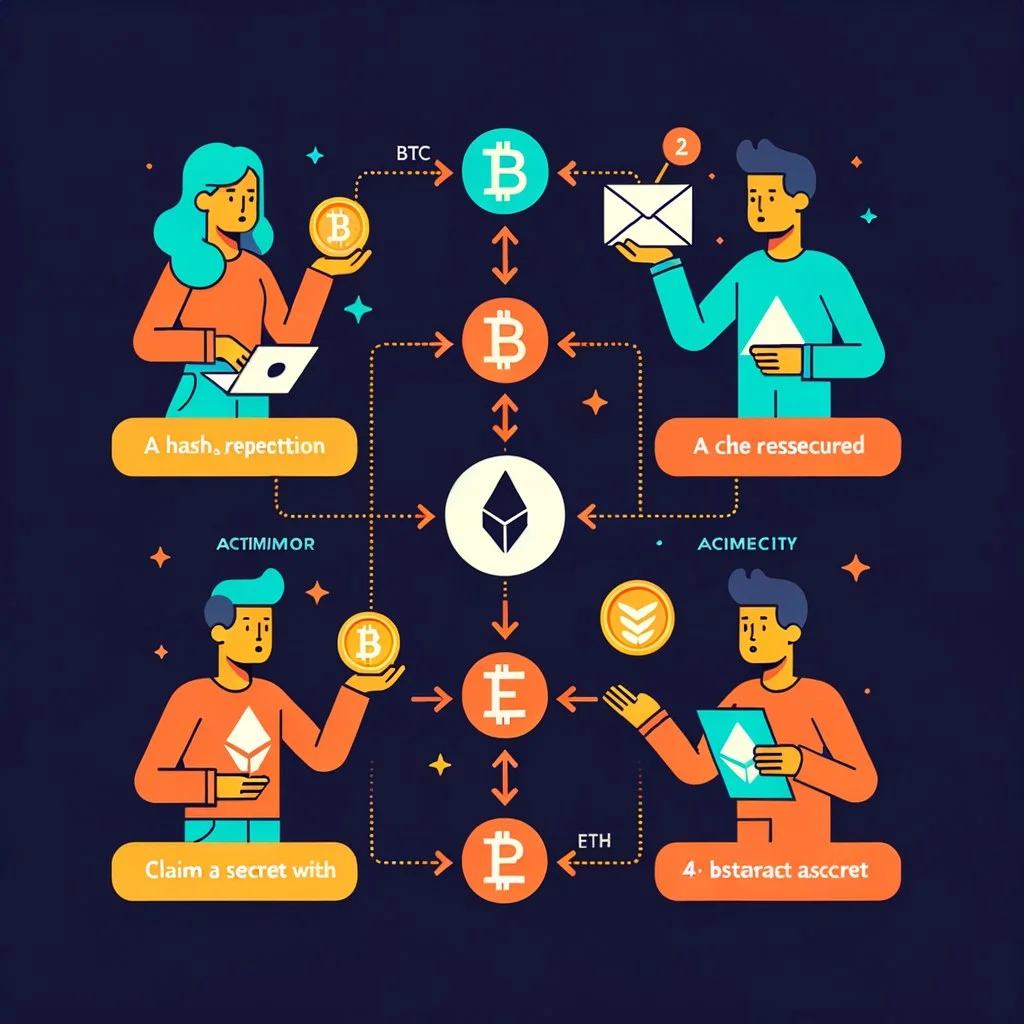
Let us walk through a complete atomic swap between Alice (who has 1 BTC and wants 30 ETH) and Bob (who has 30 ETH and wants 1 BTC). They have already agreed on the exchange rate off-chain. Now they execute the four-step on-chain protocol.
Step 1: Alice locks her BTC. Alice generates a random 32-byte secret s, computes h = SHA256(s), and broadcasts a Bitcoin transaction that locks 1 BTC into a script with two spending paths. Path A: Bob can spend it if he provides the preimage s and his signature. Path B: Alice can spend it after 48 hours have passed (enforced by OP_CHECKLOCKTIMEVERIFY). She shares the hash h and the transaction ID with Bob, but keeps s private.
Step 2: Bob locks his ETH. Bob verifies that Alice's BTC really is locked on the Bitcoin blockchain and that the script uses the hash h she shared. Satisfied, he sends 30 ETH to a Solidity HTLC contract on Ethereum with two spending paths. Path A: Alice can withdraw if she provides preimage s such that SHA256(s) == h. Path B: Bob can refund after 24 hours. Note the shorter timeout: Bob's lock expires before Alice's. This is the asymmetry that protects both sides.
Step 3: Alice reveals the secret and claims the ETH. Alice now sees Bob's ETH locked. She submits a transaction to Bob's Ethereum HTLC, including s as part of the calldata. The contract verifies SHA256(s) == h and releases the 30 ETH to Alice's address. The moment that transaction is included in an Ethereum block, the preimage s is forever public. Anyone watching the Ethereum chain can extract it.
Step 4: Bob uses the revealed secret to claim the BTC. Bob (or any bot running on his behalf) is monitoring the Ethereum contract. He sees Alice's claim, extracts the preimage s from her transaction's calldata, and submits a Bitcoin transaction that spends Alice's BTC HTLC by revealing the same s. The Bitcoin script checks OP_SHA256(s) == h, returns true, and pays the 1 BTC to Bob. The trade is complete. Alice has 30 ETH on Ethereum. Bob has 1 BTC on Bitcoin. No third party touched any funds.
If Bob disappears after step 1, Alice waits 48 hours and reclaims her BTC. If Alice disappears between steps 2 and 3, Bob waits 24 hours and reclaims his ETH; then Alice waits an additional 24 hours and reclaims her BTC. The two-tier timelock ensures Bob's refund window opens first, so he is never left waiting for Alice's refund to expire before he can act on his own.
The timelock asymmetry is not optional. If both HTLCs had identical deadlines, an attacker could wait until just before expiry, claim one side, and broadcast the claim too late for the counterparty to react on the other chain. The initiator's timeout must always be substantially longer than the responder's timeout (typically 2x). If you ever see an atomic swap implementation with equal timeouts, do not use it. Also: never start a swap if you cannot stay online (or run a watchtower) for at least the full duration of your timelock. A dead laptop during the protocol does not lose your funds, but it does waste your time and the on-chain fees you already paid.
Atomic Swap vs Centralized Exchange vs Bridge vs Wrapped Tokens
Atomic swaps are one of four common ways to move value between blockchains in 2026. Each makes different trade-offs between trust, speed, cost, and supported assets. Understanding the differences is the easiest way to see what atomic swaps actually offer.
Peer-to-peer, no custody, fully trustless. Settles via HTLC on both chains. Requires both parties online and a matching counterparty.
You deposit into the exchange's hot wallet, trade on their order book, withdraw to the new chain. They custody your funds end to end.
Lock asset on chain A, a multi-sig or light-client validator set mints a representation on chain B. Speed but introduces a new trust set.
A custodian (BitGo for WBTC) or a smart contract holds the native asset and issues an ERC-20 IOU. You trade the IOU, redeem 1:1 later.
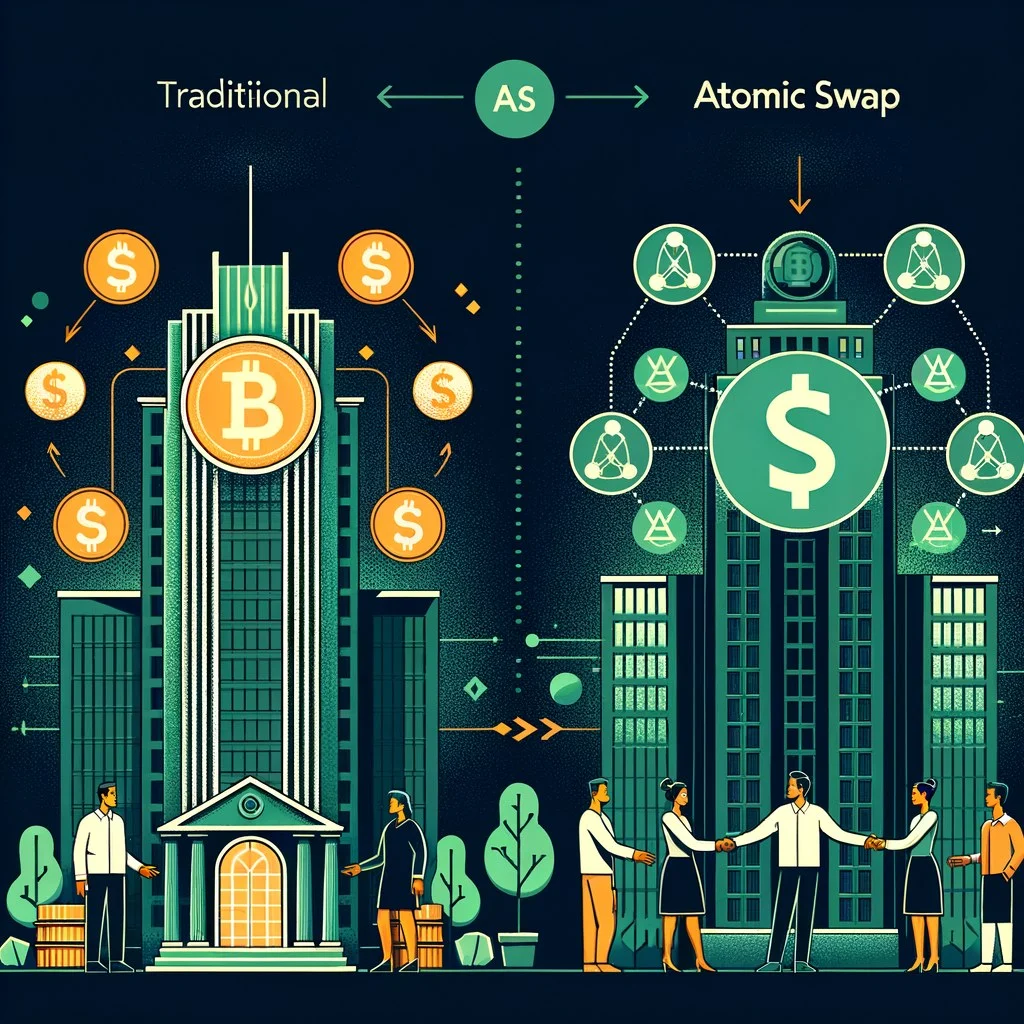
The honest summary is this: atomic swaps win on trust and lose on UX. Every other option introduces some kind of third party (the exchange, the bridge validators, the wrapping custodian) that can be hacked, frozen, sanctioned, or rugged. Atomic swaps remove that entity entirely. The cost is that you need to find a counterparty willing to take the other side of your trade, you both need to stay online, and the protocol is interactive rather than fire-and-forget. If you read about a bridged token losing peg or a bridge contract getting drained for $200M, the failure mode you are looking at is the trust assumption that atomic swaps were designed to avoid.
Famous Atomic Swap Implementations
Atomic swaps are not a theoretical idea. They have been running in production for nearly a decade. Several teams have built mainnet implementations, each with its own design choices and lessons learned. The history is worth knowing because most of the patterns used by modern cross-chain protocols trace directly back to these projects.
Tier Nolan's 2013 proposal is the original. Tier Nolan, an early Bitcoin developer, described the HTLC-based cross-chain swap protocol on the Bitcointalk forum in May 2013. The post laid out the asymmetric timelock structure, the hashlock, and the four-step interactive flow that every subsequent implementation has used. For years it remained a thought experiment because most altcoins lacked the script primitives needed.
Decred and the September 2017 BTC-DCR swap was the first widely publicized on-chain atomic swap between two production blockchains. The Decred team executed a swap between Bitcoin and Decred without any third party. They open-sourced the reference implementation as decred/atomicswap, supporting BTC, LTC, DCR, and Vertcoin pairs. This codebase became the template for most subsequent UTXO-to-UTXO swaps.
Komodo BarterDEX, launched in 2017 and later evolved into AtomicDEX (now Komodo Wallet), built one of the first user-facing atomic swap interfaces. It introduced an order book where makers post offers and takers fill them, all settled via HTLC. Komodo also pioneered support for ERC-20 to UTXO swaps by abstracting the HTLC into a Solidity contract on the Ethereum side and a Bitcoin Script on the UTXO side.
Liquality, founded by ConsenSys alumni, was for several years the cleanest end-user atomic swap product. Their browser extension wallet supported BTC, ETH, RBTC, and several ERC-20s, with an embedded order book and one-click swaps. Liquality's UX work showed that atomic swaps did not have to feel like a research demo. The project wound down in 2023 but their open-source SDK is still studied by developers building modern cross-chain protocols.
COMIT (Cryptographically Secure Off-Chain Multi-Asset Instant Transaction) is a protocol developed by CoBloX that generalizes atomic swaps into a network of routed payments. Rather than every swap requiring a direct counterparty, COMIT lets liquidity providers route trades across multiple chains, similar to how the Lightning Network routes Bitcoin payments. The project demonstrated atomic swaps between BTC and ETH, and later between BTC and Monero (via adaptor signatures, since Monero cannot express hashlocks directly).
Bitcoin-Litecoin Lightning submarine swaps, deployed by Lightning Labs and Boltz in 2018-2019, applied atomic swap mechanics to layer-2 channels. A submarine swap exchanges on-chain BTC for off-chain Lightning BTC (or vice versa), or even on-chain LTC for off-chain BTC. The same HTLC primitive used in cross-chain atomic swaps is used inside the Lightning Network to route every payment, which means in a sense every Lightning payment is an atomic swap.
Use Cases for Atomic Swaps
The pure use case is moving value between blockchains without trusting anyone. But that high-level pitch breaks down into several concrete reasons why someone would choose an atomic swap over a faster, easier alternative.
Cross-chain trading without custody risk. If you remember Mt. Gox, FTX, or QuadrigaCX, you know what custody risk looks like. Centralized exchanges have a roughly 100% historical rate of either getting hacked, going bankrupt, or running off with customer funds, on a long enough time horizon. Atomic swaps are the only cross-chain method where your coins never leave your wallet's signing authority. There is nothing to seize, freeze, or rehypothecate.
Censorship resistance. Centralized exchanges enforce KYC, sanctions screening, and geographic restrictions. Bridges, in practice, can also be censored at the validator level. Atomic swaps run entirely between two self-custodied wallets following a public protocol. There is no operator to subpoena, no sequencer to pressure, and no front-end domain to seize. As long as you can broadcast a transaction to each chain's mempool, you can complete the swap.
Privacy. Atomic swaps do not directly improve transaction privacy (both legs are still visible on their respective blockchains), but they avoid the deanonymizing chokepoint of a KYC exchange linking your two wallet addresses. If you swap BTC for XMR via an atomic swap, the exchange's compliance team never learns that the BTC address and the XMR address belong to the same person. Combined with techniques like CoinJoin on the Bitcoin side, atomic swaps materially improve practical privacy.
MEV protection. When you trade on an AMM, your transaction sits in the mempool where it can be front-run or sandwiched. MEV bots routinely extract value from large DEX swaps. Atomic swaps are negotiated bilaterally off-chain (the rate is agreed before the HTLCs are posted), so there is no public quote for a bot to front-run. The on-chain HTLC posts do not reveal a tradeable opportunity. This is a meaningful reason why some OTC desks still settle large cross-chain trades via atomic swap rather than via DEX or bridge.
Trading exotic pairs. Many pairs simply do not exist on centralized exchanges or have terrible liquidity. BTC-DCR, BTC-XMR, LTC-RVN, and similar pairs are often easier to execute via atomic swap than to route through ETH or USDT on a CEX, accumulating slippage and fees at each hop.
How to Perform an Atomic Swap in Practice
If you actually want to do an atomic swap today, the realistic options are narrower than the hype suggests. Most of the consumer-friendly atomic swap apps that existed in 2019-2022 have shut down or pivoted. The ones that remain require some technical comfort. Here is what the workflow looks like in 2026.
Pick a tool. Komodo Wallet (formerly AtomicDEX) is the most active maintained product, with mobile and desktop apps and a built-in order book covering BTC, LTC, KMD, DOGE, ETH, BNB, and many ERC-20 and BEP-20 tokens. For pure BTC-LTC or BTC-DOGE swaps you can also use the original decred/atomicswap command-line tool, which forces you to coordinate with a counterparty manually. For BTC-XMR specifically, the COMIT team's xmr-btc-swap tool is the standard. For BTC to Lightning, Boltz remains the cleanest submarine swap interface.
Check supported pairs. Atomic swaps require both chains to express HTLCs. UTXO chains with Bitcoin-derived scripting (BTC, LTC, BCH, DOGE, ZEC, DASH, DCR) all work. Account-based chains with general smart contracts (ETH, BNB Chain, Polygon, Arbitrum, Avalanche) all work. Chains with limited or non-existent scripting (like older Solana versions before SPL upgrades, or like Monero which uses ring signatures and cannot express hashlocks natively) require workarounds like adaptor signatures. If a pair is not listed in your tool of choice, the limitation is almost always one chain's scripting expressiveness rather than the swap protocol itself.
Understand fees. An atomic swap incurs at least four on-chain transactions: Alice's lock, Bob's lock, Alice's claim, Bob's claim. If something goes wrong, refunds add more. Each transaction pays its own native gas/fee on its own chain. For a BTC-ETH swap in 2026 you should budget roughly 4 to 12 USD in total fees depending on Ethereum gas conditions, plus the order-book maker's spread (typically 0.2-1%). For BTC-LTC the total fee load can be under 1 USD because both chains have low fees.
Plan for settlement time. Atomic swaps are slow by modern crypto standards. You need confirmations on both chains before each step can safely proceed. A typical BTC-ETH swap takes 30 to 90 minutes to fully settle (driven mostly by Bitcoin's 10-minute block time and the need for 2-6 confirmations on each lock). BTC-LTC can complete in 15-30 minutes. Compare that to a modern bridge at 1-5 minutes or a CEX at near-instant, and the UX trade-off is obvious.
Stay online. Do not start the protocol if you cannot remain online (or run a server agent) until both claims settle. If your wallet disconnects after step 1, you can still reclaim via the timelock, but the swap fails and you waste the lock-transaction fee. Most modern atomic swap tools handle the watcher process automatically as long as the app stays open.
Limitations and Risks
Atomic swaps are mathematically beautiful but operationally clunky. Anyone considering them should be honest about the friction. The short list of real limitations is well known to anyone who has tried to build a swap product around them.
Liquidity. An atomic swap requires a counterparty willing to take the other side at your price. Unlike an AMM, which has pooled liquidity available 24/7, atomic swap order books are thin. For major pairs like BTC-LTC or BTC-ETH on Komodo Wallet you will usually find liquidity for retail-sized trades, but the spread is wider than a CEX and large orders can take hours to fill. Exotic pairs may have no liquidity at all.
Online requirement. Both parties (or their watchtower agents) must remain online to react to the counterparty's actions within the timelock window. This is incompatible with the "set and forget" UX that DeFi users have come to expect from AMMs and order book DEXs. It is also incompatible with mobile-only users on flaky networks.
Timelock failures. If a chain experiences congestion (think Bitcoin during a fee spike), a refund or claim transaction may not confirm before the timelock window expires on the other chain. The protocol is still safe (you cannot lose funds, only have them temporarily locked), but the swap can land in a complicated state requiring patience and the right RBF settings. Setting timeouts generously avoids this in normal conditions.
Supported chain limitations. Chains without scripting flexibility need workarounds. Monero atomic swaps require adaptor signatures, which are sophisticated and harder to audit. Some chains (newer high-performance L1s with restricted VM models) simply cannot participate in classical HTLC swaps at all. This means the universe of pairs you can swap atomically is smaller than the universe of pairs available on bridges or CEXs.
UX complexity. Even with the best wallet UI, atomic swaps expose users to concepts (HTLC, hashlock, timelock, preimage, refund) that most users do not understand and should not have to. If something goes wrong mid-swap, the error states are difficult to explain in plain language. This UX cliff is the single biggest reason atomic swaps lost the cross-chain trading market to bridges between 2020 and 2024.
Free option problem. A subtle attack vector worth knowing: between step 1 and step 2, Alice has effectively given Bob a free option to back out if the market moves against him. If BTC pumps 5% in the hour between Alice's lock and Bob's lock decision, Bob can refuse to lock and Alice gets her BTC back, having locked her funds for nothing while Bob got a free look at the market. Practical implementations mitigate this with short pre-commitment windows, fee deposits, and reputation systems on the order book.
Atomic Swaps vs Lightning Network Submarine Swaps
One of the more confusing topics is the relationship between classical atomic swaps and the Lightning Network's submarine swaps. They share the same cryptographic primitive (HTLC), so they often get conflated, but they solve different problems.
A classical atomic swap exchanges value between two different on-chain currencies (BTC for ETH, LTC for BTC, etc.). Both legs settle on layer 1. The protocol takes minutes to hours depending on block times.
A submarine swap exchanges value between an on-chain transaction and an off-chain Lightning payment. For example, you have BTC sitting in a Lightning channel and want to send it to someone who only accepts on-chain BTC. A submarine swap operator (like Boltz) accepts your Lightning payment and pays out on-chain BTC to your counterparty, secured by HTLCs that guarantee atomicity. The "submarine" name comes from the fact that the trade goes under the layer between L2 and L1 atomically.
Lightning itself uses HTLCs internally to route every multi-hop payment. When Alice pays Bob through three intermediate nodes, each hop is an HTLC chained to the next via a shared preimage. So in a real sense, every Lightning payment is a multi-hop atomic swap of in-channel balances. The same math powers all of it.
Cross-chain Lightning swaps extend the idea further: a Lightning channel on Bitcoin and a Lightning channel on Litecoin can be linked via a shared HTLC so a single off-chain payment moves value between the two networks. This is the model some atomic swap products use to settle in seconds rather than minutes.
The Future of Atomic Swaps in 2026 and Beyond
Atomic swaps have been declared dead more than once. After Liquality wound down and most consumer-facing atomic swap products lost mindshare to bridges and aggregators, the conventional take in 2023-2024 was that atomic swaps were a beautiful but obsolete primitive. That take is starting to look premature.
Three trends are pulling atomic swaps back into relevance. First, the wave of bridge exploits from 2022-2025 (Ronin, Wormhole, Nomad, Multichain, and several smaller ones, with combined losses well over 2.5 billion dollars) reminded everyone that trusted bridges are a systemic single point of failure. As more capital moves cross-chain, the demand for genuinely trustless cross-chain settlement has reasserted itself. Atomic swaps remain the only cross-chain primitive that survives a malicious validator set.
Second, intent-based and solver-based DEX architectures (CoW Swap, UniswapX, Across, Connext xCall) are converging on a design where users sign an intent and competing solvers fulfill it across chains. The settlement layer of these systems increasingly uses HTLC-style atomic commitments under the hood, even when the user-facing UX hides this completely. In other words, atomic swaps are alive and well, but they have become infrastructure rather than a consumer product.
Third, the rise of cross-chain DEXs and same-chain settlement layers on rollups makes the latency problem less painful. When both legs of a swap can settle in seconds on L2s, the historical UX penalty shrinks dramatically. Some teams are building atomic swap protocols that batch many trades into a single coordination, amortizing the on-chain footprint and making the experience feel close to a normal DEX swap.
For 2026 the prediction is straightforward: the average crypto user will not "do an atomic swap" the way they would in 2018, but the average cross-chain trade they execute will increasingly be settled by an atomic-swap-like primitive running invisibly in the background. The cryptography is too good to abandon. The UX was the only real problem, and intent-based architectures are solving it.
Frequently Asked Questions
What is an atomic swap in simple terms?
An atomic swap is a way for two people on two different blockchains to exchange their cryptocurrencies directly, with no exchange or intermediary in the middle. The trade either fully completes or both parties get their original coins back. It is "atomic" because it cannot be partially executed: there is no state where one side has paid and the other has not. The mechanism is a Hashed Time-Locked Contract on each chain, linked by a shared cryptographic secret.
Are atomic swaps safer than using a centralized exchange?
From a custody perspective, yes. Your coins never leave your wallet's signing authority during an atomic swap, so an exchange hack, bankruptcy, or freeze cannot affect you. The protocol is mathematically trustless. The trade-offs are slower settlement (typically 30-90 minutes for BTC-ETH), narrower liquidity, and a more complex UX. If your priority is eliminating counterparty risk, atomic swaps are the safest cross-chain trading method available.
Can I do an atomic swap between Bitcoin and Ethereum?
Yes. BTC-ETH is one of the most well-supported atomic swap pairs because both chains can express HTLCs (Bitcoin via OP_SHA256 and OP_CHECKLOCKTIMEVERIFY, Ethereum via a Solidity contract). Tools like Komodo Wallet support BTC-ETH swaps directly. Expect the full swap to take roughly 30-90 minutes due to Bitcoin's block time and the need for confirmations on each leg.
What happens if my counterparty disappears mid-swap?
You get your original coins back. The timelock in your HTLC means that if nobody claims your locked funds with the secret before the deadline, you can broadcast a refund transaction and recover them. The asymmetric timelock design (your timeout is longer than your counterparty's) guarantees you always have time to react and reclaim. You lose only the on-chain transaction fees you already paid to lock and unlock, not the principal.
Why are atomic swaps not more popular?
UX and liquidity. Atomic swaps require both parties to stay online, take 30-90 minutes to settle, and have thinner order books than centralized exchanges or bridges. Most users prefer the near-instant convenience of a CEX or bridge even when it means accepting some counterparty risk. That said, atomic-swap-like primitives are increasingly being used invisibly inside intent-based cross-chain DEXs, so the technology is regaining relevance as infrastructure even though it lost the direct-to-consumer battle.
Is an atomic swap the same as a bridge?
No. A bridge typically locks your asset on chain A and issues a representation on chain B, secured by a validator set, a multi-sig, or a light client. You trust that validator set not to mint fraudulently. An atomic swap exchanges two native assets directly, with no representation issued, secured only by cryptography. Bridges are faster and easier; atomic swaps are trustless. They solve overlapping problems with very different security models.
Conclusion
Atomic swaps solve the original cross-chain problem with the cleanest possible cryptography. Two people, two blockchains, one shared secret, and a guarantee that the trade either completes fully or refunds completely. No exchange, no bridge validators, no wrapped-token custodian, no third party of any kind. The Hashed Time-Locked Contract that powers them has been running in production since 2017 and continues to secure billions of dollars of value, both in standalone swap products and as infrastructure inside Lightning Network and modern intent-based DEXs.
The reasons atomic swaps did not become the dominant cross-chain trading method are not cryptographic. They are operational: interactive protocols are harder than fire-and-forget ones, both parties need to stay online, liquidity is thinner than on centralized order books, and the UX exposes concepts most users do not want to learn. Bridges and CEXs won the user-facing battle precisely because they sacrificed trustlessness for convenience.
But after several years of bridge exploits and exchange collapses, the value of the trustlessness atomic swaps offer has only gone up. As intent-based architectures absorb HTLC-style settlement under the hood, the average cross-chain trade in 2026 increasingly runs on atomic-swap math even when the user never sees it. The technology was never really obsolete. It was just waiting for the ecosystem to admit that trusting bridges and exchanges, at scale, eventually breaks. If you understand the four-step protocol covered in this guide, you understand the most resilient cross-chain primitive crypto has ever produced, and you can recognize it the next time you see it operating behind a sleek UI in a wallet or DEX you already use.
Related Guides
- Ethereum vs Solana for Cross-Chain Swaps in 2026
- How to Use AnySwap: Step-by-Step Cross-Chain Swap (2026)
- How to Use Raydium on Solana: Swaps, Liquidity Pools and CLMM Guide (2026)
- How to Use Curve Finance: Stablecoin Swaps, Pools and Slippage Guide (2026)
- How to Use 1inch for Swaps: Classic, Fusion and Limit Orders (2026)
- What Is a Death Cross in Crypto Trading? Guide 2026