What Is Account Abstraction: ERC-4337 Explained Simply (2026)
— By Tony Rabbit in Tutorials
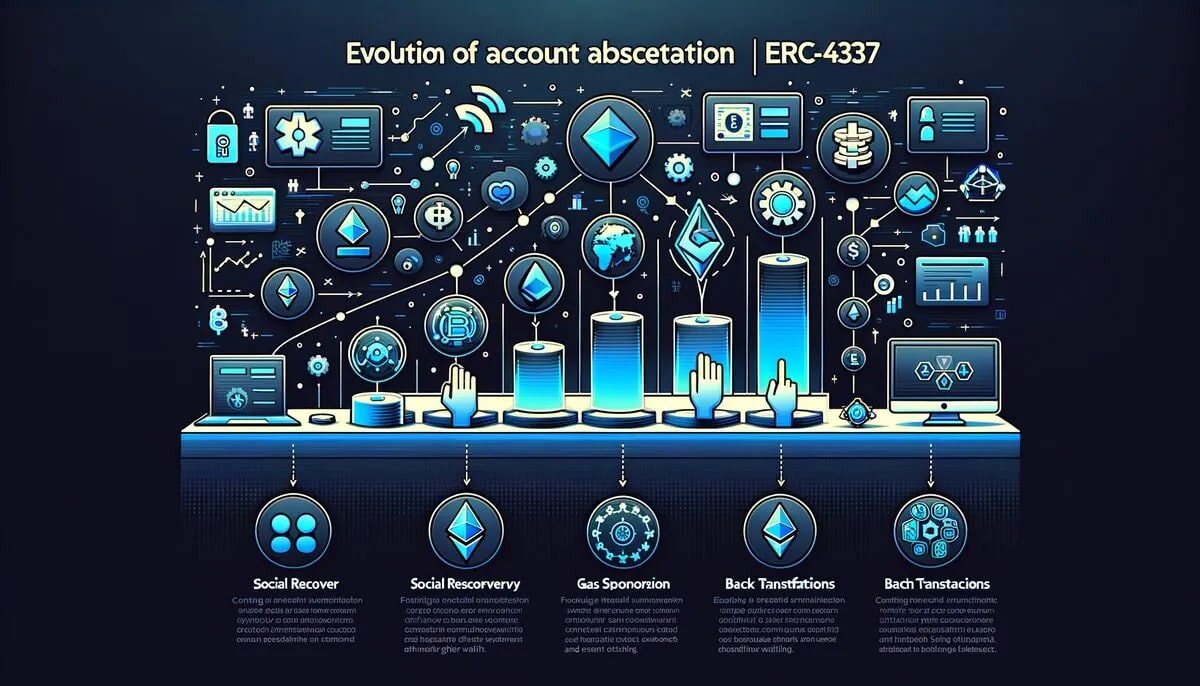
What is account abstraction? Learn how ERC-4337 replaces traditional wallets with smart accounts, enabling gas sponsorship, social recovery, and batched transactions. Complete 2026 guide.
If you have ever lost access to a crypto wallet because you misplaced your seed phrase, or paid a gas fee just to approve a token before you could actually swap it, you have experienced the limitations of how Ethereum wallets work today. Account abstraction is the upgrade that fixes these problems, and ERC-4337 is the standard that makes it possible without changing Ethereum itself.
Account abstraction is one of the most important developments in the Ethereum ecosystem heading into 2026. It fundamentally changes how users interact with the blockchain by replacing rigid, key-dependent wallets with programmable smart accounts that can sponsor gas, recover from lost keys, batch multiple transactions into one, and much more. Vitalik Buterin has called it a critical step toward mainstream crypto adoption.
This guide explains everything you need to know about account abstraction and ERC-4337 in plain language. Whether you are a beginner trying to understand what smart accounts are, or an experienced user evaluating wallets like Safe, Coinbase Smart Wallet, or Biconomy, this article covers the technical mechanics, practical benefits, security considerations, and the real-world wallets putting account abstraction into production today.
What Is Account Abstraction?
Account abstraction is a concept that removes the hard-coded rules about how Ethereum accounts work and replaces them with flexible, programmable logic. In simple terms, it turns your wallet from a rigid lockbox with a single key into a customizable smart account that can enforce whatever rules you define.
To understand why this matters, you need to know how Ethereum accounts work today. Ethereum has two types of accounts:
Account abstraction blurs the line between these two account types. It allows smart contracts to act as primary accounts, meaning your wallet can be a smart contract with custom logic for authentication, transaction validation, and fund management. Instead of relying on a single private key for everything, your account can use multiple signers, biometric authentication, spending limits, session keys, and any other rule you can program.
"Account abstraction means making the account itself smart, not just the applications you interact with."
The word "abstraction" in computer science means hiding complexity behind a simpler interface. Account abstraction hides the complexity of key management and transaction signing behind a programmable layer, letting developers build wallet experiences that feel as intuitive as traditional apps while maintaining the security and self-custody benefits of blockchain.
If you are new to Ethereum and wallets, our Cryptocurrency for Beginners guide covers the fundamentals before you dive into account abstraction.
EOA vs Smart Account: Understanding the Difference
The easiest way to understand account abstraction is to compare traditional EOA wallets with the new smart accounts it enables. The differences are fundamental and affect every aspect of how you use crypto.
As the table shows, smart accounts are strictly more capable than EOAs. Every feature that an EOA has, a smart account can replicate. But smart accounts add an entire layer of programmable functionality that EOAs simply cannot support because their behavior is hardcoded into the Ethereum protocol.
The practical impact is enormous. With a smart account, a new user can start using a dApp without first buying ETH for gas. A DAO can require multi-signature approval for large transfers. A trader can set up automated strategies with spending caps. A parent can give their child a wallet with daily spending limits. These are use cases that are simply impossible with traditional EOA wallets.
The reason EOAs have persisted for so long is historical. When Ethereum launched in 2015, the simplest possible account model was chosen to get the network running. Account abstraction has been discussed since 2016, but it took years of research and multiple failed proposals (EIP-86, EIP-2938) before ERC-4337 found a way to implement it without requiring changes to Ethereum's core protocol.
How ERC-4337 Works: The Technical Architecture
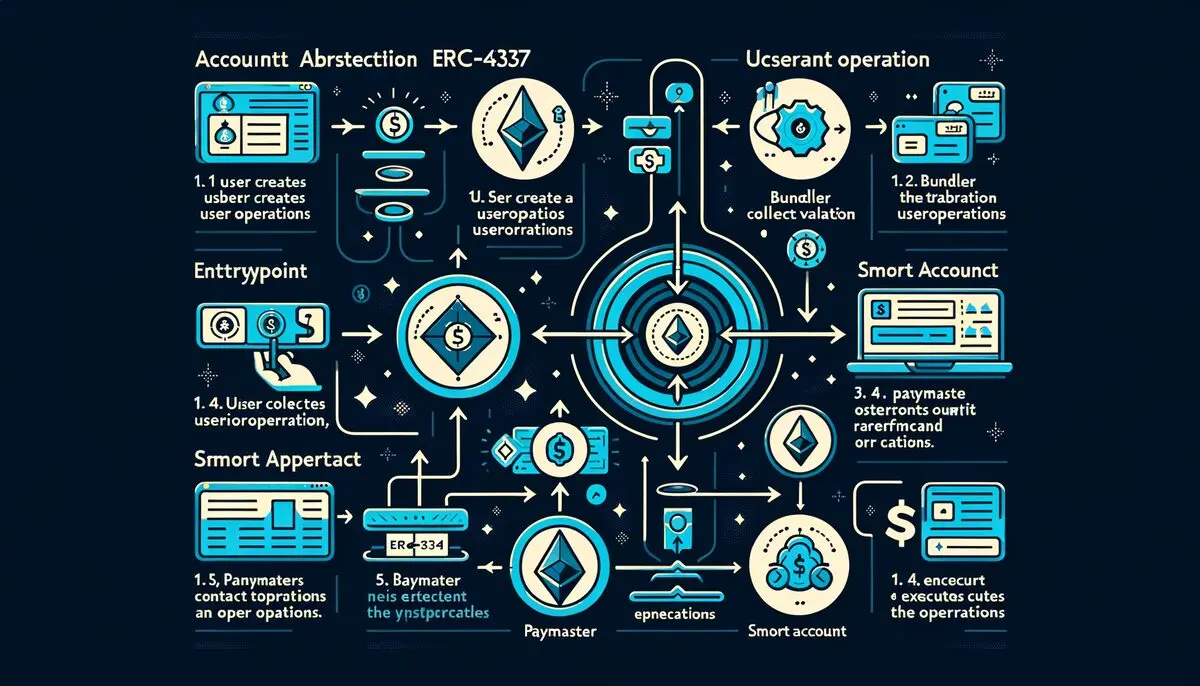
ERC-4337 is the standard that brings account abstraction to Ethereum without modifying the protocol itself. This is a critical distinction. Previous proposals required hard forks to change how the Ethereum Virtual Machine processes transactions. ERC-4337 achieves the same result using smart contracts deployed on top of the existing protocol, making it compatible with Ethereum as it exists today.
The system introduces several new components that work together. Understanding each piece is important for grasping how account abstraction functions in practice.
UserOperations (UserOps)
In the traditional Ethereum model, users sign and broadcast transactions directly to the network. With ERC-4337, users instead create UserOperations. A UserOperation is a data structure that describes what the user wants to do: which account to use, what calldata to execute, how much gas to allocate, and how to pay for it. Think of it as an "intent" rather than a raw transaction.
UserOperations are not real Ethereum transactions. They exist in a separate mempool (called the UserOperation mempool or alt mempool) and must be processed by a special entity called a Bundler before they reach the blockchain.
Bundlers
Bundlers are the bridge between UserOperations and the Ethereum blockchain. A Bundler collects multiple UserOperations from the alt mempool, packages them together into a single on-chain transaction, and submits that transaction to the EntryPoint contract. The Bundler pays the actual gas fee for the on-chain transaction and is reimbursed by the UserOperations it processes.
Bundlers are similar to block builders in the MEV supply chain. They are economic actors who compete to process UserOperations profitably. Anyone can run a Bundler, creating an open and competitive market for UserOperation processing. Major bundlers in 2026 include Pimlico, Stackup, Alchemy, and Biconomy.
EntryPoint Contract
The EntryPoint is a singleton smart contract (one canonical deployment shared by all ERC-4337 accounts) that serves as the central hub for UserOperation processing. When a Bundler submits a bundle, the EntryPoint contract validates each UserOperation, calls the target smart account to verify the signature, executes the requested operations, and handles gas payment and reimbursement.
The EntryPoint contract is audited, immutable, and shared across the entire ecosystem. Version 0.7 is the current standard as of 2026, with significant gas optimizations over the original v0.6 deployment.
Paymasters
Paymasters are one of the most powerful features of ERC-4337. A Paymaster is a smart contract that can sponsor gas fees on behalf of users. This means a dApp can pay for its users' transactions, a protocol can subsidize activity, or a user can pay gas in any ERC-20 token (like USDC) instead of ETH.
The flow works like this: a UserOperation includes a paymaster field pointing to a Paymaster contract. When the EntryPoint processes the UserOperation, it checks with the Paymaster whether it will cover the gas cost. If the Paymaster agrees, the user's transaction executes without the user spending any ETH. The Paymaster is debited instead.
Paymasters enable gasless experiences that are critical for onboarding non-crypto users. Imagine signing up for a blockchain game and being able to play immediately without buying ETH first. That is the experience Paymasters make possible.
Smart Account Contracts
The smart account itself is a smart contract that implements the IAccount interface defined by ERC-4337. At minimum, it must implement a validateUserOp function that verifies whether a given UserOperation is authorized. Beyond that, the account can implement any logic the developer wants: multi-signature requirements, spending limits, key rotation, module systems, and more.
Most smart accounts in production use a modular architecture where the core account is minimal and additional features are added through pluggable modules. This approach (standardized in ERC-6900 and ERC-7579) allows accounts to be extended without redeployment.

Benefits of Account Abstraction
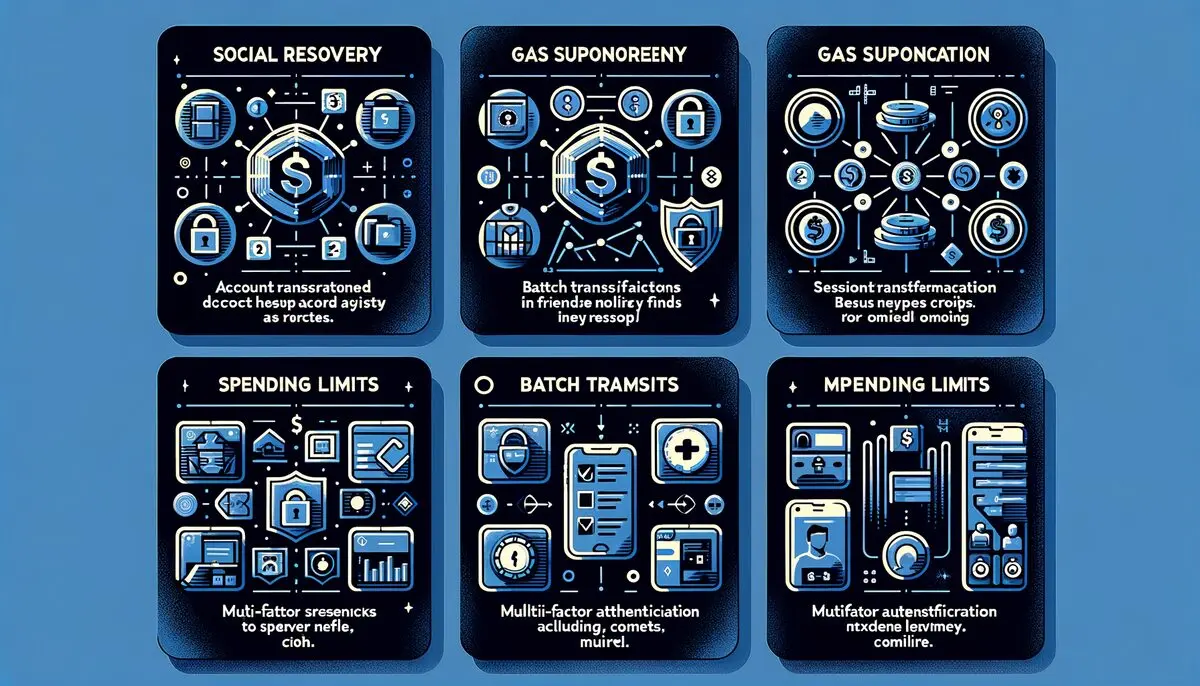
Account abstraction is not a theoretical improvement. It solves real problems that have frustrated crypto users for years. Here are the most significant benefits that smart accounts bring to the table.
Social Recovery
The number one fear in crypto is losing your seed phrase and being locked out of your funds forever. With account abstraction, this problem disappears. Smart accounts can implement social recovery, where you designate trusted guardians (friends, family members, hardware wallets, or institutional recovery services) who can help you regain access to your account if you lose your primary key.
The recovery process typically requires a threshold of guardians to approve. For example, you might set up five guardians and require three of them to confirm the recovery. This means no single guardian can steal your funds, but you have a robust safety net if you lose your own credentials. Vitalik Buterin has personally advocated for social recovery as a superior security model compared to seed phrases.
Gas Sponsorship
With traditional wallets, every single action on Ethereum requires you to hold and spend ETH for gas. This creates a terrible onboarding experience: before a new user can do anything, they need to buy ETH on an exchange, transfer it to their wallet, and hope gas prices are reasonable. Many potential users abandon the process entirely.
Account abstraction solves this through Paymasters. DApps and protocols can sponsor gas for their users, eliminating the need to hold ETH. A gaming platform can pay gas for its players. A DeFi protocol can subsidize trades for new users. An NFT marketplace can cover gas for minting. This transforms the onboarding experience from "buy ETH on Coinbase, transfer to MetaMask, approve the token, then swap" to simply "sign in and start using the app."
Batched Transactions
If you have ever swapped tokens on a DEX, you know the frustrating two-step process: first you approve the token (one transaction, one gas fee, one confirmation wait), then you execute the swap (another transaction, another gas fee, another wait). With account abstraction, you can batch both operations into a single transaction. Approve and swap happen atomically in one step.
Batching goes far beyond approve-and-swap. You can claim rewards from three different protocols, swap them to USDC, and deposit into a lending market, all in one transaction. You can revoke approvals for ten different contracts in a single action. The compound effect of batching saves time, gas, and mental overhead across every interaction with the blockchain.
Session Keys
Traditional wallets require you to manually approve every single transaction. This makes sense for high-value operations, but it creates friction for repetitive, low-value actions like in-game purchases or frequent swaps. Account abstraction introduces session keys: temporary, limited-permission keys that a dApp can use to execute pre-approved actions without prompting you for a signature each time.
A session key might say: "This dApp can spend up to 0.1 ETH on gas and interact only with this specific contract for the next 2 hours." After the session expires, the key becomes invalid. This gives dApps the flexibility to provide smooth user experiences while keeping you in control of your overall security.
Programmable Security
Smart accounts let you define custom security rules that match your specific needs. You can set daily transfer limits so that even if an attacker gains access, they can only drain a small amount before you notice. You can require multi-signature approval for transfers above a certain threshold. You can whitelist specific addresses that do not require additional confirmation. You can freeze your account instantly if you suspect compromise.
This level of customization is impossible with EOAs, where security is binary: either someone has your private key and can do everything, or they do not have it and can do nothing. Smart accounts turn security into a spectrum that you can tune to your risk tolerance.
Wallets Using Account Abstraction in 2026
Account abstraction has moved beyond theory. Several major wallets and infrastructure providers are shipping ERC-4337 smart accounts to millions of users. Here is how the leading implementations compare.
The wallet landscape for account abstraction is maturing rapidly. Safe remains the most battle-tested option, with over $100 billion in assets secured across its smart accounts. Coinbase Smart Wallet has brought account abstraction to the mainstream by allowing users to create wallets with just a fingerprint or Face ID, no seed phrase required. Biconomy and ZeroDev lead the developer tooling space, making it straightforward for app builders to integrate smart accounts.
For users choosing between these wallets, the decision depends on your priorities. If you want the most proven security with multi-sig capabilities, Safe is the standard. If you want the simplest onboarding experience, Coinbase Smart Wallet eliminates virtually all friction. If you are a developer integrating smart accounts into your application, Biconomy and ZeroDev provide the most flexible SDKs.
How to Use a Smart Account
Getting started with a smart account is significantly easier than many people expect. The entire point of account abstraction is to simplify the user experience, and modern implementations deliver on that promise. Here is a step-by-step walkthrough using two popular approaches.
Option 1: Coinbase Smart Wallet (Easiest for Beginners)
Coinbase Smart Wallet is the most beginner-friendly smart account implementation available. Setting one up takes less than a minute:
There is no seed phrase to write down, no extension to install, and no ETH to buy upfront. Your passkey (stored in your device's secure enclave) serves as your authentication method. If you set up the wallet on multiple devices, you have built-in redundancy. This is what crypto onboarding should feel like.
Option 2: Safe Smart Account (Most Flexible)
Safe provides the most feature-rich smart account experience, especially for users who want multi-signature security or advanced module configurations:
Safe accounts are ideal for treasuries, DAOs, investment clubs, or individuals who want maximum security. The modular architecture means you can add features like spending policies, recovery modules, and automated actions after initial setup.
"The best smart account is the one you do not realize is a smart account. Users should never have to think about the underlying architecture."
Account Abstraction on Different Chains
While ERC-4337 was designed for Ethereum, account abstraction is not limited to one chain. Different blockchains have adopted different approaches to making accounts programmable, and the landscape varies significantly across ecosystems.
Ethereum and L2 Rollups
Ethereum mainnet supports ERC-4337 through the deployed EntryPoint contract. However, the real action is on Layer 2 rollups where gas is cheaper and transaction throughput is higher. Base, Arbitrum, Optimism, and Polygon all support ERC-4337 natively, and most smart account deployments in 2026 happen on these L2s. The lower gas costs on L2s make features like gas sponsorship economically viable at scale.
Some L2s go further. Base has deeply integrated with Coinbase Smart Wallet and sponsors gas for many operations. zkSync Era has native account abstraction built into the protocol itself (every account is a smart account by default), going beyond ERC-4337. StarkNet also implements native account abstraction, meaning all accounts on StarkNet are smart accounts from day one.
Solana
Solana does not use the ERC-4337 standard (it is an EVM-specific proposal), but it has its own approach to account flexibility. Solana's program-derived addresses (PDAs) and the recent developments around Squads Protocol provide multi-sig and programmable account functionality. While not called "account abstraction" in the Ethereum sense, the practical outcomes are similar: programmable custody, multi-sig, and transaction automation.
Other EVM Chains
BNB Smart Chain, Avalanche, Fantom, and other EVM-compatible chains all support ERC-4337 since it is deployed as a smart contract rather than a protocol change. The availability of bundlers and paymasters varies by chain, but the core standard works identically. Biconomy supports 20+ EVM chains through their infrastructure, making cross-chain smart account deployment straightforward for developers.
The Cross-Chain Challenge
One significant challenge in 2026 is maintaining the same smart account address across multiple chains. Since smart accounts are deployed contracts, your address depends on the deployment parameters. Solutions like Safe's CREATE2 deployments and Biconomy's cross-chain modules aim to give users a consistent address everywhere, but the experience is not yet as seamless as using the same EOA private key on any EVM chain.
Security Considerations for Smart Accounts
Smart accounts introduce new security properties that are mostly positive, but also come with their own set of risks and considerations. Understanding these tradeoffs is essential for anyone adopting account abstraction.
Smart Contract Risk
The most fundamental difference is that your wallet is now a smart contract, and smart contracts can have bugs. If there is a vulnerability in your smart account's code, an attacker could potentially exploit it to drain your funds. This risk does not exist with EOAs because they have no code to exploit.
In practice, this risk is mitigated by using well-audited, battle-tested account implementations. Safe has been running since 2018 with over $100 billion secured and no critical exploits. The ERC-4337 EntryPoint contract has been audited by multiple firms. Established implementations have strong security track records. The risk is highest with new, unaudited, or custom account implementations.
Upgradeability Risks
Many smart accounts support upgradeable logic through proxy patterns. This is a double-edged sword. Upgradeability means you can patch bugs and add features after deployment, but it also means the account's behavior can change. If the upgrade mechanism is compromised, an attacker could upgrade your account to a malicious implementation. Always verify who controls the upgrade authority and what timelock or multi-sig protections are in place.
Module and Plugin Security
The modular architecture of modern smart accounts (ERC-6900, ERC-7579) allows third-party modules to extend account functionality. Each module you install is a potential attack surface. A malicious or buggy module could drain funds, brick the account, or introduce backdoors. Only install modules from reputable sources, and treat module installation with the same caution you would give a smart contract approval.
Guardian and Recovery Risks
Social recovery is powerful but introduces social engineering risks. If an attacker can compromise a threshold of your guardians, they can steal your account. Choose guardians carefully, use diverse guardian types (individuals, hardware wallets, institutional services), and consider timelocks on recovery operations so you have time to intervene if an unauthorized recovery is initiated.
Gas Overhead
Smart account transactions are more gas-expensive than simple EOA transactions because they involve smart contract execution. The overhead has decreased significantly with EntryPoint v0.7 optimizations, but it remains a factor on Ethereum mainnet where gas is expensive. On L2 rollups where gas is cheap, the overhead is negligible. This is one reason most account abstraction activity is concentrated on L2s.
Account Abstraction vs Traditional Wallets: When to Use Each
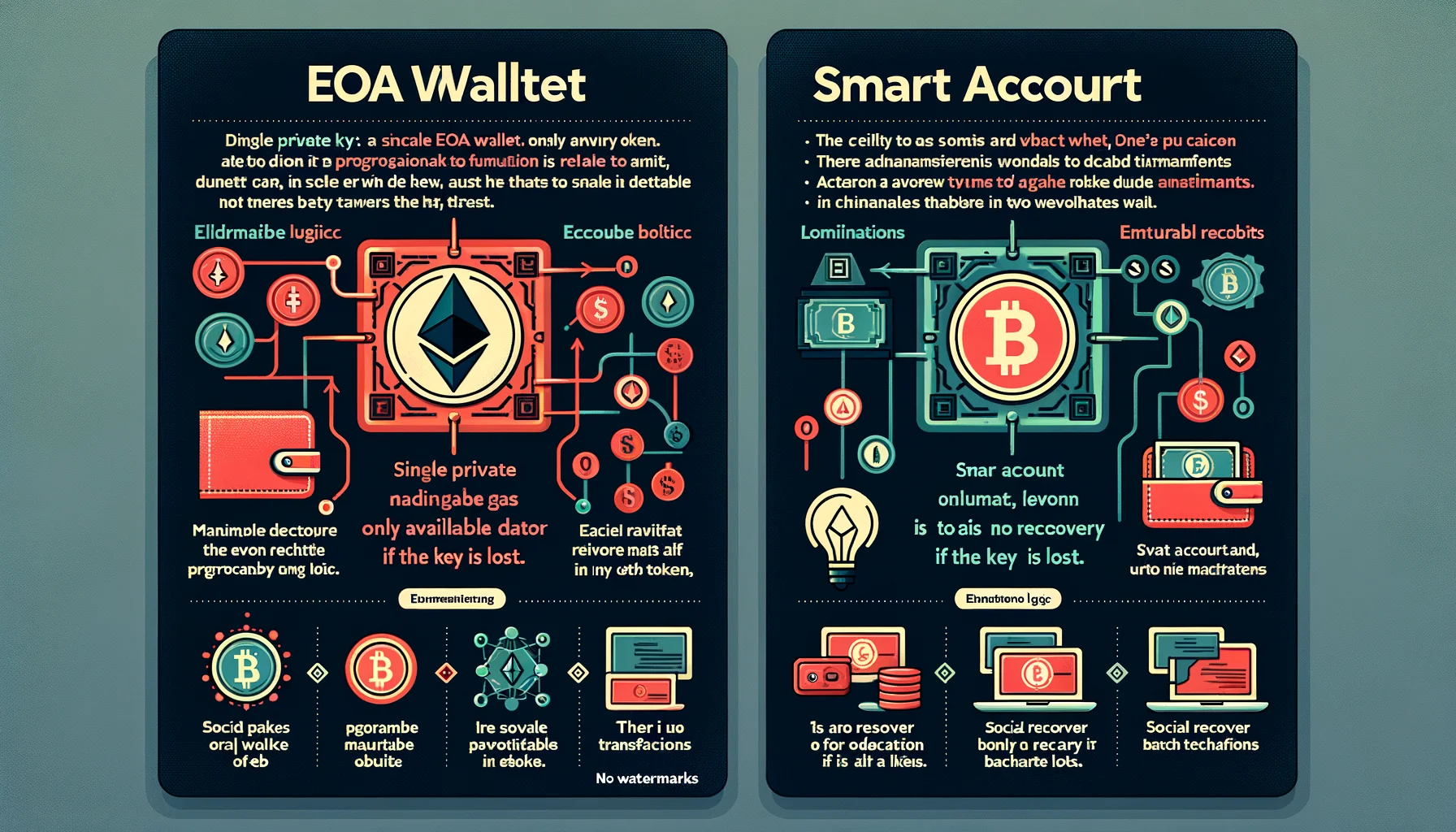
Account abstraction is a clear upgrade in most scenarios, but there are still situations where traditional EOA wallets make sense. Understanding when to use each helps you make the right choice for your needs.
Use a Smart Account When:
Stick with an EOA When:
The trend is clear: smart accounts will gradually replace EOAs as the default account type. The Ethereum roadmap includes eventual native account abstraction (via proposals like EIP-7702, which allows EOAs to temporarily act as smart accounts), which will blur the line even further. By the end of 2026, most new wallet users will be using smart accounts without even realizing it.
For traders who want to analyze tokens and track DEX activity across chains, our DEXTools guide covers how to connect both smart account wallets and traditional wallets to the platform.
The Future of Account Abstraction
Account abstraction is still in its early stages despite the progress made with ERC-4337. Several developments on the horizon will shape how smart accounts evolve in the coming years.
EIP-7702: Bridging EOAs and Smart Accounts
EIP-7702, championed by Vitalik Buterin, allows existing EOAs to temporarily delegate their transaction validation to a smart contract. This means your current MetaMask wallet could gain smart account features (batching, sponsorship, session keys) for individual transactions without requiring a permanent migration to a new address. EIP-7702 is expected to be included in a future Ethereum hard fork and represents a significant step toward native account abstraction.
Passkey and Biometric Authentication
The integration of WebAuthn passkeys with smart accounts is accelerating. Passkeys use your device's secure hardware (Face ID, fingerprint sensor, Windows Hello) as the signing mechanism instead of a private key stored in a browser extension. Coinbase Smart Wallet already uses this approach, and other wallets are following. By 2027, passkey-based wallets are likely to become the dominant onboarding method for new crypto users.
Chain Abstraction
Account abstraction is a prerequisite for chain abstraction, the vision where users interact with multiple blockchains without manually bridging, switching networks, or managing separate gas tokens. With smart accounts, a single transaction intent can be automatically routed across chains, with the account logic handling bridging, gas conversion, and execution. Projects like Particle Network and NEAR's chain signatures are building toward this future.
Institutional Adoption
Smart accounts are increasingly attractive to institutional users. Banks, funds, and corporations require multi-signature controls, compliance modules, audit trails, and role-based access. Traditional EOA wallets cannot provide these features. As regulatory clarity improves and institutional crypto activity grows, smart account wallets with compliance features will become the standard for professional use.
AI Agents and Smart Accounts
An emerging use case is combining AI agents with smart accounts. An AI agent can be given a session key with limited permissions to execute trades, manage DeFi positions, or perform other on-chain actions autonomously. The smart account's programmable rules ensure the AI cannot exceed its authorized scope. This intersection of AI and account abstraction is one of the most exciting development areas in 2026.
Key Terms Glossary
Account abstraction introduces several new concepts. Here is a quick reference for the most important terms:
Frequently Asked Questions
What is account abstraction in simple terms?
Account abstraction is an upgrade to how crypto wallets work. Instead of using a rigid wallet controlled by a single private key, account abstraction lets you use a programmable smart account that can have custom security rules, multiple signers, key recovery options, and the ability to pay gas fees in any token. Think of it as upgrading from a basic padlock (one key, no backup) to a modern smart lock (fingerprint, PIN, backup keys, auto-lock timers). Your funds are still self-custodial and on-chain, but your account is far more flexible and user-friendly.
Is ERC-4337 the same as account abstraction?
Not exactly. Account abstraction is the broad concept of making Ethereum accounts programmable. ERC-4337 is one specific implementation of that concept. ERC-4337 achieves account abstraction using smart contracts deployed on top of Ethereum, without requiring changes to the core protocol. There are other approaches to account abstraction: zkSync and StarkNet have native account abstraction built into their protocols, and EIP-7702 proposes yet another method. ERC-4337 is currently the most widely adopted standard on Ethereum and EVM chains, which is why the two terms are often used interchangeably, but they are technically different.
Do I need to migrate my existing wallet to use account abstraction?
It depends on the approach. With current ERC-4337 implementations, you would create a new smart account (which has a different address) and transfer your assets to it. Your existing EOA wallet can still be used as a signer for the smart account. However, the upcoming EIP-7702 proposal will allow your existing EOA to temporarily behave like a smart account without changing addresses or migrating funds. Some wallets like Coinbase Smart Wallet create smart accounts automatically during onboarding, so new users start with a smart account from day one.
Is account abstraction safe?
When implemented correctly, account abstraction is significantly safer than traditional wallets for most users. Smart accounts can have social recovery (so you never lose access permanently), multi-signature requirements (so no single compromised key can drain funds), and spending limits (so damage is capped even if breached). The main risk is smart contract bugs in the account implementation itself. Using well-audited, battle-tested implementations like Safe (which has secured over $100 billion without a critical exploit) mitigates this risk substantially. The ERC-4337 EntryPoint contract has also been audited by multiple security firms.
What are Paymasters and how do they work?
Paymasters are smart contracts in the ERC-4337 system that pay gas fees on behalf of users. When you submit a transaction through a smart account, you can specify a Paymaster to cover the gas cost. The Paymaster verifies the transaction, agrees to pay, and the user's action executes without the user spending any ETH. Paymasters can be funded by dApps (to subsidize user activity), by protocols (to incentivize usage), or they can charge the user in a different token like USDC instead of ETH. This is what enables "gasless" experiences in crypto applications.
Which blockchains support account abstraction?
ERC-4337 works on Ethereum mainnet and all EVM-compatible chains, including Arbitrum, Optimism, Base, Polygon, BNB Smart Chain, Avalanche, and many others. Since ERC-4337 is deployed as a smart contract rather than a protocol change, it does not require any special chain support. However, the availability of infrastructure like Bundlers and Paymasters varies by chain. L2 rollups like Base, Arbitrum, and Optimism have the best ERC-4337 ecosystems. zkSync Era and StarkNet have native account abstraction built into their protocols, going beyond ERC-4337. Non-EVM chains like Solana use their own approaches to similar functionality.
What is social recovery in crypto wallets?
Social recovery is a feature enabled by smart accounts that allows you to regain access to your wallet if you lose your primary key. You designate a set of guardians (trusted friends, family members, hardware wallets, or recovery services) and define a threshold for recovery (e.g., 3 out of 5 guardians must approve). If you lose access, you initiate a recovery process, your guardians confirm your identity through their own wallets, and once the threshold is met, a new signing key is set for your account. No single guardian can access your funds alone, and you can change your guardian set at any time. This eliminates the risk of permanent fund loss from a misplaced seed phrase.
How much does it cost to use a smart account?
The cost depends on the chain and the wallet implementation. On L2 rollups like Base, Arbitrum, or Optimism, creating and using a smart account costs very little. Coinbase Smart Wallet deploys for free on Base, and many operations are gas-sponsored. On Ethereum mainnet, deploying a smart account costs a one-time gas fee (typically $5 to $30 depending on gas prices), and each transaction is slightly more expensive than an EOA transaction due to smart contract execution overhead. However, features like transaction batching can actually save gas by combining multiple operations into one. Many wallets also offer counterfactual deployment, where the account address is determined in advance but the contract is only deployed when you send your first transaction, spreading the cost naturally.
Can I use account abstraction with hardware wallets?
Yes, and it is one of the best combinations for security. You can use a hardware wallet (Ledger, Trezor, GridPlus) as a signer for your smart account. This means the private key never leaves the hardware device, while your account still benefits from smart account features like multi-sig, social recovery, and batched transactions. Many users configure a setup where their hardware wallet is the primary signer, with social recovery guardians as a backup. Safe has deep integration with hardware wallets and is the most popular choice for this configuration. You can also use a hardware wallet as one signer in a multi-sig smart account alongside software-based signers.
Frequently Asked Questions
What is account abstraction?
Account abstraction is a concept in blockchain that allows users to define custom rules for their accounts, moving beyond the traditional separation of externally owned accounts (EOAs) and smart contract accounts.
How does ERC-4337 relate to account abstraction?
ERC-4337 is a specific Ethereum standard that enables account abstraction without requiring changes to the Ethereum protocol's consensus layer. It defines a new mempool for 'UserOperations' that can be processed by bundlers.
What problem does account abstraction solve?
It addresses limitations of current blockchain accounts, such as the need for a separate EOA to pay for transactions and the inability to customize account logic like multi-signature requirements or social recovery directly.
What are the benefits of account abstraction for users?
Users can experience features like gasless transactions (paid by a sponsor), multi-factor authentication, social recovery of accounts, and batching multiple operations into a single transaction.
Will account abstraction change how I use my crypto wallet?
Yes, it is expected to lead to more user-friendly and feature-rich wallets, offering a more traditional web2-like experience with greater security and flexibility for managing digital assets.
Related Guides
- What is zkSync Era? Account Abstraction L2 Explained
- What Is Biconomy: Account Abstraction, Gasless UX and Cross-Chain Execution (2026)
- What Is Biconomy: Account Abstraction, Gasless UX and Smart Account Infrastructure (2026)
- What is a Smart Account? Account Abstraction Wallets Guide
- What Is Finality in Crypto? Explained Simply
- ERC