Raydium on Solana: Hybrid AMM, CLMM and RAY Token Explained (2026)
A protocol-level guide to Raydium hybrid AMM design, concentrated liquidity, launchpad flows, and the role of the RAY token in Solana DeFi.
Intent check: This page is the protocol explainer for Raydium architecture, CLMM, launch flows, and RAY. If you want the hands-on product walkthrough for swaps and liquidity pools, read How to Use Raydium on Solana: Swaps, Liquidity Pools and CLMM Guide (2026).
What is Raydium?
- Raydium is an automated market maker (AMM) and decentralized exchange (DEX) built on the Solana blockchain that leverages its ultra-fast speeds and near-zero transaction fees. It serves as a core pillar of Solana's DeFi ecosystem, allowing users to swap tokens, earn rewards through yield farming, and participate in project launchpads.
- A defining feature of Raydium is its integration with a central limit order book, which enables it to share liquidity across the wider ecosystem, providing traders with better prices, faster execution, and deeper liquidity than traditional, isolated AMMs.
The Liquidity Hub: Anchoring High-Velocity Trading on Solana
- Decentralized exchanges must optimize their internal mechanics to take full advantage of their host blockchain's underlying processing speeds. In early decentralized finance (DeFi) layouts, automated market makers (AMMs) operated in isolation, fracturing capital across disconnected liquidity pools and forcing high execution slippage on large-scale orders. Raydium rewrote this operational playbook.
- Launched as the first pioneer of the hybrid AMM model on the Solana network, Raydium functions as a central liquidity hub. By combining traditional peer-to-pool trading deposits with high-speed on-chain matching frameworks, the protocol delivers institutional-grade capital efficiency with minimal execution latency.
- This comprehensive guide provides an introductory analysis of Raydium's pool mechanics, concentrated liquidity features, automated token launchpad pipelines, and native token economics.
1. Core Infrastructure: The Pioneer Hybrid AMM Model
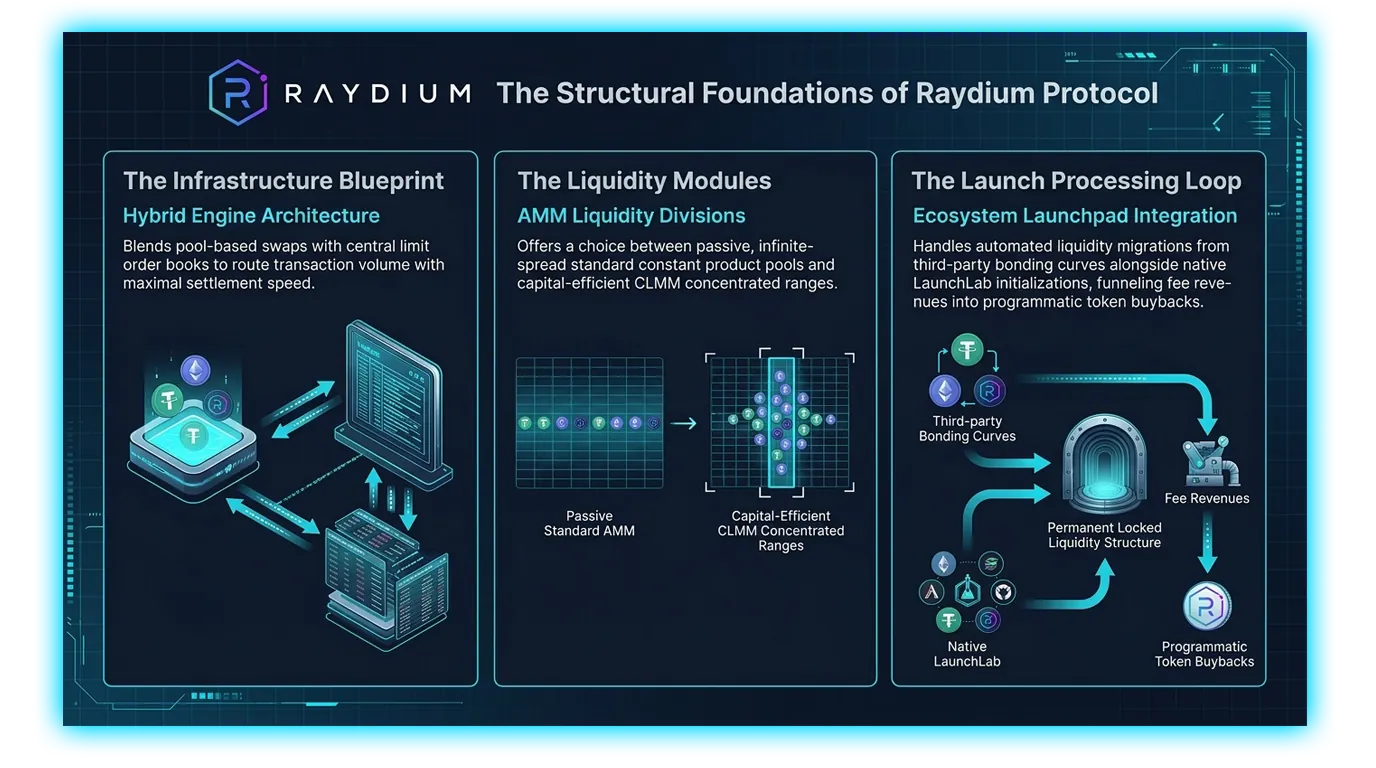
- Traditional decentralized applications rely exclusively on constant product formulas to clear trades, separating pool depositors from the wider order matching infrastructure used by institutional traders. Raydium's foundational innovation was the introduction of the Hybrid AMM.
The Ledger Integration: Raydium's smart contracts natively interlink with on-chain central limit order book (CLOB) architectures across the network.
- Capital Dual-Routing: When a liquidity provider (LP) deposits tokens into a standard Raydium pool, the protocol does not leave those assets sitting idle. Instead, the engine automatically translates the pool's asset ratios into limit orders directly on the shared on-chain order books.
- Unified Execution: This architecture allows a casual swapper using the AMM interface to clear their trade directly against institutional order book limit orders, or conversely, allows professional market makers to clear their limit orders against Raydium's pool reserves, maximizing transaction velocity for both execution types.
2. Advanced Liquidity Architecture: Standard Pools vs. CLMM
To support diverse trading strategies and accommodate varying asset risk profiles, Raydium splits its market-making infrastructure into distinct pool modalities.
Standard Constant Product Pools (V4 Engine)
The classic framework utilizes the standard constant product model (X x Y = K). When LPs deposit capital here, their tokens are distributed uniformly across an infinite price scale ranging from zero to infinity.
The Advantage: Fully passive and low-maintenance. The position requires zero active rebalancing and will continuously collect transaction fees regardless of market trends.
The Drawback: Extremely low capital efficiency, as the vast majority of the pool's assets sit unused far away from the active market price.
3. Concentrated Liquidity Market Makers (CLMM)
- To maximize capital efficiency, Raydium deployed its CLMM infrastructure. Mirroring advanced concentrated liquidity structures, CLMM allows providers to bound their capital within tight, custom price intervals (ticks).
- By concentrating assets directly around the active trading zone, an LP's fee-earning potential multiplies significantly. However, if the market price breaks out past the chosen boundaries, the position converts entirely into the underperforming asset and goes inactive, requiring the provider to manually rebalance their brackets.
- The exact moment the curve hits 100% completion, the launchpad protocol executes an automated migration instruction.
- The system automatically terminates the internal bonding market and transfers roughly $12,000 to $17,000 worth of accumulated SOL directly into a permanent Raydium V4 pool.
- The liquidity provider tokens are instantly routed to a burn address, guaranteeing a locked, rug-proof execution venue where the broader public can trade the asset safely.
The LaunchLab Response
- To retain market share and provide alternative decentralized launch options, Raydium introduced LaunchLab, a permissionless token creator and automated bonding curve program. LaunchLab provides project creators with advanced customization options:
- JustSendIt Mode: A streamlined, one-click creation utility requiring a flat funding target (e.g., 85 SOL) before automatically migrating into an active Raydium pool with permanently locked LP tokens.
- Pro Mode: Grants full developers complete control over bonding curve mathematics (linear, exponential, or logarithmic), customizable funding targets, and integrated fee-sharing metrics that return a portion of early swap fees straight to the project treasury.
4. The RAY Token and Protocol Buyback Economics
- The native RAY token acts as the central economic anchor of the protocol, functioning as a governance asset, staking reward vehicle, and the primary beneficiary of a structural buyback engine.
The platform implements an aggressive token-scarcity model by routing its diverse revenue streams directly into open-market asset contraction:
- Swap Fee Allocations: A defined percentage of the trading fees collected across standard AMM and CLMM execution pools is automatically used to purchase RAY tokens from the market.
- LaunchLab Minting Take-Rate: LaunchLab applies a 1% fee on bonding curve initializations, and 25% of this entire platform revenue is programmatically routed into the RAY repurchase engine.
- These collected tokens are permanently burned or redistributed to network stakers, creating a sustained economic buying pressure that scales alongside the total transaction velocity of the platform.
Technical Breakdown: Raydium Pool Modalities
| Technical Metric | Standard Pools (V4) | CLMM Pools | LaunchLab Modules |
| Liquidity Distribution | Infinite Scale (0 to infinity) | Targeted Custom Tick Intervals | Initial Bonding Curve to Passive V4 Pool |
| Capital Efficiency | Baseline Standard | Highly Optimized (Multipliers Apply) | Speculative Initial Discovery Phase |
| Management Type | Fully Passive | Active Range Rebalancing Required | Automated Permissionless Issuance |
| Fee Structure | Fixed 0.25% Baseline | Dynamic Tiers (0.01 to 1.00%) | 1% Issuance Fee + standard pool fees |
5. Universal On-Chain Forensics and Trading Telemetry via DEXTools
Evaluating performance profiles, auditing contract securities, and tracking cross-market capital shifts requires access to robust independent charting architecture. Advanced data analytical platforms like DEXTools provide an indispensable, universal toolkit for contemporary decentralized finance market participants, operating seamlessly across all public execution networks without anchoring to a single project or asset framework.
You can access DEXTools here and start trading today.Disclaimer: This article is for informational purposes only and does not constitute investment advice, financial advice, trading advice, or any other kind of advice. DEXTools does not recommend buying, selling, or holding any cryptocurrency or token. Users should conduct their own research and consult with a qualified financial advisor before making any investment decisions. Cryptocurrency investments are volatile and high-risk. DEXTools is not responsible for any losses incurred.
Related Guides
- How to Use Raydium on Solana: Swaps, Liquidity Pools and CLMM Guide (2026)
- Raydium vs Orca: Best Solana DEX Compared (2026)
- How to Trade on Raydium: Solana Swaps, Entries and Execution Guide (2026)
- What Is Vertex Protocol: Hybrid Perp DEX & Ink Move 2026
- What Is Cetus Protocol? Sui & Aptos CLMM DEX Guide 2026
- UTK Token
- What Is Heaven? The Solana Launchpad and LIGHT Token Explain
Frequently Asked Questions
What is an automated market maker?
An automated market maker, or AMM, is a type of decentralized exchange that uses liquidity pools and a pricing formula instead of a traditional order book. Traders swap against the pool, and prices adjust based on the ratio of assets in it.
What is concentrated liquidity?
Concentrated liquidity lets providers focus their funds within a chosen price range rather than spreading it across all prices. This can improve capital efficiency and fees but requires more active management.
What is the RAY token used for?
RAY is the native token of Raydium, used within its ecosystem for purposes such as governance and incentives. Its specific utilities are defined by the protocol and can change over time.
What are the risks of providing liquidity on an AMM?
A key risk is impermanent loss, which occurs when the prices of pooled assets diverge compared to simply holding them. Smart contract risk and exposure to volatile tokens are also important to consider.