Validator Slashing Explained: Risks of Solo Staking

Prioritizing liveness over safety is the primary vulnerability for solo stakers. We break down the technical realities of double-signing faults, post-Pectra correlation penalties, and DVT mitigation tools.
The Ultimate Penalty: Demystifying Consensus Discipline
The problem with solo staking.
- Solo staking represents the gold standard of blockchain self-sovereignty. By running independent physical hardware and locking up native capital directly to maintain network consensus, solo stakers bypass third-party middleman platforms, capture un-diluted protocol yields, and maximize decentralization. However, running a sovereign validator node introduces severe operational and cryptographic responsibilities.
- Many incoming operators look at staking through a simple "uptime vs. downtime" lens, assuming that the worst-case scenario of a system failure is a minor penalty equal to missed rewards. This is a hazardous misunderstanding. In modern proof-of-stake architectures, blockchains draw an uncompromising line between inactivity (being offline) and equivocation (submitting conflicting data).
- The latter triggers Slashing: a catastrophic, automated protocol defense mechanism that programmatically burns a validator's principal stake, ejects the node from the network, and exposes capital to cascading correlation fines. This guide analyzes the core mechanics of validation faults, explains the updated penalty metrics, and breaks down the advanced infrastructure strategies needed to protect your principal capital.
1. The Cryptographic Cardinal Sins: What Triggers Slashing?
Slashing is never triggered by standard device issues like local power cuts, corrupted operating system drives, or dropped internet connections. The consensus engine only invokes slashing rules when a validator key signs two distinct, irreconcilable cryptographic data payloads for the exact same slot or height.
There are three primary consensus faults that violate network finality:
Double Block Proposal: Occurs when a validator is selected as the official block producer for a specific network slot but signs and propagates two completely different block variations for that same slot, attempting to introduce competing historical timelines.
Double Attestation (Attestation Equivocation): The most common source of accidental slashing. This happens when a validator signs two conflicting voting statements (attestations) targeting different blocks or checkpoints within the same validation window.
Surround Voting: A complex structural consensus fault where a validator submits an attestation vote that completely overlaps or engulfs the boundary coordinates of a previous vote they cast, threatening the finality guarantees of the underlying blockchain ledger.
2. The Math of Punishment: Initial vs. Correlation Penalties
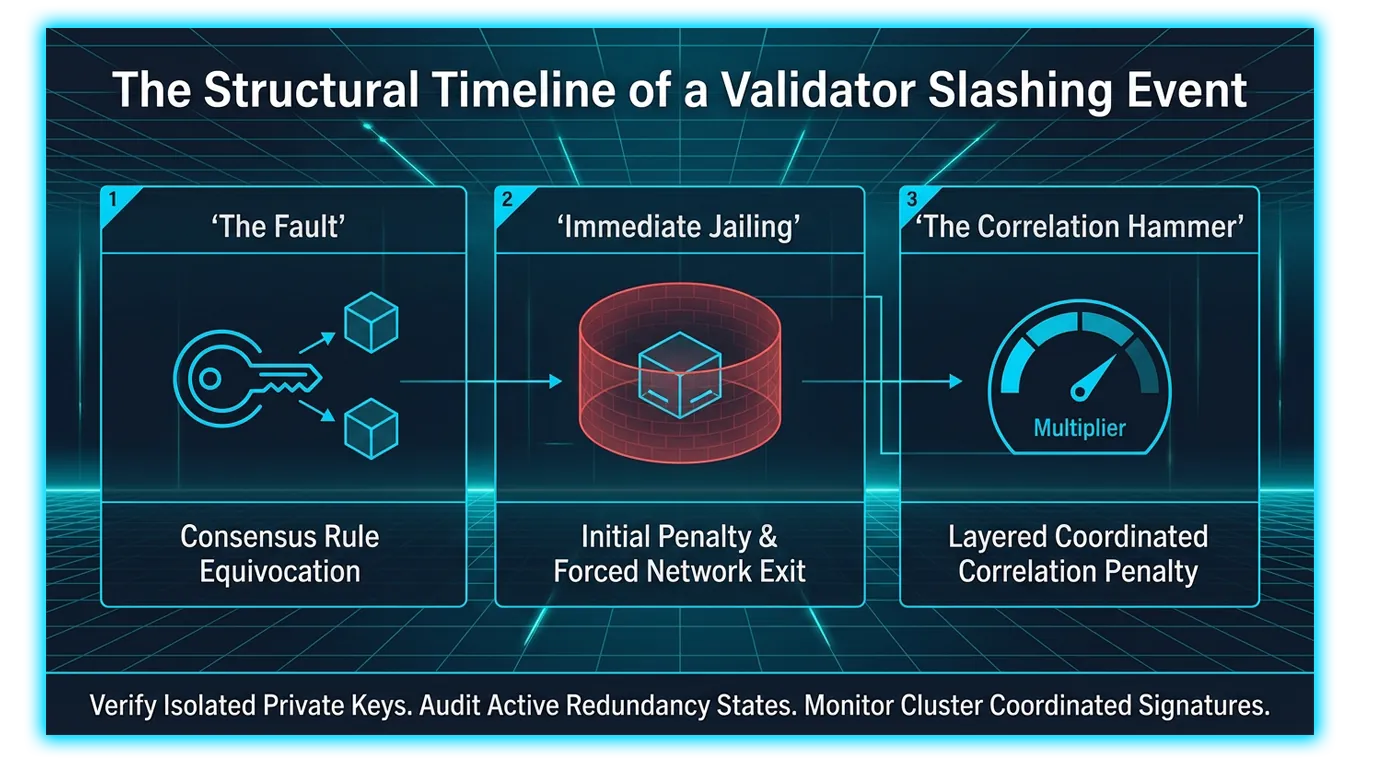
The financial architecture of a slashing event is designed to punish isolated accidents lightly while ruthlessly destroying coordinated attacks or massive multi-node configuration errors. Following the structural integrations of modern network upgrades (such as Ethereum's Pectra framework), the penalty lifecycle operates across three distinct phases.
The Initial Baseline Penalty
The moment a validator's equivocation is proven on-chain by a whistleblowing node, the protocol applies an immediate, structural penalty. To protect consolidated operators using the expanded Maximum Effective Balance (EIP-7251) limits, this initial fine is highly optimized:
The Scale: The initial penalty scales at a flat 1/4096 fraction of the validator's effective balance.
Standard 32 ETH Node: Incurs an immediate baseline reduction of just 0.0078125 ETH.
Max 2048 ETH Consolidated Node: Faces a baseline drop of 0.5 ETH.
The Real Monster: The Correlation Penalty
- Approximately 18 days into a slashed validator's forced removal window, the protocol applies a secondary, far more devastating adjustment: the Correlation Penalty. The system reviews a 36-day historical window surrounding the fault to measure how many other network validators were slashed concurrently.
- If your node suffers an isolated double-sign due to a personal machine mistake, the correlation multiplier remains at zero, resulting in a negligible total fine. However, if your node fails because you share a faulty client version or an identical cloud server hub with thousands of other validators, the penalty scales linearly. If more than one-third of the total network stake is compromised within that window, the correlation penalty will automatically ramp up to 100%, burning your entire staked principal balance.
Jailing and Forced Network Removal
- Beyond financial penalties, a slashed validator is subjected to immediate jailing. The protocol marks the node as untrusted, strips away its block-proposing privileges, and places it into a mandatory 8,192-epoch (~36 days) forced exit queue.
- Crucially, during this entire 36-day jailing isolation block, the node is structurally blocked from performing validator duties but is continuously penalized for being offline, suffering steady inactivity leaks until it is fully cleared to exit the network ledger.
3. Compact Matrix: Slashing vs. Downtime Penalties
| Operational Parameter | Inactivity / Downtime Faults | Programmatic Slashing Faults |
| Core Cause | Node offline or dropped network | Signed conflicting blocks/votes |
| Start Penalty | Sub-cent protocol reward loss | 1/4096 of node's effective balance |
| Long-Term Risk | Slow, predictable inactivity leak | Linear Correlation Penalty up to 100% |
| Account Status | Stays active; recovers when online | Forced jailing and permanent network exit |
| System Threat | Minor network performance lag | Threat to cryptographic finality |
4. The Failover Paradox: The Solo Staker's Primary Vulnerability
The absolute number-one cause of slashing events for solo stakers is not malicious hacking; it is a conceptual design flaw known as the Failover Paradox.
- New operators are terrified of losing rewards due to power or internet outages. To maximize liveness, they configure a redundant backup machine loaded with a duplicate copy of their validator private keys. They write script rules designed to automatically boot the backup machine if the primary machine stops responding.
- This is a catastrophic setup. If the primary machine experiences a simple network hitch or temporary operating system lockup, the backup script assumes a crash has occurred and initializes the second instance. When the primary machine wakes back up a few minutes later, both nodes begin running the exact same active key signature concurrently. Within seconds, the duplicate nodes process the same slot events, sign two different blocks or attestations, and commit a clear, un-appealable double-signing infraction that is instantly caught and slashed by the network. In self-custody solo staking, safety must always be prioritized over liveness; running an offline node is cheap, but running a duplicate active key is devastating.
5. Advanced Mitigations: Hardening Your Node Architecture
Building a resilient, institutional-grade solo staking profile requires moving past simple software defaults and implementing active security guardrails.
Maintain an Ironclad Slashing Protection Database: Modern consensus clients include built-in, standardized JSON databases that log the exact history of every block and attestation signed by your key. Never copy your validator keys to a new machine without physically migrating this signing history log first. If the new instance lacks historical context, it cannot verify if it is duplicate-signing a previously validated slot.
Integrate Distributed Validator Technology (DVT): Advanced solo setups deploy open-source DVT frameworks (such as Obol Network or SSV Network). DVT splits your validator private key into distinct, encrypted cryptographic shards distributed across an independent cluster of nodes (e.g., a 3-of-4 multisig-style matrix). The individual cluster nodes must coordinate to sign transactions; no single machine running a key shard can generate a valid block signature on its own, completely eliminating single-point-of-failure double-signing vulnerabilities.
Enforce Absolute Client Diversity: Never run a majority consensus or execution client implementation. If a dominant client version (controlling more than 66% of network nodes) experiences a critical code bug that forces it to split consensus or invalidly double-sign slots, every validator running that software will be slashed simultaneously. Due to the math of the Correlation Penalty, this shared software failure will instantly scale up to destroy 100% of your staked principal capital.
Universal On-Chain Forensics and Trading Telemetry via DEXTools
- The use of advanced decentralized charting architectures, such as DEXTools, provides market participants with an essential, universal platform for monitoring token behavior in real time, assessing the depth of liquidity pools, and inspecting contract parameters across all public blockchains.
- By leveraging key features such as the Pair Explorer, the Live New Pairs dashboard, and Trade Story, among other options, technical traders can analyze localized volume trends and verify the security scores of automated contracts before initiating any on-chain interactions. This ensures that their secure hardware setup only interacts with verified markets.
You can access DEXTools here and start trading today!
How to Bridge Crypto Between Chains: Complete Cross-Chain Tutorial 2026How to Use 1inch for Swaps: Classic, Fusion and Limit Orders (2026)OKX Web3 Wallet Tutorial 2026: Multi-Chain Setup Guide
Disclaimer: This article is for informational purposes only and does not constitute investment advice, financial advice, trading advice, or any other kind of advice. DEXTools does not recommend buying, selling, or holding any cryptocurrency or token. Users should conduct their own research and consult with a qualified financial advisor before making any investment decisions. Cryptocurrency investments are volatile and high-risk. DEXTools is not responsible for any losses incurred.
Related Guides
- What Is Validator Slashing in Staked Crypto?
- Validator Node vs ETH Staking: Which Path in 2026?
- What Is Staking in Crypto? How It Works, Rewards, Risks and Best Practices (2026)
- What Is Ethereum Staking? How It Works, Rewards and Risks (2026)
- How to Use Lido Finance: Stake ETH, Receive stETH and Manage Risks (2026)
Frequently Asked Questions
What is validator slashing?
Slashing is a penalty in proof-of-stake networks where a validator loses part of its staked funds for serious misbehavior, such as signing conflicting blocks. It exists to discourage actions that could harm network security.
What causes a validator to get slashed?
Common causes include double-signing, where a validator signs two conflicting messages, or other provable protocol violations. Simple downtime usually leads to smaller inactivity penalties rather than full slashing.
What are the risks of solo staking?
Solo staking means you are responsible for running validator infrastructure correctly, so configuration errors or running duplicate setups can lead to penalties. The tradeoff for full control and rewards is taking on operational and slashing risk yourself.
How can solo stakers reduce slashing risk?
Good practices include avoiding running the same validator keys on two machines at once, maintaining reliable uptime, and using tested setups. Some technologies aim to distribute validator duties to reduce single-point failures.