What is Bittensor (TAO)? Subnets and Validator Mining

Bittensor decentralizes artificial intelligence by creating a marketplace for compute. We break down the roles of subnets, miners, validators, and the TAO emission lifecycle.
The Decentralized Intelligence Machine: Breaking the AI Monopolies
- The commercial artificial intelligence landscape is dominated by a handful of centralized technology conglomerates. Because training cutting-edge foundational models requires multi-billion dollar data centers, proprietary data harvesting agreements, and consolidated silicon pipelines, independent developers are increasingly squeezed out of the market. This centralized infrastructure creates systemic vulnerabilities: corporate gatekeepers control what a model is allowed to think, personal data is aggregated without transparent compensation, and proprietary algorithms operate as opaque black boxes.
- Bittensor introduces a radical alternative to this centralized paradigm. Operating as an open-source, decentralized Layer 1 blockchain protocol, Bittensor treats machine intelligence as a commodity that can be measured, tokenized, and traded in an open peer-to-peer marketplace. Instead of relying on a single mega-corporation's cloud infrastructure, Bittensor networks combine global computing power, crowdsourced algorithmic development, and strict economic consensus to build an internet-scale neural network. This comprehensive guide details the inner architecture of Bittensor’s subnets, explores the competitive dynamics between miners and validators, and outlines the native tokenomics of the TAO emission schedule.
What is Bittensor?
- Bittensor is a decentralized machine learning network built on top of a specialized cryptoeconomic consensus engine. Funded organically without venture capital pre-mines or predatory token sales, the protocol serves as a universal marketplace that connects consumers of machine intelligence directly with distributed providers.
- The primary financial asset powering this ecosystem is the TAO token. Rather than functioning merely as a speculative asset, TAO serves as the literal network equity and fuel of the platform. Holding TAO gives users direct access to the network’s collective machine learning capabilities, enables participants to register custom development sectors, and functions as the baseline reward currency distributed to those who contribute verifiable intelligence to the ledger.
1. The Core Architecture: Understanding Subnets
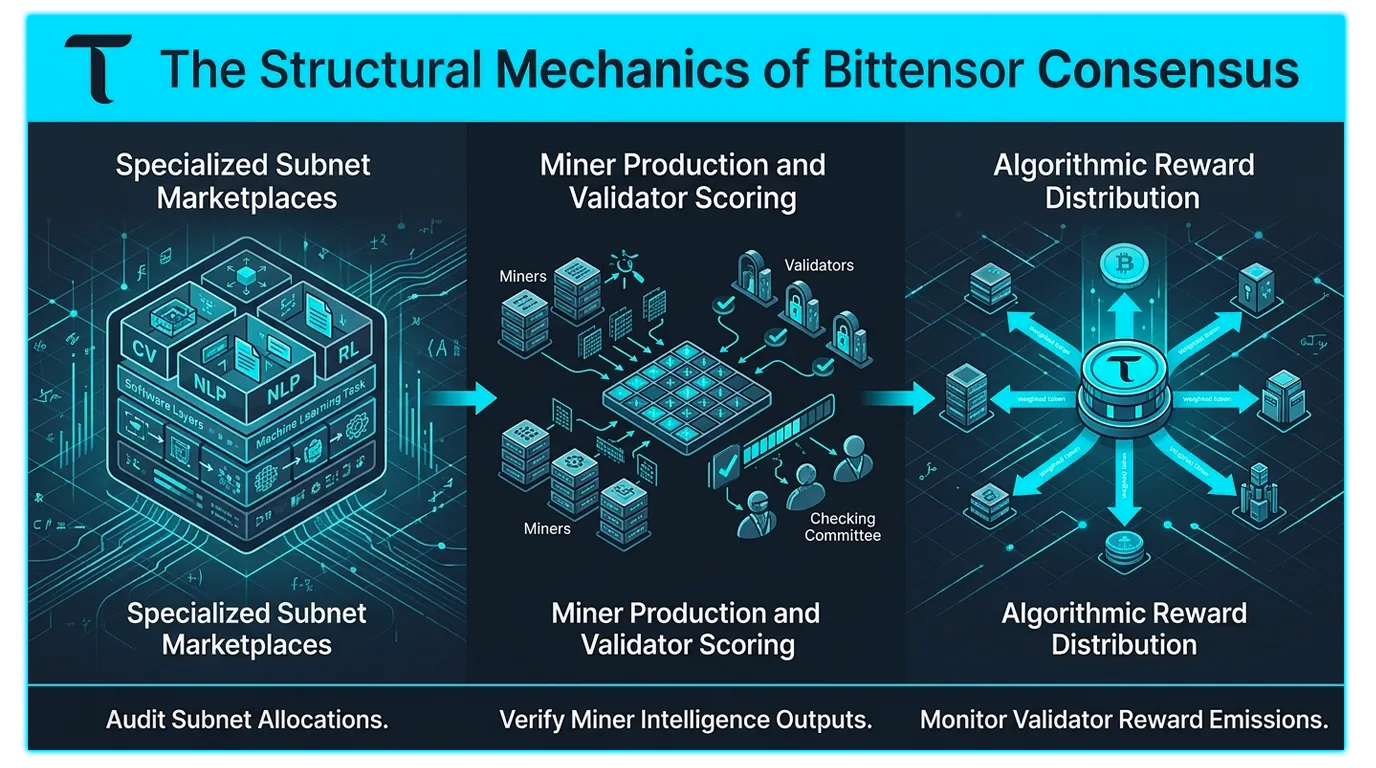
The fundamental building blocks of the modern Bittensor network are its Subnets. A subnet is a specialized, independent marketplace dedicated to solving a distinct algorithmic or computational problem.
Instead of forcing the entire global blockchain to process one massive, generic AI model, Bittensor splits its network into multiple specialized channels. Anyone who locks the required registration amount of TAO can launch a custom subnet, defining the exact rules, evaluation criteria, and performance benchmarks for that specific competitive domain.
Specialized Domain Execution: Individual subnets focus exclusively on niche computational outputs, including zero-knowledge machine learning (ZKML) proofs, advanced text-to-image rendering, crowdsourced search engine indexing, automated medical data analysis, or distributed storage.
Continuous Innovation Loops: Because subnets compete with one another for a share of daily token emissions, underperforming sectors are automatically deregistered by the blockchain's root mechanism if their real-world utility drops below the competitive baseline of alternative emerging applications.
2. Miners vs. Validators: The Competitive Network Dynamic
The operational integrity of every individual subnet relies on a continuous, adversarial relationship between two primary participant categories: Miners and Validators.
Miners: The Intelligence Producers
Miners represent the computational engine of the subnet. They run localized machine learning models, deploy raw processing units, or write specialized code to execute the specific tasks demanded by their chosen subnet. When a query enters the subnet, miners race to produce the most accurate, rapid, and resource-efficient output possible, submitting their cryptographic solutions directly to the ledger for review.
Validators: The Quality Inspectors
- Validators act as the network's decentralized quality control layer. They continually generate test queries, distribute them to the active pool of miners, and evaluate the incoming solutions based on the subnet’s hardcoded evaluation scripts.
- To prevent centralization and ensure impartial grading, validators must back their evaluations by staking TAO tokens. The system leverages the Yuma Consensus framework: a mathematical architecture that rewards validators for reaching a consensus on miner performance scores. If a validator attempts to game the system by intentionally over-scoring their own mining rigs, the consensus mechanism detects the statistical deviation and systematically strips the rogue validator of their validation weight and staking rewards.
3. The Economic Engine: TAO Emissions and Tokenomics
Bittensor’s tokenomic framework is heavily inspired by Bitcoin’s hardcapped, programmatic scarcity model, adapting those proven distribution mechanics to fund global intelligence networks instead of raw cryptographic calculations.
The Scarcity Model and Halving Cycles
- The lifetime supply of TAO is strictly limited to exactly 21,000,000 tokens. The distribution follows a programmatic schedule where one token is minted on-chain every single block confirmation (~12 seconds), resulting in an emission velocity of roughly 7,200 TAO tokens per day.
- To maintain long-term token scarcity, Bittensor incorporates a structural halving cycle. Every time the circulating ledger reaches 10.5 million tokens (the 50 percent milestone of total supply), the block emission rate is cut precisely in half. This transparent mechanism ensures that early hardware providers are heavily incentivized to build early infrastructure, while protecting long-term capital allocators from inflationary token dilution.
The Emission Lifecycle Architecture
The distribution of the daily minted TAO is calculated dynamically across the ecosystem:
Subnet Allocation: The network's core root layer evaluates the aggregate utility and performance of every active subnet. Subnets that demonstrate high market demand and valid consensus metrics receive a larger percentage slice of the daily token issuance.
Internal Subnet Distribution: Once a subnet receives its daily allocation, the payload is split directly between its active participants based on performance weights: exactly 50 percent goes to the top-performing miners for producing raw intelligence, and the remaining 50 percent is distributed to validators and their token delegators for conducting accurate quality audits.
Bittensor Network Participant Matrix
| Ecosystem Actor | Primary Function | Capital Requirement | Primary Incentive Vector |
| Subnet Owner | Defines game logic and rules | High registration lock | Captures a percentage cut of subnet emission |
| Intelligence Miner | Produces computational output | Hardware-focused | Earns TAO based on output accuracy and speed |
| Network Validator | Grades and audits miner outputs | High TAO staking balance | Earns TAO based on consensus alignment |
| Token Delegator | Backs trusted validators | Flexible staking minimum | Shares a percentage of validator yield lines |
Analyzing Network Parameters via DEXTools Telemetry
- Evaluating active subnet traction, monitoring token distribution structures, and reviewing live liquidity dynamics across automated trading pools requires absolute transparency. Utilizing advanced decentralized charting architectures like DEXTools gives market participants an essential universal platform to monitor live token behaviors, evaluate pool depths, and inspect contract parameters across all public execution networks.
- By leveraging core features like the Pair Explorer, Live New Pairs dashboard, and the integrated Trade Story or Top Traders diagnostic tools, technical traders can seamlessly audit localized volume trends, track large whale wallet capital reallocations via the Big Swap Explorer, and check automated contract safety scores before initiating any on-chain interactions, ensuring your hardened hardware setup interacts safely with verified market venues.
Disclaimer: This article is for informational purposes only and does not constitute investment advice, financial advice, trading advice, or any other kind of advice. DEXTools does not recommend buying, selling, or holding any cryptocurrency or token. Users should conduct their own research and consult with a qualified financial advisor before making any investment decisions. Cryptocurrency investments are volatile and high-risk. DEXTools is not responsible for any losses incurred.
Related Guides
- What Is Bittensor: TAO Token & Subnets AI Guide (2026)
- What Are Bittensor Subnets? dTAO and Alpha Tokens Explained 2026
- 5 Best AI Crypto Tokens 2026: Bittensor, Render, NEAR + 2 More
- How to Use Avalanche Subnets: Beginner's Guide
- What Is Firedancer? Solana's Jump Crypto Validator Client 2026
Frequently Asked Questions
What is Bittensor (TAO)?
Bittensor is a decentralized network that aims to create a marketplace for machine learning and artificial intelligence resources. TAO is its native token, used within the network's incentive system.
What are subnets in Bittensor?
Subnets are specialized networks within Bittensor that focus on specific tasks or types of machine intelligence. Participants contribute to a subnet and are rewarded based on the value of their contributions.
What is the difference between miners and validators in Bittensor?
Miners contribute work such as machine learning outputs to the network, while validators assess and score the quality of that work. This division helps the network rank contributions and distribute incentives.
What is TAO emission?
Emission refers to how new TAO tokens are released and distributed to participants as rewards over time. The emission system is meant to incentivize miners and validators who add value to the network.