Top 5 Crypto Research Platforms in 2026
— By Tony Rabbit in Tutorials

Compare CoinGecko, CoinMarketCap, Messari, Token Terminal and Nansen to find the best crypto research platform in 2026.
Crypto research platforms matter because being early is not enough if your context is weak. The best research stack helps you compare sectors, track protocol traction, filter narratives and understand what is actually worth deeper work instead of reacting to every trend that flashes across the timeline.
In 2026, the main research platforms worth comparing are CoinGecko, CoinMarketCap, Messari, Token Terminal and Nansen. They all answer different parts of the same problem. Some help you map the market, some help you understand protocols, and some help you study capital behavior.
Official websites worth checking
How this ranking was built
- Workflow fit mattered more than raw hype.
- We favored tools that actually improve decision quality, not just surface more noise.
- Screenshot quality was checked manually to avoid popups, captcha walls and broken pages.
- We weighted how well each tool fits a real crypto workflow in 2026, not just old brand memory.
Why this category matters in 2026
The reason top-5 comparisons still matter is simple. The crypto market keeps getting noisier, but user attention does not scale with it. Every category becomes more crowded over time, and that means the best tool is rarely the one with the loudest marketing. It is usually the one that shortens the path between question and answer. The stronger the market gets at producing noise, the more valuable clear tooling becomes.
A good comparison article also needs to do more than rank logos. It should explain why a category matters, which user each option fits, and how to use the ranking without becoming lazy. If a list does not change the reader's decision quality, it is just content filler. That is exactly what we are avoiding here.
That is also why screenshots matter in this batch. Real clean screenshots make the category easier to read and help the user understand whether the interface feels right before clicking through. Features, workflows and usability all become easier to compare when the visuals are honest and uncluttered.
Verified real screenshots
The screenshots below were checked to avoid the usual junk that lowers trust, including cookie walls, captcha blocks, blank states and broken pages. They are not decorative filler. They are there to make the comparison more practical.

CoinGecko ranks first because it remains one of the cleanest ways to get broad market context before moving into deeper tools.
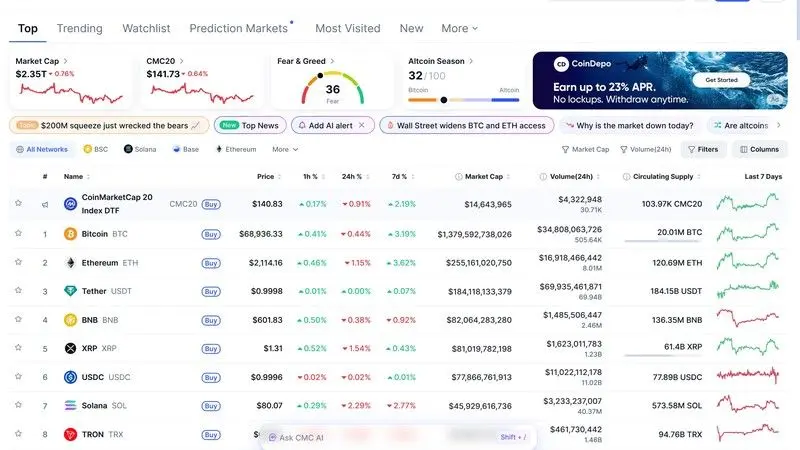
CoinMarketCap stays relevant because many users still begin research with a wide market directory and asset overview layer.

Token Terminal belongs near the top because research gets much stronger when market narrative is checked against real protocol metrics.
More verified real screenshots
One weakness in the first pass of this batch was screenshot density. These extra real captures make the pages more practical and closer to how people actually compare tools before clicking through.

Nansen deserves a visual spot in the research stack because serious research often improves when capital behavior is visible, not just market rankings.
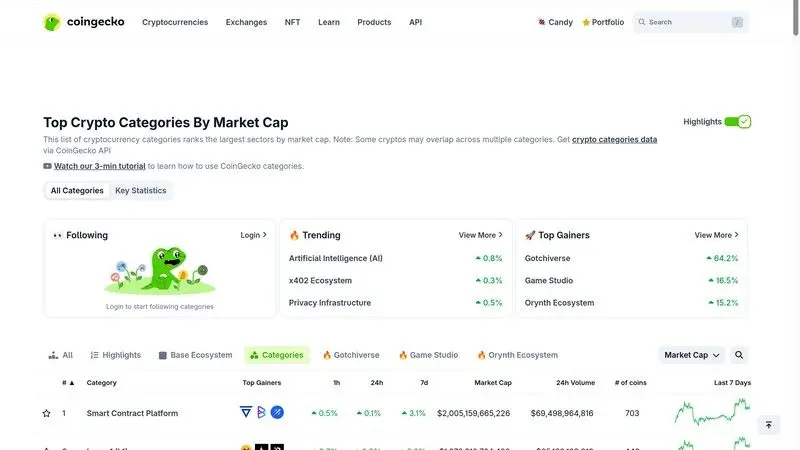
A category view is useful here because research platforms earn their keep by helping users move from broad market context to a narrower thesis faster.
The top 5 compared
1. CoinGecko
CoinGecko leads because it is still one of the most balanced starting points for crypto research. It gives you broad market visibility, token coverage, category context and a workflow that helps narrow the field without overwhelming you.
Use CoinGecko if you want the best broad first-pass research platform before switching into deeper specialist tools. That is why the ranking is not just about brand size. It is about the type of workflow the tool supports under real pressure. Main tradeoff: The tradeoff is that it becomes stronger when paired with deeper analytics rather than used alone for every decision.
2. CoinMarketCap
CoinMarketCap remains highly useful as a broad market directory and starting point for asset discovery. It is especially good for quick context and coverage across a wide range of assets and categories.
Use CoinMarketCap if you want a familiar market-wide reference point that helps you orient quickly. That is why the ranking is not just about brand size. It is about the type of workflow the tool supports under real pressure. Main tradeoff: The tradeoff is that it often feels more directory-like than insight-first when compared with deeper research stacks.
3. Messari
Messari earns a place because many users want research that goes beyond prices and listings into protocol framing, narratives and structured context. It helps create a sharper mental model.
Use Messari if your process starts with market structure, protocol positioning and higher-level interpretation. That is why the ranking is not just about brand size. It is about the type of workflow the tool supports under real pressure. Main tradeoff: The tradeoff is that it is not the first stop for purely execution-focused workflows.
4. Token Terminal
Token Terminal stays critical because revenue, fees, usage and protocol traction still separate stronger projects from weaker stories. It makes research more concrete.
Use Token Terminal if you care about whether activity is translating into business quality. That is why the ranking is not just about brand size. It is about the type of workflow the tool supports under real pressure. Main tradeoff: The tradeoff is that it focuses more on protocol substance than on broad token-directory coverage.
5. Nansen
Nansen rounds out the top five because serious research often improves when wallet behavior and capital movement are visible. That gives another layer to the thesis.
Use Nansen if you want research tied directly to capital behavior and wallet intelligence. That is why the ranking is not just about brand size. It is about the type of workflow the tool supports under real pressure. Main tradeoff: The tradeoff is that its best value appears when you already have a clear question to investigate.
How to use this ranking properly
The most common mistake people make with a top-5 article is treating rank one like a universal answer. That is not how good comparisons work. Rank one is usually the strongest broad default, not a permanent winner for every reader. The right way to use a ranking is to look at the first two or three options, decide what your actual workflow needs, and then test the best fit with a small amount of time or capital before committing to it as a routine.
Another mistake is confusing familiarity with quality. A known brand can deserve its position, but sometimes familiarity only explains why users start there, not why they should stay there. That is why each option above includes both fit and tradeoff. The goal is not to romanticize the list. The goal is to make the shortlist more honest.
And finally, remember that no top-5 article replaces direct verification. Interfaces change, pricing changes, supported chains change, and even good products can drift. Use the article to narrow the field, then verify current details directly on the platform before you build anything serious around it.
What separates a useful tool from a noisy one
The best crypto tools usually do three things well. First, they reduce search friction. Second, they make important context easier to read. Third, they fit naturally into the next step of the workflow. Bad tools often fail at one of those points. They either show too much, explain too little, or interrupt the next action the user needs to take. In crypto, where speed and context both matter, that weakness compounds fast.
The higher-ranked names in this guide tend to be there because they keep the workflow tighter. Even when two tools appear similar on the surface, the better one usually creates fewer unforced errors over time. That is an underrated edge. Cleaner decisions often come from cleaner tooling long before they show up in PnL.
Who should pick what
If you are newer to the category, the highest-ranked broad default is usually the safest place to start. If you already know your style well, then the better move is often picking the tool that matches the part of the workflow you care about most. Speed-focused users should not choose the same way as research-first users. Context-first users should not choose the same way as pure execution users. That is the whole point of making the tradeoffs explicit.
The best readers of comparison articles are not the ones who blindly copy the list. They are the ones who use the list to make a sharper shortlist. That is where this guide is trying to help.
How serious users actually work with this category
Serious crypto users rarely rely on one tool in isolation. They build stacks. A strong stack usually has one tool for broad discovery, one tool for deeper verification, and one tool for execution or monitoring. That pattern appears across almost every category in this article. The top-ranked options tend to be the ones that slot into a stack cleanly instead of demanding that they become the entire stack by themselves.
That point matters because many buying decisions in crypto tooling go wrong at the expectation stage. A user buys a platform hoping it will solve discovery, analysis, validation, alerts and execution in one shot. Then they get frustrated when it does not. The better move is to decide which exact part of the workflow you want the tool to improve, then judge it on that job. The tools that win in this list are usually the ones that perform their core job well enough to make the rest of the workflow sharper.
Another thing serious users do differently is they measure consistency, not just excitement. A tool that feels amazing for one day but creates low-grade friction every week is usually worse than a tool that feels calmer but works cleanly over time. That is especially true in crypto, where small workflow mistakes accumulate faster than people realize.
Common mistakes people make when choosing tools in this category
The first mistake is choosing by hype instead of fit. A tool can be famous and still be wrong for your workflow. Many traders and researchers lose time because they start with the loudest brand instead of the platform that best matches what they actually do every day. That is why this guide keeps returning to fit, tradeoff and practical use case instead of pretending every reader wants the same thing.
The second mistake is confusing speed with quality. Faster dashboards, louder alerts or more data points do not automatically produce better decisions. In many crypto workflows, more information simply creates more noise. The better tool is often the one that reduces the number of bad decisions, not the one that produces the most stimulation. Ranking tools by raw feature count usually leads to weak outcomes.
The third mistake is skipping verification after reading the comparison. Articles like this should narrow the field and improve your starting point, but they should not replace direct checks. Interfaces, plans, chain support, pricing and data depth can all shift. If a tool looks right in the article, the final step is still to verify the current version directly on the official site and test whether it fits your own workflow in practice.
Checklist before you commit to a tool
Before you adopt any platform from this list, run a simple checklist. First, define the exact job you want the tool to perform. Second, confirm the current pricing, limits and supported features. Third, make sure the interface feels clean enough that you will actually use it consistently. Fourth, pair it with the other tools your workflow still needs instead of expecting it to do everything. Fifth, test it with a small workflow before making it central to your routine.
If you follow that checklist, top-5 articles become much more valuable. They stop being content you skim once and forget, and become decision frameworks that help you choose faster with fewer mistakes. That is the real point of a comparison guide, especially in crypto where noisy decisions get punished quickly.
Fast checklist
- Know exactly what problem you want the tool to solve.
- Verify current features and pricing on the official site.
- Pair the tool with the rest of your workflow instead of expecting magic.
- Test the interface with a small routine before committing fully.
- Use DEXTools and other verification layers where they make the decision cleaner.
Frequently Asked Questions
Related DEXTools tutorials
Top 5 Crypto Research Platforms in 2026: Best Tools for Smarter Analysis is really about choosing the workflow that improves your decisions, not just the brand that is easiest to recognize. Pick the tool that gives you cleaner signal, clearer context and fewer unforced errors, then verify the current details before you make it a habit.
Related Guides
- How to Use Dune Analytics: Build Better Crypto Dashboards and On-Chain Research (2026)
- How to Use DeFi Llama: Complete TVL and DeFi Research Tutorial (2026)
- How to Use CoinMarketCap: Crypto Research Tutorial (2026)
- How to DYOR on Any Crypto Token: The Complete Research Guide (2026)
- CoinGecko Tutorial: Master Crypto Research and Market Analysis (2026)