Holder Churn Rate: Why Growing Holder Count Can Still Be Bearish
— By Whatsertrade in Tutorials

Holder count is one of the most popular metrics in crypto. Traders often see a rising number of holders and assume a token is gaining strength. At first glance,
Holder count is one of the most popular metrics in crypto. Traders often see a rising number of holders and assume a token is gaining strength. At first glance, this makes sense. More holders should mean more adoption, more distribution, and more community interest.
But holder count can be misleading. A token can gain new holders while still losing conviction. It can attract small new wallets while larger, more experienced wallets exit. It can show growth on the surface while the quality of the holder base deteriorates.
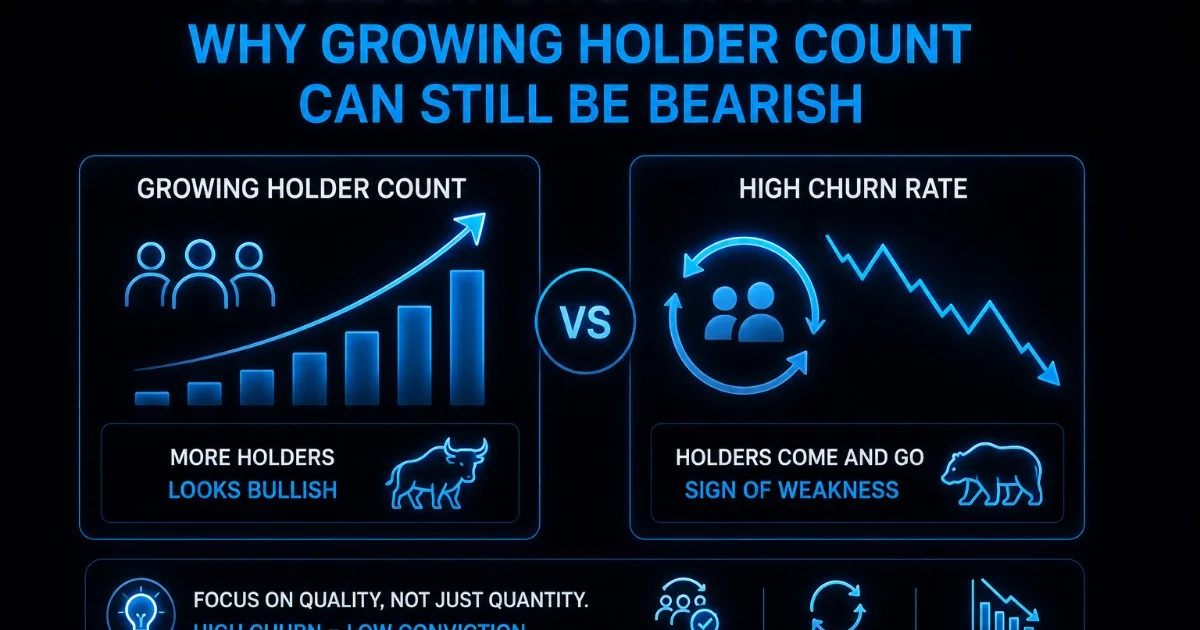
This is where holder churn rate becomes important. Holder churn rate measures how much the holder base is changing over time. It helps traders understand whether a token is building a stable community or constantly replacing old buyers with new ones.
What Is Holder Churn Rate?
Holder churn rate refers to the rate at which wallets enter and leave a token’s holder base. A healthy token may add new holders while keeping many existing holders. A weaker token may add new wallets but lose previous buyers at the same time.
The difference matters. If a token adds 1,000 new holders but loses 900 previous holders, the headline holder count may still look positive. However, the market may not be gaining strong conviction. It may simply be rotating from one group of short term buyers to another.
Holder growth shows quantity. Holder churn shows stability.
Why Holder Count Alone Is Not Enough
Holder count is easy to read, which is why many traders rely on it. The problem is that it does not show whether holders are staying, selling, accumulating, or abandoning the token.
A token can increase its holder count through tiny wallets, dust balances, airdrops, bot activity, or short term speculation. These wallets may not represent meaningful demand. If many of them sell quickly or hold insignificant amounts, the holder count becomes less useful.
A better question is not only how many holders the token has. The better question is how many holders remain engaged after buying.
When Growing Holder Count Can Be Bearish
A rising holder count can become bearish when new holders are replacing stronger old holders. This often happens when early or larger wallets sell into fresh demand. The chart may look active, and the holder count may rise, but the token may be losing its most committed participants.
This pattern can appear during promotional campaigns, influencer calls, exchange rumors, or trending market moments. New buyers arrive because the token is visible. At the same time, earlier buyers use the attention to exit.
The result is a holder base that grows in number but weakens in quality.
Signs of High Holder Churn
High holder churn often appears when many wallets buy and sell within a short period. The token may have frequent new entrants, but few wallets hold through volatility. Volume may look strong, but price struggles to move higher because new demand is constantly absorbed by sellers.
Another sign is a flattening or unstable holder base after a major spike. If many wallets enter during hype and then disappear soon after, the token may not be building durable interest.
A third sign is repeated turnover near the same price zone. If new buyers enter during every rally but quickly exit during every pullback, the token may be dominated by short term speculation.
Holder Churn vs Healthy Rotation
Not all holder rotation is bad. Healthy markets naturally have buyers and sellers. Some holders take profit, while new participants enter. This can be constructive if the token maintains liquidity, volume, and price structure.
Healthy rotation becomes visible when the market absorbs selling without losing momentum. Holder count grows, but existing holders do not disappear too quickly. The chart consolidates instead of collapsing. Liquidity remains stable or improves.
High churn becomes a problem when the token cannot retain buyers. If every new group of holders exits quickly, the market may struggle to form a strong base.
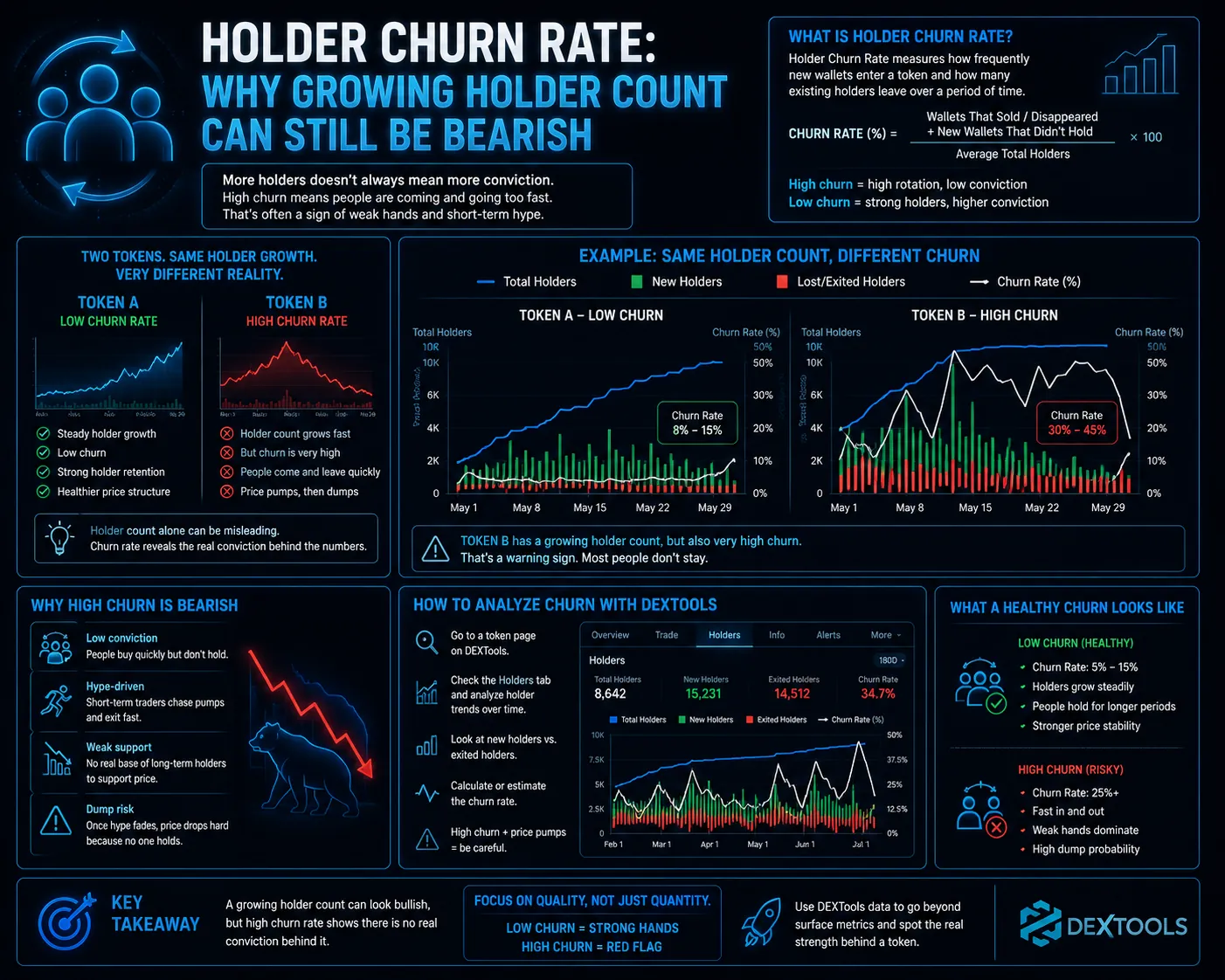
How DEXTools Helps Analyze Holder Churn
DEXTools can help traders evaluate whether holder growth is supported by real market strength. Start with the token pair page and review price action, volume, liquidity, transactions, and pair age. Then compare holder growth with market behavior.
If holders increase while volume remains healthy and liquidity stays stable, the token may be gaining real traction. If holders increase while price falls, liquidity weakens, and sells dominate transactions, the growth may be lower quality.
Traders should also watch how the chart reacts after holder spikes. A strong token often holds structure after new buyers arrive. A weak token may show a brief pump followed by heavy churn.
Practical Questions Traders Should Ask
Before treating holder growth as bullish, traders should ask whether existing holders are staying. They should check whether new holders are buying meaningful amounts or only tiny positions. They should consider whether larger wallets are reducing exposure while smaller wallets enter.
They should also ask whether holder growth is happening with organic volume or during a short promotional burst. If growth depends entirely on attention spikes, the holder base may be fragile.
Holder count is useful, but it needs context.
Conclusion
Holder churn rate gives traders a deeper view of token strength. A rising holder count can be bullish, but only when new holders are joining a base that remains stable. If the token is constantly replacing old buyers with new ones, the market may be weaker than it appears.
DEXTools helps traders study holder growth in context by combining it with liquidity, volume, transactions, and price behavior. This broader view can reveal whether a token is building conviction or simply recycling attention.
In crypto, more holders do not always mean more strength. Sometimes the real signal is who stays.
How to Bridge Crypto Between Chains: Complete Cross-Chain Tutorial 2026 How to Use 1inch for Swaps: Classic, Fusion and Limit Orders (2026) OKX Web3 Wallet Tutorial 2026: Multi-Chain Setup GuideThe Microstructure of Churn: Deconstructing the "Why"
Understanding the Holder Churn Rate goes beyond simply observing the metric; it demands a deeper dive into the underlying market microstructure. While a high churn rate might broadly signal weakness, the specific reasons for this churn are crucial for accurate interpretation. Is it driven by short-term speculation, a loss of confidence among a core group of early investors, or perhaps a strategic redistribution of tokens? Each scenario carries different implications for a token's long-term health and price trajectory.
For instance, a churn driven by early seed investors taking profits after a significant pump, while increasing the churn rate, might actually be healthy. It signifies liquidity entering the market and a broader distribution, potentially reducing future sell-pressure from large, concentrated holders. Conversely, a churn rate driven by a rapid succession of retail investors buying at peaks and selling at troughs, often indicates a lack of fundamental conviction and can be a significant red flag for sustained price action.
Practical Applications for DEXTools Users
- Cross-reference churn with transaction size: Are large wallets or small retail wallets driving the churn?
- Analyze the average holding period of churned wallets: Is it short-term flipping or longer-term holders exiting?
- Compare churn with new wallet creation: Is the rate of new holders significantly outpacing the rate of exiting holders?
- Examine the timing of churn: Does it coincide with major news, product launches, or market-wide volatility?
- Use DEXTools' 'Wallets' tab to identify specific large wallets contributing to churn and investigate their historical behavior.
Related Guides
- Holder Count vs Holder Quality in Token Analysis
- RWA Liquidity Quality: Why Tokenized Assets Can Be Real but Still Hard to Trade
- Apparent Liquidity vs Executable Liquidity: Why a Large Pool Can Still Give You a Bad Entry
- XRP Price Prediction 2030: Honest Bear/Base/Bull Analysis
- What Is a Bull Run and Bear Market in Crypto: Complete Guide (2026)
Frequently Asked Questions
What is holder churn rate?
Holder churn rate measures how quickly existing token holders sell their assets and are replaced by new holders. A high churn rate means many people are buying and selling, rather than holding long term. It indicates instability in the holder base.
Why can a growing holder count be bearish?
While a rising holder count seems positive, it can be bearish if accompanied by high churn. This suggests that new buyers are quickly replacing sellers, but not necessarily adding long-term conviction. It might indicate a rotating door of short-term traders rather than sustained adoption.
How does churn rate affect price stability?
High churn rate often leads to price instability. When many holders are short-term oriented, they are more likely to sell during price dips or minor rallies, creating sell pressure. This makes it harder for the asset to establish a stable price floor and sustain upward momentum.
What is the ideal holder profile for a crypto asset?
The ideal holder profile involves a growing number of holders who are also long-term oriented. This indicates strong conviction and belief in the asset's future. A low churn rate combined with increasing holders suggests genuine adoption and a more resilient community.