How to Spot Fake Crypto Communities: Bots and Shillers
— By Whatsertrade in Tutorials
Learn to spot fake crypto communities: detect bot followers, paid shillers and manufactured hype, and tell real projects from coordinated pump groups.
A strong community can help a crypto project grow. It can create awareness, attract liquidity, support holders, and keep attention alive during quiet markets. But not every active community is real.
Some token communities are manipulated by bots, paid shillers, fake engagement, and artificial FOMO. At first glance, they may look exciting. The Telegram is loud, X posts are full of comments, influencers are talking, and everyone seems convinced the token is about to explode.
The problem is that fake activity can create a dangerous illusion. Traders may buy because they believe thousands of people are interested, when the hype is actually manufactured.
This guide explains how to detect a manipulated crypto community before you buy. You will learn how to review social activity, engagement quality, Telegram behavior, influencer promotion, chart data, liquidity, and DEXTools signals.
Why Community Analysis Matters
In crypto, attention moves markets. A token with a real community can maintain interest longer than a token with no support. This is especially true for memecoins, narrative tokens, gaming tokens, and early stage DeFi projects.
However, community can also be used as a marketing weapon. Fake community activity can pressure traders into buying too late or ignoring obvious risks.
Community analysis helps you answer one question: is this attention real, or is it being manufactured to create exit liquidity?
Sign 1: Engagement Looks Repetitive
One of the easiest ways to spot fake activity is repetition. Bots and low quality shillers often post similar messages across X, Telegram, Discord, and comment sections.
Watch for phrases like "next 100x gem", "last chance to buy", "dev is based", "send it higher", "this is the next big thing", "do not miss this entry", "whales are coming", or "CEX listing soon".
These phrases are not always fake by themselves. The red flag appears when many accounts post the same style of message with no real discussion.
A real community usually has variety. People ask questions, challenge assumptions, share charts, discuss risks, talk about product updates, and disagree sometimes. A fake community often sounds like a copy and paste campaign.
Sign 2: Many Accounts Look Newly Created
Check the accounts promoting the token. If many were created recently, have few followers, post only about one token, or use generic profile pictures, the community may be inflated.
Red flags include accounts created in the last few weeks, no personal history, only reposting token content, no real conversations, the same hashtags repeated constantly, similar profile names or bios, and engagement from the same small group of accounts.
Fake communities often depend on networks of low quality accounts that exist only to amplify hype.
Sign 3: High Engagement, Low Quality Conversation
A post with many replies is not always meaningful. Look at the content of the replies.
Low quality engagement includes emojis only, one word comments, repeated slogans, identical bullish phrases, no questions about fundamentals, no discussion of risk, and no real user experience.
High quality engagement includes specific questions, product feedback, technical discussion, community debates, real user screenshots, detailed concerns, organic memes and jokes, and different writing styles.
Fake engagement is usually loud but shallow.
Sign 4: Telegram or Discord Does Not Allow Real Questions
A manipulated community often tries to control the conversation. If users ask normal questions and get banned, muted, or attacked, that is a warning sign.
Be cautious if the community blocks questions about liquidity, token supply, contract ownership, team identity, roadmap progress, utility, wallet distribution, previous projects, sell pressure, or exchange rumors.
A serious project should be able to handle reasonable questions. A community that only allows bullish comments may be trying to hide weaknesses.
Sign 5: Influencer Promotion Feels Coordinated
Influencer marketing is common in crypto. It is not automatically bad. The risk comes when many influencers promote the same token at the same time using similar talking points without disclosing incentives.
Warning signs include multiple influencers posting within a short time window, similar wording across posts, no mention of risk, unrealistic price targets, focus only on urgency, no explanation of tokenomics, no clear reason for the recommendation, and influencers deleting posts after price drops.
If the promotion feels coordinated, ask who benefits from the attention.
Sign 6: Social Hype Does Not Match On Chain Activity
A token can look viral on social media but weak on chain. This mismatch is important.
Use DEXTools to compare community hype with market data. Is volume actually increasing? Is liquidity growing? Are there real buyers? Are transactions diverse? Is the token trending for a reason? Are large wallets selling into social hype? Is market cap realistic compared with liquidity?
If social activity is exploding but liquidity is thin and large holders are selling, the hype may be designed to attract exit liquidity.
Sign 7: The Community Pushes Urgency Over Research
Fake FOMO depends on pressure. The goal is to make you buy before you think.
Common urgency tactics include "buy now before it is too late", "next candle will be huge", "announcement in minutes", "only early buyers will win", "do not fade this", "you will regret missing this", and "smart money is entering".
Real opportunities do not require you to ignore research. If the community makes you feel guilty, stupid, or late for asking questions, slow down.
Sign 8: Price Pumps When Promotion Starts, Then Sellers Appear
Watch the chart when a promotion campaign begins. If price pumps briefly and then sellers appear aggressively, early holders may be using community hype to exit.
On DEXTools, check the timing of large sells, whether sells follow influencer posts, whether buy pressure fades quickly, whether liquidity supports the market cap, whether the token makes lower highs after promotion, and whether the same wallets sell repeatedly.
The chart can reveal what the community does not say.
Sign 9: The Project Has No Real Updates
A community can be loud even when the project is not building anything. For some memecoins, culture itself may be the product. Even then, there should be signs of organic growth.
Be careful when a token depends only on constant raids, paid posts, countdown announcements, vague promises, fake partnership hints, CEX listing rumors, and price target memes.
If there are no meaningful updates, the community may need constant hype just to keep the token alive.
Sign 10: Dissent Is Treated as Betrayal
Healthy communities can handle skepticism. Manipulated communities often label any question as FUD.
Signs of unhealthy culture include attacking users who ask for details, banning sellers from chat, claiming all criticism is paid FUD, refusing to discuss contract risks, mocking people who take profits, and pressuring holders to never sell.
A real community can be optimistic without becoming hostile to reality.
How to Analyze a Crypto Community Before Buying
Use this practical process before entering a trade.
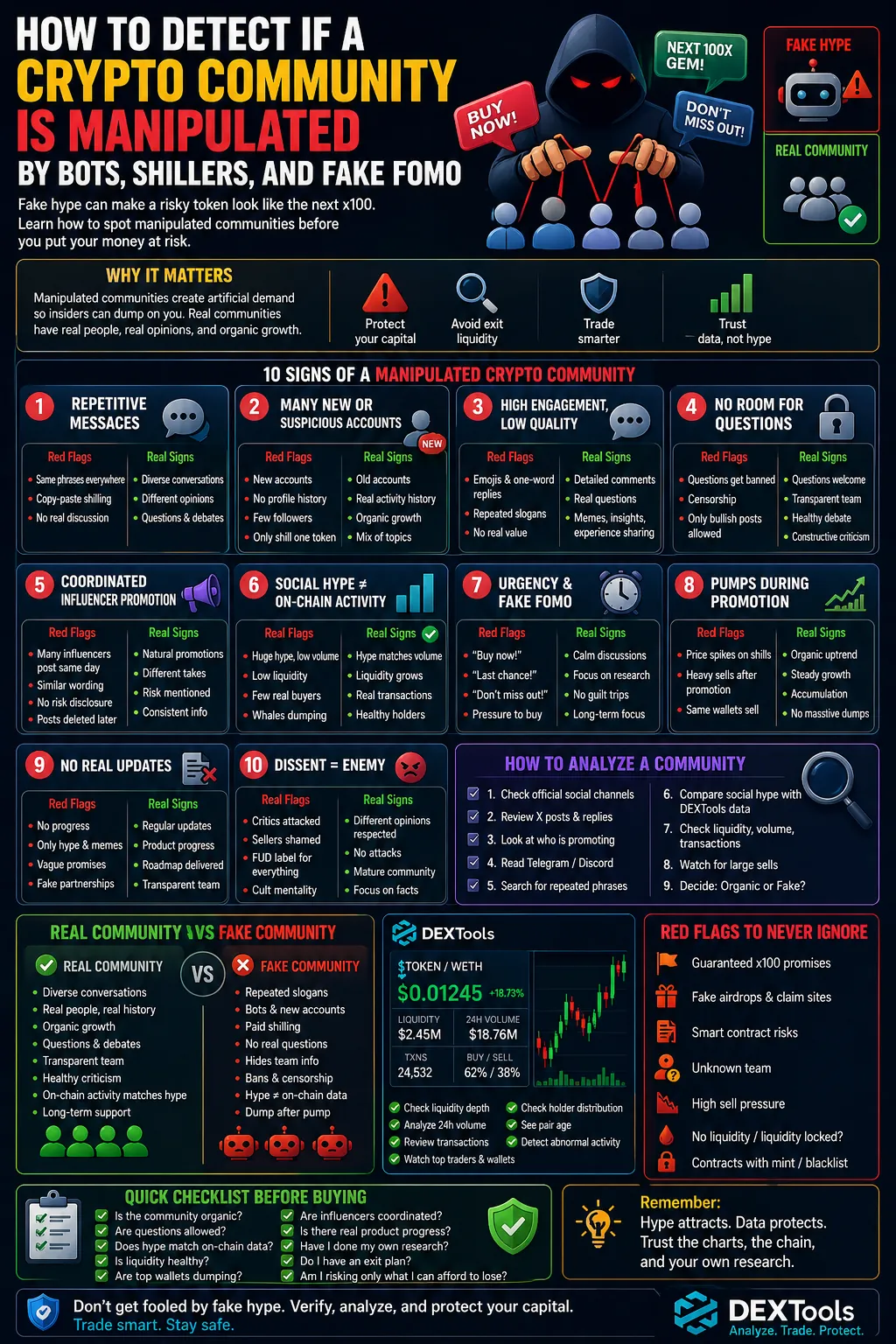
Check official social channels. Review recent X posts and replies. Look at who is promoting the token. Read Telegram or Discord for real discussion. Search for repeated phrases. Compare social hype with DEXTools volume and liquidity. Look for large sells during hype periods. Check whether questions are allowed. Review project updates. Decide whether the community feels organic or manufactured.
Do not rely on one signal. A community can have bots and still have real users. A project can use marketing and still be legitimate. The goal is to judge the balance.
Real Community vs Fake Community
A real crypto community often has mixed opinions, real questions, different writing styles, product discussion, organic memes, long term members, transparent updates, healthy debate, and on chain activity that matches attention.
A fake or manipulated community often has repeated slogans, newly created accounts, forced positivity, no risk discussion, aggressive shilling, coordinated influencer posts, high social noise but weak liquidity, bans for normal questions, and urgency based messaging.
Final Thoughts
Community is one of the most powerful forces in crypto, but it can also be manipulated. Fake FOMO, bots, and paid shillers can make a weak token look stronger than it is.
Before buying, study both the social layer and the market layer. Read the community, but also check DEXTools for liquidity, volume, transactions, and holder behavior.
The best traders do not buy because a chat is loud. They buy only after the attention, data, and risk profile make sense.
What is a fake crypto community?
A fake crypto community is a community where activity is inflated by bots, paid shillers, coordinated posts, or artificial engagement.
Are bots always a sign of a scam?
Not always, but heavy bot activity is a warning sign. It can make demand look stronger than it really is.
How can I spot fake FOMO?
Look for urgency, repeated slogans, unrealistic promises, and pressure to buy without research.
Can DEXTools help detect manipulated hype?
DEXTools can help compare social hype with actual market activity, including liquidity, volume, transactions, and price behavior.
Should I avoid every token with influencer promotion?
No. Influencer promotion is common. The risk is higher when promotion is coordinated, undisclosed, unrealistic, or disconnected from on chain data.
How to Bridge Crypto Between Chains: Complete Cross-Chain Tutorial 2026 How to Use 1inch: Complete DEX Aggregator Swap Tutorial (2026) How to Use OKX Web3 Wallet: Multi-Chain DeFi Hub Guide (2026)Frequently Asked Questions
What are crypto bots?
Crypto bots are automated software programs designed to execute trades or perform other tasks on cryptocurrency exchanges. They operate based on pre-set parameters and algorithms.
Who are crypto shillers?
Crypto shillers are individuals who promote a specific cryptocurrency, often with an agenda to inflate its price for personal gain. They might use social media or other platforms to spread positive but potentially misleading information.
How do you identify a fake crypto community?
Fake crypto communities often exhibit signs like an abundance of generic positive comments, lack of genuine discussion, and rapid growth in member count without corresponding engagement. Scrutinize the quality and depth of interactions.
What are common tactics of crypto scammers?
Scammers frequently employ tactics such as promising guaranteed high returns, creating urgency, and pressuring individuals to invest quickly. They might also impersonate legitimate projects or individuals.
Why is it important to research crypto projects thoroughly?
Thorough research helps in understanding a project's fundamentals, technology, and team, reducing the risk of falling victim to scams or misinformation. It enables informed decision-making in a volatile market.