How to Use DeDust on TON Safely: Guide 2026
— By Tony Rabbit in Tutorials

How to use DeDust on TON safely: understand volatile vs stable pools, check liquidity and slippage, and verify tokens with DEXTools before you swap.
To use DeDust safely, connect a trusted TON wallet, verify the asset before trading, understand if the pool is volatile or stable, and review slippage and execution quality before approving transactions. DeDust is a protocol for swaps and liquidity on TON, with unique architecture involving assets, vaults, pool types, and factories.
DeDust occupies a different conceptual space from a generic TON token-buying guide because it is not only a place to swap. It is a protocol design choice about how swaps and liquidity should behave on TON. That is why the official documentation spends real time on concepts such as assets, vaults, pool types, and the role of the factory. The average user does not need to memorize the architecture, but understanding the broad logic helps explain why DeDust feels different and what risks still remain once you start using it for real trades.
Quick answer: to use DeDust safely, connect a trusted TON wallet, verify the asset you intend to trade before using the interface, understand whether the pool is a volatile or stable route, review slippage and execution quality before approval, and treat liquidity and pool interactions as a different job from simple swapping. DeDust can be efficient, but efficiency is not the same thing as safety.
- DeDust is a TON DEX. The project describes itself as a decentralized exchange liquidity pool built natively on TON.
- Its design is more than branding. The docs explain concepts such as asset abstraction, vaults, and multiple pool types.
- Pool type matters. A stable pool and a volatile pool are not interchangeable just because both live inside the same app.
- Fast swaps can still be bad swaps. Wrong asset identity or weak liquidity turns good UX into bad execution.
- DEXTools still does the judgment work. DeDust helps you interact with the market, but DEXTools helps you inspect whether the market deserves the interaction.
What DeDust is on TON
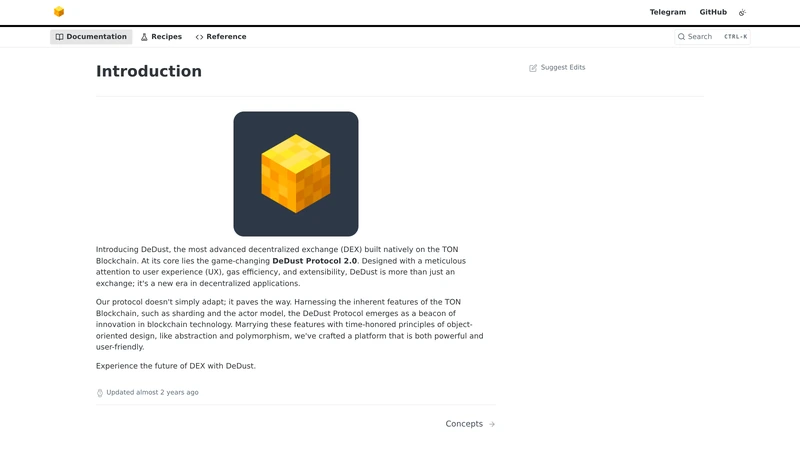
The official DeDust introduction calls it an advanced decentralized exchange built natively on the TON blockchain, with DeDust Protocol 2.0 at the center. That framing matters because it tells you the project is not trying to be just a clone of a generic DEX interface on another chain. It is trying to use TON-specific design choices to make swaps and liquidity interactions more efficient.
Trade TON with Not.Trade, the fastest terminal on TON
Not.Trade is purpose built for TON traders: real-time on-chain charts for every jetton, insider safety scoring (Top 10 wallets, snipers, dev movement, bundlers, LP lock), MCAP-trigger limit orders, multi-wallet sniping, MEV protection and one-click swaps routed across STON.fi and DeDust. It runs natively inside Telegram and as a fast web terminal, with TON Connect non-custodial wallet support.
Read the full Not.Trade guide →For the user, the important practical translation is simple. DeDust is one of the main venues where TON assets can be swapped and pooled. If you interact with TON-native liquidity seriously, you will eventually run into it. But the interface is only the last visible layer. Under it sits a system designed to handle TON's native asset and jettons through a more flexible internal architecture.
This guide is not a replacement for the broader Jettons-on-TON safety article. It is a platform-specific operating guide for users who want to understand what makes DeDust distinct before they start swapping or providing liquidity.
The DeDust asset model in plain English
One of the most useful pieces of the DeDust docs is the explanation of the Asset concept. Instead of designing everything around one token type only, DeDust uses an abstraction that can represent native TON, jettons, and additional asset types over time. That sounds technical, but it matters because it changes how the protocol handles transfers and pools without forcing everything through a wrapped-native-coin habit.
The docs also explain the role of Vaults. A vault is the component that receives and handles the asset type involved in the interaction, while the pool tracks reserves and pricing logic. In practice, this means users are dealing with a system built to handle the asset path more efficiently than a simplistic one-size-fits-all design.
You do not need to read the schema to use the DEX, but understanding that DeDust was designed around native TON and jettons helps explain why it is worth treating as a TON-native tool, not just another interchangeable swap page.
Volatile pools versus stable pools on DeDust
The DeDust docs distinguish between two important pool styles. A volatile pool uses the familiar constant-product logic, while a stable-swap pool is optimized for assets that should trade near each other in value, such as a stablecoin pair or a staking derivative versus its underlying reference.
This distinction matters more than most users expect. If you are swapping assets with very different market behavior, the volatile route is the natural mental model. If you are dealing with assets that are supposed to remain close in value, the stable route may offer better execution characteristics. Treating every pair the same simply because it lives inside DeDust is the wrong habit.
| Pool type | Best fit | Main user question |
|---|---|---|
| Volatile pool | Assets with normal market price movement | Is the liquidity deep enough for my size? |
| Stable pool | Assets expected to stay near the same value | Is the pair really stable in practice, or only in theory? |
That final question is important. A pair can be marketed as stable-adjacent and still drift when liquidity weakens or market conditions change. Stable-pool logic improves fit. It does not guarantee the economic relationship stays clean forever.
How to make a DeDust swap safely
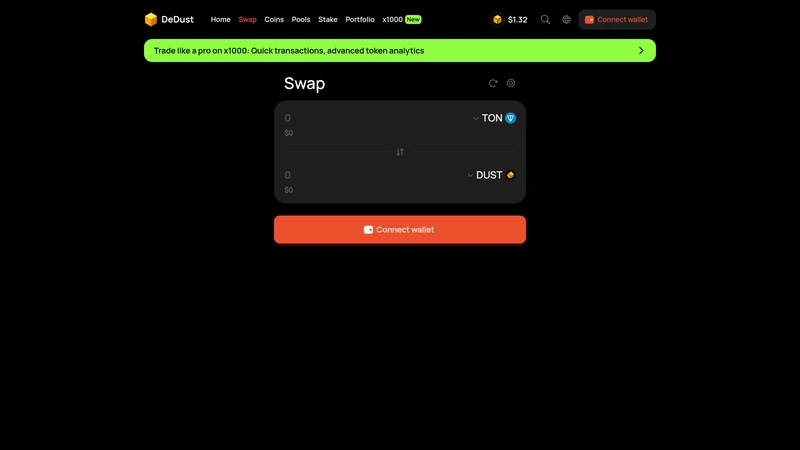
The user workflow begins the same way most safe TON workflows begin: open the real site, connect a wallet you control, verify the asset identity, and review the trade details before you approve anything. The faster TON gets, the more important the review step becomes.
Users should ask four questions before every DeDust swap. Is the input and output asset exactly what I intended? Is the pair using the pool type I think it is using? Does the quote reflect acceptable slippage and minimum received? And is this market strong enough that I would still want exposure after the trade lands?
- Confirm the real asset identity first.
- Look at the pool context, not only the swap box.
- Read the slippage and minimum-received fields carefully.
- Size small first if the route or asset is unfamiliar.
- Keep enough TON for later actions.
That last point matters because a smooth swap often creates a false sense of completion. If the token later needs to be moved, sold, or used elsewhere, running low on TON for fees becomes an annoying and very avoidable friction point.
Liquidity risk and why low fees are not the real cost
On TON, the visible network fee is often tiny. That is helpful operationally, but it is not the cost users should focus on. The real cost is usually execution quality. If the pair is thin, if the route is unstable, or if you are swapping into a weak market, then slippage and exit risk matter more than the fee number on the screen.
This is why slippage deserves attention in every serious DEX workflow. Users who obsess over gas savings while ignoring price impact are optimizing the wrong variable. A cheap bad trade is still a bad trade.
Stable pools add another nuance. Some users assume “stable” means “safe.” It does not. It means the pool design is optimized for assets that should remain close in value. If the asset relationship breaks, or if liquidity gets ugly, the pool label alone will not save the trade.
Providing liquidity on DeDust
DeDust is not only for swapping. The protocol is also about liquidity pools, and that means users may move from trader to liquidity provider. This is where the risk profile changes meaningfully.
As a liquidity provider, you are no longer only asking whether a trade quote looks fair. You are asking whether the pair deserves your capital to help make a market. That brings in pool composition risk, fee-generation expectations, and in many cases impermanent loss considerations. If the pair is unstable or narrative-driven, the LP position can behave much worse than a beginner expects.
The simplest rule is to learn DeDust in layers. First understand swaps. Then understand pool types. Only then consider LP exposure. If a user jumps straight from “I used the swap once” to “I should park serious funds in a pool,” they are skipping the part where risk actually becomes interesting.
Security, source verification, and user discipline
Most DEX mistakes are not protocol-whitepaper mistakes. They are operator mistakes. Wrong link, wrong token, wrong assumption, rushed approval. That is why self-custody safety habits matter just as much on DeDust as they do anywhere else on TON.
Use the real site, do not trust forwarded links blindly, and remember that a TON-native interface can still be paired with a bad asset or a bad social setup. A fake support account does not stop being fake just because it names a real DEX.
This is where the broader DEXTools security guide and wallet poisoning guide are still relevant. DeDust is a venue. User discipline is the defense layer that sits above every venue.
How DEXTools helps before you use DeDust
The cleanest workflow is to let DEXTools answer the market question before DeDust answers the execution question. Search the token or pair correctly, inspect liquidity and transaction quality, judge whether the market is actually deep enough, and then move to DeDust only if the trade still makes sense.
- Verify the token identity in DEXTools.
- Inspect liquidity depth and recent activity.
- Decide whether the pair deserves your size.
- Use DeDust for the execution once the market passes the test.
This approach matters even more on TON because low fees and fast confirmation can train users to move too quickly. DEXTools adds the deliberate pause that keeps “easy” from becoming “careless.”
How to think about DeDust versus STON.fi as a TON user
One way to strengthen a DeDust guide is to answer the question users actually ask in practice: when should I use DeDust instead of STON.fi? The correct answer is not tribal. It depends on the pair, the liquidity profile, and the type of action you are taking.
DeDust becomes especially interesting when its pool design or routing fit the asset relationship you are touching better than a generic “just swap it” mindset would suggest. The docs themselves emphasize that pool type matters, and that becomes more useful when users are working with stable-like pairs, paired ecosystem assets, or setups where understanding the pool architecture improves execution quality.
STON.fi may still feel simpler for many users because its brand association inside TON DeFi is already strong, but brand familiarity is not a routing argument. If a DeDust pair offers stronger conditions for the asset relationship you want, then DeDust can be the better venue. If not, the user should not force it just to feel more “TON-native.”
The safest habit is venue comparison after market validation. First verify the token and thesis. Then compare where the execution and liquidity look healthiest. That keeps protocol loyalty from overriding trade quality.
A realistic checklist before providing liquidity on DeDust
Most guides warn users about impermanent loss and stop there. That warning is correct, but incomplete. Before you provide liquidity on DeDust, you should know why this pair deserves passive capital, how the pool type affects your expectation, and what would make you remove liquidity later. If you cannot answer those questions, the LP position is probably being opened too casually.
Start with the pair logic. Are these assets naturally suited to a volatile pool or a stable pool? If the stable relationship is only aspirational, the pool design alone will not save the economics. Then ask whether the fees are likely to compensate for the risk you are taking. This requires realism, not farming optimism. A pool can sound productive while still being too small or too unstable to deserve real capital.
- Know the pair thesis: do not LP a pair just because you already hold both assets.
- Know the pool type: understand why the pool is volatile or stable and whether that fits the assets in practice.
- Know the exit trigger: decide in advance what market change would make you reduce or close the LP position.
- Know the opportunity cost: compare the LP plan against simply holding TON or holding the stronger asset alone.
That final point is underrated. Sometimes the best DeDust decision is to use the DEX for one swap and stop there. Not every user needs to become a liquidity provider just because the protocol supports it.
The right DeDust mindset for active traders
Active traders should think of DeDust as a precision venue, not a permission slip. The protocol may be efficient, but efficiency only helps when the user already knows what they are trying to achieve. If the plan is vague, fast routing simply accelerates vague execution.
A better habit is to define the trade first, the acceptable execution range second, and the venue third. That framing keeps DeDust in the role it handles best: implementing a decision that was already made carefully.
Final takeaway: DeDust is worth using when you want a TON-native DEX with deeper architectural logic than a superficial swap box. Just make sure you understand what job you are doing each time: simple swap, stable-pair route, or liquidity exposure. That distinction is where most good decisions begin.
Disclaimer: This draft is for educational purposes only and does not constitute investment, financial, or technical implementation advice. DeFi risks remain real even on efficient networks.
Related Guides
- How to Use Raydium on Solana: Swaps, Liquidity Pools and CLMM Guide (2026)
- How to Use Curve Finance: Stablecoin Swaps, Pools and Slippage Guide (2026)
- Top 3 TON Trading Terminals 2026: Not.Trade vs STON.fi vs DeDust
- DeDust vs STON.fi: Complete TON DEX Comparison Guide (2026)
- TON Validators and Nominator Pools: Complete Architecture Guide (2026)
Frequently Asked Questions
What is DeDust used for on TON?
It is mainly used for swaps and liquidity provision across TON-native assets and jettons.
Why does DeDust talk about volatile and stable pools?
Because different asset relationships need different pool logic and should not be treated as identical.
Is DeDust safer than other TON DEXes?
No DEX label removes the need for token verification, source verification, and liquidity judgment.
Should I provide liquidity on DeDust right away?
Usually not. Most users should understand swap behavior and pool types first.
Why would I still use DEXTools if I already have the DeDust interface open?
Because DEXTools helps you judge the token and market quality before the swap itself.