How to Stake and Unstake ETH on Coinbase (2026)

Learn how to stake and unstake ETH on Coinbase in 2026: cbETH liquidity, waiting periods, exit routes, staking fees and what changes when you exit.
Intent check: This page is the operational stake-and-unstake guide, focused on cbETH, exit mechanics, fees, and getting out. If you want the simpler beginner setup and rewards overview first, read How to Stake ETH on Coinbase.
How to Stake and Unstake ETH on Coinbase: The 2026 Complete Guide
If you hold Ethereum on Coinbase and you are not staking it, you are leaving money on the table. In 2026, Coinbase ETH staking has matured into one of the most accessible yield products in crypto, generating roughly 2.8% to 3.5% APY with a single click, no 32 ETH minimum, and a liquid wrapper token (cbETH) that lets you exit without waiting for the network queue. But the convenience comes with a price: a 25% commission on rewards, regulatory restrictions in several US states, and an exit process that surprises most users the first time they try it.
This guide walks through every step of staking and unstaking ETH on Coinbase in 2026. You will learn how to enable staking on web and mobile, how cbETH liquid staking actually works, how to calculate your true after-fee yield, what changed after the 2023 SEC settlement, and how Coinbase compares against Kraken, Binance, Lido, Rocket Pool, and running your own validator. Every number, fee, and procedure here reflects the current 2026 product, including the post-Pectra and Fusaka upgrades that reshaped how Ethereum validators operate.
Whether you are a first-time staker with 0.05 ETH or a long-term holder looking to optimize a six-figure position, this article gives you the framework, the fee math, and the comparison tables to decide whether Coinbase is the right venue for your ETH yield strategy in 2026.
What Is ETH Staking on Coinbase?
ETH staking on Coinbase is a custodial service where Coinbase runs Ethereum validator nodes on your behalf using your deposited ETH, and shares the staking rewards with you after deducting a 25% commission. You keep beneficial ownership of the staked ETH, Coinbase handles the technical work (validator uptime, key management, slashing protection), and you receive a portion of the network's issuance and priority fees as yield.
Unlike solo staking, you do not need 32 ETH, you do not run any hardware, and you do not manage validator keys. Unlike DeFi liquid staking protocols, you do not interact with smart contracts directly. The trade-off is custody: your staked ETH lives inside Coinbase's infrastructure, and your access to it depends on Coinbase remaining solvent, compliant, and operational.
A Short History of Ethereum Staking on Coinbase
Coinbase launched ETH staking in 2021, shortly after Ethereum's Beacon Chain went live in December 2020. The product was opt-in, custodial, and rewarded users with native ETH that accrued daily on their dashboard. In June 2021, Coinbase introduced cbETH, a wrapped liquid staking token (LST) that represented staked ETH plus accrued rewards, giving users an exit valve before The Merge enabled native withdrawals.
The product hit regulatory turbulence in February 2023, when the SEC sued Kraken over its staking-as-a-service offering, forcing Kraken to shut down US staking entirely. Coinbase faced the same scrutiny, and in June 2023 the SEC filed suit against Coinbase alleging that its staking service was an unregistered security. State regulators in California, New Jersey, South Carolina, Wisconsin, Maryland, Vermont, and others ordered Coinbase to suspend new ETH staking enrollments for residents of those states.
In 2024 and 2025, the regulatory tide turned. Following the broader political shift, the SEC dropped its case against Coinbase in early 2025, and state-by-state, most of the original restrictions were lifted or restructured. By 2026, ETH staking is available to Coinbase users in nearly every US state, with a small number of holdouts still requiring residents to use Coinbase Wallet's non-custodial routes instead of the integrated exchange product.
On the protocol side, the Ethereum Shanghai upgrade in April 2023 enabled validator withdrawals for the first time, the Dencun upgrade in March 2024 reduced Layer 2 fees through blob transactions, the Pectra upgrade in 2025 raised the Maximum Effective Balance (MaxEB) from 32 ETH to 2,048 ETH per validator and added EIP-7251 consolidations, and the Fusaka upgrade in early 2026 introduced PeerDAS and further validator efficiency improvements. Each of these changes affected Coinbase's operational cost structure and, indirectly, the yield it can offer.
How Coinbase ETH Staking Actually Works
When you click Stake on Coinbase, your ETH does not get teleported into a single validator. Coinbase aggregates user deposits into batches of 32 ETH (or larger consolidated stakes post-Pectra), spins up new validator nodes on the Ethereum Beacon Chain, and registers them with Coinbase Cloud's institutional validator infrastructure. Your individual position is tracked as a pro rata claim against the pooled validator set.
Rewards on Ethereum come from two sources: consensus layer issuance (newly minted ETH paid to validators for proposing and attesting blocks) and execution layer rewards (priority fees and MEV from blocks that the validator proposes). Coinbase captures both, deducts its 25% commission, and credits the remainder to your staked ETH balance daily. The rewards accumulate as additional staked ETH, compounding automatically.
The pooled architecture has two important consequences. First, your effective APY is averaged across the entire Coinbase validator set, so it is more stable than running a single validator (where one slashing event could wipe out months of rewards). Second, your unstake request enters the Ethereum network exit queue, but Coinbase processes it as part of a larger batch, which can either speed up or slow down your individual exit depending on internal scheduling.
How to Stake ETH on Coinbase: Step by Step (Web and Mobile)
The full enrollment flow takes under two minutes once your account is verified. Here is the exact sequence for both the web app and the mobile app in 2026.
Web App Flow
- Verify your account: Sign in to coinbase.com and confirm that your KYC is at Level 2 or higher. Staking requires full identity verification because rewards are reported as taxable income.
- Confirm your state eligibility: On your home dashboard, look for a banner if staking is unavailable in your jurisdiction. Most US states are eligible in 2026, but a handful still require Coinbase Wallet instead of the exchange.
- Buy or deposit ETH: You need ETH in your spot balance. Buy with USD via ACH (free, T+3), wire (instant, fee applies), or transfer from an external wallet (gas fee paid by you).
- Open the Ethereum asset page: Click Assets, scroll to Ethereum, click the row to open the asset detail page.
- Click Earn or Stake: On the right side of the asset page, you will see an Earn module showing the current estimated APY. Click Stake ETH.
- Enter amount and confirm: Type the amount of ETH you want to stake (any fraction is allowed). Review the disclosed APY, commission, and unstaking terms. Click Confirm Stake.
- Wait for warm-up: The first reward credit typically appears within 1 to 4 days, depending on how quickly Coinbase assigns your stake to an active validator.
Mobile App Flow
- Open the Coinbase mobile app and tap the Earn tab in the bottom navigation.
- Find Ethereum in the list of stakeable assets and tap it.
- Tap the orange Stake button.
- Enter the amount, slide to confirm.
- Enable biometric confirmation if prompted.
The Coinbase mobile app surfaces staking more aggressively than the web app, which is why most retail enrollments happen on mobile. The Earn tab also lets you stake other assets like SOL, ADA, MATIC, and DOT through the same workflow.
What Is cbETH and Why It Matters
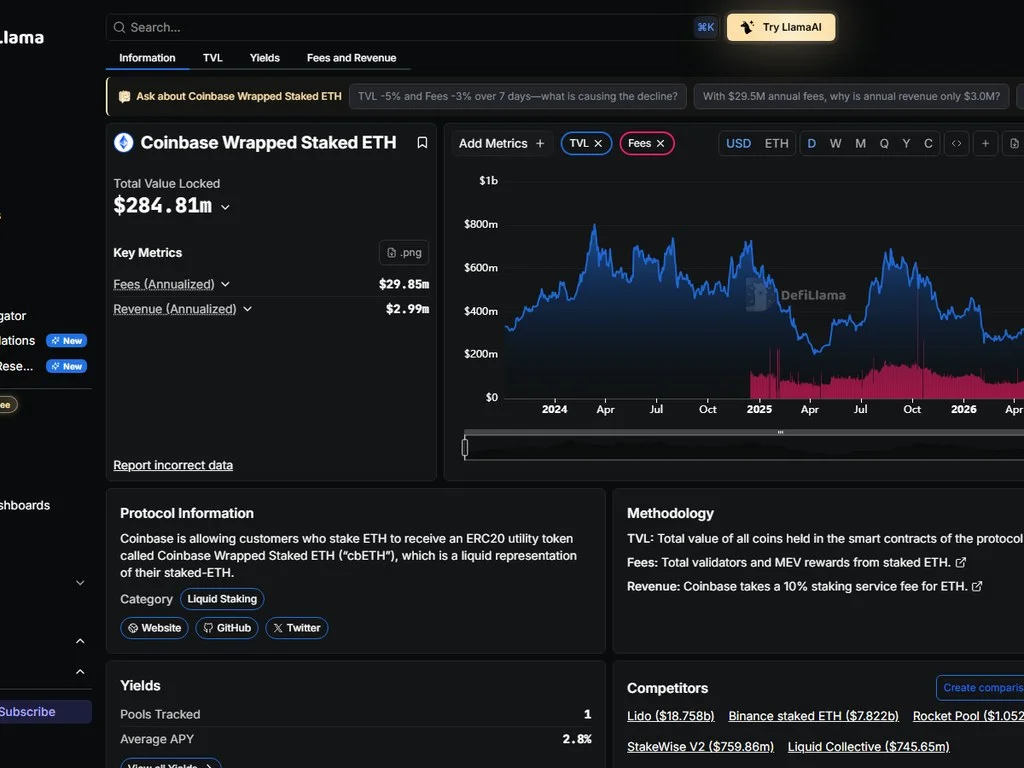
cbETH (Coinbase Wrapped Staked ETH) is the ERC-20 liquid staking token that represents your Coinbase-staked ETH plus accrued rewards. It is the single most important feature differentiating Coinbase from a pure custodial staking service. Unlike vanilla staked ETH on Coinbase, cbETH is freely transferable, tradeable on decentralized exchanges, usable as DeFi collateral, and bridgeable to Layer 2 networks.
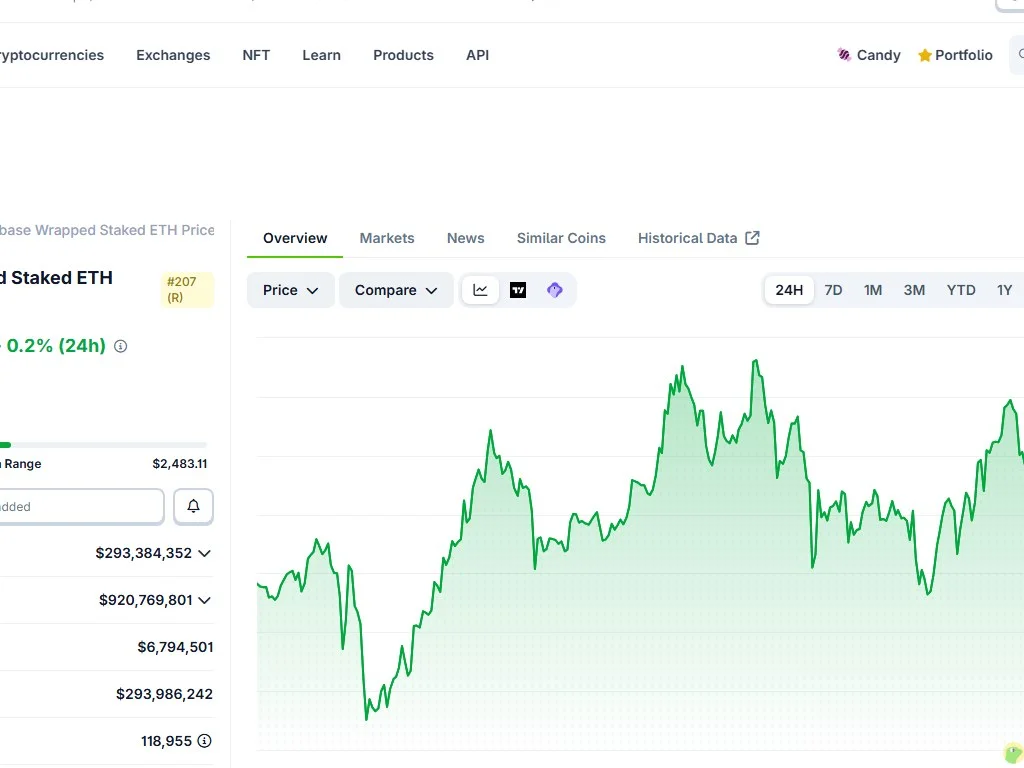
The token uses a non-rebasing design. Instead of your cbETH balance increasing over time, the exchange rate between cbETH and ETH gradually rises as rewards accrue. As of mid-2026, 1 cbETH is worth approximately 1.11 ETH, reflecting roughly three years of compounded staking yield since cbETH launched in 2022. This makes cbETH easier to integrate with DeFi protocols, since most smart contracts handle fixed balances better than rebasing tokens.
| Total cbETH supply | ~1.1M cbETH |
| cbETH/ETH exchange rate | ~1.11 |
| Deepest DEX pool | Uniswap V3 cbETH/ETH 0.01% |
| Typical peg deviation | 0.05% to 0.30% |
| Major DeFi integrations | Aave, Morpho, Compound, Balancer |
| Cross-chain availability | Base, Arbitrum, Optimism |
To wrap your staked ETH into cbETH inside Coinbase, navigate to your staked ETH position and select Wrap to cbETH. The wrap is instant and free (Coinbase does not charge a fee on the conversion itself). Once you hold cbETH, you can withdraw it to any Ethereum-compatible wallet and sell it on Uniswap V4, route it through 1inch for best execution, or deploy it as collateral in DeFi lending markets.
The liquidity profile of cbETH is healthy but thinner than stETH from Lido. A $5 million swap on Uniswap V3 typically incurs 0.10% to 0.25% slippage in normal conditions. During stress events (such as the March 2023 USDC depeg), cbETH has temporarily traded at discounts of 1% to 3% below its intrinsic value, which historically reverts as arbitrageurs execute the on-chain unwrap.
How to Unstake ETH on Coinbase: Three Exit Paths
Unstaking is where most users get tripped up. Coinbase offers three distinct exit paths in 2026, and the right choice depends on how fast you need liquidity and whether you are willing to pay for it.
Path 1: Standard Unstaking (Network Queue)
This is the default route and the cheapest. When you click Unstake and choose Standard, your request is submitted to the Ethereum exit queue. The Beacon Chain limits how many validators can exit per epoch (currently around 8 to 16 full exits per epoch, equivalent to 1,800 to 3,600 validators per day across the entire network). Coinbase batches user requests against the validators it operates, so your individual wait time depends on both network congestion and Coinbase's internal scheduling.
In 2026, the typical Standard Unstaking time on Coinbase ranges from a few hours to 5 days. During calm periods, exits process in under 24 hours. During stress events (large depegs, ETF flows, or governance crises) the queue can extend to 7 to 10 days. There is no fee for Standard Unstaking other than network gas costs, which Coinbase absorbs.
Path 2: Instant Unstaking (Coinbase Liquidity)
For users who cannot wait, Coinbase offers Instant Unstaking. You pay a fee of typically 0.25% to 1.0% of the unstaked amount, and Coinbase converts your staked ETH back to liquid ETH immediately using its internal liquidity pools. The fee is dynamic and rises during periods of high demand or thin internal liquidity.
Instant Unstaking is available for most positions but caps out at a per-user daily limit (currently around $250,000 USD equivalent, though VIP tiers can negotiate higher caps). This is the simplest exit if you need liquid ETH within the same minute.
Path 3: Wrap to cbETH and Sell On-Chain
The third path skips the Unstake button entirely. You wrap your staked ETH into cbETH (free, instant), then sell the cbETH on the open market for ETH, USDC, or stablecoins. This route is ideal when:
- You are exiting a position larger than the Instant Unstaking daily cap
- cbETH is trading near or above its intrinsic exchange rate (no liquidity penalty)
- You want to deploy proceeds into DeFi rather than receive USD
- You want to avoid Coinbase's Instant fee while still skipping the network queue
The downside is slippage and gas. A large cbETH sale on a DEX will incur some price impact, and you pay Ethereum gas to execute the swap. For positions under $10,000 the Instant Unstaking fee is usually cheaper than gas plus slippage. For positions above $50,000, cbETH wrap-and-sell often wins on net cost.
2026 APY and Fee Math: What You Actually Earn
The number Coinbase shows you on the staking page is a forward-looking estimate, not a guarantee. The real yield depends on the live network APR (which fluctuates with how many validators are active and how much MEV flows through your proposer slots) and Coinbase's commission. Here is the breakdown for 2026.
| Network gross issuance APR | ~2.9% |
| Average MEV / priority fee yield | ~1.3% |
| Total gross validator APR | ~4.2% |
| Coinbase commission | -25% |
| Net Coinbase staking APY to user | ~3.15% |
| Solo staking net APY (no fee) | ~4.2% |
| Lido net APY (10% fee) | ~3.78% |
| Rocket Pool rETH net APY (~14% fee) | ~3.61% |
The 25% commission is the highest among major staking providers, and it is the single largest drag on Coinbase yield. On a $100,000 ETH stake, the difference between Coinbase (3.15% net) and Lido (3.78% net) is roughly $630 per year. Over a five-year holding period at constant APR, that gap compounds to about $3,400. For active DeFi users, the trade-off is whether Coinbase's convenience, slashing protection, and US fiat off-ramp justify the spread.
Coinbase vs Kraken vs Binance vs Liquid Staking vs Solo
The 2026 ETH staking landscape has five distinct categories, each with its own risk and reward profile. Pick the one that matches your priorities: convenience, yield, decentralization, or regulatory certainty.
When Coinbase Wins
Coinbase is the right choice if you value regulatory clarity in the US, want one-touch tax reporting through Coinbase's 1099-MISC integration, need fiat off-ramps in the same account, are starting with a small ETH position where DeFi gas fees would exceed the yield difference, or simply do not want to manage wallet keys and DeFi exposure.
When Liquid Staking Wins
Liquid staking via Lido (stETH) or Rocket Pool (rETH) wins when you want maximum on-chain composability, lower fees, exposure to DeFi yield stacking (lending stETH on Aave, using rETH as collateral on Morpho), or you want to avoid concentrated custodial risk. Lido's decentralization profile has improved since 2024 governance reforms that capped any single node operator's share of the validator set.
When Solo Staking Wins
If you hold 32 ETH or more and you are willing to maintain hardware (or use a managed validator service like Allnodes or Stakefish), solo staking gives you the full 4.2% APR with no commission. The Pectra upgrade's MaxEB increase to 2,048 ETH means you can consolidate multiple validators into one, reducing operational overhead. The trade-off is responsibility: a misconfiguration that causes downtime or, worse, double-signing can lead to slashing penalties that no insurance will cover.
Coinbase Exchange Staking vs Coinbase Wallet Staking
An important distinction many users miss: Coinbase the exchange and Coinbase Wallet are two different products with two different staking approaches.
Coinbase Exchange Staking is the custodial product described throughout this article. Coinbase holds the ETH, runs the validators, takes 25%, and credits rewards to your exchange balance. You access it through coinbase.com or the main Coinbase app. It is the simplest path but you do not control the keys.
Coinbase Wallet Staking is a non-custodial mobile interface (Coinbase Wallet app, separate from the Coinbase exchange app) that routes you to third-party staking protocols like Lido, Rocket Pool, or Coinbase's own permissioned validator service. You control the private keys, the staking happens on-chain via smart contracts, and Coinbase does not custody your ETH. This is the path used by residents of states where exchange staking is restricted, and by users who want non-custodial yield without leaving the Coinbase brand.
For most users, Coinbase Exchange Staking is the right product. For users who want self-custody or live in states with residual restrictions, Coinbase Wallet routed to Lido or Rocket Pool is the workaround.
US State Availability and the Post-SEC Settlement Landscape
The 2023 to 2025 regulatory saga left a patchwork of state-level rules that mostly resolved by 2026. As of May 2026, Coinbase Exchange ETH staking is available to residents in approximately 45 US states. The handful of states with residual restrictions either require Coinbase to use a slightly different disclosure or route users through Coinbase Wallet's non-custodial paths.
Before staking, the Coinbase interface will check your declared residency and block enrollment if your state is restricted. Always confirm directly in the app rather than relying on third-party lists, since regulations are still evolving and the state map can shift quarter by quarter.
Tax Treatment of Coinbase ETH Staking Rewards
In the United States, the IRS issued Revenue Ruling 2023-14 clarifying that staking rewards are taxable as ordinary income at fair market value on the date the taxpayer gains dominion and control over the rewards. For Coinbase ETH staking, this means each daily reward credit creates a taxable event at the ETH/USD price at the moment of credit.
Coinbase issues a Form 1099-MISC to US users who earned more than $600 in staking rewards in a calendar year. The form aggregates the USD value of all reward credits. When you eventually sell the staked ETH (or the cbETH wrapping it), you trigger a separate capital gains event based on the difference between sale price and the cost basis you established when the reward was credited.
Outside the US, tax treatment varies. The UK treats staking rewards as miscellaneous income, Germany applies its 10-year holding rule, Portugal generally exempts long-term crypto gains, and most of the EU is converging on the MiCA framework. Always consult a local tax advisor familiar with crypto staking.
Risks of Staking ETH on Coinbase
Coinbase staking is among the lowest-friction staking products in crypto, but it carries real risks that any honest guide must surface.
Your ETH lives inside Coinbase's infrastructure. A solvency event, court-ordered freeze, or operational outage could block your access. Coinbase publishes audited proof-of-reserves but custody risk is non-zero.
If a Coinbase validator misbehaves (double signs, downtime), the network slashes the staked ETH. Coinbase historically absorbs slashing losses on behalf of users, but this is a discretionary commercial commitment, not a contractual guarantee.
The SEC settled with Coinbase in 2025, but future administrations could revisit staking-as-a-service classification. State-level restrictions remain a moving target. A reclassification could force suspension of US staking.
During stress events the exit queue can grow to weeks, Instant Unstaking fees spike, and cbETH can trade at a discount. Plan exits before you need the cash, not after.
cbETH is an ERC-20 contract. A bug in the wrapper logic or in any DeFi protocol you deploy cbETH into could result in loss. Coinbase has audited the contract but smart contract risk never reaches zero.
Coinbase operates roughly 10% to 12% of all Ethereum validators in 2026. Critics argue this validator concentration is a systemic risk to Ethereum decentralization, which could trigger protocol-level countermeasures (validator caps, reduced rewards for large operators).
Best Practices for Coinbase ETH Stakers
- Enable hardware 2FA: Use a YubiKey or equivalent, not SMS. Staking creates a long-lived position that is an attractive target for SIM swap attacks. Read our guide on crypto wallet security.
- Set up a Coinbase Vault: Keep your non-staked ETH (the buffer you may use for emergencies) in a Vault with time delay withdrawals.
- Stake in tranches: If your position is large, stake in two or three tranches a few days apart so your rewards do not all credit on the same day, smoothing your tax reporting and exit timing.
- Track your cost basis: Export your reward history every quarter. Coinbase's tax center is solid but you should maintain an independent record.
- Decide your exit plan in advance: Before you stake, know whether you will use Standard Unstaking, Instant, or cbETH. The cost difference is meaningful at scale.
- Monitor cbETH peg: If you hold cbETH long-term, set a price alert for a 1% or larger deviation from intrinsic value, which historically signals stress or arbitrage opportunity.
- Diversify staking venues: For positions above $50,000, consider splitting between Coinbase, Lido, and one other to reduce single-venue concentration.
- Understand gas fees: If you plan to wrap to cbETH and withdraw on-chain, time the withdrawal to a low-gas window.
Pros and Cons of Coinbase ETH Staking
- No minimum, no hardware, no validator keys
- One-click enrollment on web and mobile
- cbETH liquid wrapper for instant on-chain exit
- Coinbase-absorbed slashing protection (historically)
- Integrated tax reporting via 1099-MISC
- Direct USD off-ramp in same account
- Regulatory clarity post-2025 SEC settlement
- 25% commission is the highest of major providers
- Custodial: you do not hold the keys
- Instant Unstaking has daily caps and dynamic fees
- cbETH liquidity thinner than stETH
- Some US states still restricted
- Validator concentration concern (~10% of network)
- No DeFi composability inside the exchange UI
Worked Example: Three Investor Profiles
To make the trade-offs concrete, here are three realistic 2026 investor profiles and the optimal strategy for each.
Profile 1: Maria, $2,000 First-Time Staker
Maria buys 0.5 ETH on Coinbase and wants passive yield. She is not technical, lives in California, and has never used a DeFi protocol. Recommendation: Stake the full 0.5 ETH on Coinbase Exchange. The 25% commission costs her about $4 per year compared to Lido, but the gas fees and learning curve of DeFi would erase any savings. She uses Standard Unstaking when she eventually exits.
Profile 2: David, $80,000 DeFi-Native Holder
David holds 20 ETH and is comfortable with self-custody. Recommendation: Split the position: stake 5 ETH on Coinbase for the convenience, off-ramp, and slashing protection, and stake 15 ETH via Lido (stETH) or Rocket Pool (rETH) for higher yield and DeFi composability. Use rETH as collateral to borrow stablecoins for opportunistic trades. Total weighted net APY: ~3.62%. He can monitor pair liquidity and on-chain action through tools like the DEXTools Ethereum dashboard.
Profile 3: Karen, $400,000 Long-Term Investor
Karen holds 100 ETH and prioritizes simplicity, US tax compliance, and avoiding single-venue concentration. Recommendation: Diversify across three venues: 40 ETH on Coinbase Exchange (custodial, easy tax reporting), 40 ETH on Lido stETH held in a hardware wallet (highest yield, self-custody), and 20 ETH via solo staking through a managed service like Allnodes (full ~4.2% APR, decentralization contribution). Blended net APY: ~3.71%. The diversification protects against any single venue failure.
Connecting Coinbase Staking to the Broader 2026 Crypto Stack
ETH staking does not exist in isolation. Your staking decision interacts with the rest of your crypto portfolio, your DeFi positions, and your trading workflow. A few connection points to consider:
If you also trade ERC-20 tokens, your unstaked ETH balance covers gas, but staked ETH does not. Always keep a small buffer of liquid ETH for transactions. If you use lending markets, cbETH is accepted as collateral on Aave, Compound, and Morpho, letting you borrow stablecoins against your staked position without exiting. Be aware of liquidation thresholds, which you can monitor through liquidation zone analytics.
If you trade with leverage on perpetuals, the difference between your staked APY and your funding rate cost is the spread you are actually earning. In a contango funding environment, your cbETH-backed long synthetic ETH position can compound both staking yield and trading PnL. Watch for long versus short positioning imbalances that can predict funding rate flips.
For analytical traders, knowing when to enter or exit a staked position is its own discipline. Tools like VWAP for sizing entries, backtesting for validating rotation strategies, and on-chain dashboards for monitoring validator queue dynamics all feed into a coherent staking strategy.
Frequently Asked Questions
Q Q Q How do I stake ETH on Coinbase?
Open the Coinbase app or coinbase.com, navigate to your Ethereum asset page, click Stake, enter any amount (there is no minimum), and confirm. Rewards begin accruing within 1 to 4 days and credit daily to your staked ETH balance, with Coinbase taking a 25% commission.
Q Q Q How do I unstake ETH on Coinbase?
You have three options. Standard Unstaking is free but takes hours to 10 days via the Ethereum exit queue. Instant Unstaking is immediate but costs 0.25% to 1.0%. Wrapping to cbETH and selling on a DEX is fast and often cheapest for large positions, but you pay gas plus slippage.
Q Q Q What is the minimum amount to stake ETH on Coinbase?
There is no minimum. You can stake any fraction of an ETH, even 0.001 ETH. Coinbase pools user deposits to fill 32 ETH validator slots, so individual users do not need to reach that threshold.
Q Q Q What APY does Coinbase pay for ETH staking in 2026?
Approximately 2.8% to 3.5% net APY, depending on network conditions. The gross validator APR is roughly 4.2% (about 2.9% issuance plus 1.3% MEV and priority fees), and Coinbase deducts a 25% commission, leaving the user with about 3.15% on average in May 2026.
Q Q Q How long does it take to unstake ETH on Coinbase?
Standard Unstaking typically takes a few hours to 5 days, occasionally up to 10 days during periods of high exit queue congestion. Instant Unstaking returns liquid ETH within the same minute. Selling cbETH on a DEX is immediate but requires a separate withdrawal step.
Q Q Q What is cbETH and how does it work?
cbETH is Coinbase Wrapped Staked ETH, an ERC-20 liquid staking token that represents your staked ETH plus accrued rewards. It uses a non-rebasing design: instead of your balance growing, the cbETH/ETH exchange rate rises over time. You can wrap and unwrap inside Coinbase for free, or sell cbETH on DEXs and DeFi protocols for instant liquidity.
Q Q Q Is ETH staking on Coinbase available in all US states?
As of May 2026, ETH staking is available in approximately 45 US states. Following the 2025 SEC settlement, most of the state restrictions imposed in 2023 have been lifted. A small number of states still require residents to use Coinbase Wallet (non-custodial routing to Lido or Rocket Pool) instead of the Exchange staking product. The app checks your eligibility automatically.
Q Q Q How are Coinbase staking rewards taxed in the US?
Per IRS Revenue Ruling 2023-14, staking rewards are taxable as ordinary income at fair market value when received. Coinbase issues a 1099-MISC for users earning over $600 per year. When you later sell the staked ETH, you also owe capital gains based on the difference between sale price and the cost basis set when the reward was credited.
Q Q Q Is Coinbase ETH staking safe?
It is one of the lower-risk paths in crypto staking, but not risk-free. Custodial risk, regulatory risk, and liquidity risk during stress events remain. Coinbase historically absorbs slashing penalties on behalf of users but this is a commercial commitment, not a contractual guarantee. Diversifying across venues reduces exposure to any single failure mode.
Q Q Q Can I lose money staking ETH on Coinbase?
Your principal is subject to ETH price volatility regardless of staking. The staking itself rarely loses principal: slashing events on Coinbase have been rare and Coinbase has historically reimbursed affected users. The main loss vector is opportunity cost (lower net APY than competitors) and liquidity discount during stress events when selling cbETH below intrinsic value.
Q Q Q How does Coinbase staking compare to Lido and Rocket Pool?
Coinbase charges 25% commission for a net APY of about 3.15%. Lido charges 10% for about 3.78%. Rocket Pool charges about 14% for around 3.61%. Lido and Rocket Pool are non-custodial and DeFi-composable, while Coinbase is custodial with US fiat off-ramp and tax integration. For yield-maximizers, liquid staking wins; for simplicity, Coinbase wins.
Q Q Q What is the difference between Coinbase Exchange and Coinbase Wallet staking?
Coinbase Exchange staking is custodial: Coinbase holds the ETH and runs the validators. Coinbase Wallet staking is non-custodial: the Coinbase Wallet app routes you to on-chain staking protocols like Lido or Rocket Pool while you keep your private keys. Exchange is simpler; Wallet is self-custodied and used by residents of restricted states.
Conclusion: Should You Stake ETH on Coinbase?
For most retail ETH holders in the US in 2026, Coinbase staking is the path of least resistance and the right starting point. You get a one-click yield product with no minimum, slashing protection, cbETH as a liquid escape hatch, and integrated tax reporting. The 25% commission is the price you pay for that convenience, and at small position sizes it costs only a few dollars per year compared to lower-fee alternatives.
For larger positions, sophisticated users, and anyone who values self-custody or DeFi composability, the calculus changes. Lido stETH and Rocket Pool rETH deliver meaningfully higher net yields, work seamlessly across Layer 2 networks, and integrate with the broader DeFi stack including lending, restaking, and structured products. A blended strategy that splits between Coinbase (for the convenience and US compliance) and a liquid staking protocol (for yield and composability) often produces the best risk-adjusted outcome.
Whichever path you choose, the most important rule is to understand the exit before you enter. Know which of the three unstaking routes you will use, model the fees, and avoid being forced into a high-fee Instant Unstaking during a stress event. To monitor your ETH positions, track cbETH liquidity in real time, and explore the deepest Ethereum trading pairs, use the DEXTools Ethereum dashboard at dextools.io/app/ether/hot-pairs. It gives you the real-time data and security insights you need to manage your staked ETH position with confidence in the 2026 digital economy.
Disclaimer: This article is for informational purposes only and does not constitute investment advice, financial advice, trading advice, or any other kind of advice. DEXTools does not recommend buying, selling, or holding any cryptocurrency or token. Users should conduct their own research and consult with a qualified financial advisor before making any investment decisions. Cryptocurrency investments are volatile and high-risk. DEXTools is not responsible for any losses incurred.
Related Guides
- How to Stake ETH on Coinbase: Rewards, Setup and Beginner Flow (2026)
- What Is Ethereum Staking? How It Works, Rewards and Risks (2026)
- How to Stake Ethereum (ETH) in 2026: Platforms and Methods
- ETH vs ETH2 Explained in 2026: Upgrades, Staking and Fees
- How to Use Lido Finance: Stake ETH, Receive stETH and Manage Risks (2026)