CEX vs P2P vs OTC: How to Choose for Buying Crypto
— By AliceOnChain in Tutorials

An advanced comparative analysis of Centralized Exchanges (CEX), Peer-to-Peer (P2P) marketplaces, and Over-The-Counter (OTC) desks, highlighting how order execution mechanics and capital volume dictate the optimal acquisition pathway.
CEX vs P2P vs OTC: How to Choose for Buying Crypto
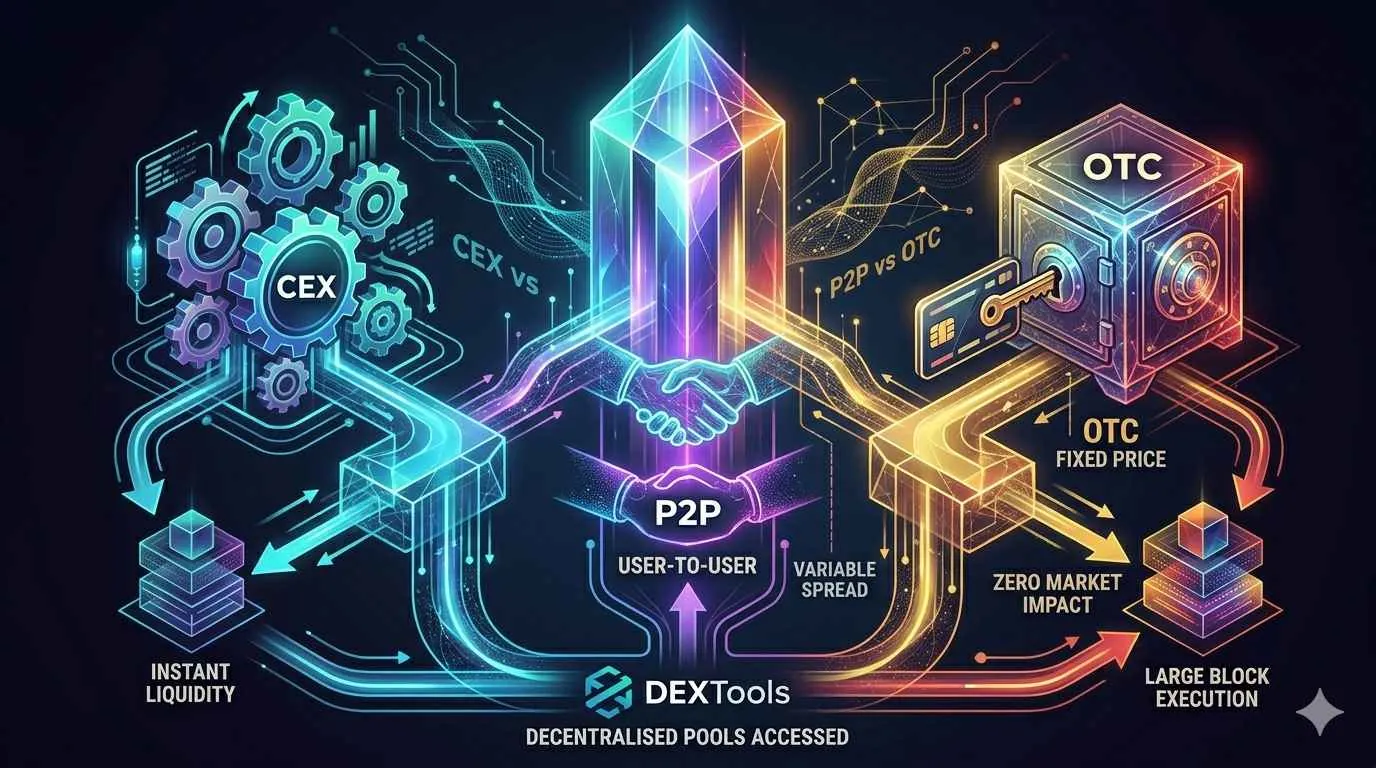
Deploying capital into digital assets efficiently requires a deep understanding of market microstructure. For market participants evaluating their onboarding infrastructure, selecting the proper execution route among CEX vs P2P vs OTC options is not merely a matter of convenience; it directly governs capital efficiency, counterparty risk, and execution slippage. When establishing or rebalancing a portfolio, the choice typically narrows to three institutional and retail methodologies: Centralized Exchanges (CEX), Peer-to-Peer (P2P) networks, and Over-The-Counter (OTC) desks. Each channel utilizes fundamentally distinct clearing mechanisms, pricing parameters, and liquidity depths.
Choosing blindly without analyzing these distinct settlement layers can result in hidden operational premiums, unexpected market impact, or prolonged settlement bottlenecks. For systematic traders who evaluate market health using advanced order-flow data and on-chain intelligence platforms, mapping out the precise architecture of these fiat-to-crypto gateways is the first line of defense in protecting capital margins.
Centralized Exchanges (CEX): High-Velocity Order Books
Centralized Exchanges represent the most common entry point for retail and institutional market participants alike. Analyzing the structural traits of these digital asset hubs reveals that a standard exchange thrives on automated, programmatic matching.
Mechanism of Action
A CEX aggregates mass market liquidity through a centralized matching engine governed by a Central Limit Order Book (CLOB). Buyers and sellers place automated instructions-such as immediate market execution, resting limit orders, or condition-based stop triggers-and the engine matches these orders deterministically based on price-time priority.
Capital Alignment and Efficiency
The primary advantage of the centralized exchange framework is near-instantaneous execution speed and tight bid-ask spreads, provided the target asset has deep market liquidity. It operates as a highly fluid ecosystem where capital can be rotated across spot pairs or derivatives within milliseconds.
However, this model demands full custody surrender. Users must deposit assets into exchange-managed omni-wallets, exposing themselves to platform-specific operational risks. Furthermore, executing large orders on a CEX can cause substantial market impact, where a massive market buy eats through available order book depth, resulting in unfavorable execution slippage.
Peer-to-Peer (P2P) Marketplaces: Decentralized Localized Liquidity
When contrasting different trade matching systems, Peer-to-Peer networks remove the automated matching engine entirely, replacing it with a direct, user-to-user marketplace facilitated by software-driven escrow.
Mechanism of Action
On a P2P platform, the marketplace does not maintain an active limit order book for instant execution. Instead, it serves as a bulletin board of localized advertisements. Independent buyers and sellers publish specific bids and asks, specifying their preferred pricing, trade limits, and an extensive array of localized settlement methods-such as domestic bank transfers, digital wallets, or regional payment processors.
Once a trade is initiated, the platform’s escrow contract locks the seller's cryptocurrency until the buyer confirms the off-chain fiat settlement directly to the seller's bank or payment account.
Operational Trade-offs
Evaluating various fiat on-ramps highlights that P2P excels in structural flexibility and jurisdictional independence. It permits capital placement without a central counterparty routing your funds through traditional clearing house rails.
The downside is execution friction. Trades rely on human interaction and manual validation, extending settlement times from seconds to hours. Additionally, because liquidity is fragmented across hundreds of disparate individual ads, the pricing is rarely aligned with global spot rates. Buyers often pay a variable premium, and high-volume operations are virtually impossible due to low individual order limits.
Over-The-Counter (OTC) Desks: Bespoke Institutional Settlement
For large-scale capital allocators, institutions, and high-net-worth individuals, navigating the structural limitations of alternative platforms inevitably leads to Over-The-Counter execution environments.
Mechanism of Action
An OTC desk operates completely off the public books. Instead of routing an order through a visible public exchange or a localized bulletin board, a buyer engages directly with an OTC broker or principal desk via an automated Request for Quote (RFQ) interface or a dedicated communication channel.
The OTC desk acts as a principal market maker or an agency broker, providing a fixed, single-price execution quote for a substantial block of cryptocurrency, often measuring hundreds of thousands or millions of dollars in value. Once both parties agree on the localized quote, the transaction is locked, and settlement occurs safely through private, pre-arranged trust accounts or multi-signature custody wallets.
The Institutional Advantage
The core value proposition of an OTC desk is the total mitigation of market impact and execution slippage. If an institution attempts to acquire millions of dollars of an asset directly on a public CEX order book, they risk triggering a cascading price expansion, causing panic or front-running by algorithmic market participants.
OTC desks absorb this risk completely, offering price stability and strict confidentiality. The compromise is accessibility; OTC desks enforce high minimum transaction sizes, require comprehensive institutional verification protocols, and lack the instantaneous agility needed for rapid, short-term scalp trading.
Bridging CEX vs P2P vs OTCs with On-Chain Strategy
For tactical traders, these entry points serve as the launchpad for broader on-chain activities. Markets are intrinsically linked; liquidity shifts on centralized or institutional platforms inevitably transmit signals down to decentralized pools.
By monitoring live price feeds, volume profiles, and liquidity allocations through on-chain analytical tools like the DEXTools Pair Explorer, active traders can track where capital goes after entering the system via different payment architecture setups. Weighing the technical benefits of CEX vs P2P vs OTC dynamics helps clarify how large capital injections enter the ecosystem.
For instance, a sharp influx of stablecoin issuance or high-volume trading on institutional OTC desks often precedes structural rotations into micro-cap assets and early-stage on-chain pools. When decentralized metrics signal an early breakout or massive whale accumulation on a particular smart contract, understanding your gateway infrastructure ensures you can onboard fiat capital through the correct, low-slippage venue to fund your on-chain positions before the opportunity window compresses.
Comparative Assessment: Navigating Strategic Scenarios
To optimize capital deployment, market participants can align their transactional intent with the native strengths of each model within the broader market framework. Looking closely at CEX vs P2P vs OTCs helps define the ideal deployment path.
When to Select a Central Limit CEX
High-Frequency Execution: Essential when executing systematic, short-term trading strategies based on immediate technical analysis indicators or real-time order flow data.
Complex Order Automation: Mandatory when your capital preservation framework relies on automated, low-latency stop-loss parameters, multi-tiered trailing take-profits, or conditional triggers.
Broad Asset Diversity: Ideal for active portfolio management requiring instant access to hundreds of distinct spot and derivatives trading pairs under one single infrastructure.
When to Select a P2P Network
Localized Settlement Preferences: The optimal path when capital cannot be routed through traditional international wire transfers, or when relying heavily on local alternative payment mechanisms.
Jurisdictional Flexibility: Useful for peer-to-peer asset acquisition without relying on a centralized financial intermediary to hold your capital during price discovery.
Small to Mid-Scale Capital Adjustments: Highly practical for minor fiat-to-crypto conversions where spot-market slippage is secondary to settlement convenience.
When to Select an Institutional OTC Desk
High-Volume Capital Allocation: Mandatory for large block acquisitions where public exchange execution would cause severe market distortion and negative slippage.
Guaranteed Fixed Pricing: Best when executing large positions where you require an absolute, pre-negotiated price target that remains insulated from intra-hour market volatility.
Discrete Capital Movement: Crucial for high-net-worth positions or corporate balance sheet allocations requiring strict transaction privacy away from public order books.
Conclusion: Engineering Your Capital On-Ramp
There is no singular superior pathway when assessing the global digital asset gateways. Instead, execution efficiency depends entirely on your capital scale, need for speed, and operational risk tolerance. Centralized exchanges provide the required agility for high-velocity trading; P2P platforms offer unmatched structural and payment versatility; and OTC desks deliver the necessary price stability and depth for massive institutional blocks.
By masterfully selecting the appropriate on-ramp and integrating it with real-time on-chain data via analysis suites like DEXTools, you can eliminate hidden transaction friction, minimize operational costs, and navigate the broader digital asset markets with institutional-grade precision.
How to Bridge Crypto Between Chains: Complete Cross-Chain Tutorial 2026How to Use 1inch for Swaps: Classic, Fusion and Limit Orders (2026)
OKX Web3 Wallet Tutorial 2026: Multi-Chain Setup Guide
Disclaimer: This article is for informational purposes only and does not constitute investment advice, financial advice, trading advice, or any other kind of advice. DEXTools does not recommend buying, selling, or holding any cryptocurrency or token. Users should conduct their own research and consult with a qualified financial advisor before making any investment decisions. Cryptocurrency investments are volatile and high-risk. DEXTools is not responsible for any losses incurred.
Related Guides
- What Is OTC Trading in Crypto: Complete Guide to Over-the-Counter Desks (2026)
- Validator Node vs ETH Staking: Which Path in 2026?
- Hot Wallet vs Cold Wallet: Which One to Choose
- How to Withdraw from a CEX to Self-Custody Wallets
- Where to Trade New Meme Coins Early: DEX vs CEX Entry Map (2026)
Frequently Asked Questions
What is the difference between CEX, P2P, and OTC for buying crypto?
A centralized exchange matches your order against a shared order book, P2P connects you directly with another individual, and OTC uses a desk to handle large trades privately. They differ in execution method, typical trade size, and the role of an intermediary.
When is OTC better than a centralized exchange?
OTC desks are often used for large trades that could move the market or cause heavy slippage on a public order book. They can offer privacy and negotiated pricing for high-volume buyers and sellers.
What is P2P crypto trading?
P2P trading lets two individuals buy and sell crypto directly, often with the platform providing escrow to reduce counterparty risk. It can offer flexible payment methods but requires care to avoid fraudulent counterparties.
Which method is best for beginners buying crypto?
Many beginners start with a centralized exchange because of its straightforward interface and built-in order matching. P2P and OTC are typically more relevant for specific payment needs or larger trade sizes.