Sui Network Architecture: Object-Centric Design, Parallel Execution and DeFi Apps (2026)
— By Tony Rabbit in Tutorials

Learn how Sui Network works through object-centric state, parallel execution, Mysten Labs design choices, and the main DeFi apps shaping the ecosystem in 2026.
Intent check: This page owns the deeper Sui architecture and ecosystem angle. If you want the simpler beginner overview first, read What Is Sui?.
If you have ever felt that blockchains feel slow, awkward, or expensive every time the market gets busy, Sui Network was built specifically to fix that. While most L1s queue every transaction through one shared state, Sui treats every asset as an independent object that can move in parallel. The result is a chain that can clear simple transfers in well under half a second, scale linearly with hardware, and host applications that genuinely feel like Web2 in terms of speed.
Sui is one of the youngest tier-1 blockchains, but its DNA goes back to Diem, the stablecoin project that Meta tried to launch in 2019. After Diem was shut down by regulators, the core engineering team spun out as Mysten Labs and rebuilt the technology from scratch as a public, permissionless network. They kept the best part, the Move programming language, and combined it with an object-centric data model and a brand-new consensus protocol called Mysticeti.
This guide is a deep, evergreen explanation of what Sui Network actually is in 2026. You will learn how the object model differs from Ethereum and Solana, why Move is considered the most secure smart contract language ever shipped, how parallel execution works without a global mempool, who runs the validators, what the SUI token does, which dApps actually have users, how Sui stacks up against Aptos and Solana, and what to watch out for if you are a builder or an investor.
What Is Sui Network?
Sui Network is a permissionless Layer 1 blockchain built around three core ideas that almost no other chain combines in the same way. First, it uses the Move programming language, which was originally designed at Meta to make digital asset programming safer than Solidity. Second, it stores everything as discrete objects rather than account balances, which means the chain has no single piece of global state that every transaction has to fight over. Third, it processes independent transactions in parallel by default, so adding hardware genuinely adds throughput instead of just inflating fees.
The practical effect is that simple operations like sending a token, minting an NFT, or updating a profile do not need to go through full network-wide consensus at all. They can be finalized in around 250 to 400 milliseconds using a fast path. Only transactions that touch shared objects, like a DEX pool that everyone is trading against, go through the full Mysticeti consensus pipeline. Even those typically settle in under a second.
If you are new to L1 trade-offs, Sui sits firmly on the high-throughput side of the blockchain trilemma. It optimizes for scalability and user experience while accepting a smaller validator set than something like Ethereum in exchange. It is not trying to be a settlement layer for the entire global economy. It is trying to be a chain where consumer apps, games, and high-frequency DeFi actually feel usable.
History: From Meta Diem to Mysten Labs
The story of Sui starts inside Meta, the parent company of Facebook. In 2019, Meta announced Libra, later renamed Diem, a global stablecoin project intended to give billions of users access to a low-cost digital dollar. To build Diem, Meta assembled a team of distributed systems researchers and language designers, and they made a key decision early on. They were not going to fork Ethereum or use Solidity. They were going to design a new language from scratch.
That language became Move. It was created by Sam Blackshear, Evan Cheng, Adeniyi Abiodun, and a small group of co-authors. Move treats digital assets as first-class resources that cannot be copied, accidentally destroyed, or implicitly transferred. The team believed Solidity had baked-in foot-guns that made smart contract security extremely hard, and they wanted a language where common bugs were impossible to even express.
Regulators in the United States, Europe, and elsewhere effectively killed Diem in 2022. Meta sold the codebase to Silvergate Bank and the team scattered. Five of the senior engineers, including Evan Cheng, Adeniyi Abiodun, Sam Blackshear, George Danezis, and Kostas Chalkias, founded Mysten Labs in late 2021 with the goal of taking what they had learned at Diem and building a public, permissionless chain. Mysten raised over $300 million from a16z, FTX Ventures, Binance Labs, Coinbase Ventures, Jump Crypto, and others before the FTX collapse, and they launched the Sui mainnet on May 3, 2023.
The Object-Centric Model Explained
This is where Sui differs most from almost every other blockchain you have used. On Ethereum, Solana, and most other L1s, the chain stores accounts. An account has a balance, maybe some code, and maybe some storage slots. If you want to send a token, you call a smart contract that subtracts from one account's balance entry and adds to another's. Everything sits inside a giant global key-value store that the whole network has to agree on.
Sui throws that model away. On Sui, every asset is its own object with a unique ID, a type, and an owner. A USDC coin is an object. An NFT is an object. A position in a lending pool is an object. A liquidity pool itself is an object. When you own a token, you do not have a balance entry inside a contract. You literally own the object, and it sits in your address like a file in a folder.
The reason this matters is parallelism. If Alice is sending an NFT to Bob, and Carol is sending a different NFT to Dave, those two transactions touch completely separate objects. There is no reason they need to be ordered with respect to each other, and Sui does not bother to order them. They execute literally at the same time on different cores. On account-based chains, every transaction has to be sequenced through global state, which is why throughput hits a wall as activity grows.
Bob → balance: 50 USDC
Pool → balance: 1M USDC
All TXs fight over the same state map.
Bob owns: Coin#0xc3, NFT#0xd9
Pool: shared Object#0xff
Independent TXs run in parallel.
Sui has three flavors of objects. Owned objects belong to a single address and can be modified only by that owner. These are the ones that get the fast path treatment, with finality in around 300 milliseconds. Shared objects can be accessed by anyone, like a DEX pool or a lending market, and these have to go through full consensus because two people might try to use them at the same time. Immutable objects cannot be changed after creation, useful for things like NFT metadata or shared configuration.
One subtle benefit is the user experience around NFTs and assets. On Sui, your wallet does not query a contract to figure out what you own. The chain itself tracks ownership at the object level, so wallets, explorers, and dApps can list everything you own with one query. This is why Sui wallets feel snappier than Solana or Ethereum wallets when you have a lot of assets.
Move vs Solidity: A Different Philosophy
The Move language was designed with a single guiding principle: digital assets should behave like real-world assets. A dollar bill cannot be duplicated, cannot vanish, and cannot be in two places at once. Move enforces these rules at the type system level rather than asking developers to remember them.
In Solidity, a token balance is just a number in a mapping. There is nothing structurally stopping a developer from accidentally writing code that mints tokens out of thin air, double-spends a balance, or destroys an asset without the owner's permission. The compiler will happily ship the bug. The Solidity ecosystem has built up an entire industry of auditors and static analyzers to catch these mistakes, but they still slip through, which is why over $7 billion has been lost to smart contract exploits since 2020.
Move uses a concept called linear types, also called resources. A resource can be moved between owners but never copied or silently dropped. If you try to write a function that returns a resource and then ignore the return value, the compiler refuses to compile. If you try to clone a coin, the compiler refuses. If you try to overwrite a resource without explicitly destroying it, the compiler refuses. Entire categories of bugs, like reentrancy and integer-overflow-driven mints, are either impossible or extremely hard to trigger.
Sui Move, the variant used on Sui, goes further than the original Diem Move by removing global storage entirely and replacing it with the object model. This makes Sui Move slightly different from Aptos Move, which kept the original global storage design. Code is not directly portable between the two, although the syntax is very close. Developers learning Move once can work in both ecosystems with relatively small adjustments.
Parallel Execution Without a Global Mempool
Most blockchains process transactions one after another. Ethereum does this strictly. Even chains that claim parallel execution, like Solana with Sealevel or Sei with parallel EVM, still funnel everything through a single mempool and a single block builder who has to figure out at runtime which transactions can run in parallel and which cannot.
Sui takes a different approach. Because every transaction explicitly declares which objects it touches, the network can know in advance whether two transactions conflict. If they touch completely different objects, they are independent by definition. If transaction A only touches Alice's coin and transaction B only touches Bob's NFT, neither validator nor consensus needs to choose an order. They both just execute.
This means Sui has no global mempool in the traditional sense. There is no shared queue where everything piles up and a block builder picks the order. Validators receive transactions, classify them as either touching only owned objects (fast path) or touching shared objects (consensus path), and process accordingly. The result is that simple transfers and most consumer interactions skip consensus entirely, while DeFi swaps and other shared-state operations go through Mysticeti.
Critics argue that this design pushes complexity onto developers, who have to think carefully about which objects are shared and which are owned. That is a fair point. But the upside is that throughput scales horizontally. Adding more CPU cores to validator nodes lets them process more parallel transactions. This is fundamentally different from a chain where the bottleneck is single-threaded execution.
Consensus: Mysticeti and Narwhal
Sui uses a two-layer consensus design. The first layer is a data availability mempool called Narwhal, which is responsible for reliably broadcasting transaction data among validators. The second layer is a consensus layer called Bullshark, and as of 2024 it was upgraded to Mysticeti, which is significantly faster.
The key innovation is that the data layer and the ordering layer are decoupled. Narwhal makes sure every validator has the transaction data even before consensus is run on the order, so when ordering happens it is just choosing among already-distributed data. This is the same idea behind data availability sampling in modern Ethereum scaling, but Sui has had it baked in since launch.
Mysticeti is a DAG-based consensus protocol that achieves around 390 millisecond commit latency under realistic network conditions. It is Byzantine fault tolerant, meaning the network keeps working as long as fewer than one-third of validators are malicious or offline. Mysticeti also pipelines block production, so commitment of an earlier block does not have to finish before validators start working on later ones.
For the user, all of this is invisible. You sign a transaction in your wallet, and it finalizes in well under a second. The interesting engineering is in how Sui manages to do that with hundreds of geographically distributed validators running on commodity hardware.
The SUI Token and Staking
The SUI token is the native asset of the network and has four main roles. It is used to pay gas fees, to stake with validators to secure the network, to vote on on-chain governance, and as the unit of account for all storage rebates. The genesis supply was set at 10 billion SUI, with a portion released at mainnet and the rest unlocking on a schedule that runs through about 2030.
Staking SUI is one of the simplest yield products in crypto. You delegate your SUI to a validator through your wallet or the official staking dashboard, and you start earning rewards based on the validator's performance. Average staking yield in 2026 has settled around 2.5 to 4 percent APY, paid in SUI. There is no slashing for delegators, although that policy could change as the network matures.
The SUI token also powers a unique storage fund mechanism. Every time a developer creates a new object on-chain, the gas they pay includes a portion that goes into the storage fund. Validators earn yield from this fund as long as the object continues to exist. If the object is eventually deleted, the storage rebate is returned. This makes long-term state storage a sustainable cost rather than a free externality, and it solves the so-called state bloat problem that plagues older chains.
Validators and Decentralization
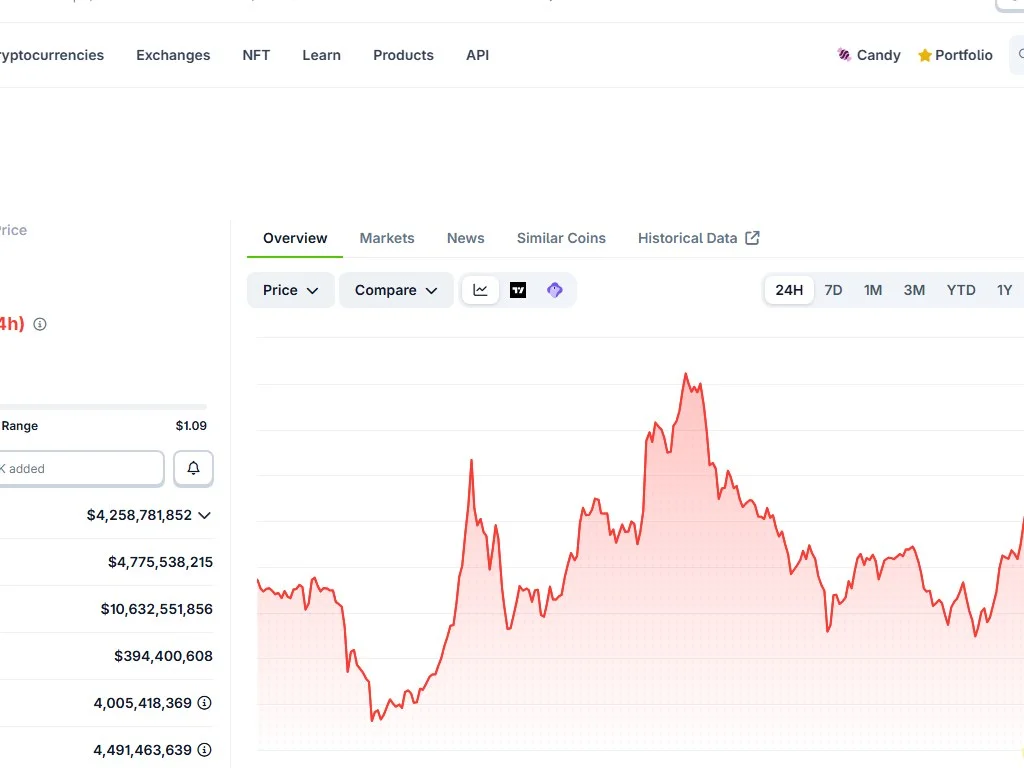
Sui currently runs with around 110 to 130 active validators distributed across more than 25 countries. This is smaller than Ethereum's nearly one million solo and pooled validators, but larger than most newer high-performance chains. The validator set rotates each epoch, which is roughly 24 hours, based on stake-weighted election.
To run a validator, an operator needs to meet a minimum stake threshold, currently 30 million SUI between self-stake and delegated stake. The hardware requirements are higher than Ethereum but lower than Solana, with the official spec calling for 32 CPU cores, 128 GB of RAM, and fast NVMe storage. Validators earn a percentage of all gas fees and storage fund yield, with most operators charging a commission of 5 to 10 percent on delegator rewards.
Decentralization on Sui is a work in progress. The validator distribution is reasonably good, but a large portion of the genesis token supply was concentrated in Mysten Labs, early investors, and the Sui Foundation. Token unlocks have been a recurring concern for the market, and the foundation has at times paused or restructured unlocks in response to price pressure. As an investor, you should track the unlock schedule and the foundation's token policy carefully.
Top dApps on Sui in 2026
Sui has built up a real ecosystem in just three years. While it is nowhere near the size of Ethereum or Solana, the activity is genuine and concentrated in a few flagship protocols.
Largest concentrated liquidity DEX on Sui. Cetus pioneered the Move-native CLMM design and powers most on-chain swap volume in the ecosystem.
Sui's leading lending protocol, with multi-asset money markets, isolated risk parameters, and a points program that drove most of the 2024-2025 TVL boom.
Built by the Solend team after they ported expertise from Solana. Suilend combines lending, liquid staking (sSUI), and a points farm into one app.
A central limit order book built by Mysten Labs itself. DeepBook v3 is used as the matching engine under many Sui DEXs and aggregators.
The dominant NFT marketplace on Sui, with collection trading, launchpads, and a points program that captures Sui's active collector base.
Money market with a yield-bearing sCoin model and SCA governance token. One of the first lending protocols on Sui to ship full leverage features.
Beyond DeFi, Sui has built a notable consumer and gaming presence. Sui 8192, a fully on-chain version of the 2048 puzzle game, was an early proof that complex frontend logic could live on Sui. More recent titles like Beats by Mysten and Cosmocadia show off Sui's ability to handle high-frequency game state. The chain's zkLogin feature, which lets users sign into dApps with their Google or Apple account, has been a meaningful onboarding upgrade for non-crypto users.
Sui vs Aptos: The Move Twins
Sui and Aptos share the same DNA. Both were spun out of Meta's Diem project by senior engineers, both use Move, and both launched mainnet in 2022 to 2023. From outside, they can look almost interchangeable. Inside, they have made very different design choices.
Aptos kept Diem's original Move design, which uses global account-based storage. Sui rewrote Move around the object model. Aptos uses Block-STM, an optimistic parallel execution engine that retries conflicting transactions automatically. Sui declares object dependencies up front and avoids the retry path entirely. Aptos has a more centralized fee market and a single mempool. Sui has the fast path for owned objects and only routes shared object transactions through consensus.
In terms of ecosystem traction, Sui has pulled ahead in 2025 and 2026, particularly in DeFi TVL and active addresses. Aptos has a stronger institutional and stablecoin presence and tighter ties with Asian payment partners. Both chains face the same long-term question, which is whether Move can carve out enough developer mindshare to compete with EVM and Solana's Rust-based ecosystem.
Sui vs Solana: Different Bets on Speed
Solana is the obvious comparison point on the high-performance side. Both chains aim for sub-second finality and high throughput, but they get there in very different ways. Solana uses Proof of History, a verifiable clock that lets validators agree on ordering with very little communication. It runs all transactions through Sealevel, an optimistic parallel execution engine roughly similar to Aptos's Block-STM. Solana's data model is account-based.
Sui's object model gives it some structural advantages. It can finalize simple transfers without consensus at all, while Solana still has to run every transaction through PoH and Tower BFT. Sui's storage fund handles state growth more elegantly than Solana's rent system. Move's safety guarantees are stronger than Rust's, and the entire history of Solana exploits, from Wormhole to Mango to Saber, would have been harder to express in Move.
Solana wins on raw throughput in 2026, with sustained mainnet TPS regularly exceeding 4,000 versus Sui's typical 1,000 to 1,500, and Solana's ecosystem is much larger. Sui wins on user experience for new users, with sub-second finality on owned object transactions, zkLogin, and a generally smoother wallet experience. If you are picking a chain to build a consumer app on, Sui is arguably the better default. If you need maximum liquidity and trading volume, Solana still leads.
Sui Bullshark Quest and the Airdrop Era
One of the things that drove Sui adoption in 2024 and 2025 was the Bullshark Quest program. Bullshark Quest was a series of seasonal points campaigns where users earned points by completing on-chain quests across different dApps. Cetus swaps, NAVI deposits, Suilend lending, BlueMove NFT trades, and dozens of other activities all granted points, and at the end of each season, the points were redeemed for SUI rewards or partner token airdrops.
Quest 1 launched in June 2023 and was small. Quest 2 in late 2023 was where the program really took off, distributing several million SUI to participants. Quest 3 and 4 in 2024 brought in hundreds of thousands of unique wallets and pushed Sui to the top of the daily active address charts across all of Web3 at certain points. Quest 5 in early 2025 was more focused, emphasizing real economic activity over pure interaction farming.
By 2026, Bullshark Quest has wound down in its original form, but the model lives on. Most major Sui protocols run their own points campaigns now, and the Sui Foundation has rolled out targeted incentive programs to support specific verticals like real-world assets, gaming, and AI integrations. If you are looking to farm Sui-native airdrops, the playbook is straightforward. Use the major DeFi protocols regularly, hold sSUI or vSUI for liquid staking points, mint and trade on BlueMove, and watch the foundation's blog for new programs.
Developer Experience
Building on Sui means learning Move, and Move is not Solidity. The learning curve is real. Move is closer to Rust than to JavaScript, and the type system enforces resource semantics that take time to internalize. Mysten Labs has invested heavily in tooling to soften this. The Sui CLI is excellent, the move-analyzer language server provides solid editor integration, and the Sui Move Prover lets developers write formal specifications that the compiler verifies against the code.
One of the better developer features is sponsored transactions. A developer can build a dApp where the application itself pays the gas fee instead of the end user. The user signs the transaction, the dApp's gas station service co-signs and pays the gas budget, and the user never needs to hold SUI just to interact. This is the kind of feature that makes consumer applications viable, because asking new users to first buy a gas token is one of the biggest onboarding hurdles in crypto.
Another standout is Programmable Transaction Blocks, often abbreviated PTBs. A PTB lets a single transaction chain together up to 1,024 separate Move calls, with the output of one feeding into the input of the next. This is similar to multicall on Ethereum but more powerful and much more gas-efficient. A complex DeFi composition that would require five separate transactions on Ethereum can often be done as a single PTB on Sui.
Risks and Open Questions
Sui is not without serious risks, and an honest evaluation needs to call them out. The first is centralization. Mysten Labs and the Sui Foundation, together with early investors, hold a large share of the token supply. Validator selection is still influenced heavily by foundation delegations. The chain is more decentralized than at launch, but it is not in the same league as Ethereum or Bitcoin.
The second risk is ecosystem concentration. A handful of dApps dominate the Sui economy. If Cetus, NAVI, or Suilend suffered a catastrophic exploit, the impact on the chain's TVL and reputation would be severe. The 2024 Cetus incident, where an attacker drained over $200 million from a pricing vulnerability, was a real wake-up call, even though most of the funds were recovered through validator-coordinated freezing. That recovery was itself controversial because it required validators to alter the chain in a way that some consider against the spirit of permissionless settlement.
The third risk is competitive. Move is a small ecosystem compared to EVM. If Ethereum L2s solve their UX problems through account abstraction and shared sequencing, or if Solana keeps growing its dev community faster than Sui, the network effect gap could become impossible to close. Sui needs to keep shipping novel features and onboarding builders to stay relevant.
The fourth risk is regulatory. Sui's connection to Diem and Meta still casts a shadow. Some regulators view the project as Diem-by-another-name, and the SUI token has been a topic in several U.S. enforcement discussions. The token's legal status outside the U.S. is generally fine, but U.S. listings and integrations have been more cautious than for older L1s.
Ecosystem Outlook for 2026 and Beyond
Looking forward, Sui has a few clear vectors of growth. Real-world assets are an obvious fit, because the object model maps almost perfectly to representing tokenized securities or commodities, where each unit is a unique digital asset rather than an entry in a balance sheet. Several institutional projects piloted RWA issuance on Sui in 2025, and the foundation has prioritized RWA partnerships in its current grant cycle.
Consumer applications are another major bet. Sui's combination of zkLogin, sponsored transactions, and sub-second finality genuinely solves the onboarding problem that has kept crypto out of mainstream consumer apps. Whether that translates into actual user adoption depends less on the chain and more on whether builders ship apps that people want to use. The first Sui-native consumer hit has not happened yet, but the infrastructure is ready.
Cross-chain integration through Wormhole, LayerZero, and Axelar gives Sui access to liquidity from Ethereum and Solana. Sui does not have a native sharding roadmap because the object model already scales horizontally on validator hardware, but the team has talked about further consensus improvements and improved data availability proofs.
How to Get Started With Sui
If you want to actually try Sui rather than just read about it, the process takes about 10 minutes. Install a Sui wallet like Sui Wallet, Suiet, or Phantom (which added Sui support in 2024). Fund it with SUI bought from a major exchange or bridged from Ethereum or Solana. Visit a major dApp, swap a small amount on Cetus or DeepBook, deposit into NAVI or Suilend to earn yield, and bridge in some USDC if you want to test stablecoin flows.
For staking, the official staking dashboard at the Sui Foundation site is the simplest path. Pick a validator with reasonable commission, ideally one not already at the top of the stake distribution to support decentralization. Your rewards will start accruing immediately and can be claimed each epoch.
If you are a developer, the Sui Docs site has a complete getting-started guide. Install the Sui CLI, run a local devnet, write your first Move module, and deploy it to the testnet. The official Move book and the Sui by Example repo are excellent learning resources, and the Sui Discord has an active developer support channel.
Video: Sui Network Explained
Visual walkthrough of Sui's object model and parallel execution.

Frequently Asked Questions
Q What is Sui Network in simple terms?
Q Who created Sui Network?
Q How is Sui different from Ethereum?
Q Is Sui better than Aptos?
Q What is the SUI token used for?
Q Can I stake SUI?
Q What is the object-centric model?
Q Is Sui actually decentralized?
Q What are the best dApps on Sui?
Q Can I bridge to Sui from Ethereum or Solana?
Q Is Move hard to learn coming from Solidity?
Q Will there be another Sui airdrop?
Related Guides
- What Is Sui? Move-Based L1 and SUI Guide 2026
- What is Aptos? Move L1 vs Sui Compared (2026 Battle)
- How Blockchain Sharding Works: Parallelization, Throughput and Design Tradeoffs (2026)
- What Is Aftermath Finance? Sui DeFi Perps CLOB Guide 2026
- What Is Plume Network: RWA L1 Blockchain Guide (2026)
- What Is Fuel Network? FuelVM and Modular Execution Explained