What is Aptos? Move L1 vs Sui Compared (2026 Battle)
— By AliceOnChain in Tutorials

Move twins compared! Discover what Aptos is and why the Aptos vs Sui debate is shaping the L1 landscape. A technical and market deep-dive for DEXTools users.
What is Aptos? Move L1 vs Sui Compared
In the high-stakes world of Layer 1 blockchains, 2026 has become the year of the "Move Twins." If you are a regular on DEXTools, you’ve likely seen the explosive volume coming from both ecosystems. But to truly master your trading strategy, you need to answer a fundamental question: What is Aptos, and how does it stack up against its closest rival, Sui?
Both networks were born from the ashes of Meta’s (formerly Facebook) Diem project. They share a common DNA-the Move programming language-yet they have diverged into two distinct powerhouses with different architectural philosophies. This guide will explore the nuances of Aptos vs Sui, helping you decide where to allocate your capital for maximum efficiency and security.
The Shared Heritage: The Move Language
To understand what is Aptos, we must first recognize the brilliance of the Move language. Unlike Solidity (used by Ethereum), Move is "resource-oriented." It treats digital assets like physical objects that cannot be copied or accidentally deleted. This native protection against common exploits, such as re-entrancy attacks, makes both Aptos and Sui significantly safer environments for DeFi.
However, even with a shared language, the way these two chains execute transactions is vastly different. While Aptos stays closer to the original Diem design, Sui has pioneered a more radical, object-centric approach.
Architecture: Parallel Execution Reimagined
The primary battleground in the Aptos vs Sui debate is how they handle massive transaction loads.
Aptos: Block-STM and Optimistic Concurrency
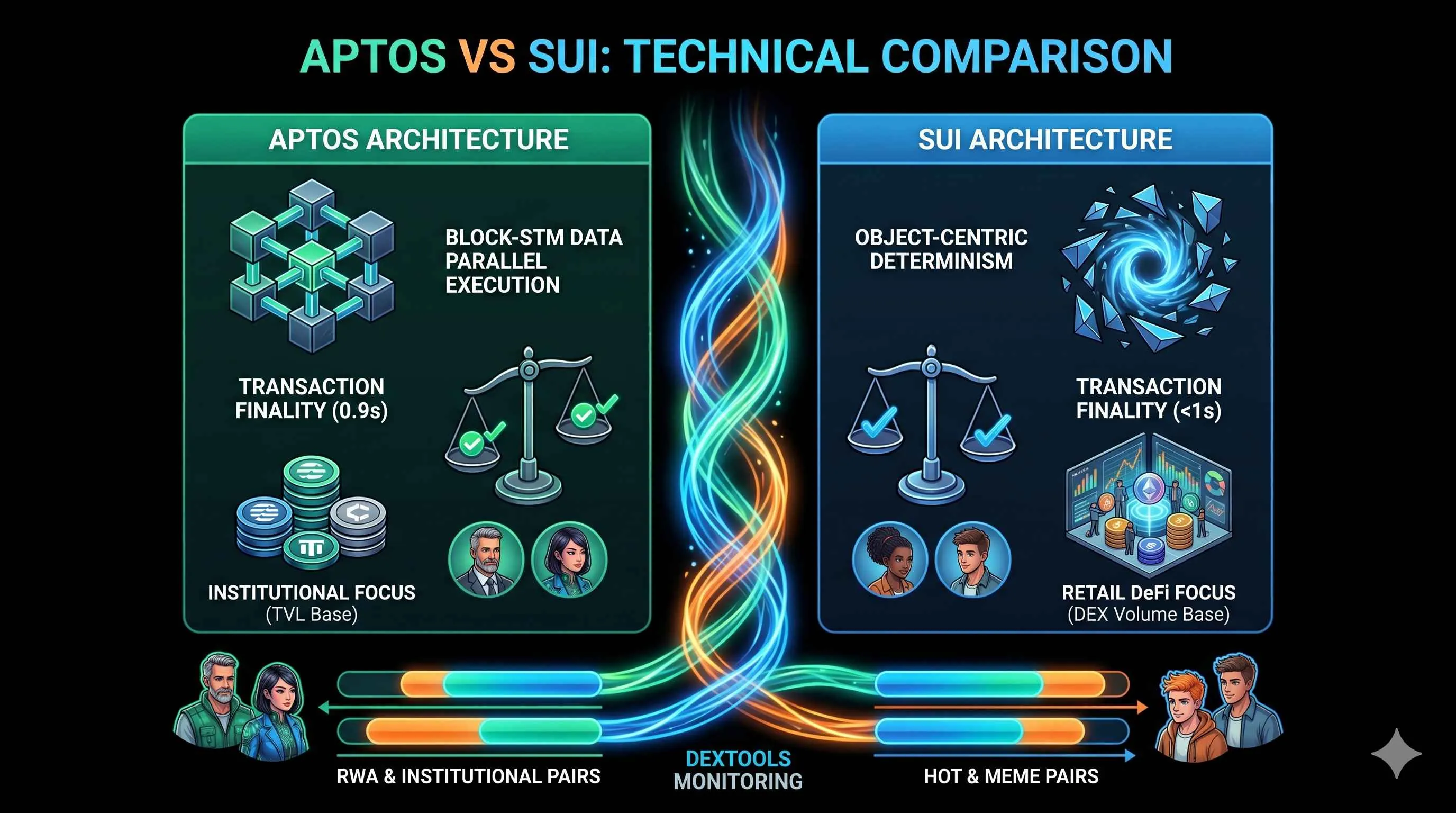
Aptos utilizes a sophisticated engine called Block-STM (Software Transactional Memory). It takes an "optimistic" approach to parallel execution. The network assumes all transactions in a block can be processed simultaneously. If a conflict is detected-for instance, two people trying to buy the same NFT-the system identifies the collision and re-executes those specific transactions. This allows Aptos to achieve a stable finality of roughly 0.9 seconds, making it one of the fastest "account-based" chains in existence.
Sui: Object-Centric Determinism
On the other side of the Aptos vs Sui comparison, Sui uses an object-centric model. Instead of looking at accounts, Sui looks at individual objects. If two transactions don't share the same objects, they bypass the traditional consensus entirely through "Byzantine Consistent Broadcast." This leads to sub-second finality and theoretical throughput that can scale horizontally.
For a trader on DEXTools, the difference is subtle but important: Aptos offers consistent, steady throughput, while Sui excels in scenarios with high-concurrency demands, such as large-scale gaming or social on-chain interactions.
Ecosystem Growth: TVL and Market Dominance in 2026
When comparing Aptos vs Sui through the lens of market data, the numbers tell a compelling story of two divergent destinies.
Sui’s DeFi Momentum: As of early 2026, Sui has taken a lead in decentralized finance (DeFi) metrics. With a TVL often hovering near $1 billion and processing 3.5x the DEX volume of Aptos, it has become a favorite for high-frequency traders.
Aptos’ Institutional Focus: While Sui wins the "retail war" in volume, Aptos is winning the "institutional war." With deep partnerships in RWA (Real World Assets) and traditional finance, Aptos is positioning itself as the enterprise-grade Move L1.
Monitoring the DEXTools Hot Pairs often shows a trend: Sui is where the "degen" and meme-coin volume flourishes, while Aptos is where you find more stable, utility-driven liquidity pools.
Tokenomics: APT vs SUI
The economic model is another crucial factor in the Aptos vs Sui showdown.
APT (Aptos): Features a built-in deflationary mechanism where transaction fees are burned to balance the inflation rate. By 2026, Aptos has focused heavily on incentivizing long-term stakers.
SUI (Sui): Uses a storage fund mechanism to ensure that as the data on the chain grows, the validators are compensated fairly. This makes the long-term cost of on-chain storage more predictable.
Using the DEXTools Pair Explorer, you can see how these native tokens act as the primary "gas" and liquidity pairs for their respective ecosystems.
Transaction Fees and Speed: The User Experience
If you are swapping tokens discovered via DEXTools, the user experience is remarkably similar on both, but with slight edges:
Fees: Both chains offer negligible fees (often under $0.01). However, Sui's architecture allows for "gas price stability," preventing the sudden spikes seen during NFT mints on other networks.
Latency: Aptos provides a very "smooth" feel with its consistent block times. Sui feels "instant" for simple transfers but can vary slightly for complex smart contract interactions.
Which One Should You Choose?
Deciding between Aptos vs Sui depends on your goals as a participant in the crypto market.
Choose Aptos if: You value institutional-grade stability, are interested in the RWA boom, and prefer an ecosystem that feels more organized and corporate-backed. Its integration with wallets like Backpack and OKX is seamless.
Choose Sui if: You are a DeFi power user who wants the highest possible throughput, loves the "Move-based" meme coin culture, and wants to be part of an ecosystem that is currently leading in developer activity and raw DEX volume.
The DEXTools Advantage
Regardless of which Move L1 you prefer, DEXTools is your essential command center. By using our Sui and Aptos Explorers, you can:
Track real-time liquidity migrations between the two chains.
Monitor the DEXTscore to avoid high-risk "Move" tokens.
Set price alerts for APT and SUI to catch breakout moments in the 2026 bull cycle.
Conclusion
The Aptos vs Sui rivalry is not a zero-sum game. Both networks have proven that the Move language is the future of secure, scalable smart contracts. While Sui is currently leading in retail DeFi volume, Aptos remains a formidable giant with its eye on institutional adoption. By understanding the architectural and economic differences between these two "Move Twins," you can navigate the 2026 market with the precision of a professional trader.
What is Sui? Move-Based L1 for BeginnersWhat Is Chain Abstraction: The End of Bridging in Crypto
L1 and L2 Ecosystems 2026: Solana, BNB, Ethereum, and Base Crypto Market
Analysis 2026: Capital Rotation & L3 Growth
Disclaimer: This article is for informational purposes only and does not constitute investment advice, financial advice, trading advice, or any other kind of advice. DEXTools does not recommend buying, selling, or holding any cryptocurrency or token. Users should conduct their own research and consult with a qualified financial advisor before making any investment decisions. Cryptocurrency investments are volatile and high-risk. DEXTools is not responsible for any losses incurred.
Related Guides
- What Is Cetus Protocol? Sui & Aptos CLMM DEX Guide 2026
- Solana vs Sui vs Aptos: Which Monolithic L1 Wins 2026
- Sui Network Architecture: Object-Centric Design, Parallel Execution and DeFi Apps (2026)
- What Is Sui? Beginner Guide to the Move-Based L1 and SUI Token (2026)
- Not.Trade vs BonkBot: TON vs Solana Memecoin Battle 2026
Frequently Asked Questions
What is Aptos blockchain?
Aptos is a Layer 1 blockchain that utilizes the Move programming language, designed for high-speed transactions and security, making it a competitive player alongside Sui.
How does Aptos differ from Sui?
Aptos focuses on an account-based model with optimistic concurrency for transaction execution, while Sui employs an object-centric approach that allows for faster finality and scalability.
What is the transaction finality of Aptos?
Aptos achieves a stable transaction finality of approximately 0.9 seconds, making it one of the fastest blockchains in its category.
Which blockchain has a higher Total Value Locked (TVL) in DeFi?
As of early 2026, Sui has a higher Total Value Locked (TVL), often near $1 billion, compared to Aptos, which focuses more on institutional partnerships.
What are the tokenomics of APT and SUI?
APT features a deflationary mechanism where transaction fees are burned, while SUI employs a storage fund mechanism to manage data on the chain.