How to Buy Memecoins Safely: Avoid Honeypots
Buy memecoins safely: learn the anatomy of smart contract honeypots, variable sell taxes, and multi-layered verification before you risk your funds.
A crypto honeypot is a malicious smart contract designed to allow users to buy a memecoin but prevent or heavily tax its sale. These scams are prevalent in DeFi, particularly with memecoins, and have become easier to deploy due to automated tools. Traders must exercise caution and conduct on-chain forensics to avoid losing capital to such traps.
Avoiding Honeypots and Smart Contract Traps with memecoins
- In the modern decentralized finance (DeFi) environment, memecoins represent a highly liquid but technically precarious market segment. As automated deployment toolkits and "Honeypot-as-a-Service" kits have proliferated across EVM-compatible networks and Solana, the barrier to entry for launching sophisticated scams has dropped significantly.
- A honeypot is a malicious smart contract designed to permit memecoins purchases while programmatically blocking or heavily taxing asset liquidation (selling).
- To participate in this high-velocity sector without losing principal capital to malicious code, traders must treat token acquisition as a process of on-chain forensics. This guide outlines the core mechanics of these traps and provides a structured verification framework.
1. The Anatomy of a Honeypot: How the Trap Closes
Scammers manipulate open-source token standards (such as ERC-20 or SPL) by inserting hidden restrictions within the contract's execution logic. The most common technical variations include:
Trading memecoins on TON? Not.Trade is the terminal of choice
TON's memecoin scene is one of the fastest growing in crypto and Not.Trade is the fastest terminal on TON for catching launches early. Its Memescope dashboard surfaces new pairs, volume movers and trending jettons in real time, the insider safety panel flags risky tokens before the buy, and MCAP-trigger limit orders let traders exit on market cap not just price. Multi-wallet sniping and MEV protection ship by default.
Explore Not.Trade in depth →Blacklist Implementation: The contract executes normally for initial buyers, but the deployer retains a hidden function to append user wallet addresses to a
_snapshotorblacklistarray, preventing them from calling thetransfer()orapprove()functions.Overriding the Sell Function: The contract code explicitly verifies the identity of the message sender during execution. It allows general addresses to interact with the buy routing but limits the sell routing strictly to the developer’s specific wallet address.
Variable Minimum/Maximum Thresholds: The contract permits sales but sets the required minimum execution threshold to an impossibly high variable number, causing standard decentralized exchange (DEX) routers to throw a generic execution error.
2. The Defensive Framework: Multi-Layered Verification
Relying on a single metric or a "verified contract" badge on a block explorer is insufficient. A robust defensive approach uses multiple independent verification steps.
Automated Contract Scanners
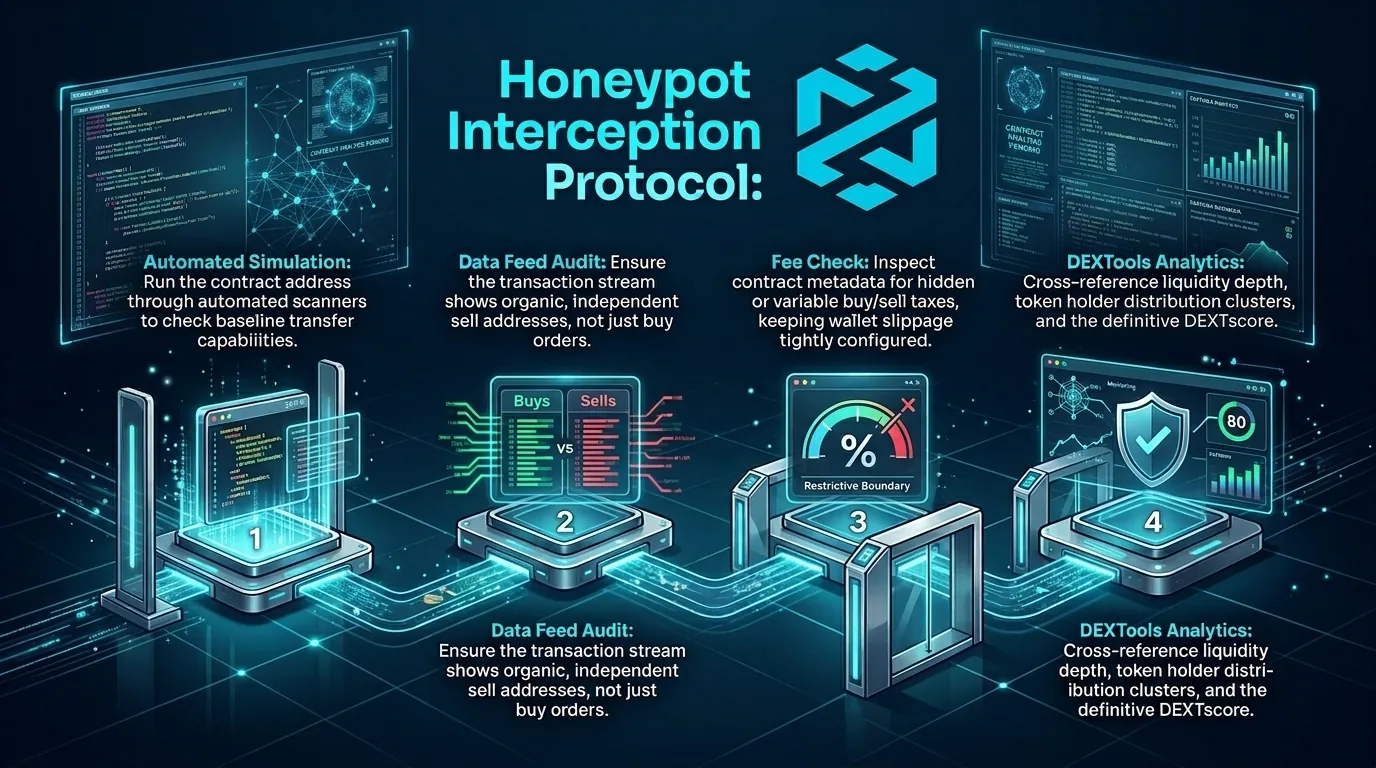
Before interacting with any decentralized application (dApp) router, paste the token’s contract address into automated evaluation tools such as Token Sniffer or Honeypot.is. These platforms operate by running simulated execution loops (forking the state locally to test buying and immediate selling mechanics) to verify if a standard user wallet can execute a complete transaction lifecycle.
Evaluating Chart Health and Transaction Streams
Analyzing price charts and live transaction ledgers provides raw behavioral data that code scanners might miss during early deployment blocks.
The All-Green Red Flag: If a newly launched token displays a price chart consisting exclusively of buy orders (green candles) with an absolute absence of sell transactions from independent wallets, it is highly likely a honeypot. Scammers occasionally execute small, controlled sell orders from their own whitelisted wallets to simulate organic trading volume, requiring traders to audit the individual transaction signatures.
Sell Tax and Slippage Configuration
Many modern traps do not block the sell transaction; instead, they implement an aggressive variable fee structure. A contract may allow you to sell your tokens but impose a 99% sell tax, effectively destroying your capital upon execution. Mathematically, the net token output can be expressed as:
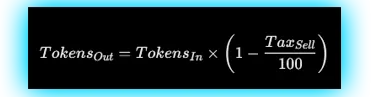
If Tax_Sell approaches 100, the output converges to zero. To defend against this, always verify the tokenomics and set your maximum wallet slippage tolerance to a reasonable threshold (e.g., 5% to 10%). If a hidden tax exceeds your slippage boundary, the DEX router will automatically abort the transaction, protecting your assets.
Technical Trade-offs and Market Realities
| Verification Method | Operational Advantages | Technical Blind Spots / Risks |
| Automated Scanners | Instant execution; quickly flags known malicious code signatures. | Cannot detect proxy-upgradable contracts that alter rules post-launch. |
| Live Transaction Auditing | Confirms real-world wallet behavior and market activity. | Scammers can use automated bot networks to simulate realistic sell data. |
| Small-Scale Test Selling | Provides definitive confirmation for your specific wallet address. | The developer may whitelist early blocks, closing the trap only after volume scales. |
3. The MEV and Bot Landscape
Traders must also differentiate between an structural smart contract trap and the standard predatory behavior of the public mempool with memecoins.
Maximal Extractable Value (MEV): If you execute a trade with excessive slippage allowances without using a private RPC node, MEV bots will perform a sandwich attack, buying right before you and selling right after, degrading your execution price. This is a market-dynamic penalty, not a contract-level lock.
Sniper Manipulations: Automated bots often monopolize the initial liquidity pools of fresh token launches. High early volatility or temporary transaction failures are often caused by thousands of automated snipers competing for block space, rather than a definitive honeypot setup.
4. Verification via DEXTools
- In an ecosystem where token deployment occurs continuously, manual contract reading is too slow for active market participants. DEXTools functions as a centralized security aggregation hub, providing immediate data feeds on assets and memecoins health.
Professional traders utilize the platform to cross-reference multiple data vectors.
- To monitor the DeFi market in an agile and secure way in real-time and trade memecoins safely with the help of the best crypto tools, you can access DEXTools here.
Disclaimer: This article is for informational purposes only and does not constitute investment advice, financial advice, trading advice, or any other kind of advice. DEXTools does not recommend buying, selling, or holding any cryptocurrency or token. Users should conduct their own research and consult with a qualified financial advisor before making any investment decisions. Cryptocurrency investments are volatile and high-risk. DEXTools is not responsible for any losses incurred.
Related Guides
- EVM Honeypot Prevention Checklist: What to Verify Before You Buy
- How to Buy Memecoins on Solana: Complete Step-by-Step Guide (2026)
- What Is a Pump and Dump Scheme in Crypto: How to Spot and Avoid Scams (2026)
- Wallet Drainer Attacks Explained: How to Recognize and Avoid
- Top 5 Mistakes Crypto Beginners Make in 2026 (And How to Avoid Them)
Frequently Asked Questions
Does a "Verified Contract" badge on Etherscan or Solscan mean a token is safe?
No. A verified contract simply means the developer has made the source code visible to the public. It does not mean the code is safe or fair. Scammers frequently verify their contracts to build a false sense of security while hiding complex blacklist logic inside thousands of lines of code.
What is a "Proxy Upgradable Contract" and why does it represent a security risk?
An upgradable contract allows the developer to change the underlying logic of the token after it has already launched. A token might pass every automated scanner test during its first hour, only for the developer to update the code later to implement a 100% sell tax or enable a global blacklist.
Can I perform a small "test sell" to guarantee a token is not a honeypot?
While executing a small purchase and an immediate sale is a valid diagnostic test, it is not an absolute guarantee of long-term safety. Sophisticated developers can code the contract to allow sales during the first few hours of launch or whitelist specific early wallet addresses to create a false appearance of a clean asset lifecycle.
How does setting a strict slippage tolerance protect me from high sell taxes?
If a token contract implements a hidden 95% sell tax at the router level, your expected output will drastically drop. If your wallet's slippage tolerance is set to a standard boundary (e.g., 5%), the decentralized exchange router will detect that the token output does not match your minimum criteria and will automatically fail the transaction, leaving your original tokens in your wallet.
What should I do if my funds are stuck inside a honeypot contract?
Due to the immutable nature of public ledger architectures, if a smart contract blocks your ability to execute a sell or transfer function, the funds cannot be recovered by standard means. Your primary recourse is to revoke any unlimited spending approvals you granted to that contract via security dashboards to prevent the malicious architecture from interacting with the remaining unaffected assets in your wallet.