Wallet Drainer Attacks Explained: How to Recognize and Avoid
Guarding your seed phrase is no longer enough to secure your Web3 assets. We break down how automated wallet drainers exploit off-chain signatures, CREATE2 contract address predictions, and EIP-7702 delegation flows.
The Invisible Threat: When Your Private Key is Safe, but Your Wallet is Drained
- Many Web3 participants operate under the false assumption that as long as they never share their 12-word seed phrase or private keys, their digital assets are completely immune to theft. While seed phrase protection remains a critical security baseline, modern cryptocurrency thieves no longer need to steal your private keys to empty your accounts. Instead, they exploit the very features built to make decentralized finance (DeFi) seamless and efficient.
- Wallet Drainers are highly automated phishing scripts deployed on malicious web applications that trick users into signing harmful payloads. These exploits do not breach blockchain networks or crack cryptography; they compromise the human layer through front-end deception, malicious off-chain signatures, and innovative protocol integrations like EIP-7702 or Permit2. This comprehensive guide details the mechanics of modern wallet drainer infrastructure, breaks down the dominant attack signatures, and provides actionable opsec frameworks to isolate and protect your capital.
What is a Wallet Drainer?
- A wallet drainer is a specialized software-as-a-service (DaaS) malicious toolkit designed to automatically detect, catalog, and steal the most valuable digital assets inside a victim's connected Web3 wallet.
- When a user accidentally connects their wallet to a fraudulent web interface, the drainer script scans the public ledger to index the wallet's holdings, including high-value tokens, liquid staking derivatives, and premium NFTs. The script then systematically generates a rapid succession of tailored transaction requests or signature prompts, presenting them to the user under disguised UI labels (such as "Claim Airdrop," "Verify Network," or "Migrate Token") to trick the victim into giving up asset control.
1. The Attack Vectors: From DApp Impersonation to Evasion
A modern wallet drainer deploy a combination of social engineering and technical evasion tactics to intercept users before they realize they have stepped off the safe path.
DApp Impersonation & Clone Interfaces: Attackers deploy pixel-perfect clones of popular Web3 applications, decentralized exchanges, or upcoming token launches. These malicious links are distributed via sponsored search engine ads, hijacked official X accounts, or compromised Discord community bots, creating an immediate sense of urgency or financial reward.
CREATE2 Alert Bypassing: To evade the real-time security alerts built into advanced wallets, modern drainers heavily abuse the CREATE2 opcode. This opcode allows a contract address to be mathematically predicted before it is physically deployed on-chain. The drainer tricks the user into signing an approval toward an inactive, seemingly harmless address. The moment the signature settles, the drainer instantiates the malicious smart contract at that predicted address and immediately strips the wallet of its tokens, bypassing legacy static security blocklists.
2. Explaining Malicious Approvals and Off-Chain Signatures
Understanding the specific payloads used by a wallet drainer requires analyzing how contemporary token allowance architectures function behind the scenes.
The Classical Approval Trap (approve / setApprovalForAll)
The oldest form of wallet draining involves tricking a user into executing a native on-chain transaction that grants an external address unlimited permission to spend a specific token. Once signed, the attacker invokes the transferFrom function on the token contract from their own device, pulling all approved assets out of the victim's wallet without needing their private key again.
The Off-Chain Permit Exploit (Permit / Permit2)
To eliminate gas fees for routine swaps, protocols introduced off-chain signatures via EIP-2612 (Permit) and Uniswap's Permit2 contract.
The Vulnerability: Instead of sending a live blockchain transaction, the user simply signs a structured message with their wallet. This off-chain signature contains specific cryptographic validation variables.
The Siphon: The drainer captures this raw signature string and passes it to the token contract on-chain. Because the user previously granted general permission to an ecosystem contract like Permit2, the drainer can instantly redeem that signature to drain the asset balance. Permit-based scams represent one of the single most damaging signature exploits across EVM layers.
3. The Next Frontier: EIP-7702 Account Abstraction Exploits
- Following recent protocol updates like Ethereum's Pectra upgrade, a powerful technical primitive called EIP-7702 was introduced to bring advanced account abstraction features to standard Externally Owned Accounts (EOAs).
- EIP-7702 permits a standard, non-contract wallet to temporarily delegate its execution rights to a smart contract for a specific transaction payload. While this unlocks incredible user convenience (such as gas sponsorship and atomic transaction bundling) it establishes an entirely new phishing vector for sophisticated drainer services.
- Instead of prompting users for individual token approvals, next-generation drainers trick victims into signing an EIP-7702 delegation contract under the guise of a "wallet security upgrade" or "AI asset assistant." Once signed, the victim's wallet essentially functions as a programmable contract controlled by the attacker. The malicious contract can immediately execute batched transactions to sweep multiple independent token balances, pull liquid staking allocations, or trigger complex re-entrancy pathways in a single block execution, completely bypassing legacy transaction simulation tools.
Technical Breakdown Matrix: Drainer Vector Signatures
| Exploited Vector | Signature Standard | Target Interface | Core Threat Vector |
| On-Chain Approval | setApprovalForAll | Live Ledger Tx | Grants full NFT/Token transfer rights |
| Off-Chain Gasless | Permit / Permit2 | Gasless Message | Cryptographic signature stolen off-chain |
| Address Evasion | CREATE2 Opcode | Predicted Contract | Bypasses wallet address blocklists |
| Account Upgrade | EIP-7702 (0x04) | Delegation Payload | Bundles and sweeps entire wallet state |
4. How to Recognize and Protect Your Portfolio
Defending your capital against automated drainer toolkits requires rigorous operational discipline and the implementation of active defense habits.
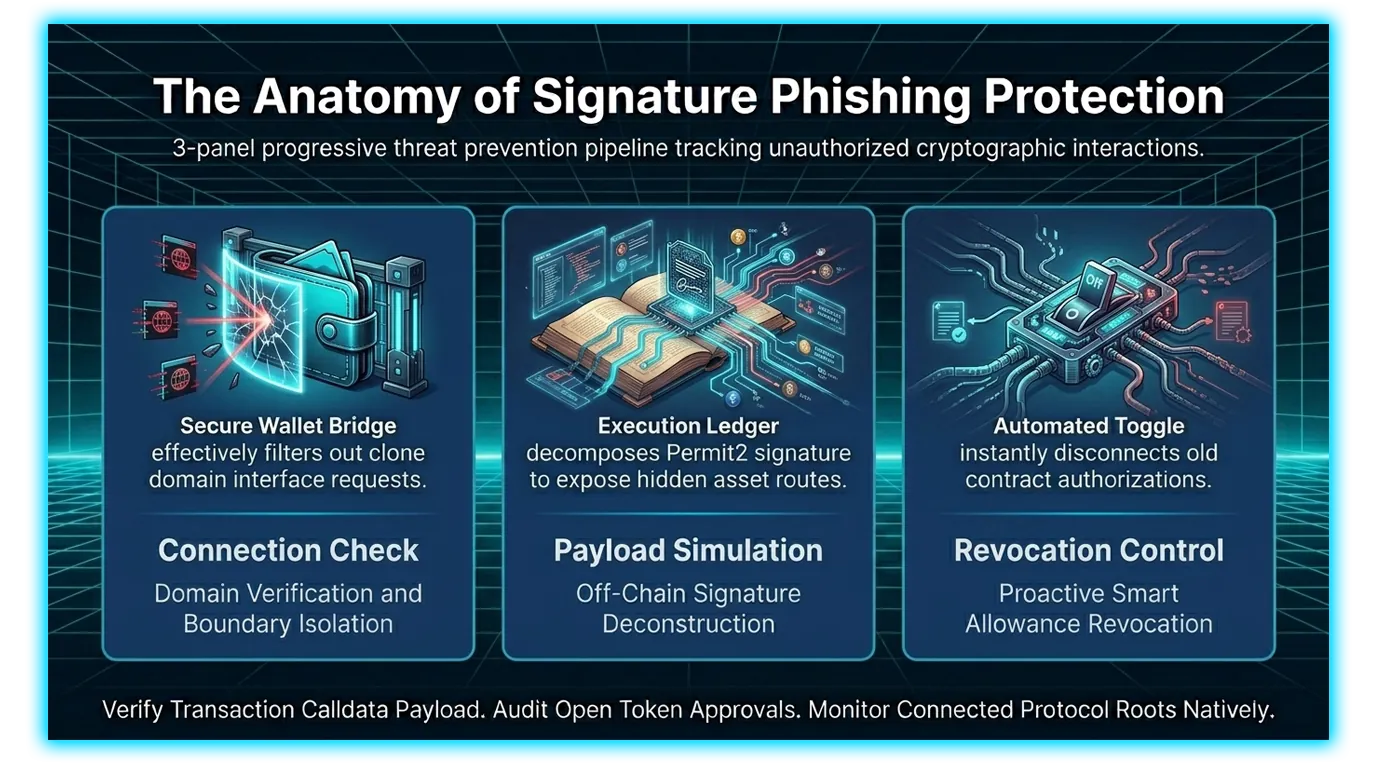
Deconstruct the Wallet Confirmation Screen: Never click "Confirm" or "Sign" based on the text labels displayed on a website's front-end interface. The front-end can lie. Always scroll down inside your wallet software to read the actual raw execution path. If a site promising an airdrop claim requests an action containing words like
approve,permit,SET_CODE, or a generic string of hexadecimal code, reject the transaction immediately.Maintain Strict Wallet Compartmentalization: Divide your crypto assets into distinct operational layers. Use a low-balance, disposable "hot wallet" to interact with new dApps, mint experimental NFTs, or claim community rewards. Keep your core generational wealth entirely isolated on institutional hardware devices that are never connected to daily browsing browsers or unfamiliar web protocols.
Proactively Revoke Token Allowances: Periodically audit your open token permissions using verified on-chain authorization tools like Revoke.cash or native wallet security dashboards. Regularly clearing out old approvals ensures that even if a historical dApp you previously used gets compromised or a drainer targets your past allowances, your current wallet balances remain completely insulated.
Tracking Malicious Inflows via DEXTools Forensic Telemetry
- Utilizing advanced decentralized charting architectures like DEXTools provides market participants with an essential, universal platform to monitor live token behaviors, evaluate pool depths, and inspect contract parameters across all public execution networks.
- By leveraging core features such as the Pair Explorer, the Live New Pairs dashboard, and Trade Story, among other options, technical traders can audit localized volume trends and verify automated contract safety scores before initiating any on-chain interactions. This ensures that your secure hardware setup only engages with verified market venues.
How to Bridge Crypto Between Chains: Complete Cross-Chain Tutorial 2026How to Use 1inch for Swaps: Classic, Fusion and Limit Orders (2026)OKX Web3 Wallet Tutorial 2026: Multi-Chain Setup Guide
Disclaimer: This article is for informational purposes only and does not constitute investment advice, financial advice, trading advice, or any other kind of advice. DEXTools does not recommend buying, selling, or holding any cryptocurrency or token. Users should conduct their own research and consult with a qualified financial advisor before making any investment decisions. Cryptocurrency investments are volatile and high-risk. DEXTools is not responsible for any losses incurred.
Related Guides
- What Is a Wallet Drainer? Crypto Security Guide 2026
- TON Wallet Drainer Scams: How to Stay Safe (2026)
- What Is a MEV Bot: Complete Frontrunning & Sandwich Attacks Guide (2026)
- What Is a 51% Attack? How Majority Attacks Work (2026)
- SIM Swap Attacks: How They Work and How to Prevent Them
Frequently Asked Questions
What is a wallet drainer attack?
A wallet drainer is malicious software or a scam flow designed to trick users into approving transactions or signatures that let attackers steal their assets. They often rely on deceptive websites or fake apps rather than stealing the seed phrase directly.
How do drainers steal funds without my seed phrase?
Many drainers exploit malicious signature or approval requests that grant the attacker permission to move tokens. By tricking the user into signing, they can transfer assets without ever knowing the private key.
How can I recognize a wallet drainer scam?
Warning signs include unexpected signature requests, urgent or too-good-to-be-true offers, and unfamiliar sites asking you to connect your wallet. Carefully reading what you are signing and verifying the site are key defenses.
What should I do if I think my wallet is compromised?
Move any remaining assets to a new, secure wallet and revoke suspicious token approvals from the affected wallet. Treat the compromised wallet as unsafe for storing funds going forward.