Ethereum Layer 2 vs Layer 3 Explained 2026
Ethereum Layer 2 vs Layer 3 explained: explore the shift to specialized scaling and how it impacts decentralized finance and gaming efficiency.
Ethereum Layer 2 vs. Layer 3: The Battle for Hyper-Specialized Scaling
- By March 2026, the architectural debate surrounding Ethereum has shifted from basic scalability to specialized efficiency. The days of questioning whether Ethereum could handle mass adoption are over. Today, the network functions as a robust settlement layer, while the real action happens across a multi-tiered landscape of Layer 2 (L2) and Layer 3 (L3) solutions. With the consolidation of the Superchain and the rise of application-specific environments, the industry is witnessing a war for the most efficient, low-latency execution.
The Era of the Superchain and L2 Dominance
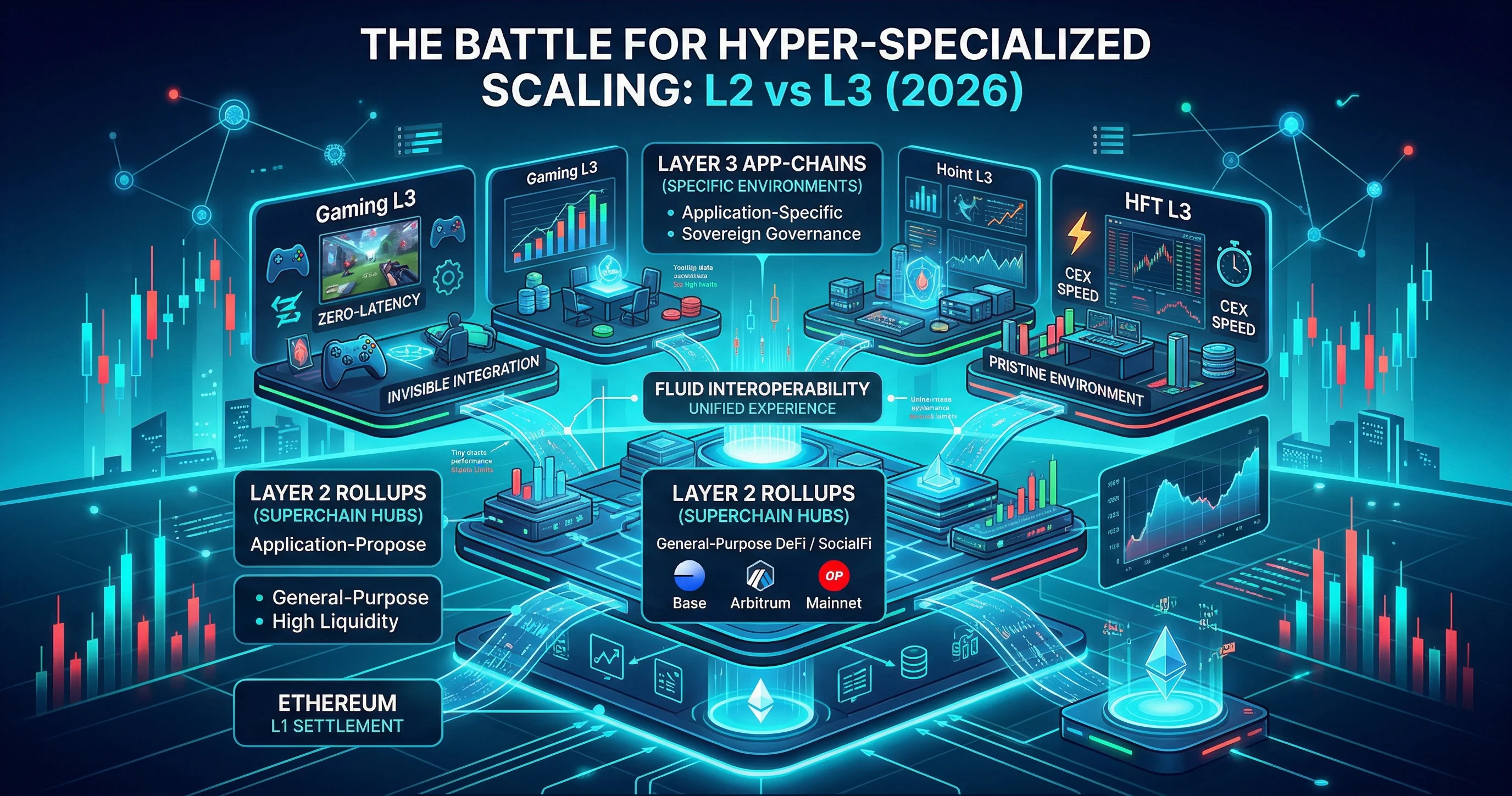
- In the current landscape, Layer 2 networks like Arbitrum, Base, and OP Mainnet have evolved into massive liquidity hubs. These platforms are no longer just experiments in scaling: they are the primary consumer layers of the Ethereum ecosystem. The emergence of the Superchain, powered by the OP Stack, has allowed networks like Base and Zora to share a common security and communication framework. This has effectively solved the initial fragmentation issues that plagued early rollups.
- Arbitrum continues to lead in total value locked, positioning itself as the premier destination for institutional-grade decentralized finance. Meanwhile, Base has leveraged its integration with mainstream interfaces to become the default home for social finance and retail applications. These L2s provide the general-purpose infrastructure needed for the vast majority of transactions. However, their very success as crowded hubs has created a new demand for even more specialized layers.
Understanding the Rise of Layer 3 Solutions
What Makes L3s Unique?
- Layer 3 solutions are specialized rollups built on top of existing Layer 2s. While L2s scale Ethereum by moving transactions off the mainnet, L3s scale L2s by providing dedicated block space for specific use cases. By settling on an L2 rather than directly on Ethereum, L3s can achieve sub-cent transaction costs and customized execution environments that were previously impossible.
- The primary advantage of an L3 is its ability to offer hyper-low latency and sovereign governance without losing the underlying security of the Ethereum ecosystem. In 2026, we see L3s as the final frontier for applications requiring massive throughput, such as fully on-chain gaming or high-frequency trading. These networks act as "app chains" that inherit the liquidity of their parent L2 while maintaining their own specialized rulesets.
Gaming L3s: The Quest for Zero Latency
Gaming has become the primary driver for L3 adoption in 2026. High-performance games require thousands of microtransactions per second, and even the small fees on a general-purpose L2 can become a barrier for players. L3s like Xai and various Orbit chains have solved this by optimizing their execution layers specifically for game logic and asset minting.
- For example, a modern on-chain MMORPG might use an L3 to track every item movement and player interaction. Because the L3 is dedicated solely to that game or studio, there is no competition for block space with DeFi bots or NFT mints happening on the parent L2. This environment allows for a seamless user experience where the blockchain operates in the background, providing true ownership of digital assets without the lag or cost usually associated with decentralized networks.
High Frequency Trading and Financial L3s
The financial sector has also embraced the L3 model to compete with centralized exchanges. Traditional general-purpose blockchains often suffer from "noisy neighbors," where a popular NFT drop can spike gas prices and delay critical financial trades. Financial L3s eliminate this risk by providing a pristine environment for professional market makers and decentralized order books.
- A specialized HFT L3 can implement custom features like native limit order support and specialized pre-compiles for complex mathematical calculations. This allows decentralized perpetual platforms to offer a trading experience that is indistinguishable from a centralized platform like Binance or Coinbase. By settling their net balances on a major L2 like Arbitrum, these L3s maintain access to massive liquidity pools while offering the speed and precision required by professional traders.
The Interoperability Challenge: Fragmentation vs. Unity
- The proliferation of L3s has reintroduced the concern of liquidity fragmentation. If every application lives on its own L3, how do users move assets between them? In 2026, this is being solved through advanced cross-chain messaging protocols and shared sequencers. Protocols that enable atomic swaps between an L2 and its child L3s have become the industry standard.
- The "Orbit" ecosystem from Arbitrum and the "Hyperchains" from ZKsync have pioneered a model where moving assets between a parent and its sub-layers is near-instantaneous. Users often do not even realize they are jumping between layers. Their wallets manage the complexity of routing transactions through the most efficient L3, providing a unified experience that feels like using a single, massive computer.
The Economic Model: Rent and Revenue
- The relationship between L2s and L3s is also an economic one. L3s essentially pay "rent" to their parent L2 by submitting transaction batches and paying for data availability. This creates a powerful revenue stream for L2s, which in turn use that capital to subsidize their own security and development.
- For the L3 operator, the benefit is the ability to capture their own MEV (Maximal Extractable Value) and potentially use a custom gas token. This allows for creative monetization strategies, such as subsidizing gas for loyal users or requiring the use of a native project token for all network fees. This economic sovereignty is a major reason why many successful dApps are choosing to migrate from being a simple smart contract on an L2 to becoming their own independent L3.
A Tiered Future for Ethereum
As we navigate through 2026, it is clear that the future of Ethereum is not a single chain, but a massive web of interconnected layers. Layer 2s serve as the robust, liquid foundations for our digital economy, while Layer 3s provide the specialized playgrounds where innovation in gaming, finance, and social media can flourish without limits. This tiered approach ensures that Ethereum can remain decentralized at its core while scaling to meet the needs of every possible application.
Key Points Summary
L2 Consolidation: Networks like Base and Arbitrum are now the primary liquidity hubs and consumer entry points for the Ethereum ecosystem.
L3 Specialization: Layer 3s offer hyper-low costs and dedicated block space for apps that require extreme throughput, such as gaming and HFT.
Gaming Evolution: L3s have enabled fully on-chain games to operate with zero latency, making blockchain integration invisible to the average player.
Institutional HFT: Specialized financial layers now offer decentralized trading experiences that rival the speed and efficiency of centralized exchanges.
Seamless UX: Advanced interoperability tools allow users to interact with multiple layers without the friction of manual bridging or network switching.
In this rapidly evolving multi-layer landscape, staying ahead of the curve is essential for any trader. To monitor the latest tokens and liquidity movements across the growing L2 and L3 ecosystems, we invite you to use DEXTools. It is the most reliable platform to track real-time data and ensure your trades are executed safely in the decentralized world.
You can access DEXTools dashboard here!
Disclaimer: This article is for informational purposes only and does not constitute investment advice, financial advice, trading advice, or any other kind of advice. DEXTools does not recommend buying, selling, or holding any cryptocurrency or token. Users should conduct their own research and consult with a qualified financial advisor before making any investment decisions. Cryptocurrency investments are volatile and high-risk. DEXTools is not responsible for any losses incurred.
Related Guides
- Top 5 Layer 2 Networks in 2026: Best Ethereum Scaling Solutions Compared
- What Are Layer 2s: Complete Guide to L2 Scaling Solutions (2026)
- Based Rollups Explained: Ethereum Scaling Guide
- What Is Arbitrum? Beginner Guide to Ethereum's Leading Layer 2
- Base vs Arbitrum: Ethereum Layer 2 Networks Compared (2026)
- Danksharding Explained
Frequently Asked Questions
What is the difference between Ethereum Layer 2 and Layer 3?
Layer 2 solutions scale Ethereum by moving transactions off the mainnet, while Layer 3 solutions are built on top of L2s to provide dedicated block space for specific use cases, offering hyper-low latency and specialized governance.
Why are Layer 3 solutions important for gaming?
Layer 3 solutions are crucial for gaming as they can handle thousands of microtransactions per second with minimal fees, providing a seamless user experience without competition for block space from other applications.
How do Layer 2 networks like Arbitrum and Base function?
Layer 2 networks like Arbitrum and Base serve as liquidity hubs and general-purpose infrastructures for the Ethereum ecosystem, facilitating a majority of transactions while benefiting from shared security and communication frameworks.
What advantages do Layer 3 solutions offer for financial applications?
Layer 3 solutions provide a dedicated environment for financial applications, eliminating risks from network congestion and allowing for custom features like native limit order support, which enhances trading efficiency.
What is the Superchain in the context of Ethereum?
The Superchain is a framework that allows Layer 2 networks to share security and communication, addressing fragmentation issues and enabling a more cohesive and efficient multi-tiered Ethereum ecosystem.