Yield Aggregators Explained: Yearn, Beefy and Sommelier

Automating manual reward harvesting and re-depositing maximizes capital efficiency while minimizing gas fee drag. We break down the technical differences between Yearn V3, Beefy multi-chain optimization, and Sommelier algorithmic routing.
The Liquidity Friction: Automating the Yield-Seeking Economy
- Maximizing returns across decentralized finance (DeFi) presents a continuous operational challenge for capital allocators. In an ecosystem fragmented across dozens of Layer 1 blockchains, Layer 2 scaling networks, and hundreds of independent decentralized exchanges, tracking the most profitable yield opportunities requires constant monitoring. Manually moving assets to capture shifting incentives introduces substantial friction: depositors face repetitive gas fees, manual reward harvesting tasks, execution slippage when swapping reward emissions, and constant exposure to transaction entry errors.
- Yield Aggregators eliminate these complexities. Operating as automated investment managers, these protocols rely on programmatic vault strategies to pool user assets, automate compounding frequencies, and split gas costs across thousands of participants. This comprehensive guide breaks down the underlying technical mechanics of yield optimization and evaluates the core architectural models of the sector's dominant market leaders: Yearn Finance, Beefy Finance, and Sommelier Finance.
What is a Yield Aggregator?
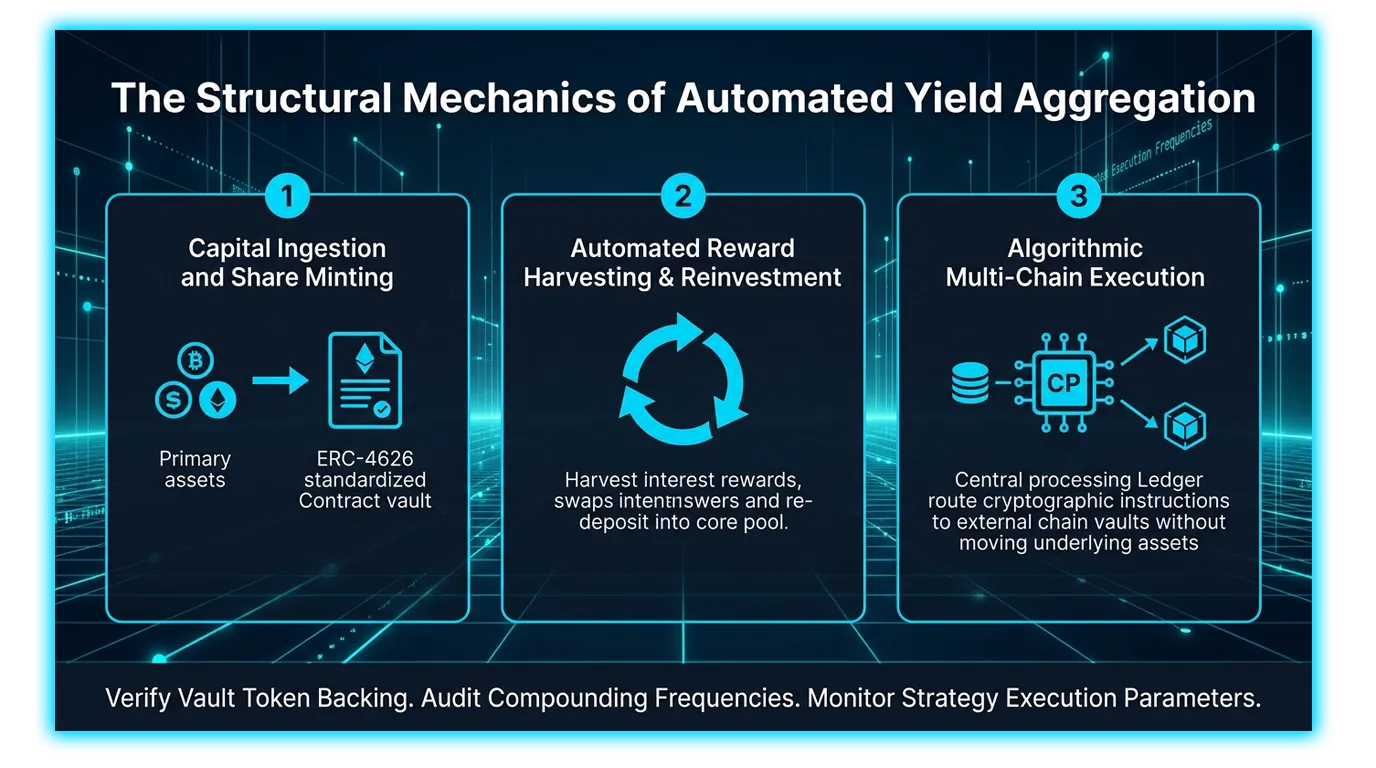
- A yield aggregator is a decentralized protocol that automates the collection, conversion, and deployment of digital assets across various liquidity pools, lending markets, and yield-bearing products. Instead of manually interacting with individual decentralized applications, users deposit assets into a centralized smart contract known as a Vault.
- The vault issues receipt tokens representing the depositor's share of the collective pool. Behind the scenes, automated scripts constantly harvest emitted rewards, trade them for the vault's underlying target asset, and re-deposit the capital straight back into the strategy. This continuous compounding loop maximizes the mathematical APY through automated velocity while insulating individual depositors from paying high, standalone network gas fees.
1. Yearn Finance: The Pioneer of Permissionless Vault Infrastructure
- As the foundational protocol that established the yield aggregation sector, Yearn Finance has matured into an advanced infrastructure layer optimized by the V3 Vault architecture.
- Yearn’s V3 model shifted the platform from a manually curated, committee-approved ecosystem into a fully permissionless, decentralized asset factory. Operating natively under the unified ERC-4626 vault token standard, any independent strategist or risk manager can deploy a Yearn-compliant vault without requiring core team approval.
- Yearn splits its risk profiles into distinct tiers, incorporating features like Junior Tranches. This system allows risk-tolerant participants to supply first-loss capital to strategies in exchange for amplified yield cuts, while conservative institutional allocators capture lower-risk, protected yield lines.
- Financially, Yearn operates an automated tokenomic framework driven by its governance asset, YFI. Under its "Buyback and Build" model, excess platform revenues generated from performance fees are continually diverted to buy back YFI from open markets to fund future infrastructure development.
2. Beefy Finance: Multi-Chain Auto-Compounding Velocity
- While alternative aggregators focus heavily on complex lending and staking configurations within single layers, Beefy Finance operates as a high-speed, multi-chain automation engine running across more than 20 independent networks.
- Beefy's core focus is the absolute optimization of Automated Market Maker (AMM) Liquidity Provider (LP) tokens. When a user deposits LP positions into a Beefy vault, the platform's automated keeper bots execute high-frequency harvest functions, often compounding multiple times per day.
- To guarantee absolute execution fairness and prove that keeper bots are not manipulating transaction parameters or front-running vault transactions, Beefy incorporates advanced zero-knowledge proofs via Brevis. This ZK-coprocessing layer provides mathematical verification that all automated re-deposits match the true hardcoded strategy rules.
- The protocol's economic structure relies on a highly scarce, fixed maximum supply of exactly 80,000 BIFI tokens, which funnels platform fee shares directly back to long-term ecosystem stakers.
3. Sommelier Finance: Intelligent Vaults and Coprocessor Execution
- Sommelier Finance represents the next evolution of yield aggregation, moving past rigid, hardcoded smart contract rules toward intelligent, data-driven agent vaults.
- Traditional aggregators are fundamentally reactive; their strategies require explicit code parameters to execute trades or rebalance allocations on-chain. Sommelier alters this structure by processing off-chain quantitative finance models and machine learning data via its own independent Tendermint-based validator layer.
This architecture enables a highly unique, secure cross-chain execution pipeline:
Zero Asset Bridging: The core vault assets never leave their native blockchain layer (e.g., Ethereum or Arbitrum). Your capital stays securely locked inside local smart contract vaults.
Coprocessor Instruction Routing: Sommelier's external validator network processes multi-variable risk data off-chain, translating complex quantitative strategies into compact cryptographic instructions.
Atomic Rebalancing: These raw data instructions are beamed across secure cross-chain bridges to execute instant, atomic pool reallocations within the local target vault, enabling the platform to run real-time, algorithmic risk management strategies that protect assets during sudden market downturns.
Technical Strategy Matrix: Aggregator Comparison
| Platform | Strategy Type | Fee Model | Execution Method |
| Yearn V3 | Permissionless tranches | Performance-based | Smart contract routing |
| Beefy | Auto-compounding LPs | Small harvest cut | Automated keeper bots |
| Sommelier | Algorithmic / AI | Managed variable | Validator coprocessing |
4. Universal On-Chain Forensics and Trading Telemetry via DEXTools
- Utilizing advanced decentralized charting architectures like DEXTools provides market participants with an essential, universal platform to monitor live token behaviors, evaluate pool depths, and inspect contract parameters across all public execution networks.
- By leveraging core features such as the Pair Explorer, the Live New Pairs dashboard, and Trade Story, among other options, technical traders can audit localized volume trends and verify automated contract safety scores before initiating any on-chain interactions. This ensures that your secure hardware setup only engages with verified market venues.
Disclaimer: This article is for informational purposes only and does not constitute investment advice, financial advice, trading advice, or any other kind of advice. DEXTools does not recommend buying, selling, or holding any cryptocurrency or token. Users should conduct their own research and consult with a qualified financial advisor before making any investment decisions. Cryptocurrency investments are volatile and high-risk. DEXTools is not responsible for any losses incurred.
Related Guides
- What is Yearn Finance? V3 Vaults Yield Aggregator Guide 2026
- Top 5 DeFi Yield Aggregators in 2026: Auto-Compound Your Crypto Returns
- Top 5 DEX Aggregators in 2026: Best Swap Tools for DeFi Traders
- How to Evaluate Yield Farms in Crypto: APY Quality, Risks and Red Flags (2026)
- What Is Yield Farming: Complete DeFi Earning Guide (2026)
Frequently Asked Questions
What is a yield aggregator in DeFi?
A yield aggregator is a protocol that automatically manages deposited funds to pursue returns, often by harvesting rewards and reinvesting them. It aims to save users the manual work of claiming and compounding.
How does auto-compounding work?
Auto-compounding means the protocol periodically claims earned rewards and redeposits them so future returns build on a larger base. Automating this can reduce the gas cost and effort of doing it manually.
Why might using a yield aggregator be more gas efficient?
Aggregators can batch the harvesting and reinvesting steps across many users, spreading transaction costs instead of each person paying separately. This can make frequent compounding practical even on networks with higher fees.
What are the risks of yield aggregators?
The main risks include smart contract vulnerabilities in the aggregator itself and in the underlying protocols it deposits into. Returns are not guaranteed and can change as market conditions and reward rates shift.