What Are Bitcoin Stamps (SRC-20)? The Permanent NFT Protocol on Bitcoin Explained in 2026
— By Tony Rabbit in Tutorials
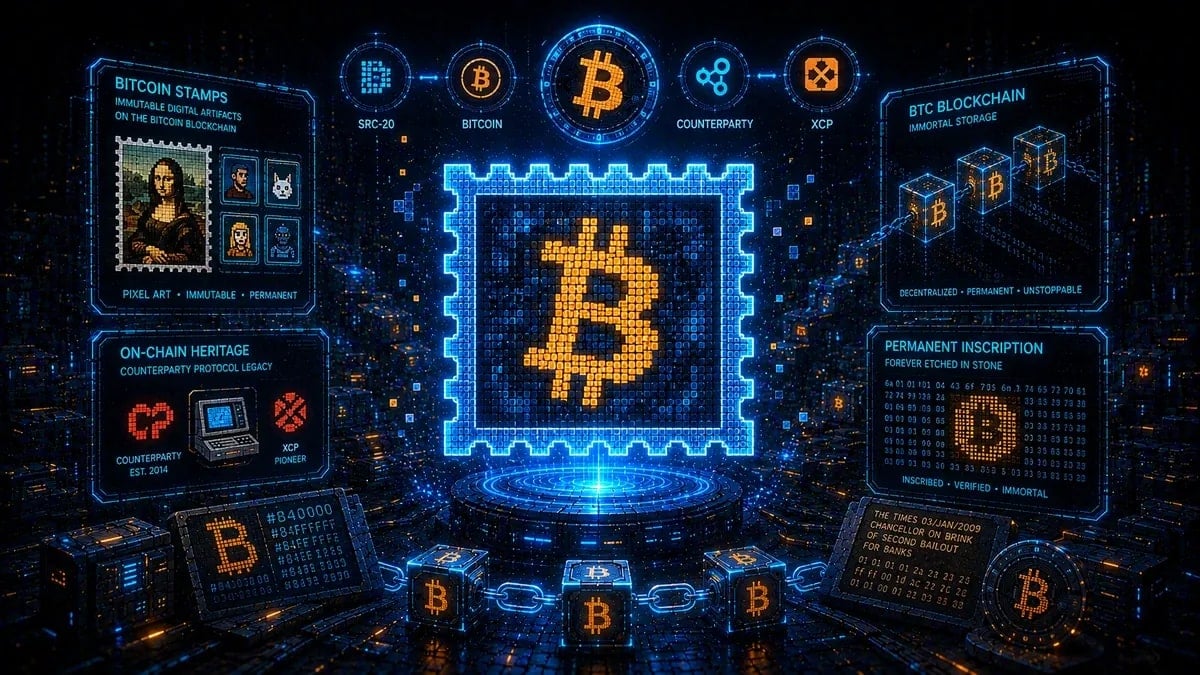
Bitcoin Stamps are the most permanent NFT protocol on Bitcoin, encoding image data directly into the UTXO set so it can never be pruned. This 2026 guide covers SRC-20, SRC-721, Mike In Space, Counterparty heritage, KEVIN STAMPS, marketplaces, and how Stamps compare with Ordinals and Runes.
What Are Bitcoin Stamps (SRC-20)? The Permanent NFT Protocol on Bitcoin Explained in 2026
When most people think about putting art or tokens directly on Bitcoin, the conversation usually starts and ends with Ordinals. But there is a quieter, more aggressive protocol living on the same chain that takes permanence to an extreme even Ordinals never attempted. It is called Bitcoin Stamps, and in 2026 it is the only major Bitcoin asset standard that guarantees the underlying image data can never be pruned, deleted, or censored, because it is encoded directly into the transaction outputs that every full node must keep forever.
Bitcoin Stamps were launched in March 2023 by an independent builder known online as Mike In Space, who designed the protocol as a philosophical response to the impermanence loophole inside Ordinals. The acronym STAMPS stands for Secure Tradable Art Maintained Securely, and the protocol has since grown into a full ecosystem with two token standards, several marketplaces, tens of thousands of collectors, and at least one collection, KEVIN STAMPS, that achieved cult status before the market had even understood what was happening. The SRC-20 fungible standard that sits on top of Stamps has minted everything from meme coins to serious experimental assets, all permanently inscribed into the most secure blockchain ever built.
This guide explains everything you need to know about Bitcoin Stamps in 2026: what they are at a technical level, how they differ from Ordinals and Runes, why Mike In Space chose UTXO encoding over witness data, what the SRC-20 and SRC-721 standards do, how KEVIN STAMPS turned a stick figure drawing into Bitcoin culture, where to mint and trade Stamps today, and the very real trade-offs you accept when you choose permanence over flexibility. By the end you will understand Stamps well enough to evaluate them as a collector, mint your first piece if you want to, and place the protocol correctly inside the broader Bitcoin asset landscape.
FEATURED SNIPPET
Bitcoin Stamps are a Bitcoin NFT and fungible token protocol launched in March 2023 by Mike In Space that encodes image and token data directly into the unspendable transaction outputs of Bitcoin blocks, making the data permanent and impossible to prune. The protocol uses two main standards, SRC-20 for fungible tokens modeled loosely on BRC-20, and SRC-721 for non-fungible collectibles. Stamps inherit the Counterparty XCP layer for issuance metadata and are traded primarily on Stampchain and OpenStamp marketplaces, with KEVIN STAMPS being the most culturally significant collection.
What Are Bitcoin Stamps in Plain English
The easiest way to understand Bitcoin Stamps is to start with a simple promise and work backward. The promise is this: whatever you stamp onto Bitcoin will exist on Bitcoin forever, in every full node, in every archival copy, in every wallet that synchronizes the chain from genesis, for as long as Bitcoin itself exists. There is no scenario in which the image can be removed, no scenario in which a future protocol upgrade can prune it, and no scenario in which a node operator can choose to discard it without breaking consensus. That is a very strong claim, and the engineering needed to back it up is the whole reason the protocol exists in its current form.
To deliver on that promise, Bitcoin Stamps encode image data inside something called the UTXO set. UTXO stands for unspent transaction output, and it is the data structure that Bitcoin uses to track who owns which coins. Every Bitcoin node must keep the entire UTXO set in fast memory, because every new transaction has to be validated against it. If you are unfamiliar with this concept, our guide to UTXOs in Bitcoin explains the model in detail. The relevant point here is that the UTXO set is the most expensive part of the Bitcoin chain to maintain, and nodes are not allowed to forget any of it.
Mike In Space realized that this property could be weaponized for permanence. By splitting an image into chunks and encoding each chunk into the output address of a multisig transaction, you can effectively force every Bitcoin node to store the image as part of the UTXO set forever, because nodes cannot tell the difference between a real multisig output and a fake one designed to hold data. The outputs are technically spendable, but the private keys do not exist, so they will never be spent, and the data they encode is etched into the chain at the deepest level possible. That is what makes a Stamp a Stamp.
By contrast, Ordinals inscribe data into the witness segment of Bitcoin transactions. Witness data is part of the block, so it cannot be deleted from history, but it is not part of the UTXO set, which means it sits in a slightly less protected layer of the protocol. There are no current plans to prune witness data, but the technical possibility exists, and the Stamps community treats that possibility as a moral failure. Stamps push the permanence claim further than any other Bitcoin asset standard, and the philosophical motivation for that push is the entire reason the protocol was created.
Mike In Space and the Philosophy of Permanence
Bitcoin Stamps would not exist without Mike In Space, the pseudonymous developer who launched the protocol in March 2023 with a Twitter thread that read more like a manifesto than a technical announcement. Mike is part of the older, weirder strand of Bitcoin culture that traces its roots back to Counterparty and the original on-chain meme economy of the mid 2010s. He has been involved with Rare Pepes and the broader Counterparty community for most of the decade before Stamps existed, and his motivation for building the protocol was as much aesthetic and ideological as it was technical.
The argument Mike made in early 2023 was that Ordinals had a flaw at the heart of their design. Casey Rodarmor inscribed data into the witness segment as a clever way of taking advantage of the SegWit discount, but that same discount was a hint that the network considered witness data less important. If a future Bitcoin Improvement Proposal ever introduced witness pruning, every Ordinal in existence would lose its image. For collectors who paid serious money for permanence, that risk was unacceptable.
Stamps were Mike's answer. By moving the data into the unspendable outputs, he placed it in the part of Bitcoin that absolutely cannot be pruned by any future soft fork without breaking consensus. The price of that decision is extreme: Stamps are more expensive to mint than Ordinals and they bloat the UTXO set in a way that some Bitcoin Core developers consider antisocial. But for the collectors who follow Mike's philosophy, that bloat is the point. If you really want something to live forever, you have to pay for the burden you are placing on every future node operator.
The Counterparty Layer and the History Stamps Inherited
Bitcoin Stamps did not appear in a vacuum. They were built on top of Counterparty, a protocol that has been issuing assets on Bitcoin since 2014, almost a decade before Ordinals appeared. Our standalone explainer on Counterparty covers the full history, but the short version is that Counterparty pioneered the entire idea of using Bitcoin as a base layer for richer assets.
Counterparty launched in January 2014 with a proof of burn mechanism. To create the protocol's native token, XCP, users sent Bitcoin to a verifiable unspendable address and were credited with XCP based on the amount burned. Counterparty then used OP_RETURN outputs to encode messages that defined new assets, transferred them, and supported smart contract style logic years before Ethereum existed.
The most famous output of Counterparty was the Rare Pepes movement of 2016 and 2017, in which artists issued thousands of Pepe-themed cards as Counterparty assets and traded them on Pepe Cash. Many of the people who built Stamps cut their teeth on Rare Pepes. The visual aesthetic of Stamps, the cultural focus on pixel art and small image sizes, and the willingness to embrace meme aesthetics rather than imitate fine art all descend directly from the Rare Pepes era. Mike In Space chose to anchor Stamps on Counterparty because the metadata layer was already battle tested and because he was paying homage to that lineage.
A Timeline of Bitcoin Stamps, 2014 to 2026
Counterparty launches on Bitcoin with a proof of burn distribution of XCP. The protocol introduces the idea of issuing arbitrary assets on Bitcoin using OP_RETURN messages and lays the metadata groundwork that Stamps will inherit nine years later.
The Rare Pepes movement explodes on Counterparty, with thousands of Pepe themed cards issued by independent artists and traded for Pepe Cash. The cultural blueprint for what would become Stamps is established during this era.
Casey Rodarmor releases the Ordinals protocol, which inscribes data into Bitcoin witness segments. Ordinals attract massive attention and become the dominant Bitcoin asset standard within weeks. Older Counterparty veterans begin to debate whether witness inscriptions are permanent enough.
Mike In Space launches Bitcoin Stamps with a manifesto thread arguing that true permanence requires data to live in the UTXO set rather than in witness bytes. The first Stamps are minted and the philosophical battle between Stampers and Ordinals maximalists begins.
The SRC-20 fungible token standard is finalized, modeled loosely on BRC-20 but adapted to the Stamps encoding scheme. The first SRC-20 tokens, including STAMP and KEVIN, begin trading and attract speculative attention.
KEVIN STAMPS launches as a free mint collection of 16,031 stick figure pixel art Stamps. Within months KEVIN becomes the unofficial mascot of the Stamps community and a status symbol among Bitcoin native NFT collectors.
Stampchain and OpenStamp mature into full marketplaces with proper indexing, wallets like Leather and Unisat begin to support Stamps natively, and the SRC-721 NFT standard formalizes the rules for multi-Stamp collections. KEVIN floor prices reach all time highs during the Bitcoin halving cycle.
Runes and Ordinals collectively capture most of the speculative volume during the post halving bull market, but Stamps carve out a defensive niche among collectors who explicitly value permanence over throughput. UTXO set bloat becomes a contentious topic in Bitcoin Core mailing lists.
The Stamps ecosystem matures into a smaller but committed segment of the Bitcoin asset market, with KEVIN STAMPS treated as a blue chip collection and SRC-20 tokens used for niche communities that prize permanence above all else.

SRC-20 and SRC-721 Standards Explained
The Stamps protocol supports two main token standards. SRC-20 is the fungible token standard, designed for assets where every unit is interchangeable, like a currency or a meme coin. SRC-721 is the non-fungible standard, designed for collectibles where every unit is unique. Both standards inherit the underlying Stamps encoding model, which means every token is permanently inscribed in the Bitcoin UTXO set.
SRC-20 borrows several conventions from BRC-20, the fungible token standard that originally appeared on top of Ordinals. Both standards use JSON formatted inscriptions to deploy a token, mint new units, and transfer them between addresses. The structural differences are small at the surface but significant underneath. A BRC-20 token is inscribed as ordinal data inside witness bytes. An SRC-20 token is encoded directly inside the unspendable outputs of a Bitcoin transaction, so the same operations leave a much heavier footprint on the chain. Mints, transfers, and deploys all consume real UTXO space.
SRC-721 came later and addressed a practical problem with the original Stamps design. Encoding a ten thousand piece collection as fully self contained Stamps would be prohibitively expensive. SRC-721 fixes this by separating the layer art from the recombination logic. Trait images are uploaded as base Stamps, and individual collection items reference those base layers in a smaller assembly Stamp. This is the same architectural insight that ERC-721 collections like Bored Ape Yacht Club use on Ethereum, adapted to the constraints of Bitcoin. Our guide to what an NFT is covers the general non-fungible token model, and SRC-721 is a pure Bitcoin native version of that idea with a level of permanence that even the strictest fully on chain Ethereum collections cannot match.
How OP_RETURN and Multisig Output Inscriptions Work
The technical machinery behind Bitcoin Stamps deserves a closer look, because the design choices that Mike In Space made create both the strengths and the trade-offs of the protocol. Every Bitcoin transaction has inputs, outputs, and optional metadata. Most outputs use standard scripts like pay to public key hash, which lock the coins to a specific address. A small subset of outputs use multisig scripts, which lock coins so that multiple signatures are required to spend them.
Stamps exploit the multisig output type by stuffing arbitrary data into the fields that would normally hold public keys. From the perspective of the Bitcoin protocol, the output looks like a valid one of three multisig in which the listed public keys cannot be distinguished from random data. Because the protocol has no way of knowing the keys are fake, the output is added to the UTXO set and replicated across every full node. The Stamps indexer software knows how to read the multisig output, reassemble the image bytes, and present the image to the user. The Bitcoin protocol itself sees only a slightly unusual but completely valid transaction.
The original Stamps specification used Counterparty messages, which travel in OP_RETURN outputs, to declare the existence of a new Stamp and link it to the multisig outputs that carry the image data. OP_RETURN is a special output script that marks data as provably unspendable, and Bitcoin nodes are permitted to discard OP_RETURN outputs from the UTXO set because they cannot be spent. The image data itself lives in the heavier multisig outputs so that the bytes are forced into the UTXO set permanently. In practice this means every Stamp pays more in fees than the equivalent Ordinal, typically between two and five times more. That premium is the cash value of the permanence guarantee.
How to Mint a Bitcoin Stamp Step by Step
STEP 1
Set Up a Compatible Wallet
Install a Bitcoin wallet that supports Stamps, such as Leather, Unisat, or the dedicated Stampchain wallet. Fund it with enough BTC to cover both the inscription fee and a buffer for network fee spikes. A practical minimum in 2026 is around 0.005 BTC for a modest image, but plan for more if fees are elevated.
STEP 2
Prepare and Upload the Image
Go to Stampchain or OpenStamp and use the minting interface to upload your image. Keep the file as small as possible, ideally under five kilobytes in PNG or GIF format. Pixel art compresses well and is the dominant aesthetic on Stamps for exactly this reason. The interface will display the estimated fee.
STEP 3
Sign, Broadcast, and Confirm
Review the constructed transaction, sign it with your wallet, and broadcast it to the Bitcoin network. Confirmation usually takes between ten minutes and an hour depending on fee rate. Once confirmed, the Stamps indexer will recognize your inscription and the image will appear in your Stampchain profile within a few minutes.
KEVIN STAMPS and the Birth of a Bitcoin Mascot
No conversation about Bitcoin Stamps is complete without KEVIN. The KEVIN STAMPS collection launched in July 2023 as a free mint of 16,031 stick figure pixel art Stamps, each one a minor variation on a simple drawing of a happy little person with a yellow head and a thin body. There was no roadmap, no token, no Discord drama, no foundation, no team page. The drop was launched by a community of Stamps enthusiasts who wanted to demonstrate what a fully native Bitcoin collection could look like, and KEVIN became the answer to a question almost nobody had asked: what does it look like when a meme is permanent.
The cultural significance of KEVIN comes from a combination of factors that are difficult to engineer deliberately. The art is intentionally bad, which gives it the same lo fi charm as the Rare Pepes that preceded it. The collection is small by current standards, which creates real scarcity. The mint was free, which means there is no story of overpriced bag holders trying to defend their entry. And the timing was perfect, because KEVIN dropped just as the broader market was discovering Stamps and looking for a flagship collection to anchor the narrative. By late 2023 KEVIN had become the unofficial mascot of the entire Stamps ecosystem.

Floor prices for KEVIN tell a story that any longtime NFT observer will recognize. The collection traded for almost nothing in the weeks after launch, climbed steadily through the back half of 2023, peaked during the Bitcoin halving rally in 2024 with individual KEVIN Stamps changing hands for several thousand dollars, and then settled into a stable mid range as the market matured. Rare traits like specific color combinations or unusual poses command outsized premiums, much like the trait based scoring systems that drive prices for Ethereum collections like CryptoPunks. For collectors who understand the cultural weight of being early to a Bitcoin native phenomenon, KEVIN remains one of the most desirable allocations in the entire Bitcoin NFT space.
There are now dozens of derivative KEVIN collections, KEVIN inspired SRC-20 tokens, and KEVIN themed art experiments. The original 16,031 Stamps continue to be the canonical reference point, and ownership of one is treated within the Stamps community as a kind of cultural credential. None of this was planned, none of it was monetized by a team, and none of it required venture capital. KEVIN is what happens when a permanence focused protocol meets a culture that already understood meme economics from the Rare Pepes era.
Stampchain, OpenStamp, and the Marketplace Ecosystem
Like every NFT and token ecosystem, Bitcoin Stamps need marketplaces that allow users to mint, list, browse, and trade. The two dominant venues in 2026 are Stampchain and OpenStamp, with smaller venues serving niche communities. Stampchain is the original Stamps marketplace, built by the same broader community that supported Mike In Space during the protocol launch. It functions as both an indexer and a trading interface, and most new Stamps are minted through its UI because the integration with the underlying protocol is tight and reliable.
OpenStamp launched later and competes by offering a slicker user interface, better mobile support, and aggressive marketing for new collection drops. Both venues support both SRC-20 and SRC-721, both display Counterparty assets alongside native Stamps for historical continuity, and both implement order book trading rather than the auction style models common on Ethereum NFT platforms. Liquidity is shared across the venues in practice because indexers and aggregators pull from multiple sources, but most serious collectors maintain accounts on both to avoid missing a listing.
For broader market discovery, asset analytics, and price tracking across the Bitcoin token ecosystem, traders increasingly rely on tools that index Bitcoin native assets alongside the larger crypto market. Our guide to using DEXTools covers the dominant trading analytics platform in 2026 and how to wire it into your daily research routine.
STAMP Token Economics and the SRC-20 Coin Market
Beyond NFT collections, the SRC-20 standard has spawned a real fungible token ecosystem. The flagship asset is STAMP, an SRC-20 token deployed in May 2023 as the canonical demonstration that fair launch fungible tokens were possible on the Stamps protocol. STAMP has a fixed supply, was minted on a first come first served basis without a presale, and has traded continuously since launch on Stampchain and OpenStamp markets. It is more of a cultural currency than a utility token, similar in spirit to ORDI on the Ordinals side, and its price tracks general sentiment toward the Stamps ecosystem more than any specific cash flow.
Beyond STAMP itself, hundreds of SRC-20 tokens have launched, ranging from earnest community currencies to obvious meme coins. The lifecycle of these tokens follows a predictable pattern that anyone familiar with BRC-20 will recognize. A new token is deployed, mints fill within hours or days, a brief speculative pump follows as collectors race to acquire supply, secondary trading begins, and then either the token settles into a long term holder base or it bleeds out as attention moves on. Because every mint and every transfer permanently inscribes data into the UTXO set, fee costs alone tend to filter out the weakest tokens fairly quickly.
If you want to compare SRC-20 with its closest siblings, our guides to Bitcoin Ordinals and Bitcoin Runes walk through the alternative standards in detail. The headline comparison is that Ordinals and Runes prioritize cost efficiency and have captured most of the speculative volume, while Stamps prioritize permanence and attract collectors who value that property explicitly.
The Immutability Advantage and Why It Actually Matters
Crypto people throw around the word immutable so loosely that the underlying meaning gets diluted, but with Bitcoin Stamps the property is genuinely strict. Once a Stamp is confirmed in a Bitcoin block, the data lives in the UTXO set of every full node from that moment forward. Since the output is constructed to be functionally unspendable, the data persists indefinitely. There is no protocol upgrade that can remove it and no legal mechanism that could compel its deletion across the global network.
This property is meaningful for several real world use cases. Artists who want their work to outlast any single hosting service can stamp their pieces and know the bytes will be readable centuries from now. Researchers who want to publish commitments in a way that cannot be retracted have a credible primitive to use. The flip side is that immutability has no opinions about content. A Stamp containing beautiful pixel art and a Stamp containing offensive material are equally permanent. The protocol cannot censor or moderate, and that is the whole point.
Bitcoin Stamps vs Ordinals vs Runes Compared
Choosing between Stamps, Ordinals, and Runes is one of the central decisions for anyone building or collecting on Bitcoin in 2026. The three protocols overlap in their high level goal of putting non Bitcoin assets onto Bitcoin, but they differ sharply in design philosophy, cost structure, and cultural orientation. A quick comparison helps clarify which protocol fits which use case, and why the same person might reasonably hold assets on all three.

Ordinals, designed by Casey Rodarmor and launched in January 2023, inscribe data into the witness segment of Bitcoin transactions. They benefit from the SegWit witness discount, which makes them dramatically cheaper to mint than Stamps, and they have inherited most of the venture capital, media attention, and developer momentum in the Bitcoin asset space. The trade-off is that witness data is technically prunable, even if no concrete plans to prune it currently exist. Ordinals are the default choice for cost sensitive minters and for projects that want to participate in the largest Bitcoin native NFT market.
Runes, also designed by Casey Rodarmor and launched at the April 2024 Bitcoin halving, are a fungible token only protocol that uses OP_RETURN messages to encode token issuance and transfers. Runes were explicitly engineered to be lighter on the chain than BRC-20 inscriptions, and they have become the default for fungible Bitcoin tokens since launch. Runes do not carry image data, so they do not compete directly with Stamps for the NFT use case, but they do compete with SRC-20 for the fungible token use case, and most of the speculative fungible token volume on Bitcoin in 2025 and 2026 has flowed to Runes rather than to SRC-20.
Stamps occupy a deliberately different niche. They are more expensive, they create more storage burden, they have less venture capital support, and they have a smaller user base. In exchange, they offer the strongest permanence guarantee available on Bitcoin and they carry the cultural lineage of Counterparty and the Rare Pepes era. For collectors who care about provenance, philosophy, and the long view, Stamps remain irreplaceable.
Risks and Trade-offs Every Stamp Collector Should Understand
The strengths of Bitcoin Stamps are real, but so are the risks. The most immediate is cost. Minting a Stamp costs significantly more than minting an Ordinal, and during fee spikes the cost can become prohibitive for anything but the smallest image sizes. Collectors who try to mint elaborate art during a bull market may find themselves paying tens of dollars per Stamp in network fees alone, which compresses the economics of free mints and pushes collections toward minimalist aesthetics.
The second risk is liquidity. Stampchain and OpenStamp work well for the major collections and the most active SRC-20 tokens, but secondary market depth thins out rapidly outside the top tier. A collector who buys into a small SRC-721 collection or an obscure SRC-20 token may struggle to exit at any reasonable price. This is not unique to Stamps, but the smaller overall user base relative to Ordinals and Runes makes the problem more acute.
The third risk is what Bitcoin Core developers call UTXO set bloat. Because Stamps deliberately force data into the part of the chain that nodes cannot prune, they impose a real ongoing cost on every full node operator. Some Bitcoin developers consider this antisocial, and there have been periodic discussions about consensus changes that would discourage non standard multisig outputs. No such change has shipped, but the political dynamic could shift, and Stampers should be aware that the protocol's permanence relies on the continued willingness of the broader Bitcoin community to tolerate the bloat.
There are also general crypto risks that apply to Stamps just as they apply to every other asset class. Phishing attacks targeting Stamps collectors are common, with scammers impersonating Stampchain or sending fake mint links via Discord. Our guide on how to avoid crypto address poisoning scams is essential reading before you start interacting with any Bitcoin asset marketplace. Custody is also non trivial: support for Stamps in mainstream hardware wallets is still maturing, and collectors who hold significant value should verify that their wallet of choice can actually display and transfer their assets safely.
PROS and CONS of Bitcoin Stamps
PROS
- Strongest permanence guarantee on Bitcoin, with image data stored in the UTXO set forever
- Built on Counterparty heritage, inheriting almost a decade of Bitcoin asset issuance experience
- Strong cultural lineage from Rare Pepes and a passionate community of long term holders
- SRC-721 supports proper trait based collections at scale, similar to ERC-721 patterns
- KEVIN STAMPS and other flagship collections give the ecosystem a recognizable identity
- Stampchain and OpenStamp provide functional marketplaces with native indexing
- Compatible with major Bitcoin wallets including Leather and Unisat in 2026
- Resistant to any future pruning or censorship effort because data lives in unspendable outputs
CONS
- Significantly higher minting cost than Ordinals, often two to five times more expensive
- Smaller market and lower liquidity than Ordinals or Runes outside the top collections
- Image size is sharply constrained by economics, pushing collections toward minimalist art
- Contributes to UTXO set bloat, which some Bitcoin Core developers view as harmful
- Tooling and wallet support is still less polished than the Ordinals ecosystem
- Niche cultural orientation may feel insular to newcomers from Ethereum or Solana
- SRC-20 fungible tokens have lost most speculative volume to Runes since 2024
- Dependence on Counterparty layer adds a small operational complexity for indexers
Best Practices for Buying, Minting, and Storing Stamps
If you decide to participate in the Stamps ecosystem, a few practical habits will save you money and protect your assets. First, never mint during a fee spike unless you have a very specific reason. The Stamps fee multiplier means that a Bitcoin fee market trading at 50 sat per byte can produce per Stamp costs that exceed the resale value of the artwork. Check mempool dot space or a comparable fee dashboard before initiating a mint and wait for calmer periods whenever possible.
Second, treat secondary purchases the same way you would treat any other illiquid collectible market. Verify the contract address on Stampchain, check trading history, look for at least a small number of independent holders, and avoid buying into collections that have been pump messaged in Discord servers. The same patterns of wash trading and coordinated hype that infect Ethereum NFT markets exist on Stamps, just at a smaller scale.
Third, take custody seriously. If you intend to hold a meaningful position, use a hardware wallet that supports Stamps natively and verify the integration before transferring high value assets. The principles are the same as for any other Bitcoin custody decision, but the niche nature of Stamps means that fewer custody products have been audited for the specific transaction patterns they involve.
Finally, treat Stamps as a long term allocation, not a short term trade. The protocol's economic value is rooted in permanence, which is a property that compounds over decades, not hours. If you do not believe in the permanence story, Runes and Ordinals are almost certainly better instruments for your trading needs. Our explainer on what DeFi is covers the wider financial application landscape that may eventually wrap around Stamps and other Bitcoin native assets through Bitcoin Layer 2 platforms like those covered in our guide to Merlin Chain and the Bitcoin L2 landscape.
Frequently Asked Questions
1. What are Bitcoin Stamps?
Bitcoin Stamps are a protocol launched in March 2023 by Mike In Space that encodes image and token data directly into the unspendable transaction outputs of Bitcoin blocks. Because nodes are required to store every UTXO forever, the data inscribed in a Stamp cannot be pruned, censored, or deleted. The acronym STAMPS stands for Secure Tradable Art Maintained Securely.
2. How are Stamps different from Ordinals?
Ordinals inscribe data into the witness segment of Bitcoin transactions, which is technically prunable in a future soft fork. Stamps inscribe data into multisig outputs that become part of the UTXO set, which cannot be pruned without breaking consensus. Stamps cost more to mint but offer a stronger permanence guarantee.
3. What is SRC-20?
SRC-20 is the fungible token standard built on top of the Stamps protocol. It uses JSON formatted inscriptions, loosely modeled on BRC-20, to deploy new tokens and to transfer them between holders. All SRC-20 data is permanently encoded into Bitcoin's UTXO set via the Stamps mechanism.
4. Who created Bitcoin Stamps?
Bitcoin Stamps were created by an independent developer who goes by Mike In Space. Mike has a long history in the Counterparty ecosystem and was active during the original Rare Pepes era, which informs the cultural orientation of the Stamps protocol.
5. What is Counterparty's role?
Counterparty is a Bitcoin asset protocol that has existed since January 2014 and was the historical foundation for asset issuance on Bitcoin. Stamps inherit Counterparty's metadata layer for declaring new assets, even though the image data itself is stored separately in multisig outputs rather than in Counterparty messages.
6. What is KEVIN STAMPS?
KEVIN STAMPS is a free mint collection of 16,031 pixel art stick figure Stamps launched in July 2023. KEVIN became the unofficial mascot of the Stamps ecosystem and is treated as a blue chip Bitcoin native NFT collection, with rare traits commanding significant premiums on secondary markets.
7. Can Stamps be deleted?
No. The data in a Bitcoin Stamp lives in the UTXO set, which every full node is required to maintain in full. There is no mechanism inside Bitcoin's consensus rules that would allow a node to discard the data without diverging from the network. As long as Bitcoin exists, the Stamp data exists.
8. How do I mint a Stamp?
Install a compatible wallet like Leather, Unisat, or the Stampchain wallet. Fund it with BTC. Upload your image to Stampchain or OpenStamp through the minting interface, review the estimated fee, sign the transaction, and broadcast it. After confirmation the Stamps indexer will recognize your inscription and display it in your profile.
9. Where can I trade Bitcoin Stamps?
The two main marketplaces are Stampchain, the original venue built by the community that supported the protocol launch, and OpenStamp, a newer competitor with stronger mobile support. Both venues handle SRC-20 fungible tokens and SRC-721 NFT collections, and serious collectors typically maintain accounts on both.
10. What is the cost to mint a Stamp?
Minting a Stamp typically costs between two and five times the price of an equivalent Ordinal. The exact cost depends on image size and the current Bitcoin fee market. During calm fee periods a small Stamp might cost a few dollars. During fee spikes the same Stamp could cost tens of dollars or more.
11. What are the main risks of Bitcoin Stamps?
High minting costs, thin secondary liquidity outside major collections, dependence on Counterparty layer tooling, the political risk of a future Bitcoin consensus change that discourages non standard multisig outputs, and the standard NFT market risks of scams, wash trading, and illiquid exits.
12. Are Bitcoin Stamps the future of permanent NFTs?
Stamps are the most permanent NFT standard ever shipped to a public blockchain, but permanence is not the only thing the market values. Stamps will likely remain a niche but durable corner of the Bitcoin asset ecosystem, attracting collectors who explicitly prize permanence over cost and liquidity.
Closing Thoughts on Bitcoin Stamps in 2026
Bitcoin Stamps will probably never be the largest asset standard. Ordinals captured the cultural moment in 2023, Runes captured the speculative volume in 2024, and Bitcoin Layer 2 platforms are now competing for the next wave of programmable use cases. Stamps will continue to be smaller, more expensive, and more idealistic than any of those alternatives. That is not a weakness, it is the entire design intention.
What Stamps actually offer is a permanence guarantee that no other Bitcoin asset standard can match, packaged in a cultural lineage that traces back through the Rare Pepes and Counterparty to the earliest days of on chain creativity. For collectors who care about that history, for artists who want their work to outlast the institutions that would normally archive it, and for builders who believe Bitcoin's true value proposition is permanence rather than performance, Stamps remain the cleanest expression of those values.
If you are coming to Stamps for the first time in 2026, approach the protocol on its own terms. Do not expect it to behave like Ethereum NFTs or compete on cost with Ordinals. Approach it as a deliberate choice to anchor something meaningful into the most durable substrate the internet has produced. Read about Bitcoin itself if you have not already, understand the UTXO model deeply, and then decide whether the permanence story matters enough to pay the premium. Either way, the existence of Stamps is good news for Bitcoin: they prove the network can host a viable asset standard built on the strictest interpretation of immutability, and that the lineage from Counterparty and Rare Pepes to modern Bitcoin NFTs is still alive.