What Is Stellar (XLM)? Cross-Border Payments Guide
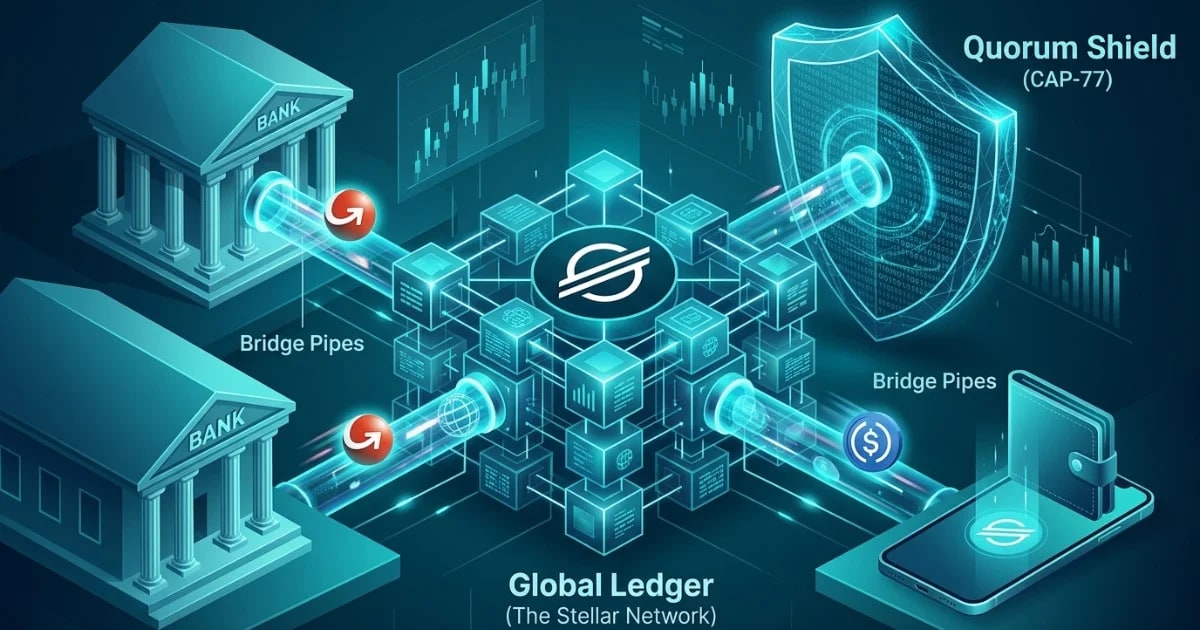
Stellar (XLM) explained: how the network powers cross-border payments and settlement, plus the 2026 roadmap and how Soroban enables new use cases.
The Institutional Backbone for Global Payments
- As of May 7, 2026, Stellar (XLM) has transitioned from a decentralized payment project into a critical piece of global financial infrastructure. While many networks focused on "DeFi summers" and "NFT hypes," Stellar spent the last decade building the "plumbing" for real-world money. Today, the network is defined by its Protocol 26 upgrade (Yardstick), which went live yesterday (May 6, 2026), introducing the industry's first protocol-level "Quorum Freeze" for institutional safety.
- Currently, XLM is trading at approximately $0.16, maintaining a market capitalization of roughly $5.3 billion.Following its classification as a digital commodity by U.S. regulators in March 2026, Stellar has seen a surge in institutional deployments, most notably from CME Group, which launched regulated XLM futures this week.
1. Technical Core: The Stellar Consensus Protocol (SCP)
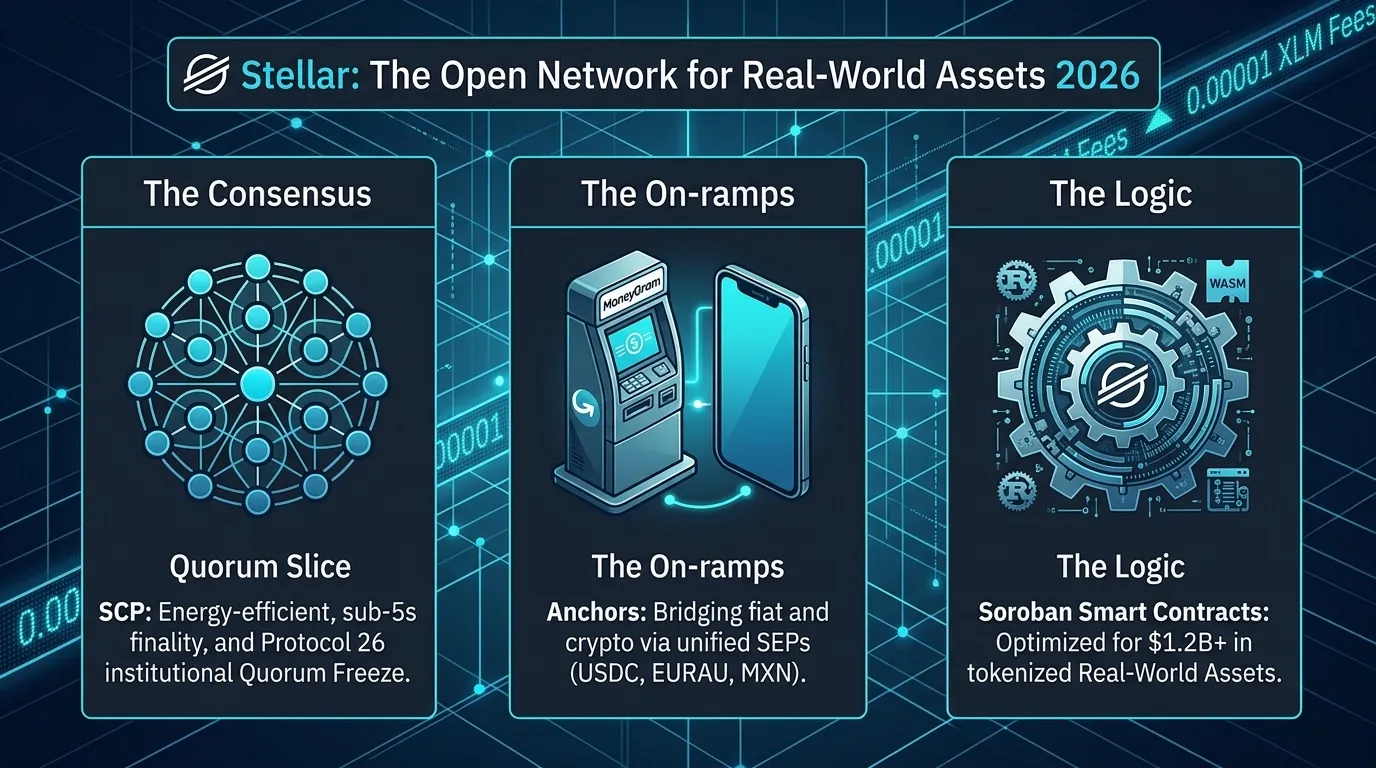
Unlike Bitcoin’s Proof of Work or Ethereum’s Proof of Stake, Stellar uses the Stellar Consensus Protocol (SCP), based on Federated Byzantine Agreement (FBA).
Trust over Energy: Instead of spending electricity to secure the network, nodes choose a "quorum slice": a set of other nodes they trust. When enough slices overlap, the network reaches a global consensus.
Protocol 26 (Yardstick): The May 2026 upgrade introduced CAP-77 (Quorum Freeze). This allows a quorum of validators to temporarily freeze compromised ledger entries (e.g., after a bridge hack). For banks and regulated institutions, this governed incident response is the "yardstick" they require to move billions on-chain.
Performance: Transactions are finalized in 3 to 5 seconds with fees typically costing 0.00001 XLM (less than a fraction of a cent).
2. Soroban: Smart Contracts for the Real World
Launched in early 2024, Soroban is Stellar’s native smart contract platform. In 2026, it has matured into a high-performance environment optimized for Real-World Assets (RWAs).
Wasm-Based: Soroban uses WebAssembly (Wasm), allowing developers to write in Rust.
Institutional DeFi: Rather than speculative "degen" pools, Soroban hosts projects like Franklin Templeton’s BENJI fund and the new State Street & Galaxy SWEEP fund, which manage institutional cash on-chain.
Protocol 26 Improvements: The latest update added "Checked 256-bit Arithmetic" and advanced ZK (Zero-Knowledge) host functions, making NoirLang proof verification cheaper and more efficient.
3. The "Anchor" Ecosystem: MoneyGram and Beyond
The true power of Stellar lies in its Anchors: regulated entities that act as on-and-off ramps between fiat and digital assets.
MoneyGram Partnership: Now in its fifth year, the partnership has expanded across LATAM, including El Salvador. Users can walk into one of 500,000 retail locations, hand over cash, and receive USDC on Stellar in their digital wallet instantly.
Universal Interoperability: Through Stellar Ecosystem Proposals (SEPs), any wallet on the network can interact with any anchor globally without custom integrations. This has turned Stellar into a "Universal Payment Interface" (UPI) for the world.
4. USDC on Stellar: The Settlement Standard
In 2026, USDC is the lifeblood of the Stellar network. It serves as the primary bridge asset for cross-border remittances, replacing the need for "nostro/vostro" accounts.
Real-Time Remittance: A worker in Europe can send Euros (EURAU), which the network’s Decentralized Exchange (DEX) automatically converts into USDC and then into Mexican Pesos (MXN) for the receiver: all in under 5 seconds.
Liquidity: Institutional liquidity is anchored by the SDF (Stellar Development Foundation) and major market makers, ensuring that large transfers do not cause price slippage.
Technical Trade-offs and Market Realities
Strengths and Opportunities
Regulatory Clarity: Its status as a recognized commodity and ISO 20022 compliance makes it a "safe bet" for enterprise treasuries.
Utility-Driven Value: Unlike many "vaporware" projects, Stellar's price is increasingly linked to actual transaction volume from RWA and remittance corridors.
Institutional Safety: Features like Quorum Freeze provide a middle ground between total decentralization and the safety required by traditional finance.
Limitations and Challenges
The "Boring" Narrative: Stellar lacks the speculative frenzy of meme-heavy chains like Solana, which can lead to slower price appreciation during retail-led bull runs.
Competition: It faces stiff competition from Ripple (XRP) in the banking sector and Ethereum L2s (like Base or Optimism) that are now targeting similar stablecoin payment use cases.
Ecosystem Growth: While TVL (Total Value Locked) in RWA is high ($1.2B+), the retail DeFi ecosystem remains smaller than major EVM chains.
To monitor the DeFi market in an agile and secure way in real-time and trade assets with the help of the best crypto tools, you can access DEXTools here.
Disclaimer: This article is for informational purposes only and does not constitute investment advice, financial advice, trading advice, or any other kind of advice. DEXTools does not recommend buying, selling, or holding any cryptocurrency or token. Users should conduct their own research and consult with a qualified financial advisor before making any investment decisions. Cryptocurrency investments are volatile and high-risk. DEXTools is not responsible for any losses incurred.
Related Guides
- How to Use Bitcoin: Beginner Guide to Wallets, Payments and Transfers (2026)
- Wormhole vs LayerZero: Cross-Chain Messaging Compared 2026
- What Is THORChain: RUNE Cross-Chain Bitcoin DEX Guide 2026
- What Is Crypto Bridge Slippage? Why Cross-Chain Transfers Drift (2026)
- What is Chainlink CCIP? Cross-Chain Protocol Guide 2026
Frequently Asked Questions
What is Stellar (XLM) used for?
Stellar (XLM) serves as a global financial infrastructure, facilitating cross-border payments and remittances, particularly through its partnership with MoneyGram and the use of USDC as a bridge asset.
How does Stellar's Consensus Protocol work?
Stellar utilizes the Stellar Consensus Protocol (SCP), which relies on a Federated Byzantine Agreement, allowing nodes to select trusted peers to achieve consensus without the energy-intensive processes used by other cryptocurrencies.
What are the benefits of the Quorum Freeze feature in Stellar?
The Quorum Freeze feature enhances institutional safety by enabling validators to temporarily freeze compromised ledger entries, providing a structured response to security incidents.
How fast are transactions on the Stellar network?
Transactions on the Stellar network are finalized within 3 to 5 seconds, making it a highly efficient option for transferring funds.
What is Soroban in the context of Stellar?
Soroban is Stellar's smart contract platform, designed to support real-world assets and institutional projects, enhancing the network's functionality and performance.