What Is PNUT (Peanut the Squirrel)? Solana Memecoin Explained in 2026
— By Tony Rabbit in Tutorials
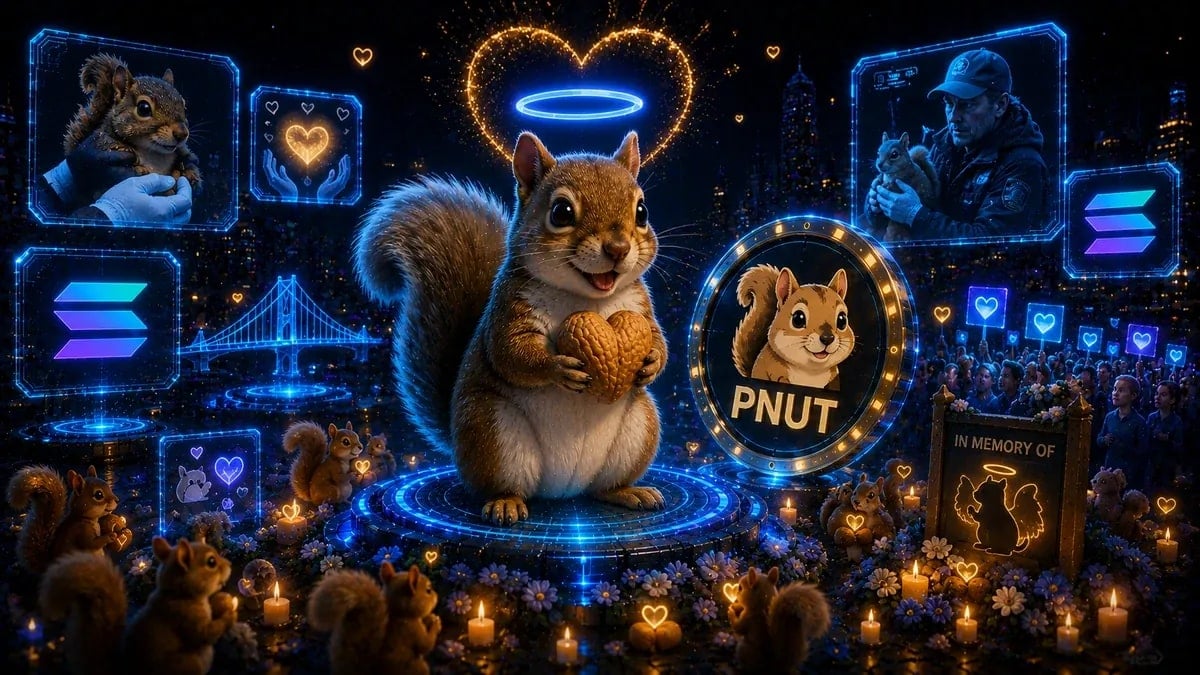
What Is PNUT (Peanut the Squirrel)? Solana Memecoin Explained in 2026 On October 30, 2024, New York State wildlife officers walked into a rural home in Pine Cit
What Is PNUT (Peanut the Squirrel)? Solana Memecoin Explained in 2026
On October 30, 2024, New York State wildlife officers walked into a rural home in Pine City and seized a rescued squirrel named Peanut along with a raccoon named Fred. Both animals were euthanized within hours. Within 72 hours, a Solana memecoin bearing Peanut's name, PNUT, had detonated from roughly three million dollars in market capitalization to north of one hundred and forty million, and by the end of that same week it had crossed a one billion dollar valuation, ranking it among the fastest billion dollar memecoin launches in crypto history.
PNUT did not arrive in a vacuum. It rode a wave of grief, outrage, and political timing that turned a quiet New York rescue story into a global flashpoint. Elon Musk amplified the narrative on X. Binance accelerated the price discovery. Pump.fun traders rotated capital out of FARTCOIN, GOAT, and POPCAT into the new ticker. By the time most retail investors had heard of Peanut the squirrel, the early movers had already booked life changing returns, and the token had transitioned from a pure tribute meme into something halfway between a charity vehicle, a political symbol, and a speculative asset.
This evergreen guide explains, in plain language, what PNUT is in 2026, where it came from, who Peanut the squirrel actually was, why his death lit such a powerful fuse across the Solana ecosystem, and what investors should know before clicking buy on any decentralized exchange. We cover the tokenomics, the animal welfare DAO that grew out of the chaos, the Pump.fun lawsuit filed by a PNUT trader, the comparisons against other animal memecoins like POPCAT and BONK, and the realistic risk profile heading into the second half of the decade.
If you have ever wondered why a dead squirrel produced one of the most discussed token launches of 2024, what is PNUT coin really worth as an asset, and whether the memecoin still has legs in 2026, this guide is structured to answer those questions without hype and without dismissal. We will look at the data, the on chain behavior, and the cultural moment that produced it.
Featured Snippet
PNUT, short for Peanut the Squirrel, is a Solana SPL memecoin launched in November 2024 as a tribute to a rescued grey squirrel euthanized by New York State wildlife authorities on October 30, 2024. The token surged from roughly three million dollars in market capitalization to over one billion dollars within five days after Elon Musk amplified the story on X and Binance announced a spot listing. PNUT positions itself as a community charity meme with an animal welfare focused DAO and trades primarily on Solana decentralized exchanges and major centralized venues. It has no intrinsic cash flow and behaves like a high beta narrative asset.
Before we dive into the specifics, it is worth setting expectations. PNUT is a memecoin. That means its value is driven by attention, community, social media velocity, and reflexive trader behavior rather than by fundamentals like revenue, users, or protocol fees. If you are familiar with our broader explainer on what memecoins are and how to trade them, much of the framework applies directly. PNUT is unusual mainly because of the speed of its initial repricing and because the story behind the token involves real animals, real grief, and real political controversy, not just an internet joke.
It is also worth noting that PNUT lives on Solana, a high throughput blockchain that has become the default home for memecoin launches in this cycle thanks to its low fees and fast settlement. If you are new to the ecosystem, our companion piece on how Solana works for beginners gives the full picture of why PNUT, BONK, POPCAT, FARTCOIN and most of the 2024 to 2026 memecoin wave landed on this chain rather than Ethereum or Base.

What Exactly Is PNUT as a Crypto Asset
Strip away the story for a moment. As a piece of code, PNUT is a Solana Program Library token, commonly called an SPL token. The Solana Program Library is the standard set of on chain contracts that defines fungible tokens on the Solana network in the same way that ERC 20 defines them on Ethereum. If you want a deeper dive into that primitive, our breakdown of SPL tokens and how they differ from ERC 20 covers the technical specifics. For the purposes of PNUT, the relevant point is that the token is cheap to transfer, settles in under a second, and integrates natively with Solana decentralized exchanges and Pump.fun style launchpads.
PNUT was not deployed by a traditional team in a private sale with a multi year vesting schedule. It was launched in the open in November 2024 as a community memecoin, with no presale, no venture allocation, and an initial liquidity pool seeded on a Solana decentralized exchange. That is the standard playbook for the post Pump.fun era. The token has a fixed maximum supply commonly cited as roughly one billion units, with the bulk of that supply already in circulation on day one. That fully diluted, no vesting structure is one reason memecoins reprice so violently. There is no overhang of locked tokens waiting to unlock, but there is also no formal team incentive to keep building beyond the meme itself.
From a market structure perspective, PNUT behaves like a high beta attention asset. It rallies when the narrative is hot, when Elon Musk or other prominent X accounts reference it, when listing rumors hit Binance, OKX, Bybit, or Upbit, and when retail traders rotate out of the previous animal meme of the week. It corrects sharply when attention fades, when whale wallets distribute into strength, or when the broader Solana memecoin index cools off. None of this is unique to PNUT, but the magnitude of the moves has been larger than average, especially during the first week after Elon Musk's amplification.
The Real Story of Peanut the Squirrel
To understand PNUT the token, you have to understand Peanut the squirrel. Peanut was a grey squirrel rescued in New York City around 2017 by a man named Mark Longo after the squirrel's mother was killed in front of him. Longo, who runs a small farm in Pine City in upstate New York along with an animal sanctuary called P'Nuts Freedom Farm, raised Peanut by hand. The squirrel could not be released back into the wild because he had become habituated to humans, and Longo documented Peanut's daily life on Instagram, where the account grew to more than half a million followers prior to October 2024.
Peanut became a minor internet celebrity in his own right well before any cryptocurrency was attached to his name. Videos of him perched on Longo's shoulder, eating waffles, and wearing tiny hats spread across TikTok, Instagram Reels, and X. The account also featured a rescued raccoon named Fred, who lived with Peanut as part of the same sanctuary. The two animals together represented something straightforward and emotionally legible in a noisy media environment, a man caring for animals who would otherwise have died.
In the months leading up to the October 2024 raid, the sanctuary had been the subject of complaints filed with the New York State Department of Environmental Conservation, often abbreviated NYSDEC. In New York, possessing a wild squirrel without a specific wildlife rehabilitator license is illegal. The complaints, the public profile of the account, and the regulatory framework collided on October 30, 2024, when wildlife officers executed a search warrant at Longo's property.
October 30, 2024 and the Catalyst Event
The raid itself lasted several hours. Officials seized both Peanut and Fred. According to subsequent NYSDEC statements, a person involved in the seizure was bitten by Peanut, which under New York public health protocols triggered a rabies risk assessment. Because there is no approved live test for rabies in squirrels and because the bite victim's exposure had to be evaluated, both animals were euthanized so their brain tissue could be tested. The tests returned negative results. Peanut had not been rabid.
News of the seizure and euthanasia spread through Longo's Instagram and X accounts within twenty four hours. The reaction was immediate and bipartisan. Animal welfare advocates, libertarian commentators, mainstream celebrities, and a long roster of political figures including J D Vance, Donald Trump Jr, and eventually Elon Musk weighed in. The story took on a life beyond any individual squirrel because it touched several charged narratives at once. State overreach, the death of a beloved pet, the proximity to a contentious United States election, and a viral internet character.
It was within this attention storm that the PNUT memecoin was deployed on Solana. Multiple unrelated wallets attempted to deploy Peanut themed tokens in the immediate aftermath, but one specific ticker, PNUT, accumulated the dominant share of attention, liquidity, and exchange listings over the next forty eight hours. That winner take most dynamic is typical of memecoins, where attention is a coordination mechanism and only one or two tokens per narrative survive the initial scramble.
PNUT Timeline From Rescue to Billion Dollar Memecoin
Mark Longo rescues an orphaned grey squirrel in New York City after the mother is killed. He names the animal Peanut and raises him by hand inside his apartment.
The Peanut Instagram account grows steadily, eventually surpassing five hundred thousand followers. Fred the raccoon joins the household. Longo opens P'Nuts Freedom Farm, an animal sanctuary in Pine City, upstate New York.
NYSDEC officers execute a search warrant, seize Peanut and Fred, and euthanize both animals later that day under the state rabies protocol after an officer is bitten.
News of the euthanasia goes viral across X, TikTok, and mainstream outlets. Within hours, the first Peanut themed tokens appear on Pump.fun and other Solana launchpads.
The PNUT ticker emerges as the dominant Peanut token by liquidity and volume. Market cap climbs through the low tens of millions of dollars as Solana memecoin traders rotate in.
Elon Musk references the Peanut story directly on X. PNUT prints a vertical candle from roughly three million in market cap to north of one hundred and forty million within a single trading day.
Binance announces a spot listing for PNUT. The token crosses the one billion dollar market cap line within forty eight hours of the listing, marking one of the fastest billion dollar memecoin runs of the year.
PNUT volatility compresses after the initial vertical move. The community begins formalizing an animal welfare donation framework. A retail trader files a lawsuit against Pump.fun related to memecoin practices.
PNUT settles into a recognizable memecoin trading range, the community continues to push an animal welfare DAO model, and the token remains one of the top tickers in the Solana memecoin category alongside BONK, POPCAT, FARTCOIN, and GOAT.
How PNUT Actually Launched on Solana
The mechanical story of how PNUT came into existence is a good illustration of how the modern memecoin pipeline works. There was no traditional team, no Discord whitelist, no know your customer process, and no professional marketing rollout. Instead, anonymous deployers used the standard Solana memecoin toolkit, predominantly Pump.fun, to mint a token, seed initial liquidity in a stablecoin pair, and let attention do the rest.
Pump.fun is a Solana launchpad that has dominated memecoin issuance through this cycle. It lets anyone deploy a new token in under a minute by paying a small fee in SOL, and it automatically migrates successful tokens to Raydium, a Solana automated market maker, once they hit a predefined liquidity threshold. If you want to understand the mechanics in detail, our walkthrough on how Pump.fun works for launching and trading memecoins covers the full launch path step by step.
In PNUT's case, the dominant contract migrated quickly to Raydium and then to major DEX aggregators. From there, listing aggregators and analytics dashboards such as DEXTools indexed the pair, surfaced the volume, and created the visibility loop that brought in centralized exchange listings. You can track that exact lifecycle for any new memecoin using our guide on how to use DEXTools to monitor new pairs, which is the same workflow professional traders applied in real time during the PNUT launch.
Step 1 Tragedy
A real world event with high emotional charge and clear narrative legibility, the seizure and euthanasia of a beloved internet animal, becomes the seed of the meme.
Step 2 Meme
Anonymous deployers tokenize the narrative on Solana via Pump.fun. Community accounts coordinate around a single ticker, PNUT, which absorbs the bulk of attention and liquidity.
Step 3 Billion
A high reach signal from Elon Musk plus a Binance spot listing compresses normal price discovery into days, taking PNUT from low millions to over one billion dollars in market cap.
Elon Musk and Binance as the Twin Catalysts
It is impossible to discuss PNUT honestly without acknowledging two specific catalysts that turned a fast moving memecoin into a billion dollar asset. The first was Elon Musk's amplification of the Peanut story on November 2, 2024. Musk did not post the contract address. He did not have to. His engagement with the narrative pulled the story into the timelines of more than two hundred million accounts and signaled to crypto native speculators that the meme had crossed into the mainstream attention cycle. PNUT printed its first vertical candle in the hours following that signal.
The second catalyst was Binance. On November 4, 2024, Binance announced a spot listing for PNUT. Binance listings have historically produced sharp, sustained repricing for memecoins because they unlock access to the broadest pool of retail and institutional liquidity in the cryptocurrency market. PNUT followed that pattern. Within forty eight hours of the Binance announcement, the token crossed one billion dollars in market capitalization, and other major centralized exchanges, including OKX, Bybit, and Upbit, queued their own listings behind Binance.

The combined effect of Musk plus Binance is what turned PNUT from another short lived Pump.fun ticker into a top tier memecoin. It is also why subsequent attempts to recreate the PNUT trajectory by deploying tribute tokens for other deceased animals have largely failed. The October 30 to November 4 window was a specific alignment of cultural grief, political timing, mainstream amplification, and centralized exchange access that has not been reproducible at scale.
PNUT Tokenomics in Plain Language
PNUT's tokenomics are deliberately simple, which is by design for a community memecoin. The total supply is fixed at approximately one billion tokens, with effectively all of that supply circulating from launch. There is no team allocation in the traditional sense and no formal vesting schedule. That structure is part of what made the early repricing so violent. Every dollar of new buying pressure had to chase a fixed, already circulating float, with no incoming unlocks to absorb the demand.
From a holder perspective, that simplicity is both a feature and a risk. The feature is that nobody can dilute existing holders by minting more PNUT, and there is no hidden insider unlock cliff approaching. The risk is that whale wallets accumulated from very early in the launch hold concentrated positions that can move price meaningfully when they distribute. On chain analytics tools and DEXTools holder dashboards make this concentration visible to anyone willing to look, and serious memecoin traders generally check the top holder distribution before sizing positions. If you have not yet read our explainer on how to spot a rug pull and check holder concentration, that framework applies directly here even though PNUT itself has not behaved like a rug.
Liquidity on PNUT is split across Solana decentralized exchanges, primarily Raydium and Orca and their aggregators, and centralized venues led by Binance. That dual liquidity profile is healthy. It means that arbitrageurs can keep CEX and DEX prices tightly aligned, that traders have multiple execution routes, and that a single venue outage or delisting risk does not strand holders without exit liquidity.
The Animal Welfare DAO Vision
One of the more interesting threads in the PNUT story is the ongoing effort by community members to push the project beyond pure speculation into a structured animal welfare donation vehicle. From the earliest days of the launch, public wallets associated with the community channeled tips and donations toward animal sanctuaries, with P'Nuts Freedom Farm itself receiving direct contributions. As the token stabilized into 2025, several community led proposals advocated for a more formal decentralized autonomous organization, often shortened to DAO, that would direct a portion of treasury funds toward verified animal welfare causes on an ongoing basis.
If you are new to the concept, a DAO is essentially a smart contract treasury whose spending decisions are made by token holders voting on proposals. The broader landscape of how this works is covered in our explainer on what DeFi is and how on chain governance works. In PNUT's case, the proposed DAO would lean less on automated yield mechanics and more on transparent grant making to wildlife rescue organizations, animal sanctuaries, and policy advocacy aimed at preventing future incidents like the Peanut and Fred euthanasia.
It is important to be precise here. As of 2026, the PNUT animal welfare DAO is more accurately described as an ongoing community initiative than a fully formed and audited governance system. Donations have flowed, and public addresses have been used for transparent giving, but the formal on chain governance contract, treasury structure, and verification framework for recipient charities remained works in progress. Investors who attribute weight to this narrative should evaluate it on its own merits and verify the current state of any DAO contracts before assuming they exist as advertised.
The Pump.fun Lawsuit and the Legal Question
In the months following PNUT's launch, a trader who had taken losses on a Peanut themed memecoin filed a lawsuit related to the Pump.fun platform. The action, covered in detail by Decrypt and other crypto outlets, argued that the platform's role in facilitating volatile memecoin launches, including PNUT and other animal themed tokens, raised consumer protection and securities law questions that had not been adequately addressed.
The lawsuit is part of a broader regulatory and legal conversation around memecoin launchpads, but the underlying question is straightforward. Are tokens that trade in highly volatile markets, launched without disclosures, and marketed through viral social media campaigns, subject to existing securities frameworks? Different jurisdictions have answered that question differently, and the case timeline has unfolded slowly. None of this is unique to PNUT, and the token itself is not the defendant. Pump.fun is.
From a holder perspective, the relevant takeaways are practical. First, regulatory action against a launchpad does not invalidate tokens already minted on it, and PNUT continues to trade on Solana DEXs and centralized exchanges independent of any Pump.fun specific legal outcome. Second, the lawsuit underscores that retail traders entering the memecoin segment should understand they are operating in a part of the market that lacks the disclosure protections of regulated securities. Third, this is part of the maturing of the memecoin category, and similar legal questions will likely follow other launches.

PNUT Compared With FARTCOIN, GOAT, POPCAT, and BONK
To understand where PNUT sits in the broader Solana memecoin ecosystem, it helps to compare it directly to four other animal or animal adjacent tickers that defined the 2024 to 2026 cycle. None of these comparisons are intended as price predictions. They simply help you place PNUT inside the right category.
BONK is the elder of the Solana memecoin family, launched in late 2022 as a community focused dog themed token. It has the largest holder base, the deepest DeFi integrations across Solana, and the most established brand. BONK is closer to a quasi infrastructure memecoin than to a pure narrative trade. PNUT, by contrast, is a younger, more narrative driven, and more event linked token. They occupy different corners of the same category.
POPCAT is a Solana cat themed memecoin that ran one of the most aggressive momentum trends of the 2024 cycle, eventually reaching multi billion dollar market capitalization. POPCAT is a more pure attention asset than PNUT, with no real world tragedy or charity narrative attached. Our deeper coverage of that token is available in our POPCAT complete memecoin breakdown. PNUT and POPCAT are often traded in the same rotation cycles by Solana memecoin specialists.
GOAT, short for Goatseus Maximus, was one of the AI agent narrative memecoins that surged in late 2024 around the Truth Terminal experiment, alongside FARTCOIN. GOAT introduced the idea of a memecoin whose narrative was partly written by an autonomous large language model. PNUT shares no AI component but did benefit from the broader wave of attention that GOAT helped seed in late October and early November 2024.
FARTCOIN is the other Truth Terminal adjacent memecoin and represents perhaps the cleanest example of attention as the entire fundamental of an asset. Our full breakdown is in the FARTCOIN AI memecoin guide. FARTCOIN and PNUT often trade in correlated regimes because both depend heavily on Solana memecoin risk appetite and on celebrity or large account amplification, but the underlying narratives could not be more different. One is a pure absurdist AI joke, the other is an emotionally charged real world story.
Real Risks Investors Should Take Seriously
PNUT is interesting precisely because the story is unusual, but the asset itself carries the standard risk profile of a high beta narrative memecoin, plus several risks specific to its origin. Investors should understand each of these before sizing any position.
The first risk is narrative decay. PNUT is anchored to an emotionally charged event from October 2024. As time passes and the cultural moment recedes, new traders entering the Solana memecoin market do not necessarily share the same emotional connection. The token has to earn its attention each cycle on the merits of community, charity work, and trading activity, rather than coasting on the original story indefinitely.
The second risk is concentration. As is typical with fast launches, a small number of wallets accumulated significant positions in PNUT's first hours of trading. Whether or not those wallets are aligned with the long term community vision, they have the capacity to move price meaningfully on distribution. On chain analytics provide transparency here, but the risk does not go away by being measurable.
The third risk is regulatory. The Pump.fun lawsuit is one example. Broader regulatory developments around memecoin launchpads, centralized exchange listings of unregistered tokens, and the application of securities law to socially driven token launches could all affect PNUT's available trading venues, even if the token itself is not directly named in any action.
The fourth risk is operational, and it is sometimes underestimated. Memecoin traders are heavy users of Solana wallets, browser extensions, and DEX aggregators, which makes them prime targets for phishing, fake airdrops, and address poisoning attacks. Our guide on how to avoid crypto address poisoning scams is required reading for anyone actively trading PNUT or any other Solana memecoin from a hot wallet.
PNUT Pros and Cons at a Glance
PROS
Tier one centralized exchange listings including Binance, OKX, Bybit, Upbit, providing deep liquidity for entry and exit.
Fixed supply with no formal team unlock cliff overhanging the market.
Recognizable, emotionally legible narrative that travels easily across non crypto audiences.
Active community efforts around animal welfare donations and a potential DAO.
Native to Solana, benefiting from low fees, deep DEX liquidity, and the broader memecoin ecosystem on the chain.
CONS
No intrinsic cash flow, no revenue, no protocol fees backing valuation.
High concentration of supply in early wallets carries distribution risk.
Narrative dependent on continued cultural relevance of the original October 2024 event.
Exposure to Pump.fun related regulatory and legal uncertainty even if PNUT is not directly named.
High historical volatility with drawdowns capable of erasing months of gains in single sessions.
Best Practices For Anyone Trading PNUT
If, after weighing the story and the risks, you decide to allocate capital to PNUT, a few discipline rules separate sustainable participation from emotional gambling. None of this is investment advice. It is operational hygiene.
Size positions assuming a full loss is possible. Memecoins, including PNUT, can and do drawdown by ninety percent or more from local highs. If you would not be comfortable with the dollar amount you have allocated going to zero, you have overallocated. This is the single most useful rule for the entire category.
Verify the contract address every single time. Imposter PNUT contracts have circulated on Solana since the original launch, and copy paste mistakes are common. Always reference the official token address listed on Binance, on the verified DEXTools page, and on at least one major analytics dashboard before approving any swap. Our walkthrough on verifying tokens and pairs on DEXTools covers the exact workflow.
Use a dedicated trading wallet, not your main self custody wallet, for memecoin activity. Solana wallets used for high frequency DEX trading accumulate signature approvals and interact with many contracts. A breach of any one of those contracts should not put your long term holdings at risk. Hardware wallets remain the right home for size positions and long term holdings.
Plan your exits before you enter. Memecoins reward discipline and punish improvisation. Pre commit to a partial take profit ladder, a stop level you will not override, and a maximum holding period. Without those rules, the same volatility that produces the upside also produces the round trips that turn green positions back into red ones.
Stay aware of correlation with the broader Solana memecoin category. PNUT does not trade in isolation. When BONK, POPCAT, FARTCOIN, and GOAT are bleeding, PNUT typically bleeds with them, and the same holds in rallies. Watching the category, not just the individual ticker, gives you a better read on what the market is really doing.
Frequently Asked Questions About PNUT
1. What is PNUT in one sentence?
PNUT is a Solana SPL memecoin launched in November 2024 as a tribute to Peanut the Squirrel, a rescued grey squirrel euthanized by New York State authorities on October 30, 2024.
2. Who is Peanut the squirrel?
Peanut was a grey squirrel rescued in 2017 in New York City by Mark Longo and raised at his upstate New York sanctuary P'Nuts Freedom Farm. The Peanut Instagram account had more than five hundred thousand followers prior to October 2024.
3. What happened on October 30, 2024?
New York State Department of Environmental Conservation officers executed a search warrant at Mark Longo's property, seized Peanut and a raccoon named Fred, and euthanized both animals later that day under state rabies protocol after an officer was bitten. Subsequent tests came back negative for rabies.
4. How did Elon Musk impact PNUT price?
On November 2, 2024, Elon Musk publicly referenced the Peanut story on X, exposing the narrative to hundreds of millions of accounts. PNUT moved from roughly three million dollars in market capitalization to more than one hundred and forty million dollars within twenty four hours of his engagement.
5. When did PNUT hit one billion dollars in market cap?
PNUT crossed the one billion dollar market capitalization line on or around November 4, 2024, within forty eight hours of Binance announcing a spot listing for the token, making it one of the fastest billion dollar memecoin runs of the year.
6. How is PNUT different from FARTCOIN or GOAT?
FARTCOIN and GOAT are AI agent adjacent memecoins associated with the Truth Terminal experiment, with narratives built around absurdist or autonomous AI generated content. PNUT is anchored in a real world tragedy and an animal welfare narrative. The tokens often trade in correlated regimes within the Solana memecoin category but represent very different underlying stories.
7. What is the PNUT animal welfare DAO?
It is a community led proposal to formalize a decentralized autonomous organization that would direct PNUT treasury funds toward animal sanctuaries, wildlife rescue groups, and related advocacy. As of 2026 it is an evolving initiative rather than a fully audited and on chain governed entity. Verify the current state of any DAO contracts directly before assuming they are live.
8. What happened with the Pump.fun lawsuit?
A PNUT related trader filed a lawsuit against Pump.fun, the Solana memecoin launchpad, raising consumer protection and securities law questions about how volatile memecoins are launched and marketed. PNUT itself was not the defendant. The action is part of a broader regulatory conversation about memecoin launchpads.
9. Where can I buy PNUT?
PNUT is available on major centralized exchanges including Binance, OKX, Bybit, and Upbit, and on Solana decentralized exchanges such as Raydium and Orca, plus DEX aggregators. Always verify the official contract address through a trusted source like DEXTools or the official Binance listing page before swapping.
10. What is the total supply of PNUT?
PNUT has a fixed maximum supply of approximately one billion tokens, with effectively the full supply circulating from launch. There is no formal team allocation or vesting schedule, which is typical of community deployed Solana memecoins.
11. What are the main risks of PNUT?
The main risks are narrative decay as the October 2024 event fades from cultural memory, supply concentration in early wallets, regulatory uncertainty around memecoin launchpads, and operational risks for traders such as phishing, address poisoning, and impostor token contracts. PNUT also exhibits high volatility characteristic of the memecoin category.
12. Is PNUT a good investment in 2026?
PNUT is a high beta narrative asset, not a traditional investment. Whether it suits any specific person depends on risk tolerance, time horizon, position sizing, and overall portfolio context. It can be appropriate as a small speculative allocation within a diversified portfolio for investors who understand the memecoin category. It is not appropriate as a core long term holding for risk averse investors. This guide is informational and not financial advice.
Final Thoughts On PNUT Heading Into The Rest Of The Cycle
PNUT is one of the strangest and most instructive memecoins of this cycle. Its origin story is tragic. Its repricing is a clean case study in how attention compounds across X, mainstream media, and centralized exchanges to produce a billion dollar asset in less than a week. Its longevity into 2026 shows that some narrative memecoins graduate from short term flips into durable category names with deep liquidity.
For new investors approaching the token in 2026, the right frame is neither cynicism nor mythology. PNUT is a Solana SPL memecoin with a fixed supply, a major exchange footprint, an evolving animal welfare initiative, and the same risks as every other memecoin in the category. Treated as a small, well sized speculative position with clear exit rules, it can be a coherent part of a portfolio. Treated as a guaranteed multiplier, it is a fast path to a painful lesson. Do the homework, verify contracts, track holder distribution, and remember that the story of Peanut is, at its core, about real animals and the people who cared for them.
Related Guides
- What Is TRUMP Coin: Official Trump Memecoin Guide (2026)
- What Is Smurf Cat? Solana Viral Memecoin from TikTok Trend Explained in 2026
- What Is SLERF? Solana Sloth Memecoin and the Burn Incident Guide 2026
- What Is Pump.fun: Complete Solana Memecoin Launchpad Guide (2026)
- What Is POPCAT? The Solana Cat Memecoin That Hit $2 Billion Explained in 2026