What Is POPCAT? The Solana Cat Memecoin That Hit $2 Billion Explained in 2026
— By Tony Rabbit in Tutorials
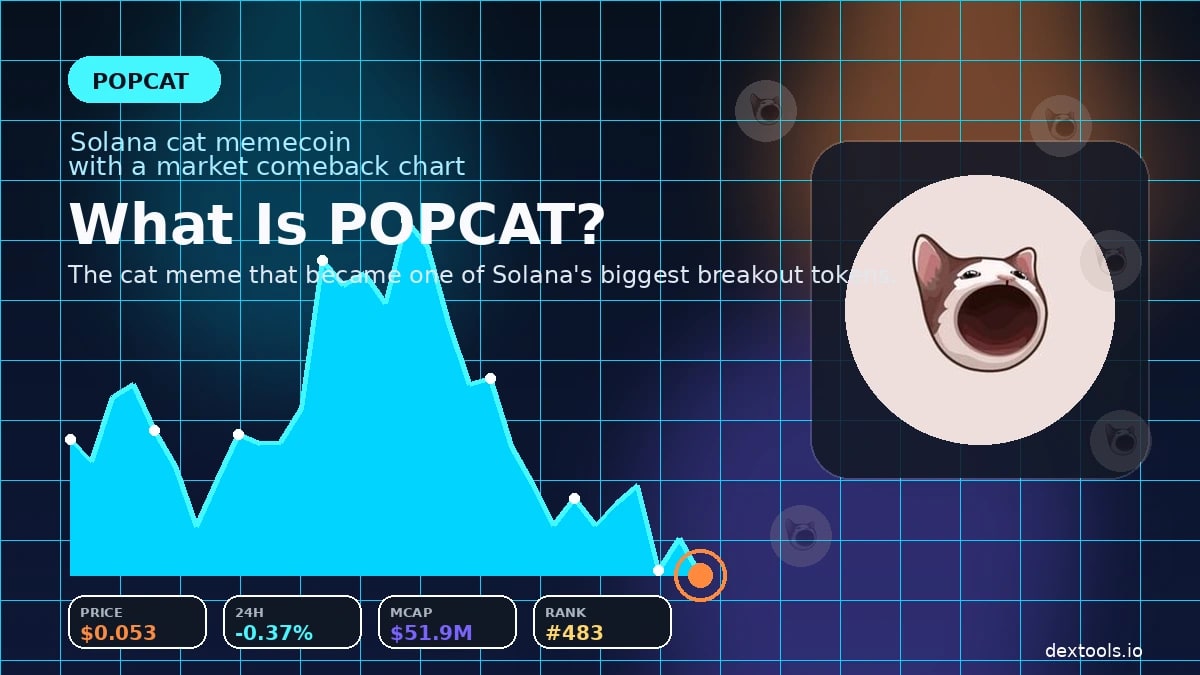
POPCAT is the Solana SPL memecoin born from the 2020 Oatmeal cat meme, launched on Raydium in December 2023 with 93.1% supply locked in a burned LP. This guide covers the tokenomics, the multisig, the $2 billion peak, the cat tribe rivalry with MEW, WIF, BONK, and MOO DENG, the Coinbase and Binance listings, and the risks every memecoin trader must understand in 2026.
What Is POPCAT? The Solana Cat Memecoin That Hit $2 Billion Explained in 2026
Every cycle in crypto produces a handful of tokens that have no business existing, no roadmap worth reading, and yet climb to valuations that rival real companies. POPCAT is the cleanest case study of that phenomenon in the entire 2024 to 2026 memecoin era. It started as a screenshot of a chubby white cat opening and closing its mouth, became a browser game that consumed millions of office hours during the pandemic, and ended up as a Solana token that crossed two billion dollars in market capitalization while shipping zero utility and zero formal team.
POPCAT is exactly the kind of asset that breaks traditional financial models. There is no discounted cash flow to compute, no revenue to project, no protocol fee switch to flip. The valuation is the meme, and the meme is the valuation. The two are tied together by a tribal community that treats the token as a flag rather than a security.
This guide unpacks POPCAT end to end. We trace the cat back to October 2020 and the Discord user who first immortalized Oatmeal in a two frame animation, walk through the December 2023 Raydium launch and the LP burn that locked permanent liquidity, and compare POPCAT to MEW, WIF, BONK, and MOO DENG inside the Solana cat tribe. By the end you will understand both the mechanics and the mythology behind a token that proved a cat could carry billion dollar market cap energy.
POPCAT is a Solana based SPL memecoin launched on Raydium in December 2023 and inspired by the original 2020 Popcat meme of Oatmeal the cat. The token has a fixed supply of just under one billion units, with 93.1 percent of supply seeded into the Raydium liquidity pool and the LP tokens permanently burned to lock liquidity. The remaining 6.9 percent sits in a multisig reserved for centralized exchange listings and cross chain bridges. POPCAT reached a peak market capitalization of more than two billion dollars in 2024 and was the first cat themed cryptocurrency to cross the one billion dollar mark on any blockchain.
What Is POPCAT in Plain English
POPCAT is a fungible token issued on Solana using the standard SPL token program. There is nothing exotic about the contract. It does not stake into validators, it does not represent governance in any protocol, and it does not earn fees from any application. It is a plain SPL token, and the value comes from what people decide it represents.
What makes POPCAT noteworthy is the launch design. The deployers committed 93.1 percent of supply as one side of a liquidity pool on Raydium, Solana's largest automated market maker, and burned the LP tokens they received in exchange. Burning the LP tokens is the on chain way of declaring that nobody, including the original deployers, can ever remove that liquidity again. The remaining 6.9 percent sits in a multisig reserved for centralized exchange listings, market making, and bridge deployments to other chains.
This structure removes the most common memecoin rug pull vector. With burned LP tokens, the pool cannot be drained by the deployers. The only way to extract value is to sell tokens into existing liquidity, which moves price down visibly on chain. That does not eliminate risk, but it shifts the model from a binary trust exercise to a market microstructure question about whether buyers keep showing up.
POPCAT lives within the broader category of cat themed memecoins on Solana, a tribe that includes MEW, MOO DENG, MICHI, and a long tail of smaller experiments. Within that tribe POPCAT is widely considered the original alpha cat, the token that proved cats could carry the kind of market cap energy that dog coins like DOGE, SHIB, and BONK had monopolized for years. For broader context on the category, our memecoin trading guide walks through the economic mechanics in detail.
The Oatmeal Cat Story: October 2020
The cat in POPCAT is a real animal named Oatmeal, owned by a Discord user who in October 2020 captured two photographs that would later seed a multi billion dollar token. The first photo shows the cat with mouth closed in a relaxed pose. The second shows the cat with mouth wide open in what looks like a mid yawn. When the two frames toggle rapidly in sequence, the cat appears to pop its mouth open and shut on loop. The effect is absurd, hypnotic, and very funny.
The original GIF spread through Discord in late 2020, hit Reddit within days, and exploded across Twitter and TikTok shortly after. The popping animation looped indefinitely and paired easily with music or text overlays. By the end of 2020 the popcat had become one of the most copy pasted reaction GIFs in internet humor, used for everything from shock to mock outrage.
In early 2021 an independent developer turned the animation into a browser based clicker game called Popcat.click. The premise was almost insultingly simple. You click the cat, the cat pops, a counter goes up. The site tracked clicks per country on a global leaderboard, which gamified national pride at the most ridiculous possible level. Entire countries organized on Discord and Twitter to push their nation up the leaderboard, with millions of clicks coordinated through bots and human raids. The game became a small cultural artifact of the pandemic.
Critically, the cryptocurrency token launched in 2023 has no formal ownership relationship to the original meme, the photographs of Oatmeal, or the Popcat.click game. It is a separate token created by anonymous developers who used the cultural recognition of the cat as social fuel. This is normal in memecoin land, and the community treats the appropriation as part of the joke rather than a problem.
From Internet Meme to Solana Token: December 2023
By late 2023, Solana memecoins were starting their second major wave. BONK had launched in December 2022 as a free airdrop and exploded in late 2023 alongside Solana's price recovery. Memecoin trading on Raydium was driving record daily volumes. Into that environment, an anonymous deployer launched POPCAT on December 22, 2023.
The launch predated the Pump.fun standard. There was no bonding curve, no automatic graduation, no factory contract. The deployer built the launch manually: deploy the SPL token, mint total supply to a treasury wallet, create a Raydium pool by pairing tokens against SOL, provide initial liquidity, and then secure the pool from rug pulls.
What made POPCAT interesting was the choice to commit 93.1 percent of supply to the LP. Most memecoin deployers in late 2023 were committing 50 to 80 percent, holding the rest in team and marketing wallets. By going to 93.1 percent, the POPCAT deployer made a very strong honesty signal. The LP tokens were burned, and the remaining 6.9 percent went to a public multisig.
The launch market cap was modest. Early reports place the fully diluted valuation at roughly two hundred thousand dollars on day one. There was no presale, no influencer allocation, no coordinated campaign. The token traded thinly for several weeks while meme awareness built organically. By early 2024, POPCAT was being discussed alongside WIF and BONK as one of the breakout Solana memes, and the chart was climbing on heavy volume.
The POPCAT Timeline: Meme to $2 Billion
POPCAT Tokenomics and the Liquidity Burn
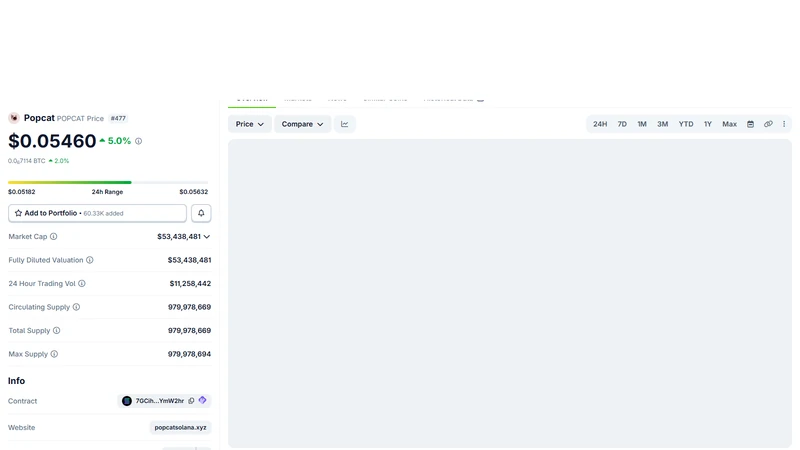
POPCAT has a fixed total supply of 979,978,235 tokens, with no inflation, no staking emissions, and no scheduled unlocks. The distribution was finalized at launch. This kind of clean fixed supply is rare in DeFi protocols and very common in memecoins, where simplicity is part of the appeal.
The deployers split supply into two buckets. The first, 93.1 percent, was paired with SOL and deposited into a Raydium pool. The second, 6.9 percent, was placed in a multisig wallet controlled by multiple signers and earmarked publicly for exchange listings, market making, and cross chain bridges. The split numbers are intentional. The 6.9 figure is a nod to the joke number that has run through internet culture for two decades, and the 93.1 matches it. Meme aware tokenomics is part of the brand.
The LP burn is the mechanic that defines POPCAT's credibility. When you provide liquidity to a Raydium pool you receive LP tokens that represent your share. Those LP tokens can later be redeemed for the underlying liquidity. By burning them, the deployers gave up the right to redeem. The SOL and POPCAT in that pool are now permanently locked. They can be traded against but never withdrawn.
The burn is verifiable on Solana block explorers. Anyone can look up the LP token mint, see the supply, and confirm that all of it went to the canonical burn address. The same verification can be done for the multisig that holds the 6.9 percent reserve. Tools like DexTools show wallet concentration and liquidity history, which makes the LP lock easy to audit. Because liquidity is fixed, large trades move price along the constant product curve predictably, and no party can pull liquidity to flash crash the pair.
The Raydium Launch Mechanics: Step by Step
It is worth walking through the technical sequence the deployers used in December 2023, because understanding it helps you evaluate any new memecoin you encounter with similar claims. The pattern is now standard for memecoin launches that want to signal honesty, and POPCAT is one of the most prominent examples of it executed cleanly.
After step three the token is live and trading on Raydium, with a permanent liquidity floor and a clearly disclosed reserve wallet. The deployers do not have to do anything else for the token to function. From that point forward the price is determined entirely by the order flow into and out of the Raydium pool, plus any additional liquidity that gets added by external LPs. If the pattern looks similar to the Pump.fun launch flow, that is because Pump.fun later automated this exact sequence into a one click product, but the manual version pioneered by tokens like POPCAT, WIF, and MEW came first.
For a deeper dive into what an SPL token actually is at the protocol level, our guide to SPL tokens on Solana covers the mint authority, freeze authority, and decimal scheme that underlie every Solana fungible token including POPCAT.
Exchange Listings: From DEX to Coinbase
For the first several weeks after launch, POPCAT only traded on Raydium and on the early Solana aggregators that scraped Raydium pools. This is the normal lifecycle of a Solana memecoin. It is born on a DEX and layers on CEX listings as size and liquidity demand them.
The first centralized listings came in early 2024 from Asia focused exchanges. KuCoin, MEXC, Bitget, and Gate.io added POPCAT spot trading within weeks of each other as the token broke past 100 million dollars in valuation. These venues list memecoins faster than US regulated exchanges because their compliance posture is more permissive. The 6.9 percent multisig reserve was used to provide initial market making inventory for several of these listings.
As POPCAT climbed through summer 2024, Bybit and OKX added spot, and the token was wrapped into perpetual futures on multiple derivatives platforms. Funding rates on POPCAT perps frequently spiked into double digit annualized percentages during euphoric phases, creating a profitable basis trade for sophisticated participants who could short the perp and long the spot.
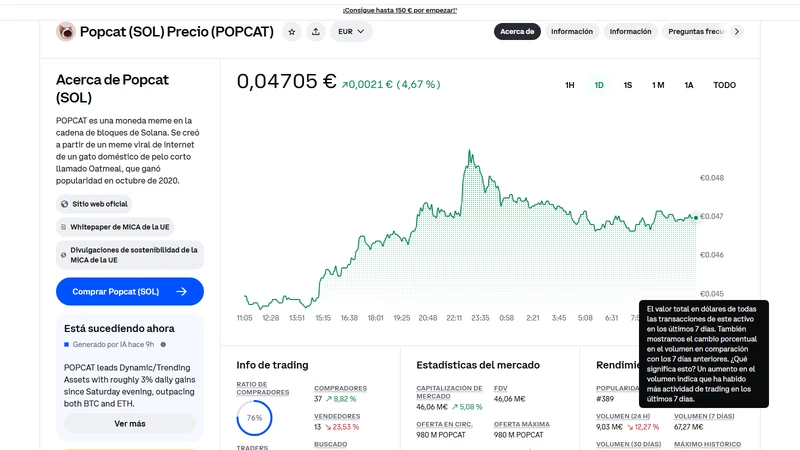
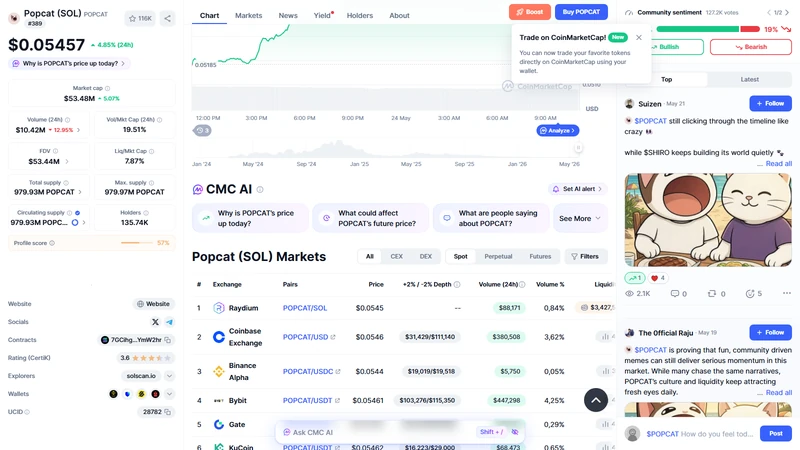
The biggest listings came after the token crossed one billion dollars. Binance added POPCAT to its main spot market, giving global retail exposure in every region where Binance operates. Coinbase listed POPCAT on its main app, a meaningful milestone because Coinbase is the most conservative major US exchange on memecoin listings. The two listings together meant any retail crypto user in the world could buy POPCAT through a regulated venue without needing a Solana wallet.
The Cat Memecoin Tribe: POPCAT vs MEW vs WIF vs BONK
Solana memecoins are a tribal landscape with overlapping but distinct communities, and POPCAT sits inside a specific subtribe. The comparison most often raised is POPCAT versus MEW, since both are cat themed Solana tokens that reached similar valuations.
MEW, full name Cat in a Dogs World, launched in March 2024 with explicit branding around the cat versus dog rivalry, taking direct aim at DOGE, SHIB, BONK, and WIF. MEW peaked above one billion dollars in 2024. POPCAT predates MEW by several months and carries the original cat meme energy without needing the cat versus dog framing as marketing. POPCAT is the cat that already existed. MEW is the cat that wanted to fight the dogs.
WIF, short for dogwifhat, is the dog comparison most often raised in the same breath. WIF launched in late 2023 around the same window as POPCAT and became the flagship Solana dog meme by crossing four billion dollars during the 2024 peak. WIF has stronger institutional and influencer backing including paid Las Vegas Sphere displays. POPCAT is grassroots by comparison.
BONK is the elder statesman of the Solana memecoin scene. It launched in December 2022 and was distributed as a free airdrop to active Solana users. BONK has the largest holder count of any Solana memecoin and is integrated into many wallets, dApps, and retail point of sale systems. POPCAT is more concentrated in active traders and less embedded into Solana infrastructure.
MOO DENG, the baby hippo token that exploded in late 2024 around a viral zoo animal in Thailand, is a pure attention play that rode a real world moment into a multi hundred million dollar valuation in weeks. POPCAT is older and has weathered more cycles. A related comparison is with FARTCOIN, the AI memecoin that broke out around Truth Terminal. Both demonstrate that a single cultural artifact, properly tokenized with clean mechanics, can sustain a billion dollar plus valuation without any utility roadmap.
Cultural Impact and Community Building
The most underrated thing about POPCAT is how much of its valuation is community labor. The token has no marketing budget, no central team running paid campaigns, no PR firm. Every viral tweet, every animated edit of the popping cat overlaid on a chart, every Telegram raid is produced by volunteers who happen to own the token. Holders are also the marketing department.
The community organizes primarily on Twitter and Telegram. The aesthetic is consistent: edits built around the two frame popping mouth animation, pastel palettes, intentionally low brow humor. Sophistication would break the brand. The community also leans into the country leaderboard heritage from the original Popcat.click game, with informal national chapters competing on wallet counts and staging coordinated buys.
There is noticeable crossover between POPCAT culture and traditional internet meme culture. Major non crypto meme accounts repeatedly use the popping cat in unrelated jokes, which keeps the underlying meme alive even when the token price is quiet. This separation between meme and token, where the meme can spread without depending on price action, gives POPCAT a cultural moat that a freshly launched memecoin would not have. The cat existed before the token and will exist after it.
Solana Speed and Low Fees: Why the Chain Matters
POPCAT could exist on any blockchain that supports fungible tokens, and bridged versions exist on a few other chains. But the home chain is Solana, and the choice was not accidental. The fit between memecoin trading and Solana is unusually tight.
Solana uses a hybrid consensus combining Proof of History with Proof of Stake. Proof of History is a cryptographic clock that lets validators agree on transaction order without communicating at every step, dramatically reducing consensus overhead. Proof of Stake handles security, with validators staking SOL to participate. The combined design lets Solana process thousands of transactions per second with sub second confirmation at fractions of a cent per transaction.
For memecoin trading this matters because typical traders make many small trades in rapid succession. On Ethereum mainnet, where gas can reach tens of dollars per swap during congestion, this style is economically impossible for retail. On Solana the same trader can place hundreds of trades per day and pay total fees of a few dollars. This unlocks a category of speculative activity that does not exist on slower chains.
Solana also has a deep ecosystem of memecoin specific tools. Aggregators like Jupiter route trades across all major Solana DEXes. Wallets like Phantom and Backpack offer one click swap interfaces. Telegram bots like BonkBot, Trojan, and Bullx let traders execute swaps from messaging apps. Analytics platforms like DexTools and Birdeye surface trending tokens and wallet behavior in real time. POPCAT benefits from an ecosystem built around exactly the use case it exemplifies.
How POPCAT Sustains Valuation Without Utility
The hardest question for any newcomer is what exactly justifies a multi billion dollar valuation for a token that produces no revenue and grants no rights to anything. The answer requires letting go of the fundamental value framework that applies to equities and reaching for a different model. POPCAT is closer to a tradable cultural unit than to a financial asset in the traditional sense.
In a cultural unit model, value is sustained by three forces. The first is the strength of the underlying meme, measured by how recognizable it remains in mainstream culture. POPCAT scores extremely high here. The popping animation works in any context. The second is the depth of holder commitment, measured by holder count and wallet age. POPCAT has tens of thousands of long term holders with a notable share of wallets that have not sold since 2024. The third is structural credibility: fixed supply, burned LP, publicly documented multisig. All three forces line up.
This model also explains why POPCAT does not need a roadmap. A roadmap would weaken the proposition by implying the token needs to do something to justify its value. The whole point of a pure memecoin is that the meme is the product. Adding staking or a play to earn game would dilute the brand. The discipline of doing nothing is part of the value proposition.
The model has obvious limits. A cultural unit that fades loses value. A community that fractures loses cohesion. A holder base that consolidates into a few whales loses credibility. POPCAT has navigated all three risks reasonably well, but none are permanently solved. Continued valuation depends on the meme staying alive, the community staying committed, and the distribution staying healthy.
Risks and Honest Tradeoffs
The honest POPCAT thesis includes real risks any buyer should sit with. None are unique to POPCAT, but all are amplified by the memecoin structure, and ignoring them is the most common way retail traders lose money in this category.
The first risk is volatility. POPCAT has swung 20 to 40 percent in a single day during high attention periods, and drawdowns of 80 percent from local highs are normal across the cycle. Position sizing for memecoins should always assume total loss. Any sizing that would meaningfully impact your life if zeroed is too large.
The second risk is meme decay. The original meme is more than five years old as of 2026, which is ancient in internet time. While it has aged better than most, there is no guarantee the cultural relevance persists into 2027 or beyond. If the meme fades from organic circulation, the token loses one of its three pillars of value.
The third risk is competitive displacement. New cat memecoins launch every week on Solana. Most die, but occasionally one siphons mindshare from POPCAT. MEW already did this in 2024. If a new cat meme catches fire with a different cultural angle, POPCAT could lose tribal alpha status.
The fourth risk is regulatory. Memecoins exist in a legal grey zone, and posture toward retail speculative tokens has been hardening. If a major jurisdiction designates memecoins as securities, exchange listings could be reversed. POPCAT has the advantage of being a community token without identifiable promoters, which reduces some legal exposure, but the risk is not zero.
The fifth risk is operational. Despite the LP burn, the token relies on infrastructure that can fail. Solana has had multi hour outages. Centralized exchanges can delist. Bridges to other chains have been vulnerable to hacks. Wallet phishing and address poisoning scams target memecoin holders because they are typically newer to crypto. Treat security as personal responsibility and use hardware wallets for significant positions.
Finally, the universal risk is that POPCAT is exactly what it claims to be. It is not productive, it pays no yield, it grants no governance. The upside scenario requires the meme to keep spreading. The downside scenario requires nothing. The chart simply drifts down over months until the token becomes another forgotten artifact in the history of internet money.
POPCAT Pros and Cons
- Burned LP makes liquidity permanent and removes the most common rug pull vector
- Fixed supply with no inflation, no unlocks, and no insider allocations
- One of the most recognizable internet memes of the 2020s
- Listed on Coinbase, Binance, Bybit, OKX, KuCoin and most major exchanges
- First cat themed crypto to cross 1 billion dollars in market cap
- Deep, tribal, country level community with multi year holder cohorts
- Lives on Solana, which has the best memecoin infrastructure in crypto
- Multisig reserve is publicly documented and tracked on chain
- Zero utility, zero revenue, zero claim on cash flows
- Historical drawdowns of 80 percent plus from local highs are normal
- Vulnerable to displacement by newer cat themed memecoins
- Meme is more than 5 years old and could lose cultural relevance
- Anonymous deployers means no formal team accountability
- Regulatory uncertainty around retail memecoin trading in some jurisdictions
- Solana network outages can freeze price discovery temporarily
- Bridge and wallet phishing risks target memecoin holders specifically
Best Practices for POPCAT and Memecoin Traders
If POPCAT belongs in your portfolio, the rest is execution. Memecoin trading rewards discipline more than insight. The traders who do well over multiple cycles are the ones with consistent risk management.
Start with position sizing. Cap memecoin exposure at 5 to 10 percent of your total crypto portfolio, and any single memecoin position at 1 to 2 percent. POPCAT can be part of a balanced exposure but should not be the centerpiece. Use limit orders rather than market orders, because memecoins are volatile enough that fast moves can fill 5 to 15 percent worse than quoted price.
Plan your exit before you enter. Decide what gain triggers a partial sell, what loss closes the position, and what time horizon you are operating on. The biggest losses come from holders who turned a 200 percent gain into a 50 percent loss by failing to take profit, or a 30 percent drawdown into a 90 percent one by refusing to cut.
Use hardware wallets for any size position. Memecoin traders are prime phishing targets because they interact with new contracts frequently. A Ledger or Trezor stops most attack vectors cold. Learn to read on chain data: DexTools, Birdeye, and Solscan show wallet concentration, large transaction patterns, and liquidity changes in real time.
Always check liquidity before entering. POPCAT has deep permanent liquidity, but newer tokens inspired by POPCAT need verification that the LP is real and burned. Our guide to spotting rug pulls covers the on chain checks every memecoin trader should run. For broader context on how memecoins fit into the larger landscape, our DeFi guide covers the surrounding primitives.
Finally, accept that the goal is survival across cycles. The traders who get rich in memecoins are the ones who held through the boring stretches between euphoric peaks. POPCAT has proven across two and a half years that it belongs in the survivor camp, but past survival does not guarantee future survival. Treat every position as a probabilistic bet, not a permanent conviction.
POPCAT FAQ
Closing Thoughts
POPCAT is the cleanest expression of what memecoin investing actually is in 2026. There is no business model, no revenue to discount, no roadmap. There is only a cat, a community, and a Raydium pool that nobody can drain. That a token built on those three ingredients can sustain a multi billion dollar valuation across cycles tells you something about how crypto has evolved since the ICO era. The dominant retail asset class is no longer pretending to be infrastructure or DeFi. It is pure attention denominated in fungible units, and POPCAT is one of the most honest examples.
Whether that honesty justifies a long term position is a question only you can answer. If you can hold through 80 percent drawdowns without flinching, if you size the position as money you are comfortable losing entirely, if you understand that the meme is the product, then POPCAT can be a reasonable allocation inside a broader crypto portfolio. If any condition does not hold, size much smaller or stay out entirely.
Either way, POPCAT will continue to exist whether you participate or not. The cat will keep popping. The community will keep raiding. The interesting question is not whether POPCAT survives the next cycle but whether the next cycle produces another cat meme of equal cultural power. POPCAT's job over the next several years is to defend its position as the original alpha cat against an endless wave of challengers. So far it has done that job better than almost anyone expected.
Related Guides
- What Is Smurf Cat? Solana Viral Memecoin from TikTok Trend Explained in 2026
- What Is BOME (Book of Meme)? Solana Darkfarms Memecoin Guide 2026
- What Is Toshi (TOSHI)? Base Memecoin from Coinbase CEO's Cat Explained in 2026
- Top Solana Meme Coins Trending This Week: DEX Watchlist
- How to Analyze Solana Meme Coins Before Trading: On-Chain Risk Checklist (2026)