Filecoin Storage Markets and FIL Economics Guide (2026)

A focused Filecoin guide covering storage markets, retrieval, FIL incentives and how decentralized storage economics work in practice.
Where this page fits: This page is the market-structure angle. It focuses on storage markets, retrieval and FIL economics. For the broader beginner explainer, read our main Filecoin guide.
What is Filecoin?
- Filecoin is a peer-to-peer decentralized storage network that enables users to rent unused hard drive space from a global network of independent operators. Built as the incentive layer on top of the InterPlanetary File System (IPFS), the network provides a cryptographically secured alternative to legacy platforms like AWS S3 or Google Cloud.
- The primary economic utility token of the ecosystem is FIL. Rather than functioning merely as an inflation-driven payment wrapper, FIL serves as a critical structural collateral asset. To host client data legally, storage providers must lock up substantial amounts of FIL. This skin-in-the-game layout ensures that if an operator drops offline or attempts to modify stored files, their staked capital is programmatically burned by the blockchain protocol.
The Verifiable Cloud: Solving the Data Sovereignty Crisis
- The global data economy relies heavily on an oligopoly of centralized cloud storage conglomerates. While modern data centers offer rapid retrieval speeds, their top-down business models introduce structural vulnerabilities: corporate gatekeepers exercise full censorship controls over stored files, lock enterprise customers into predatory pricing agreements, and operate inside opaque data storage siloes. Crucially, as the artificial intelligence revolution scales, these black-box storage systems cannot cryptographically prove that training datasets haven't been modified, tampered with, or systematically poisoned.
- Filecoin re-engineers this data architecture. Operating as a decentralized physical infrastructure network (DePIN), Filecoin transforms raw computer storage into an open, algorithmic marketplace. Instead of relying on centralized corporate compliance promises, the network uses mathematical proofs to verify data integrity. This comprehensive guide breaks down Filecoin's storage provider architecture, explores the smart contract capabilities of the Filecoin Virtual Machine (FVM), and analyzes the emerging on-chain retrieval markets designed to handle high-frequency AI workloads.
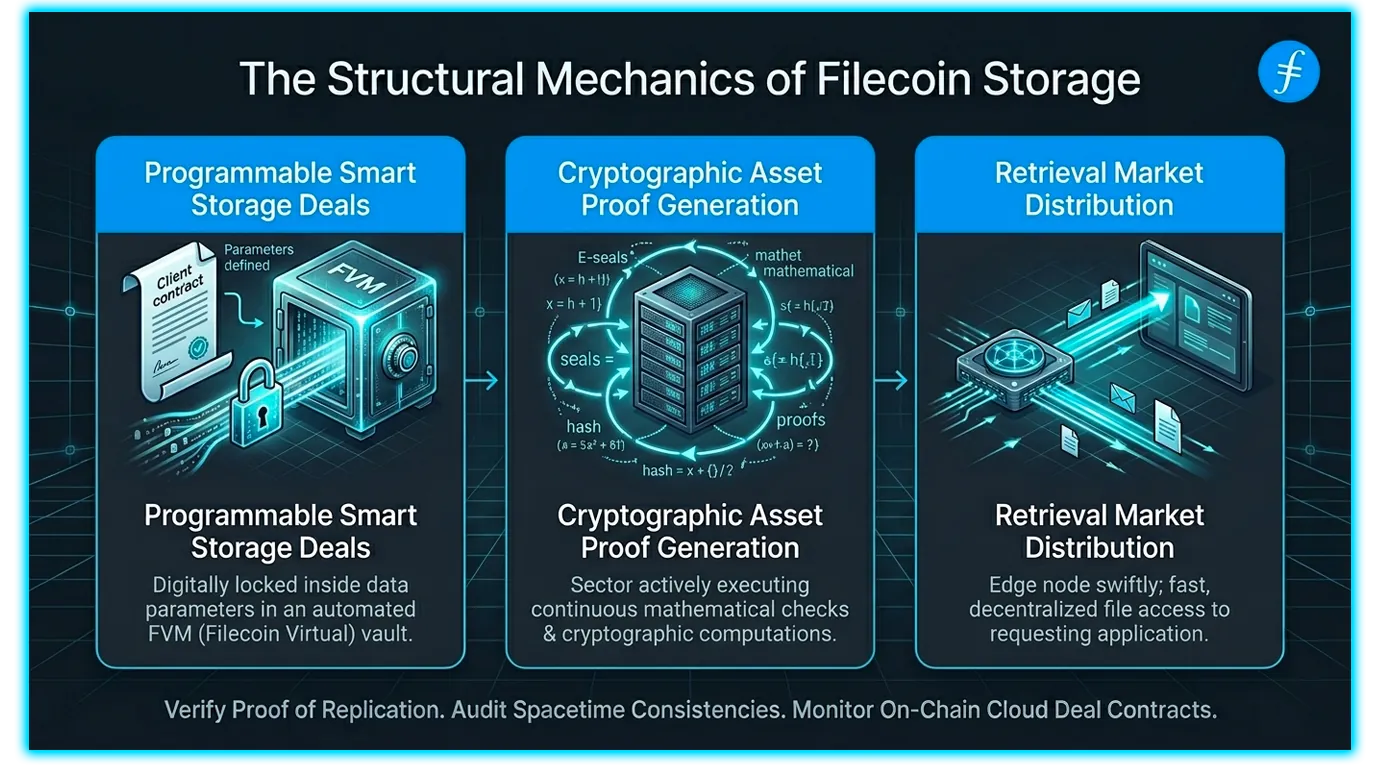
1. Core Infrastructure: Storage Providers and Cryptographic Proofs
The bedrock of Filecoin's open-market network consists of its distributed Storage Providers (SPs). Anyone with enterprise-grade server hardware can join the network to monetize their storage capacity. However, unlike traditional cloud hosts that demand blind institutional trust, Filecoin mandates continuous cryptographic proof generation.
To guarantee that data is securely preserved over the lifetime of a commercial arrangement, Filecoin's consensus mechanism utilizes two fundamental cryptographic primitives:
Proof of Replication (PoRep): Executed when a storage deal is initialized. It mathematically proves that a storage provider has received the client's data and successfully sealed it into an isolated, unique physical sector on their hard drive hardware, preventing providers from spoofing multiple data copies on a single disk.
Proof of Spacetime (PoSt): Executed continuously at random intervals. This mechanism verifies that the storage provider is still dedicating the required physical hardware sectors to the client's data over the entire timeline of the active storage agreement.
If an operator fails to submit these automated proofs to the ledger within hardcoded block windows, the protocol triggers a slashing event, automatically burning their deposited FIL collateral.
2. Programmable Data: The Filecoin Virtual Machine (FVM)
The integration of the Filecoin Virtual Machine (FVM) transformed the network from a static data archive into a programmable cloud infrastructure layer. Fully compatible with Ethereum's Solidity runtime environment, the FVM allows developers to build complex smart contracts directly alongside stored datasets.
This smart layer unlocked powerful Web3 use cases:
Data DAOs: Shared community repositories where members pool funds, vote on data governance, and collaboratively pay to permanently preserve scientific datasets, historical archives, or public genomic records.
Automated Storage Insurance: Smart contracts that automatically monitor storage providers' uptime. If a provider misses a Proof of Spacetime check, the contract instantly payouts insurance claims to the affected client.
Filecoin Onchain Cloud (FOC): This framework brings front-end infrastructure governance completely on-chain, utilizing automated smart vaults to handle storage deal pricing, multi-signature data allocations, and automated stablecoin settlement rails without relying on off-chain payment networks.
3. Market Dynamics: Storage Deals and Retrieval Markets
Filecoin partitions its open marketplace into two distinct operational vectors to maximize efficiency.
The Storage Market
This track handles long-term data preservation. Clients and storage providers negotiate commercial variables (such as total data size, price per gigabyte, and contract duration) to establish an on-chain Storage Deal. To incentivize the onboarding of highly valuable information rather than artificial filler data, the Filecoin Plus (Fil+) initiative grants tenfold block reward multipliers to providers who host verified, production-grade enterprise data.
The Retrieval Market
Historically criticized for slower data retrieval speeds, Filecoin has optimized its architecture to serve as a fast data layer for the global AI economy. High-performance edge infrastructure networks (such as the Saturn retrieval market, Lassie data clients, and the Titan network partnership) act as decentralized content delivery networks (CDNs). These systems cache frequently accessed files like AI model weights or decentralized application front-ends onto geographically distributed node terminals, providing low-latency, high-speed data delivery to end-users worldwide.
Cloud Infrastructure Feature Comparison
| Metric | Legacy Cloud | Filecoin Architecture |
| Trust Layer | Corporate SLAs | Cryptographic Proofs |
| Automation | API Silos | FVM Smart Contracts |
| Price Engine | Fixed Monopolies | Open Market Bidding |
| Data Verification | Audit Logs | On-Chain Proofs |
4. Tracking Protocol Analytics via DEXTools Telemetry
- Analyzing real-time network parameters with robust tools like DEXTools gives market allocators an invaluable command center to trace live asset trends, check automated contract safety rankings, and measure liquidity depths across global blockchains.
- By examining specialized modules like the Pair Explorer, monitoring fresh liquidity pools via the Live New Pairs aggregator, and auditing market performance using the Trade Story or Top Traders interfaces, technical analysts can map local volume changes, review major whale distributions with the Big Swap Explorer, and secure their capital allocations before executing any transactions, ensuring their local setups only interface with audited and legitimate execution venues.
Disclaimer: This article is for informational purposes only and does not constitute investment advice, financial advice, trading advice, or any other kind of advice. DEXTools does not recommend buying, selling, or holding any cryptocurrency or token. Users should conduct their own research and consult with a qualified financial advisor before making any investment decisions. Cryptocurrency investments are volatile and high-risk. DEXTools is not responsible for any losses incurred.
Decentralized Physical Infrastructure (DePIN) Explained What Is Filecoin: Decentralized Storage Markets, Incentives and Web3 Data (2026) What Is IPFS: Decentralized Storage, Content Addressing and Distributed Files (2026) What Is IPFS: Complete InterPlanetary File System Guide (2026)
Related Guides
- What Is Filecoin (FIL): Complete Decentralized Storage Guide (2026)
- What Is Filecoin: Decentralized Storage Markets, Incentives and Web3 Data (2026)
- What Is Walrus Protocol: WAL Decentralized Storage Guide 2026
- What Is IPFS: Decentralized Storage, Content Addressing and Distributed Files (2026)
- TON Storage Explained: Decentralized File Storage Guide (2026)
Frequently Asked Questions
What is Filecoin (FIL)?
Filecoin is a decentralized storage network where users pay to store data and storage providers earn rewards for hosting it. FIL is the network's native token used for payments and incentives.
How does decentralized storage work?
Decentralized storage spreads data across many independent providers rather than relying on a single company's servers. Cryptographic proofs are used to verify that providers are actually storing the data they agreed to keep.
What are PoRep and PoSt in Filecoin?
Proof of Replication (PoRep) verifies that a provider has stored a unique copy of the data, while Proof of Spacetime (PoSt) verifies it continues to store that data over time. Together they help ensure storage commitments are honored.
How is decentralized storage different from cloud storage?
Traditional cloud storage relies on a centralized provider, while decentralized storage distributes data across a network of participants. This can reduce single points of failure but introduces different trust and reliability considerations.