What Is Curve Finance? Stablecoin AMM, veCRV and CRV Token Explained (2026)
Learn what Curve Finance is, why its AMM is optimized for stable assets, how veCRV works, and where the CRV token fits into the protocol.
Intent check: This page owns the definition and protocol-structure angle for Curve Finance. If you want the hands-on tutorial for stablecoin swaps, pools, and execution flow, read How to Use Curve Finance.
The Liquidity Backbone: Redefining Efficiency for Low-Volatility Assets
- The decentralized finance (DeFi) marketplace requires specialized trading venues optimized for different classes of digital assets. While standard automated market makers (AMMs) use general pricing curves to handle volatile tokens, they introduce significant execution friction when applied to assets intended to maintain identical values, such as stablecoins or liquid staking derivatives. When trading large volumes of these pegged assets, minimal execution gaps are required to avoid severe capital loss.
- Curve Finance addresses this structural bottleneck. Launched in 2020 and serving as a premier cornerstone of on-chain liquidity infrastructure, Curve is a decentralized exchange (DEX) specifically engineered for low-slippage trading of stablecoins and pegged digital assets. By replacing general-purpose equations with a customized internal pricing engine, the protocol handles multi-billion-dollar trading volumes with maximum capital efficiency.
- This comprehensive guide explores Curve's core architecture, the vote-escrowed token governance system, its innovative soft-liquidation lending infrastructure, and the continuous struggle for emission control known as the Gauge Wars.
1. Curve and The StableSwap Engine: Redefining Low-Slippage Trading
Traditional decentralized exchanges operate on a constant product model. While this mechanism accommodates highly volatile token pairs, it forces severe price slippage on stable asset swaps when execution sizes scale up.
The Hybrid Invariant Solution
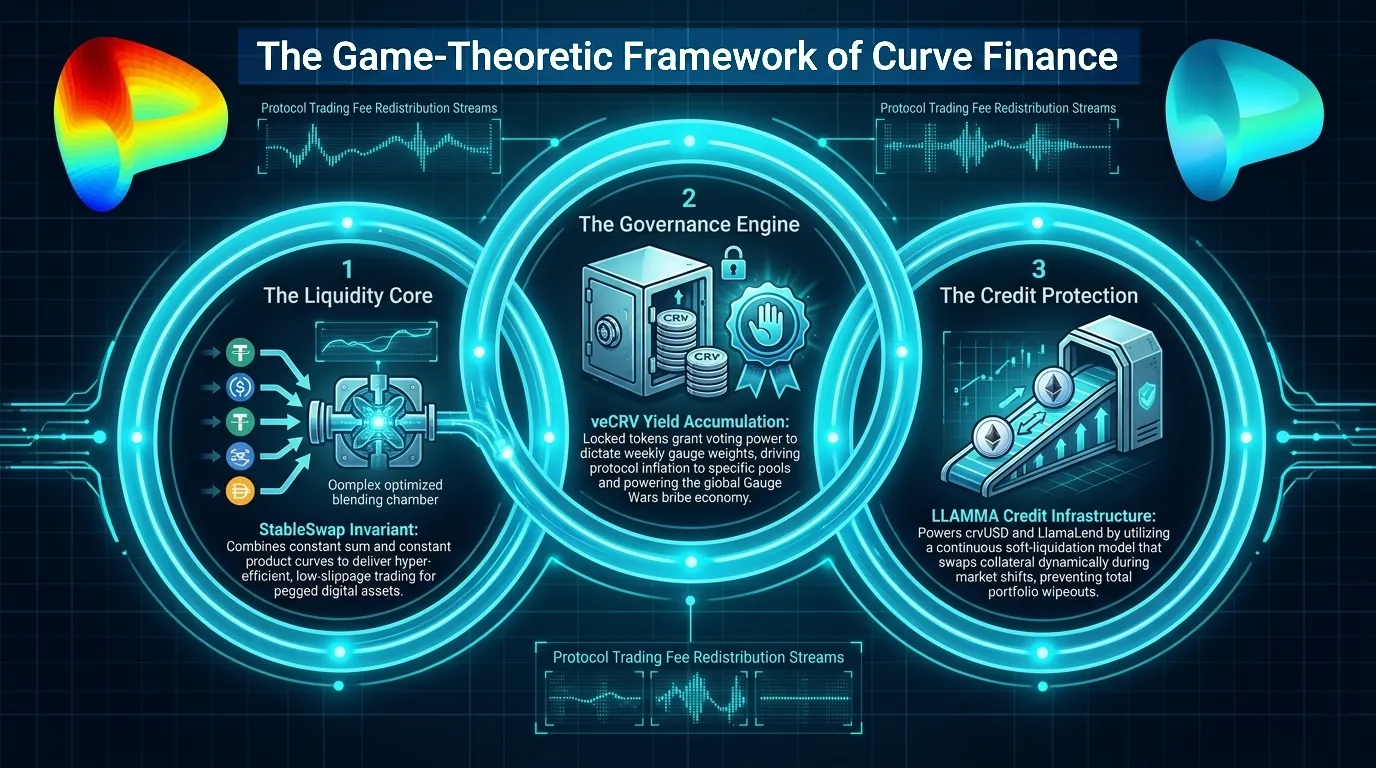
Curve resolves this limitation through its proprietary StableSwap invariant algorithm. The protocol combines two distinct pricing models into a single framework:
The Constant Sum Model: A mechanism where prices remain perfectly fixed at a 1:1 ratio, eliminating slippage entirely but risking total pool depletion if one asset permanently depegs.
The Constant Product Model: The standard decentralized pricing model that guarantees continuous pool liquidity but forces a price penalty on every swap.
- Curve's smart contracts dynamically blend these two models. When the assets inside a pool are tightly pegged near a 1:1 ratio, the algorithm behaves like a constant sum engine, allowing traders to execute multi-million-dollar swaps with almost zero slippage. However, if an asset begins to drift away from its peg, the system shifts toward a constant product curve. This adjustment alters the asset's internal price to incentivize arbitrageurs to restore the pool's equilibrium.
Expansion to Volatile Assets: CryptoSwap and FXSwap
- While StableSwap remains the foundation for stable assets, the platform extended its architecture via CryptoSwap, which utilizes dynamic concentrated liquidity to support volatile pairs like ETH/WBTC.
- Furthermore, the protocol launched FXSwap, a highly optimized market-making algorithm engineered explicitly for foreign exchange stablecoin pairs (such as Euro to USD digital fiat pairings). FXSwap uses automated simulations to concentrate pool liquidity around active foreign exchange rates, delivering superior execution speeds and reduced capital costs for international cross-border settlements compared to standard concentrated liquidity intervals.
2. The Tokenomics Framework: veCRV and the Gauge Wars
The monetization and distribution of Curve's native token, CRV, is governed by one of the most complex, game-theoretic frameworks deployed in Web3: the vote-escrowed (ve) architecture.
The Vote-Escrowed (ve) Mechanism
To actively participate in the protocol's economy, users must lock up their CRV tokens within a non-custodial governance vault for a chosen time horizon ranging from one week up to a maximum of four years. In return, the user receives veCRV (vote-escrowed CRV), a non-transferable governance token whose balance decays linearly as the lock expiration date approaches. Holding veCRV grants token holders two key economic capabilities:
Yield Boosting: LPs who hold a sufficient amount of veCRV can boost their passive liquidity provider staking yields by up to 2.5x, maximizing their share of weekly token emissions.
Gauge Weight Governance: veCRV holders gain direct voting rights to control protocol Gauges: the smart contract mechanisms that dictate exactly how newly minted CRV emissions are distributed across the exchange's thousands of independent liquidity pools each week.
The Anatomy of the Gauge Wars
- Because controlling gauge weights allows an entity to direct capital emissions to specific pools, the veCRV governance structure triggered an intense ecosystem competition known as the Gauge Wars.
- External protocols, stablecoin issuers, and decentralized asset networks require deep liquidity to secure their token pegs. Instead of spending millions building independent incentive layers, these external entities realized it was economically optimal to acquire veCRV or deposit capital into secondary aggregators like Convex Finance.
- By accumulating veCRV governance power, these protocols can vote to direct the baseline CRV inflation directly into their own token pairs. This dynamic created an open "bribe" economy where third-party platforms systematically pay recurring cash incentives directly to veCRV holders in exchange for their weekly gauge votes, turning Curve's governance layer into a highly monetized yield engine.
3. Credit Infrastructure: crvUSD, LLAMMA, and LlamaLend
Curve has transitioned from a pure asset exchange into a full-scale credit protocol through the deployment of its native decentralized stablecoin, crvUSD, and its integrated isolated lending market, LlamaLend.
The LLAMMA Soft-Liquidation Mechanism
- The core structural risk of borrowing stablecoins against volatile crypto collateral is the threat of an abrupt, catastrophic liquidation during market drawdowns. Traditional lending protocols rely on hard liquidations, instantly seizing and dumping a borrower's backing assets if their health factor slips below a rigid boundary.
- Curve counters this risk through the Lending and Liquidation AMM Algorithm (LLAMMA). Instead of executing an immediate hard liquidation, LLAMMA treats the borrower's collateral vault as an active liquidity market through an automated "soft-liquidation" loop.
Down Market De-liquidation: If the price of your collateral asset drops into a predefined liquidation band, the algorithm gradually swaps your volatile collateral into crvUSD stablecoins across continuous price ticks.
Up Market Re-liquidation: If the market recovers and the asset price climbs back upward, the protocol automatically reverses the process, buying back your original volatile collateral token using the crvUSD reserves.
This dynamic, dual-way liquidation engine dramatically reduces bad debt buildup, protects borrowers from sudden wipeouts during brief flash crashes, and gives market participants extended operational windows to manage debt health.
The Evolution of LlamaLend
- This soft-liquidation engine serves as the baseline infrastructure for LlamaLend, Curve's isolated lending marketplace. LlamaLend allows users to borrow crvUSD against virtually any digital asset or long-tail utility token, or conversely, borrow exotic tokens using stablecoin collateral.
- Following market stress events in late 2025, the protocol optimized LlamaLend's controller mechanics in early 2026, implementing specialized recovery stableswap pools to isolate and systematically absorb legacy impaired debts without impacting core protocol solvency. This refinement preserved the system's ability to support high-leverage lending while insulating passive depositors from systemic counterparty contagion.
4. Technical Trade-offs and Market Realities
Systemic Advantages and Strengths
Unmatched Peg Protection: The StableSwap invariant provides deep liquidity depth for pegged assets, serving as a primary defense line for global stablecoins.
Sustainable Revenue Redistribution: 100% of the platform's protocol trading fees are collected, converted, and redistributed directly back to veCRV governance participants, creating an organic cash-flow model.
Advanced Portfolio Insulation: The LLAMMA soft-liquidation model reduces the risk of absolute principal destruction for leveraged borrowers during volatile drawdowns.
Structural Vulnerabilities and Limitations
Complex Governance Overhead: The game-theoretic veCRV bribing architecture requires persistent active management, exposing passive retail holders to yield dilution if they do not interact with complex secondary aggregators.
Emission Value Dependency: The protocol's capacity to attract and retain multi-billion-dollar liquidity pools relies heavily on the open-market value of the CRV token emission; severe drawdowns in token price compress LP yields across the board.
Smart Contract Interconnectivity: Because Curve pools serve as a structural foundation for dozens of secondary yield vaults, farming protocols, and stablecoin pegs, an exploit or code vulnerability within a single pool can trigger cascading liquidations across the broader DeFi ecosystem.
Disclaimer: This article is for informational purposes only and does not constitute investment advice, financial advice, trading advice, or any other kind of advice. DEXTools does not recommend buying, selling, or holding any cryptocurrency or token. Users should conduct their own research and consult with a qualified financial advisor before making any investment decisions. Cryptocurrency investments are volatile and high-risk. DEXTools is not responsible for any losses incurred.
Related Guides
- How to Use Curve Finance: Stablecoin Swaps, Pools and Slippage Guide (2026)
- What Is Convex Finance? CVX & Curve Booster Guide 2026
- Curve vs Uniswap: DeFi DEX Models Compared (2026)
- What Is Balancer (BAL)? Weighted AMM DEX Protocol Guide 2026
- AMM vs Order Book DEXs: Crypto Trade Dynamics
- What Is Lybra Finance (LBR)? eUSD Stablecoin + LSDfi Guide 2
Frequently Asked Questions
What is Curve Finance?
Curve Finance is a decentralized exchange and automated market maker designed for swapping assets that are meant to trade at similar values, such as stablecoins. Its pricing model aims to reduce slippage for these similarly priced assets.
Why is Curve optimized for stablecoins?
Curve uses an AMM formula tuned for assets that should stay close in value, which keeps prices tight and slippage low for swaps between them. This makes it well suited for stablecoin and similar pegged-asset trading.
What is veCRV?
veCRV is vote-escrowed CRV that users receive by locking their CRV tokens for a period of time. It is generally associated with governance rights and incentive-related benefits within the protocol.
What is the CRV token used for?
CRV is the governance token of Curve and can be locked to participate in protocol decisions and related incentive mechanisms. Its role centers on governance and aligning long-term participants with the protocol.