What Is Chainlink (LINK)? Oracles and CCIP Explained
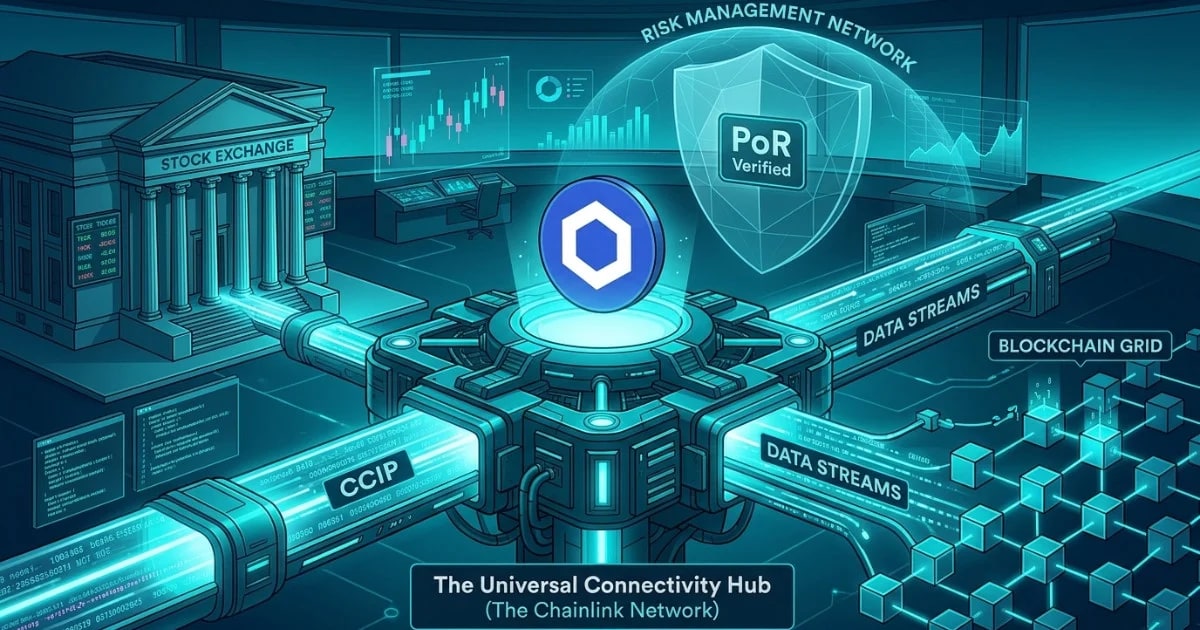
Chainlink (LINK) explained: how oracles, CCIP, Staking and the wider production stack work, and why they matter beyond simple price feeds in 2026.
Chainlink (LINK) in 2026: The Transition from Oracle to Decentralized Computing Platform
- As of May 8, 2026, Chainlink has fundamentally redefined its role within the blockchain ecosystem. While its origins as a price oracle for DeFi were groundbreaking, the network has matured into a comprehensive Decentralized Computing Platform (DCP) and a universal connectivity layer for the "Global Liquidity Layer."
- In the current market, where Bitcoin is consolidating between $80,000 and $81,200, Chainlink acts as the essential middleware bridging the $150 trillion traditional finance (TradFi) infrastructure with the programmable logic of on-chain finance.
- The year 2026 marks the "Production Era" for Chainlink, characterized by the shift from experimental pilots with institutions like Swift and BNY Mellon to live, fee-generating integrations that power the movement of tokenized Real-World Assets (RWAs).
1. Core Tech: The Connectivity Stack (CCIP and Beyond)
The technical heart of Chainlink in 2026 is no longer just "data delivery" but "cross-chain execution.
CCIP v1.5: The Interoperability Standard
The Cross-Chain Interoperability Protocol (CCIP) has become the industry standard for secure cross-chain communication.
Universal Gas: A key feature of 2026 is the ability for institutions to pay for cross-chain services in fiat or stablecoins, which the protocol automatically converts into LINK to pay node operators.
Self-Serve Integration: The v1.5 update allows developers to launch their own token pools and customize compliance logic (like rate limits and KYC hooks) without manual intervention from Chainlink Labs.
Volume: In Q1 2026 alone, CCIP processed over $18 billion in value, driven largely by institutional treasury redemptions and liquid staking protocol migrations.
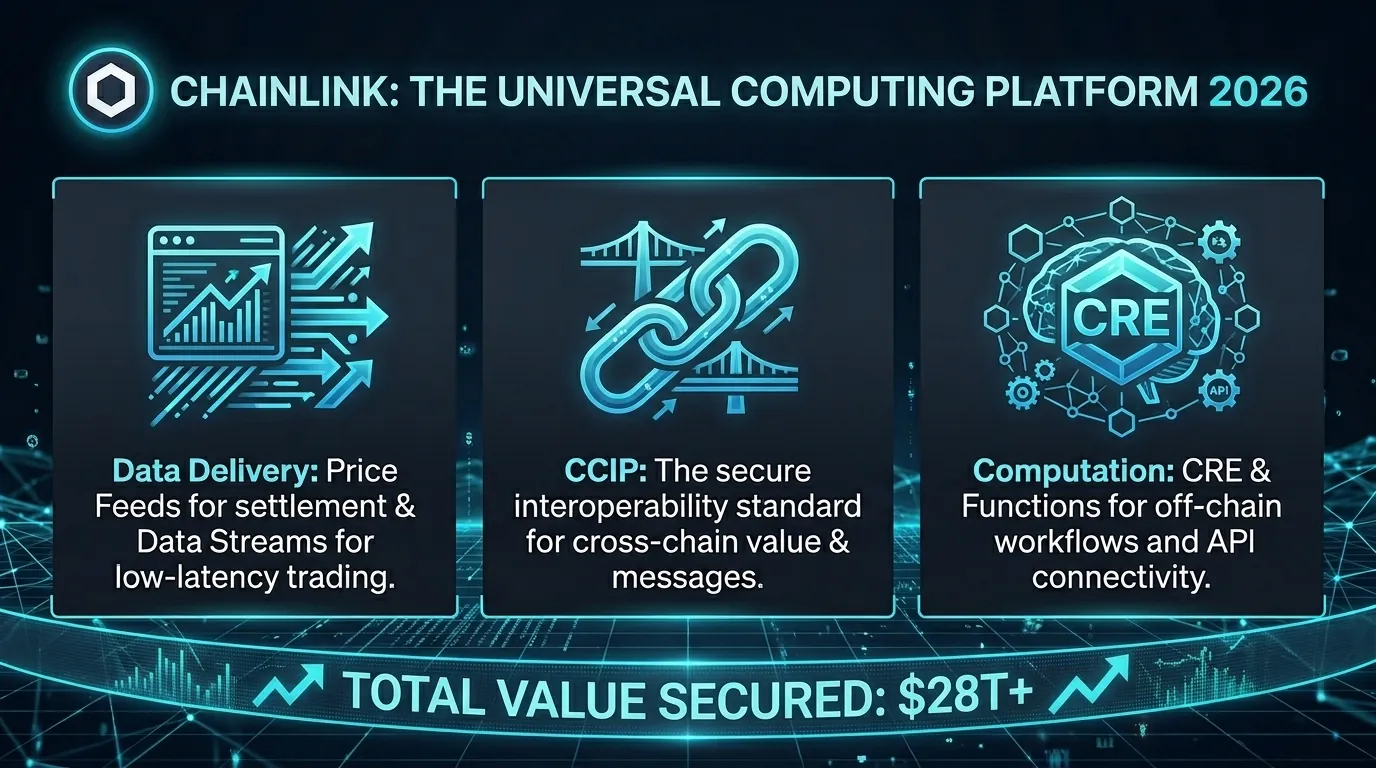
Chainlink Runtime Environment (CRE)
Introduced as the "orchestration layer," the CRE allows complex workflows (such as verifying a bank reserve, calculating a Net Asset Value (NAV), and settling a trade) to happen in a single, verifiable off-chain environment before the final result is pushed to the blockchain.
2. Data Delivery: Price Feeds vs. Data Streams
While Price Feeds remain the bedrock of DeFi, 2026 has seen the rapid expansion of Data Streams.
Price Feeds: High-security, multi-node reports used for settlement.
Data Streams: A low-latency, sub-second data solution designed for decentralized exchanges (DEXs) and high-frequency trading of RWAs. This allows decentralized platforms to compete with the speed of centralized exchanges while maintaining on-chain transparency.
3. Verification and Automation: PoR and Functions
Proof of Reserve (PoR): In a regulated 2026 landscape, PoR has become a mandatory circuit breaker for major stablecoins and tokenized gold. It provides an automated, cryptographic check that the off-chain collateral actually exists.
Chainlink Functions: This "Serverless" platform allows smart contracts to pull data from any API (weather, sports, AI inference) or even trigger off-chain identity verification services like Sumsub in a trust-minimized way.
VRF and Automation: Verifiable Randomness (VRF) continues to secure gaming and NFT mints, while Automation ensures that "asleep" smart contracts trigger automatically when certain conditions (like a price hit or a time-stamp) are met.
4. Economics 2.0: Staking v0.3
The staking model has evolved from the early v0.2 foundation into Staking v0.3, which features a total pool capacity of 75 million LINK.
Sustainable Yield: Rewards are increasingly shifting from inflationary token emissions to real user fees collected from CCIP and Data Streams.
Modular Staking: In 2026, stakers can choose to secure specific oracle services, allowing for a more granular risk/reward profile.
Current Yield: The effective base reward rate for community stakers remains around 4.3% - 4.5% APY, with node operators receiving additional delegation fees for their professional services.
Technical Trade-offs and Market Realities
Strengths and Opportunities
Unmatched Security: The use of a secondary Risk Management Network within CCIP provides a "watchdog" layer that has prevented major exploits seen in other bridging protocols.
Institutional Moat: Partnerships with Swift and major global banks provide a level of "defensibility" that is difficult for newer oracle networks to replicate.
Universal Gas: The abstraction of the LINK token for payments reduces friction for enterprises while maintaining demand for the underlying asset.
Limitations and Challenges
"Pilot Fatigue": While many institutions have integrated Chainlink, the transition from successful pilot to high-volume production is a multi-year process that can test investor patience.
Competitive Pressure: Newer oracles like Pyth have captured significant share in low-latency niches, forcing Chainlink to innovate rapidly with Data Streams to maintain dominance.
Complexity: The sheer breadth of the Chainlink stack (CCIP, Functions, PoR, CRE) creates a steep learning curve for new developers and a heavy operational burden for node operators.
Verification and Security via DEXTools
In the 2026 "Tokenized Everything" era, the risk of interacting with unverified or "fake" RWA tokens is a persistent threat. DEXTools is the optimal tool for analyzing the market, finding early crypto gems, and avoiding scams.
To monitor the DeFi market in an agile and secure way in real-time and trade tokens with the help of the best crypto tools, you can access DEXTools here.
Disclaimer: This article is for informational purposes only and does not constitute investment advice, financial advice, trading advice, or any other kind of advice. DEXTools does not recommend buying, selling, or holding any cryptocurrency or token. Users should conduct their own research and consult with a qualified financial advisor before making any investment decisions. Cryptocurrency investments are volatile and high-risk. DEXTools is not responsible for any losses incurred.
Related Guides
- What Is Chainlink: Oracles, Data Feeds and Offchain Services (2026)
- What is Chainlink CCIP? Cross-Chain Protocol Guide 2026
- Chainlink vs Pyth: Crypto Oracle Networks Compared (2026)
Frequently Asked Questions
What is Chainlink's role in the blockchain ecosystem in 2026?
By 2026, Chainlink has evolved from being a price oracle for DeFi to a comprehensive Decentralized Computing Platform, serving as a crucial middleware that connects traditional finance with on-chain finance.
How does Chainlink's Cross-Chain Interoperability Protocol (CCIP) work?
CCIP facilitates secure communication across different blockchain networks, allowing institutions to pay for services in fiat or stablecoins, which are then converted into LINK for node operators.
What are the main features of Chainlink's staking model in 2026?
The staking model has progressed to Staking v0. 3, which allows stakers to secure specific oracle services and offers a base reward rate of approximately 4.
What is Proof of Reserve (PoR) and why is it important?
Proof of Reserve has become essential for major stablecoins and tokenized assets, providing an automated verification that ensures off-chain collateral exists, thus enhancing trust in the ecosystem.
How do DEXTools help traders in the 2026 market?
DEXTools assists traders by verifying the liquidity and history of new cross-chain tokens, integrating with Chainlink's PoR to display real-time reserve statuses, and helping identify safe trading routes.