What Is Bridge Confirmation Time? Crypto Guide 2026
— By Whatsertrade in Tutorials
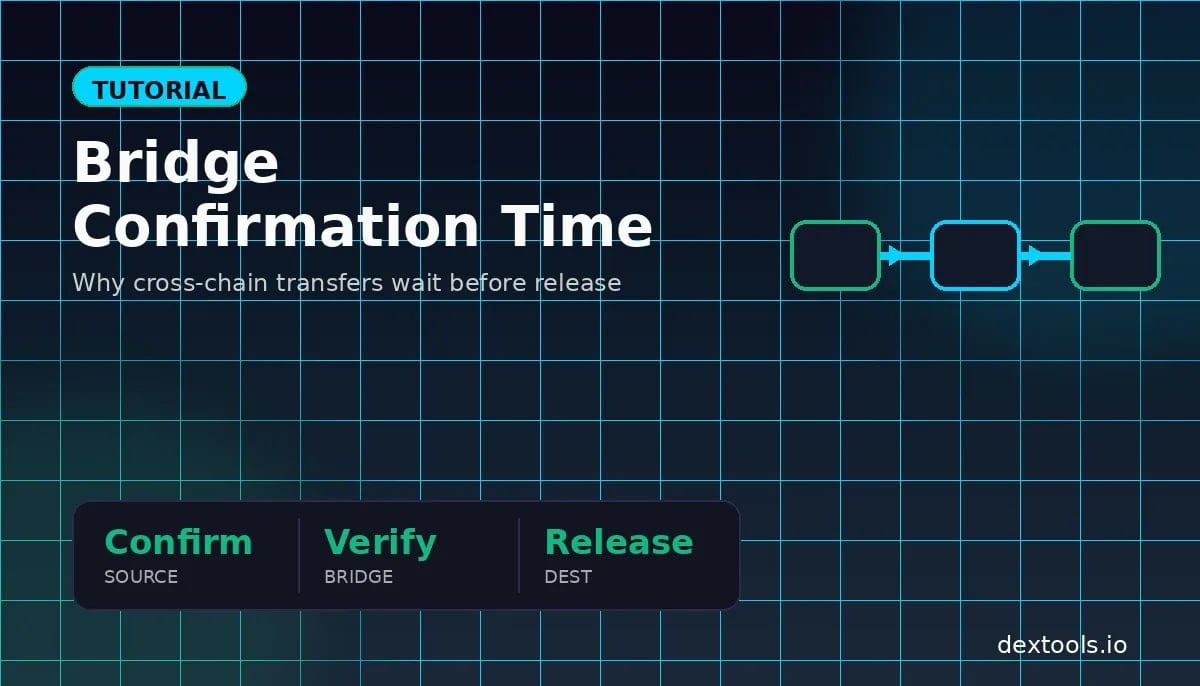
Bridge confirmation time in crypto explained: learn why cross-chain transfers wait for stronger settlement and why faster is not always safer in 2026.
Users often think a bridge is slow because the source chain is slow. That is only part of the story. Even a fast chain can feel slow in cross-chain movement if the bridge waits for deeper confirmations, relayer checks, or stronger settlement before releasing funds. Bridge confirmation time is really a security policy expressed as waiting time.
Bridge confirmation time in crypto is the period a bridge waits after seeing the source transaction before it credits or releases assets on the destination side. That wait can depend on confirmations, finality assumptions, relayer design, fraud windows, congestion, and operational policy.
Quick take
- Bridge confirmation time is not just about block speed. It is about how much settlement confidence the bridge demands.
- Faster bridges often make stronger assumptions or accept more risk somewhere in the stack.
- Long waits can come from security policy, relayer operations, or congestion on either chain.
- The right question is not only “how fast,” but also “fast under what trust model.”
What shapes bridge confirmation time
Why bridges wait
- Reversal risk: acting too early can expose the bridge to reorg or settlement problems.
- Fraud and security models: some systems intentionally delay to protect against bad state assumptions.
- Operational batching: some bridges process transfers in grouped cycles rather than instantly.
- Destination constraints: the destination chain can add its own fee or congestion bottlenecks.
Why a shorter wait is not always better
- Speed can hide trust assumptions: someone is absorbing risk when credit comes early.
- Users may confuse UI speed with final settlement: a credited transfer is not always maximally settled.
- Thin margins matter for large transfers: what feels fine for small size may be too weak for big value.
How to judge bridge timing more intelligently
- Look at the trust model: optimistic, validator-based, canonical, or liquidity-network designs behave differently.
- Check source and destination conditions: congestion on either side can matter.
- Scale patience with transfer size: larger value deserves stronger settlement assumptions.
- Compare bridge speed with bridge risk: they belong in the same conversation.
Common mistakes with bridge confirmation time
- ✘ Blaming the source chain alone when the bridge policy is the real bottleneck.
- ✘ Assuming the fastest bridge is automatically the best bridge.
- ✘ Ignoring destination-chain congestion or relayer delay.
- ✘ Treating early credit as if it meant deep final settlement.
Bridge-timing checklist
- ✔ Check how many confirmations or what finality condition the bridge requires.
- ✔ Compare speed with trust model, not speed alone.
- ✔ Expect larger transfers to deserve stronger confirmation standards.
- ✔ Watch congestion on both chains involved in the move.
- ✔ Treat waiting time as a security signal, not just a UX annoyance.
Final takeaway
Bridge confirmation time is the market-facing version of bridge security policy. Slow does not always mean bad, and fast does not always mean safe. The wait exists because moving assets across systems is ultimately a settlement problem, not just a user-interface problem.
If you want to understand bridge speed properly, you need to ask what kind of certainty the bridge is buying with that time.
Related reads on DEXTools
FAQ
What is bridge confirmation time in crypto?
Bridge confirmation time is the waiting period a bridge uses before crediting or releasing assets after it sees the source-chain transaction.
Why do bridges take so long sometimes?
Because bridges often wait for multiple confirmations, stronger finality, relayer processing, and destination-chain execution before they treat the transfer as safe.
Is bridge confirmation time just network speed?
No. Raw block speed is only one input. Security policy, finality model, congestion, and relayer design all affect the real wait time.
Can a fast bridge be riskier?
Sometimes yes. Faster crediting can mean the bridge is acting on weaker confirmation assumptions or accepting more reversal risk.
Disclaimer: This content is for informational purposes only and does not constitute financial advice. Crypto investments carry risks, including loss of capital.
Related Guides
- What Is Confirmation Depth in Crypto? Explained 2026
- Soft Confirmation in Crypto Explained (2026 Guide)
- What Is MegaETH? Real-Time Ethereum L2 Guide 2026
- What is ETH ATH? Ethereum’s All-Time High Explained
- What Is Block Time in Crypto? Speed Explained 2026
Frequently Asked Questions
What is bridge confirmation time in crypto?
Bridge confirmation time is how long a cross-chain transfer waits before the bridge treats the source transaction as settled enough to release funds on the destination chain. It exists to reduce the risk of acting on a transaction that could still be reversed.
Why do crypto bridges wait for confirmations?
Bridges wait to make sure the original transaction is deeply settled on the source chain before minting or releasing assets elsewhere. This protects against chain reorganizations that could otherwise let the same funds be spent twice.
Why is a faster bridge not always safer?
Releasing funds with fewer confirmations speeds up transfers but increases the chance of acting on a transaction that later gets reversed. Faster settlement can therefore trade away some of the security that longer confirmation times provide.
What affects how long a bridge transfer takes?
Bridge confirmation time depends on the source chain's block time, the number of confirmations required, and network congestion. Chains with slower blocks or higher security thresholds generally lead to longer bridge transfers.