What Is Bitcoin? Complete Beginner Guide 2026
— By Tony Rabbit in Tutorials
Bitcoin explained for beginners: learn how the blockchain, mining, and the 21M supply cap work, plus halving, spot ETFs, and Layer 2s in this 2026 guide.
Intent check: This page is the definition-first explainer for Bitcoin. If you want the practical guide to wallets, payments, transfers, and Lightning usage, read How to Use Bitcoin.
Bitcoin is a decentralized digital currency that runs on a peer-to-peer network, secured by cryptography and a public blockchain, with a hard-coded supply of 21 million coins. There is no central bank, no CEO, and no government that can print more BTC, freeze your wallet, or reverse a transaction. Created in 2009 by the pseudonymous Satoshi Nakamoto, Bitcoin has grown from a cypherpunk experiment into a multi-trillion dollar asset class, embraced by spot ETFs from BlackRock and Fidelity, adopted as treasury reserves by public companies, and traded 24/7 across every major exchange on earth.
This 2026 guide is the definitive answer to what is Bitcoin, written for a complete beginner but loaded with the post-Halving 2024 data, ETF inflow numbers, mining difficulty metrics, and Layer 2 developments that most evergreen explainers miss. By the end you will understand how the network works, why scarcity matters, how to buy and store BTC safely in 2026, and how Bitcoin compares to gold, altcoins, and Bitcoin Layer 2 protocols like Lightning, Stacks, and Babylon.
If you are ready to dive in, keep reading. Every concept builds on the previous one, so by section ten you will be able to confidently explain Bitcoin at a dinner party, evaluate a spot BTC ETF, set up a cold wallet, and avoid the most common scams that drain new investors every month.
BITCOIN AT A GLANCE (2026)
January 3, 2009
Satoshi Nakamoto (pseudonym)
21,000,000 BTC
~19.86M BTC (May 2026)
Proof of Work (SHA-256)
~10 minutes
3.125 BTC (post April 2024 halving)
~April 2028
What Is Bitcoin? The 60-Second Definition
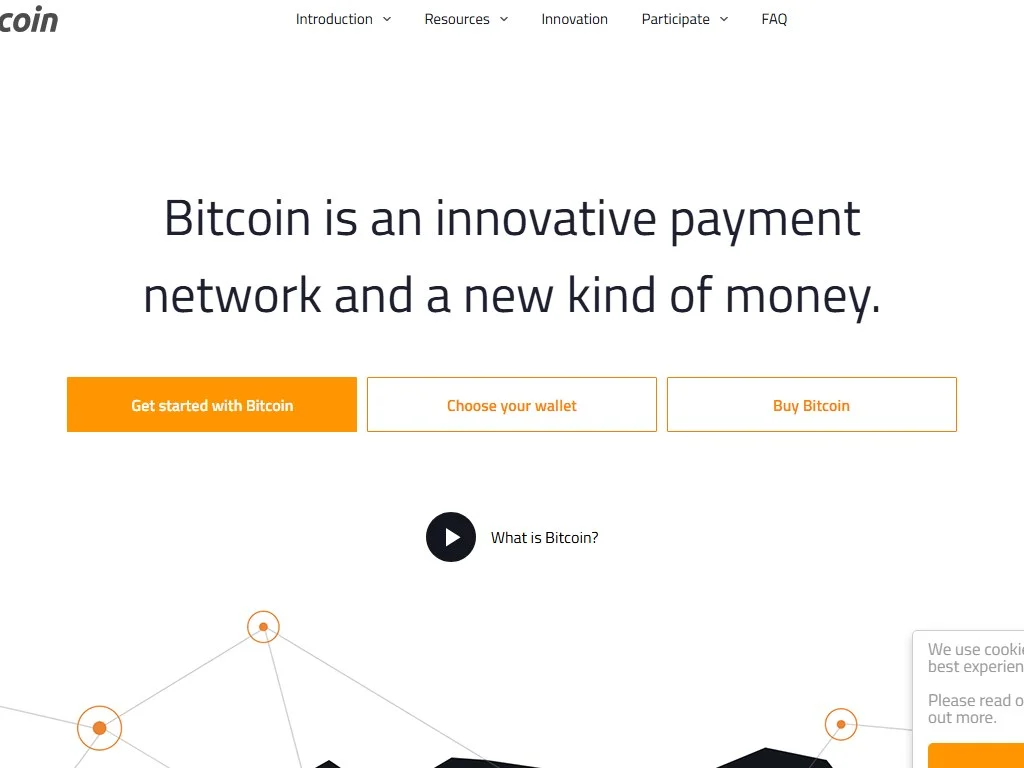
Bitcoin (ticker: BTC) is the first and largest cryptocurrency, a borderless digital money that lets anyone send value to anyone else over the internet without permission from a bank, payment processor, or government. It runs on a public, append-only ledger called the blockchain, maintained by tens of thousands of independent computers (nodes) around the world. New bitcoins enter circulation through mining, the supply is capped at 21 million, and every transaction since 2009 is publicly verifiable, immutable, and final once confirmed.
That is the answer Google wants for the featured snippet. For everything else, read on. Bitcoin is simultaneously a payment network, a savings technology, a hedge against monetary debasement, and the largest experiment in voluntary monetary policy ever attempted. Understanding it requires looking at the people who built it, the math that secures it, and the economic incentives that keep it running without a boss.
Who Created Bitcoin? Satoshi Nakamoto and the 2008 Whitepaper
On October 31, 2008, in the middle of the global financial crisis, an unknown person or group using the name Satoshi Nakamoto posted a nine-page document to the Cryptography Mailing List titled "Bitcoin: A Peer-to-Peer Electronic Cash System." The paper proposed a system where strangers could transact directly without trusting each other or any intermediary, using cryptographic proof and a shared ledger instead of a central authority.
On January 3, 2009, Satoshi mined the very first Bitcoin block, known as the genesis block or Block 0. Embedded in its coinbase parameter is a now-legendary message: The Times 03/Jan/2009 Chancellor on brink of second bailout for banks. It was a political statement and a timestamp proof rolled into one, taken from the front page of that day's London Times.
Satoshi remained active on Bitcoin forums and mailing lists until late 2010, helping shape the early protocol, then quietly disappeared in December 2010 with a final email reading "I've moved on to other things." No verified communication has emerged since. The wallets attributed to Satoshi hold roughly 1.1 million BTC, worth over $100 billion at current prices, and not a single coin has ever moved. Many researchers consider this dormancy proof that the original keys have been deliberately abandoned or lost forever.
Suspected identities have included cryptographer Hal Finney, computer scientist Nick Szabo, and Australian businessman Craig Wright (whose claims were rejected by a UK court in March 2024). The truth is that nobody knows, and arguably that is a feature, not a bug. A founder who cannot be subpoenaed, jailed, or pressured is a founder who cannot compromise the protocol.
How Does Bitcoin Work? The Blockchain Explained
At its core, Bitcoin is a giant shared spreadsheet that nobody owns and everybody can read. Each row records a transfer of value: address A sent 0.5 BTC to address B at this exact moment. New rows are added in batches called blocks, roughly every ten minutes, and each block is cryptographically chained to the one before it. That chain of blocks is the blockchain.
The genius is not the spreadsheet itself but the consensus mechanism that decides which transactions are valid and what order they go in, without anyone in charge. To learn the broader principles behind this design, see our explainer on how cryptocurrencies work, which generalises these ideas across Bitcoin, Ethereum, and other Layer 1 chains.
The Four Building Blocks of Bitcoin
Over 21,000 listening nodes worldwide store a full copy of the blockchain and enforce the rules. Anyone can run one on a $200 Raspberry Pi.
Specialised ASIC machines spend electricity solving cryptographic puzzles to add new blocks and earn the 3.125 BTC subsidy plus fees.
Software or hardware that holds the private keys controlling your BTC. Your wallet does not store coins, it stores the right to spend them.
Open-source software (Bitcoin Core) that defines block size, supply schedule, signature rules, and how nodes agree on the canonical chain.
What Actually Happens When You Send Bitcoin
When you hit send on a wallet app, your device signs a transaction with your private key, broadcasts it to the network, and waits for miners to include it in a block. The signature proves you own the coins without revealing your secret key. Other nodes verify the signature, check that you have not already spent those coins (the double-spend problem Satoshi solved), and relay the transaction to their peers. Within seconds your transaction reaches every active node on earth.
Miners pick up your transaction from the mempool (the waiting room of unconfirmed transactions), prioritise it based on the fee you attached, and try to package it into the next block. Once a miner wins the block, your transaction is considered to have one confirmation. After six confirmations (about an hour), most exchanges and merchants treat the payment as final. To reverse it, an attacker would need to outpace the combined hash power of the entire honest network, currently around 850 exahashes per second, which is economically and physically impractical.
Bitcoin Mining and Proof of Work in 2026
Bitcoin mining is the process by which new BTC enters circulation and the blockchain stays secure. Miners compete to find a number (a nonce) that, when combined with the block data and hashed with SHA-256, produces a result below a target value. It is essentially a giant guessing lottery that requires trillions of attempts per second per machine. Whoever guesses first wins the block reward.
This is called Proof of Work because the winning miner has demonstrably burned real-world energy to find the answer. That energy expenditure is what makes rewriting Bitcoin history prohibitively expensive. To compare Proof of Work with newer designs, our guide to Ethereum walks through why ETH moved to Proof of Stake while BTC stayed with PoW.
Mining Difficulty and Hash Rate, May 2026
To put 850 exahashes per second in perspective, that is 850,000,000,000,000,000,000 SHA-256 calculations every single second across the network. Modern ASIC miners like the Bitmain Antminer S21 XP Hydro produce around 473 terahashes per second per unit at roughly 14 joules per terahash, the most efficient generation ever built. Public miners like Marathon Digital, Riot Platforms, CleanSpark, and Core Scientific operate hundreds of thousands of these machines, increasingly powered by stranded gas, hydroelectric, and solar.
The Bitcoin Halving Schedule
Every 210,000 blocks (roughly four years), the block subsidy paid to miners is cut in half. This is the halving, and it is the heartbeat of Bitcoin's monetary policy. Four halvings have already happened, and there are about 28 more to go before the subsidy rounds down to zero around the year 2140.
Each halving has historically been followed by a multi-month bull market, though sample size is small and past cycles are no guarantee. What the halving definitely does is mechanically reduce sell pressure from miners, who collectively earn fewer new coins to dump on the market. After the April 2024 halving, daily issuance dropped from 900 BTC to 450 BTC, a $45 million per day reduction in structural sell pressure at $100k BTC.
The 21 Million Supply Cap and Digital Scarcity
Bitcoin's most powerful economic property is its absolute supply cap. The protocol code limits total issuance to 21 million BTC, ever. No vote, no governance proposal, and no developer can change this without a hard fork that essentially every node operator would reject. As of May 2026, approximately 19.86 million BTC have been mined, leaving only 1.14 million to be issued over the next 114 years.
This is the property that earned Bitcoin the nickname "digital gold." Gold is scarce because it is hard to extract from the earth's crust. Bitcoin is scarce because the protocol enforces scarcity by mathematical decree. Critics argue digital scarcity is illusory because anyone can fork the code; supporters point out that none of the forks (Bitcoin Cash, Bitcoin SV, Bitcoin Gold) have come close to challenging the network effect of the original.
SUPPLY BREAKDOWN, MAY 2026
- Total mined: ~19.86 million BTC (94.6% of max supply)
- Held in spot ETFs: ~1.32 million BTC (BlackRock IBIT alone holds ~640,000)
- Held by public companies (MicroStrategy, Tesla, Block, Marathon): ~720,000 BTC
- Estimated lost or inaccessible: ~3 to 4 million BTC (Chainalysis estimate)
- Effectively circulating and liquid: ~14 million BTC
- Remaining to mine: ~1.14 million BTC over the next 114 years
Bitcoin Price History: From $0 to $100,000+
Bitcoin's price chart is the most dramatic financial history of the 21st century. Below are the milestones that turned 10,000 BTC pizzas into a generational story.
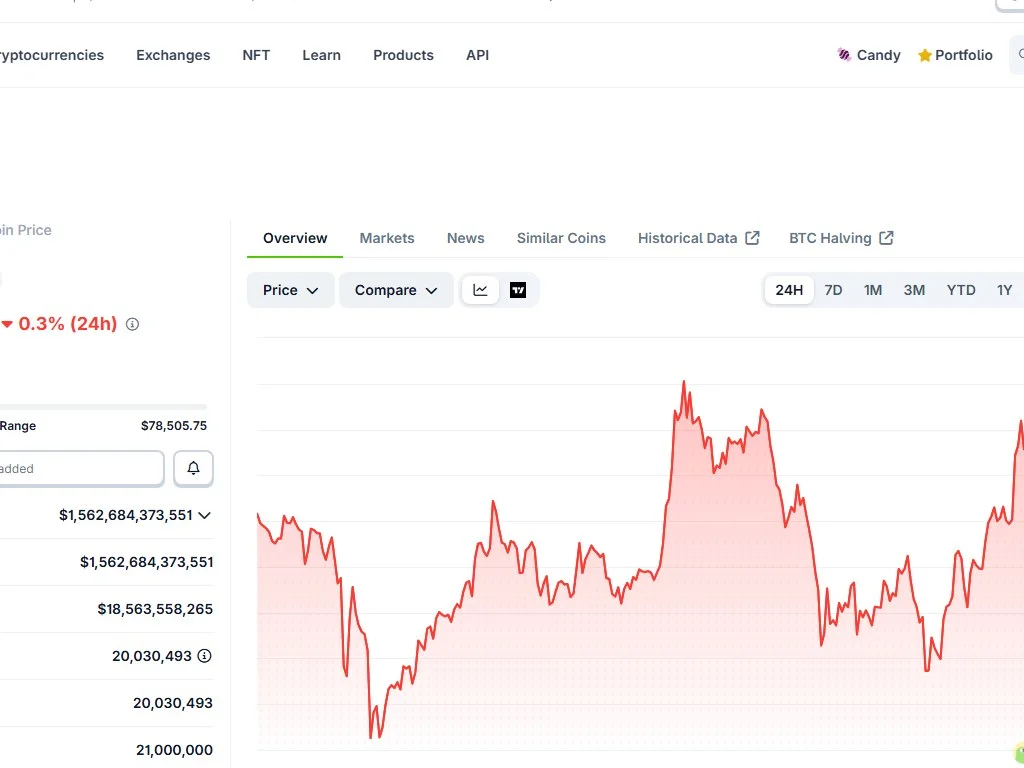
- October 2009: First published BTC/USD exchange rate, 1,309.03 BTC per dollar.
- May 22, 2010 (Bitcoin Pizza Day): Laszlo Hanyecz pays 10,000 BTC for two Papa John's pizzas. Today that is over a billion dollars.
- February 2011: BTC reaches parity with the US dollar for the first time.
- November 2013: First four-figure print, $1,163.
- December 2017: First major retail mania, $19,783 peak.
- March 2020 (COVID crash): BTC drops to $3,800 in a global liquidity panic.
- November 2021: $69,000 cycle top, NFT and DeFi boom.
- November 2022 (FTX collapse): BTC bottoms near $15,500.
- January 10, 2024: SEC approves 11 spot Bitcoin ETFs simultaneously, opening Wall Street's wallet.
- March 2024: First close above $73,000.
- April 19, 2024: Fourth halving, block reward to 3.125 BTC.
- December 2024: BTC breaks $100,000 for the first time.
- 2025-2026: Sustained $90k to $130k range as ETFs, sovereign wealth funds, and corporate treasuries absorb supply.
To track BTC and any altcoin live across centralised and decentralised venues, traders use DEXTools. For deeper context on cycle analysis, see our guides to liquidation zones and VWAP indicators.
Spot Bitcoin ETFs: The Wall Street Onramp
The single most important market event in Bitcoin's history (other than the genesis block) was the SEC's January 10, 2024 approval of spot Bitcoin ETFs. For the first time, US financial advisors, pension funds, RIAs, and 401(k) platforms could allocate to BTC through a regulated, ticker-traded wrapper that settles in cash through traditional brokerages.
The result was the most successful ETF launch in history. By May 2026, the spot Bitcoin ETF complex collectively holds over 1.3 million BTC, roughly 6.5% of all bitcoin ever mined, with cumulative net inflows of more than $90 billion since launch. BlackRock's IBIT alone crossed $80 billion in assets under management faster than any ETF in any asset class, ever.
Top Spot Bitcoin ETFs by AUM, May 2026
For comparison with the parallel Ethereum ETF approval and other regulated crypto products, you can also read our breakdown of what an XRP ETF means for liquidity.
MicroStrategy and the Bitcoin Treasury Trend
Beyond ETFs, the second great institutional story of this cycle is the corporate Bitcoin treasury. Pioneered by Michael Saylor's MicroStrategy (rebranded simply to "Strategy" in 2025), the playbook is straightforward: issue equity and convertible debt, use the proceeds to buy BTC, hold forever. As of May 2026, Strategy holds over 580,000 BTC, more than any other public company, sovereign government, or even most ETFs.
The model has been copied with varying degrees of success by Marathon Digital, Block (formerly Square), Tesla (which still holds residual BTC), Semler Scientific, Metaplanet in Japan, and dozens of smaller listed companies in 2025 and 2026. Collectively, public companies now sit on roughly 720,000 BTC. The "BTC treasury" trade has become a recognised category in equity research, with some companies trading at significant premiums to their net asset value purely because of their bitcoin exposure.
This matters for new investors because it creates structural buyers who, unlike retail, do not sell on volatility. Combined with ETF inflows, this is one of the reasons the post-2024 cycle has seen shallower drawdowns than the 2018 and 2022 bear markets.
How to Buy Bitcoin in 2026 (Four Methods)
Buying BTC in 2026 is easier than ever. Here are the four main paths, in order from most beginner-friendly to most self-sovereign.
Best for: retirement accounts, hands-off investors, those who do not want to manage keys.
Buy IBIT, FBTC, or BITB through any broker (Fidelity, Schwab, Robinhood, Interactive Brokers). Trades like a stock during US market hours.
Best for: first BTC purchase, ability to withdraw to a wallet, 24/7 trading.
Coinbase, Kraken, Binance, Bitstamp. Complete KYC, fund via bank transfer or card, place a market or limit order.
Best for: users already holding stablecoins or ETH who want self-custody.
Swap USDC for WBTC or cbBTC on Uniswap, 1inch, or any aggregator. No KYC, but you take on smart contract risk.
Best for: cash buyers, privacy-focused users, areas with poor banking.
Bisq, HodlHodl, Robosats, or any of the 38,000+ Bitcoin ATMs worldwide. Higher fees, but minimal identity disclosure.
If you go the DEX route, you should understand how stablecoins work first. Our deep dive on Tether USDT and the broader category of DeFi covers the on-ramps from fiat to crypto in detail. You will also want to learn about gas fees and gwei to avoid overpaying when bridging.
How to Store Bitcoin: Wallet Types and Security
Once you own BTC, storage becomes the most important decision you will make. Bitcoin uses public-key cryptography: every wallet has a public address (where you receive funds) and a private key (which authorises spending). Whoever controls the private key controls the coins. Period.
Hot Wallets (Software, Online)
Apps on your phone or computer that hold keys in memory. Examples include Sparrow, BlueWallet, Electrum, and the wallets built into Coinbase and Cash App. Convenient for small balances and frequent spending, but anything connected to the internet is exposed to malware, phishing, and clipboard hijacking. Good rule of thumb: never store more on a hot wallet than you would carry as cash.
Cold Wallets (Hardware, Offline)
Physical devices that store private keys in a secure element chip and sign transactions without exposing the key to the internet. Leading options are Ledger (Nano S Plus, Nano X, Stax), Trezor (Safe 5, Model T), Coldcard, BitBox02, and Foundation Passport. For long-term holdings of more than a few thousand dollars, a hardware wallet is non-negotiable. Always buy direct from the manufacturer, never on Amazon or eBay.
Custodial Wallets (Exchange Storage)
Leaving BTC on Coinbase or Kraken is technically a custodial wallet. The exchange holds your keys; you hold an IOU. This is convenient but reintroduces the very counterparty risk Bitcoin was designed to eliminate. The catastrophes of Mt. Gox (2014), Quadriga (2019), Celsius (2022), and FTX (2022) are the textbook examples of why "not your keys, not your coins" is the most repeated phrase in Bitcoin.
Seed Phrases and Backup Hygiene
Every non-custodial wallet generates a 12-word or 24-word seed phrase (BIP-39 standard) the first time you set it up. This phrase is the master key that can regenerate every private key in your wallet. Write it on paper or stamp it into steel (Cryptosteel, Blockplate). Never store it digitally, never photograph it, never type it into a website. For extra security, learn about Shamir Secret Sharing or multisig setups.
For a complete security walkthrough, see our dedicated guides on crypto wallet security tips, avoiding address poisoning scams, and using burner wallets for risky interactions.
Bitcoin vs Altcoins: How BTC Stands Apart
"Altcoin" simply means any cryptocurrency other than Bitcoin. There are now over 20,000 of them, ranging from serious infrastructure projects to literal joke tokens. Bitcoin is fundamentally different from almost all of them in a few important ways.
To explore the leading altcoin ecosystems, see our overviews of Ethereum, NEAR Protocol, and Sui Network. For programmable DeFi infrastructure built on top of Ethereum, our Uniswap V4 hooks explainer and 1inch aggregator guide are good follow-up reads.
Bitcoin vs Gold: The Digital Store of Value Debate
Bitcoin is most often compared to gold, and for good reason. Both are scarce, both are durable, both are politically neutral, and both have served as monetary metals at different points in history. But Bitcoin improves on gold in measurable ways.
The bear case for BTC vs gold is the much shorter track record and higher volatility. The bull case is that Bitcoin captures a growing share of gold's monetary premium over time. Even a 25% rotation from gold to BTC would imply a market cap of $7 trillion, roughly 3x current levels.
Bitcoin Layer 2s: Lightning, Stacks, and Babylon
Bitcoin's base layer is intentionally slow and expensive. Roughly seven transactions per second, ten-minute blocks, and limited scripting capability. This is the trade-off for maximum security and decentralisation. For everyday payments and programmable use cases, the Bitcoin community has built Layer 2 networks that settle to Bitcoin while offering more throughput and functionality.
Lightning Network
Launched in 2018, Lightning is a payment channel network that enables near-instant, near-free BTC transactions. By May 2026, Lightning has over 5,200 BTC in public channel capacity and is integrated into major wallets like Phoenix, Muun, Wallet of Satoshi, and Strike. Cash App, Bitfinex, and Kraken all support Lightning deposits and withdrawals. El Salvador's Chivo wallet runs on Lightning rails.
Stacks (sBTC)
Stacks is a Layer 2 that brings smart contracts and DeFi to Bitcoin. Its Nakamoto upgrade and the launch of sBTC (a 1:1 BTC-backed token usable in Stacks DeFi) in late 2024 made Stacks the leading platform for Bitcoin-native applications. By 2026, sBTC TVL has grown into the hundreds of millions, attracting lending, DEX, and yield protocols built specifically for BTC holders.
Babylon and Bitcoin Restaking
Babylon, which launched its mainnet in 2024, lets BTC holders stake their bitcoin to provide economic security to Proof of Stake chains, earning yield in the process. It is a major narrative in 2025 to 2026 as institutions look for ways to generate income on their BTC holdings without selling or wrapping into custodial products. For context on restaking and shared security, our explainer on liquid staking with Rocket Pool covers the Ethereum equivalent.
Other L2s and Sidechains
Liquid Network (Blockstream's federated sidechain), Rootstock (RSK, EVM-compatible BTC chain), and Mintlayer round out the Bitcoin scaling landscape. Each makes different trade-offs between decentralisation, programmability, and trust assumptions.
Risks of Owning Bitcoin (Honest Tradeoffs)
Bitcoin is not a free lunch. Anyone telling you otherwise is selling something. Here are the real risks every investor should understand before allocating.
30% to 80% drawdowns are normal in BTC's history. 2022 wiped 77% off the peak. Position size accordingly and use DCA.
Lose your seed phrase and the coins are gone. There is no support line, no chargeback, no reset password. Practice recovery before sending real funds.
Exchanges can be hacked, insolvent, or fraudulent. FTX, Celsius, and Mt. Gox cost users billions. Withdraw to self-custody for long-term holdings.
Tax rules, KYC requirements, and outright bans vary by jurisdiction. The 2024 ETF approval has stabilised the US picture, but other regions remain in flux.
Fake wallet apps, romance scams, fake support agents, address poisoning, and pig-butchering scams drain billions yearly. Verify everything twice.
In the 2030s or beyond, sufficiently powerful quantum computers could threaten current cryptography. Post-quantum upgrades are already being researched.
For tactical risk management, learn about long vs short positioning, backtesting strategies, and detecting fake volume on lower-quality exchanges.
The 2028 Halving and the Cycle Ahead
The next halving is expected around April 2028 at block 1,050,000, cutting the block subsidy from 3.125 BTC to 1.5625 BTC. Annual issuance will drop to roughly 0.4%, mathematically scarcer than gold by a wide margin.
The bull case for the 2028 cycle is straightforward: structural demand from ETFs, corporate treasuries, and (likely) more sovereign buyers will continue to absorb supply, while issuance halves yet again. The bear case is that institutional adoption has dampened the historical four-year cycle, so the parabolic blow-off tops of 2017 and 2021 may not repeat. Sample size remains too small to know for certain.
What is clear is that by the 2032 halving, miner rewards will be down to 0.78125 BTC, and transaction fees will need to provide a growing share of mining revenue to keep the network secure. The Ordinals, Runes, and BRC-20 ecosystems that emerged in 2023 and 2024 suggest the market is already exploring fee-generating use cases for the base layer.
Frequently Asked Questions About Bitcoin
Q Q Q What is Bitcoin in simple terms?
Bitcoin is a digital currency that lets you send money over the internet without a bank, with a fixed maximum supply of 21 million coins and a public ledger (blockchain) maintained by thousands of independent computers. Nobody owns it, nobody can print more, and nobody can stop you from holding or sending it. Think of it as internet cash with mathematical scarcity baked into the protocol.
Q Q Q Is Bitcoin a good investment in 2026?
Bitcoin has delivered the highest returns of any major asset class over the past decade, and the 2024 spot ETF approval plus growing corporate treasury adoption have meaningfully reduced structural sell pressure. That said, BTC is still volatile (30% to 80% drawdowns are historically normal), so most advisors suggest a 1% to 5% portfolio allocation and a dollar-cost averaging approach. Never invest more than you can afford to lose entirely.
Q Q Q How many bitcoins are left to mine?
As of May 2026, roughly 19.86 million BTC have been mined, leaving about 1.14 million to be issued before the cap of 21 million is reached around the year 2140. After the April 2024 halving, daily issuance dropped from 900 BTC to 450 BTC. The next halving in approximately April 2028 will cut daily issuance further to roughly 225 BTC.
Q Q Q Can I buy less than one whole Bitcoin?
Yes. Bitcoin is divisible to eight decimal places. The smallest unit is the satoshi (sat), equal to 0.00000001 BTC. Most exchanges let you buy as little as $1 of BTC. Buying small amounts regularly (dollar-cost averaging) is one of the most popular strategies for new investors because it smooths out volatility over time.
Q Q Q What is the difference between Bitcoin and a spot Bitcoin ETF?
Holding BTC directly means you control the private keys and the coins are yours regardless of any institution. Holding a spot Bitcoin ETF like IBIT or FBTC means you own a share in a fund that holds BTC on your behalf with a custodian (usually Coinbase Custody). ETFs are simpler, work in retirement accounts, and require no wallet management, but they only trade during market hours, charge an expense ratio (0.20% to 0.25% for most), and you cannot withdraw the underlying BTC.
Q Q Q When is the next Bitcoin halving?
The next Bitcoin halving is expected around April 2028 at block height 1,050,000. The block subsidy will drop from 3.125 BTC to 1.5625 BTC, reducing daily issuance to about 225 BTC and annual inflation to roughly 0.4%. Historically each halving has been followed by a multi-month bull market over the following 12 to 18 months, though past cycles are no guarantee of future returns.
Q Q Q Is Bitcoin really anonymous?
Bitcoin is pseudonymous, not anonymous. Every transaction is publicly visible on the blockchain forever. Addresses are not linked to your identity by default, but firms like Chainalysis and Elliptic use sophisticated clustering to tie addresses to individuals, especially after KYC purchases on exchanges. For better privacy, users employ CoinJoin tools, the Lightning Network, or dedicated privacy coins, but truly anonymous Bitcoin usage requires significant operational security.
Q Q Q What happens when all 21 million bitcoins are mined?
Around the year 2140, the last fractional BTC will be mined and the block subsidy will round down to zero. From that point on, miners will be paid exclusively through transaction fees. The network's long-term security model assumes that by then BTC will be valuable enough and used frequently enough that fee revenue can sustain a robust hash rate. Layer 2 networks like Lightning may also relieve pressure on base layer block space by aggregating many off-chain transactions into single on-chain settlements.
Q Q Q Is Bitcoin bad for the environment?
Bitcoin mining consumes roughly 160 TWh per year (less than 0.5% of global electricity). The Bitcoin Mining Council reports that the sustainable energy mix has climbed above 55% in 2026, driven by stranded gas capture, hydroelectric in Paraguay and Bhutan, and curtailed wind and solar that would otherwise be wasted. Miners are uniquely flexible loads that can be turned off in seconds, making them valuable for grid stabilisation. The environmental debate is real but more nuanced than headline numbers suggest.
Q Q Q What is the difference between Bitcoin and blockchain?
Bitcoin is the specific digital currency and network launched in 2009. Blockchain is the underlying data structure that Bitcoin pioneered: an append-only chain of cryptographically linked blocks. Blockchain technology now powers thousands of other networks (Ethereum, Solana, etc.) and use cases far beyond money, including smart contracts, supply chain tracking, and tokenisation of real-world assets. Bitcoin is to blockchain what email was to the internet, the first killer application of a much broader technology.
Tracking Bitcoin and the Wider Market on DEXTools
Once you understand what Bitcoin is, the next step is watching it move in real time. DEXTools offers live BTC pricing, on-chain analytics, multi-chain charting, and the ability to track every wrapped BTC pair across decentralised exchanges. Whether you trade WBTC on Ethereum, cbBTC on Base, or want to monitor liquidity rotations into altcoins, DEXTools surfaces the data faster than any centralised feed.
For active traders, our guides on market makers, transaction simulation, and Permit2 token approvals deepen the toolkit you will need beyond just owning BTC. And if you ever wonder about Bitcoin's place in the broader tokenisation movement, our pieces on real-world asset tokenisation and tokenised treasuries show where institutional crypto is heading next.
Your Bitcoin Starts Here
You now know what Bitcoin is, who created it, how the blockchain and Proof of Work secure the network, why 21 million matters, how halvings shape the price cycle, how to buy and store BTC safely in 2026, and how Bitcoin stands apart from altcoins, gold, and Layer 2 networks. That is more than 95% of crypto investors can articulate.
The smart next move is to put a small amount into practice. Open an account on a reputable exchange or buy a spot ETF in your existing brokerage, set up a hardware wallet, and learn by doing with a position size you would not lose sleep over. Then come back and explore the rest of the DEXTools tutorial library to deepen your understanding of DeFi, on-chain analytics, and the wider crypto market that Bitcoin made possible.
Ready to track Bitcoin and discover what is moving across every blockchain? Visit DEXTools to access live charts, liquidity data, and the analytics traders rely on every day. Your Bitcoin journey starts here.