What Is Theta Network (THETA + TFUEL)? Decentralized Video Streaming Guide 2026
— By Tony Rabbit in Tutorials
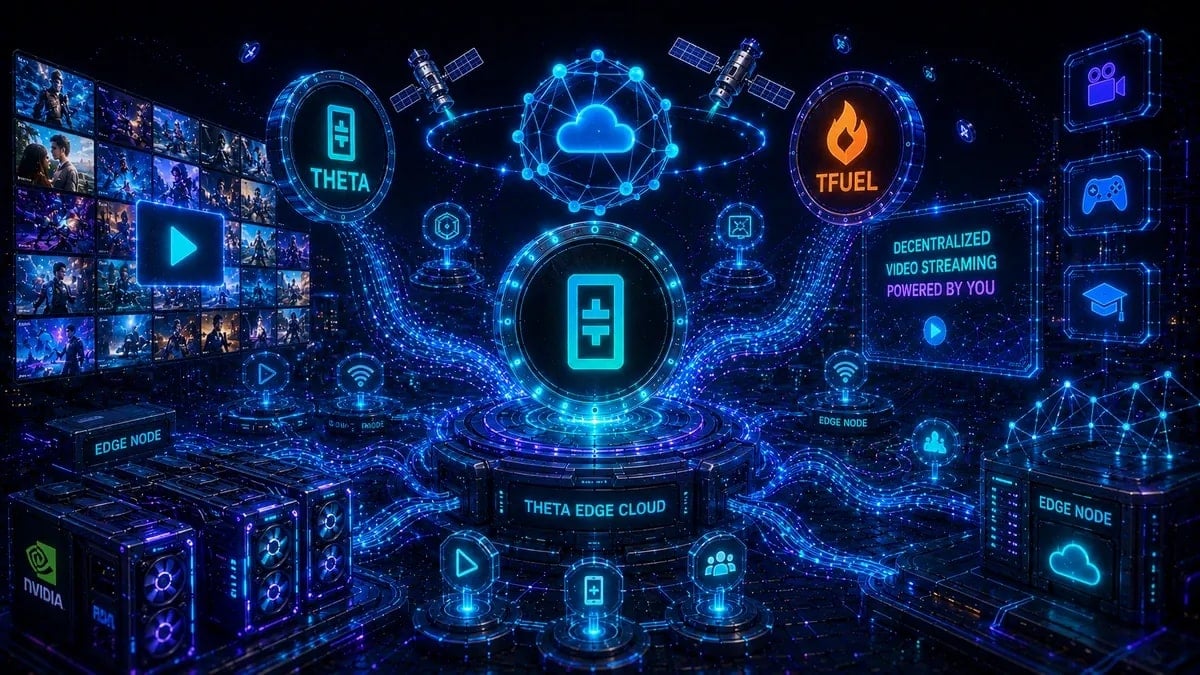
Theta Network is the dual-token decentralized video streaming and content delivery protocol launched in 2018 by Mitch Liu and Jieyi Long, backed by YouTube co-founder Steve Chen and Twitch co-founder Justin Kan. THETA secures the chain through validator staking while TFUEL pays edge nodes that relay video and now powers Theta EdgeCloud GPU compute for AI workloads. Full 2026 guide: dual-token architecture, validators and edge nodes, EdgeCloud and Metachain, comparison vs Livepeer and traditional CDN, TVA migration history, Sliver app, and the real risks.
What Is Theta Network (THETA + TFUEL)? Decentralized Video Streaming Guide 2026
Streaming video is one of the most expensive and most centralized industries on the modern internet. Every time you watch a Twitch broadcast, a YouTube clip, or a Netflix series, the bits are pulled from a content delivery network operated by a handful of giants. Cloudflare, Akamai, Amazon CloudFront, Fastly, and Google Cloud CDN together carry an overwhelming majority of the world's video traffic, and the cost of that infrastructure is baked into every ad you watch and every creator monetization rate that is lower than it should be. The CDN layer is invisible, but it is one of the largest hidden taxes on internet media.
Theta Network is the most established attempt to rebuild that layer as a decentralized peer-to-peer system where ordinary computers and idle servers do the relaying instead of corporate data centers. The project launched in 2018, predating the entire DePIN narrative by half a decade, and arrived with a founding pitch endorsed by Steve Chen, co-founder of YouTube, and Justin Kan, co-founder of Twitch. Both men spent their careers wrestling with the cost and quality limits of centralized video delivery, and both became advisors because the dual-token architecture actually addressed the structural problem they had lived with for years.
Eight years later Theta has evolved from a niche streaming experiment into a full hybrid network. THETA secures a proof-of-stake mainchain through validator and guardian nodes. TFUEL pays edge nodes that relay video bandwidth and now also pays GPU operators inside Theta EdgeCloud, the AI compute layer the project launched in 2024. The Theta Metachain framework allows partners to deploy custom subchains. This guide walks through exactly how it works, where it fits in the wider DePIN landscape, and what the realistic risks look like in 2026.
Featured Snippet
Theta Network is a dual-token decentralized video streaming and content delivery network launched in 2018 by Mitch Liu and Jieyi Long, with Steve Chen of YouTube and Justin Kan of Twitch as founding advisors. THETA is the governance and staking token that validators and guardian nodes lock to secure the chain, while TFUEL is the gas and payment token earned by edge nodes that relay video bandwidth across the peer-to-peer network. In 2024 the project launched Theta EdgeCloud, a hybrid cloud that pays GPU operators in TFUEL to run AI workloads alongside streaming traffic. The Theta Metachain subchain framework allows enterprise partners to deploy custom chains anchored to the main network. Theta competes with Livepeer in transcoding, with Filecoin and IPFS in storage, and with traditional CDNs like Cloudflare and Akamai in delivery, while offering creators lower cost and viewers a share of the economics through the Sliver app.
What Is Theta Network in Plain English
Picture a popular live stream with a hundred thousand concurrent viewers. In the traditional model, every one of those viewers pulls the video from a centralized CDN edge server that the platform pays per gigabyte. The platform passes that cost on to advertisers and creators, and the CDN operator takes a margin off the top. Every viewer is a unit of cost, not a unit of contribution.
Theta inverts that relationship. In a Theta-powered stream, the same hundred thousand viewers are also potential relay nodes. A viewer in Madrid with a stable connection can simultaneously pull the stream from a closer peer and re-share it to three other viewers in their city, slashing the load on the origin server and creating a mesh that scales naturally with the audience. The protocol pays that viewer in TFUEL for every megabit they relay, and the platform's bandwidth bill drops because most of the delivery never touches the centralized CDN at all.
That is the entire core idea. The decentralized network is not trying to replicate every feature of a traditional CDN out of the gate. It is targeting the part of the workload where geographic proximity, audience scale, and the willingness of viewers to share idle bandwidth produce real cost savings. The math works because the cost of running a Cloudflare edge in Tier 1 cities is high, while the marginal cost for a viewer to re-share what they are already downloading is essentially zero. Theta captures the gap between those two numbers and splits it between the network, the creator, and the relaying user.
The dual-token design is the second key idea. Most blockchains use a single token for both governance and gas, which creates a tension where speculation drives the price of the same asset users need to pay fees. Theta separates these. THETA is the scarce governance asset that validators stake. TFUEL is the elastic operational token used for payments, relay rewards, and EdgeCloud compute.
Founders and Advisors: Mitch Liu, Jieyi Long, Steve Chen, Justin Kan
Theta was co-founded in 2018 by Mitch Liu and Jieyi Long. Mitch Liu had previously co-founded the live esports streaming platform SLIVER.tv, where he spent years dealing first-hand with the bandwidth and CDN costs that come from delivering high-bitrate gaming video to a global audience. He understood the economics of streaming at a level that most blockchain founders did not.
Jieyi Long was the technical counterpart, a researcher with a PhD in computer engineering and patents in video encoding and distributed systems. His role was to design the protocol so that the peer-to-peer mesh could actually deliver video at quality acceptable for esports and live entertainment, where buffering for even a few seconds is a product-killer. The combination of operational streaming experience and rigorous distributed-systems engineering is rare in crypto.
The advisor lineup added credibility that almost no other 2018-era blockchain could match. Steve Chen, co-founder of YouTube and arguably one of the people most responsible for the modern video internet, signed on as a founding advisor. Justin Kan, co-founder of Twitch which sold to Amazon for nearly a billion dollars, joined alongside him. Both men spoke publicly about the structural problems with centralized video distribution and explicitly endorsed the Theta approach. Other early backers included Samsung NEXT, Sony Innovation Fund, and BDMI.
Timeline: From SLIVER.tv to Theta EdgeCloud
Theta Network launches as an ERC-20 token on Ethereum in January 2018 to fund the protocol build-out. The initial token is later called TVA, which migrates one-for-one to the native THETA asset when the dedicated Theta mainnet launches in March 2019. Mitch Liu and Jieyi Long publish the founding whitepaper, Steve Chen of YouTube and Justin Kan of Twitch sign on as advisors, and Samsung NEXT and Sony Innovation Fund participate as strategic investors.
The Theta mainnet 1.0 launches in March with a multi-level Byzantine Fault Tolerance consensus designed for high throughput video workloads. Validator nodes and guardian nodes begin staking THETA to secure the chain. The TVA legacy ERC-20 token is fully migrated to native THETA. The first generation of edge nodes go live, relaying video for early streaming partners on what was then known as Theta.tv.
Theta mainnet 2.0 ships with full guardian node decentralization. The TFUEL token activates as the operational gas and payment token, separating governance staking on THETA from elastic payment flows on TFUEL. Sony, Samsung, Binance, Blockchain Ventures and others operate validator nodes. The Theta Edge Node desktop client launches, allowing any user with a home computer to participate as an edge relay.
Theta mainnet 3.0 introduces TFUEL staking, NFT support, and elastic supply mechanics for the operational token. The Theta Drop platform launches official NFT drops with World Poker Tour, Katy Perry, and other partners. The Sliver mobile app debuts, paying users in TFUEL for sharing bandwidth from their phones. The network records its peak token price during the broader 2021 bull cycle.
Theta mainnet 4.0 launches the Metachain subchain framework, allowing partners to deploy custom EVM-compatible chains anchored to the main Theta network. This positions Theta as not just a single chain but a multi-chain media infrastructure platform. ThetaPass single sign-on rolls out across partner streaming sites and applications.
Theta EdgeCloud launches as a hybrid decentralized GPU compute network. Existing edge nodes are upgraded to optionally run AI inference and training workloads in addition to video relay, with operators earning TFUEL for the compute they provide. EdgeCloud signs early enterprise customers from sports, media, and AI sectors who want lower-cost alternatives to AWS, GCP, and Azure for batch GPU workloads.
Theta enters 2026 as one of the few DePIN networks with eight years of continuous mainnet operation, a working dual-token model, an active enterprise customer book in EdgeCloud, and a roadmap that intersects both decentralized video and decentralized AI compute. The network is more often discussed alongside Aethir and io.net for GPU narratives and alongside Livepeer for video narratives than against any single competitor.

THETA vs TFUEL: The Dual-Token Architecture
THETA is the security and governance asset. Its supply is fixed at one billion tokens, distributed at genesis with no further issuance. Validators and guardian nodes stake THETA to participate in consensus, and the staking weight determines voting power for governance proposals. Because the supply is capped, THETA functions more like a productive equity asset than a currency. Holders stake it, earn TFUEL rewards, and participate in governance, but they do not spend it.
TFUEL is the operational asset. It is the gas token used to pay for every on-chain transaction, the payment token used to compensate edge nodes for relaying bandwidth, the reward token paid out to THETA stakers, and now the unit of account for GPU compute on Theta EdgeCloud. Unlike THETA, TFUEL has an elastic supply with a moderate annual emission rate tuned to keep the operational economy liquid as network usage grows. A portion of TFUEL is burned on every transaction, similar in spirit to the EIP-1559 dynamic on Ethereum but baked in from launch.
The reason this split matters is that it lets THETA holders be patient capital while TFUEL flows through the network at whatever velocity the application layer requires. If video streaming demand spikes, more TFUEL changes hands, edge node operators earn more, THETA stakers earn more rewards, but the price of THETA itself is not under direct sell pressure from operational fee payments. By contrast, on a single-token chain, every gas transaction creates incremental sell pressure on the same asset that stakers are trying to hold.
For most users approaching Theta for the first time, the simplest mental model is this: hold THETA the way you would hold a productive blockchain like Ethereum that you stake for rewards, and treat TFUEL the way you would treat the gas balance in your wallet, with the difference that TFUEL also represents real-world payment for bandwidth and compute. Our complete guide to crypto staking covers the basics that apply to almost any proof-of-stake network.
Validators, Guardian Nodes, and Edge Nodes
Theta uses a multi-level Byzantine Fault Tolerance consensus that splits responsibilities between three distinct node types, each with different stake requirements, hardware needs, and reward profiles. Understanding this hierarchy is the key to understanding how the network actually operates and where the economic flows go.
Validator nodes sit at the top of the stack. There are a small number of them, historically around twenty to thirty, run by major partners including Google Cloud, Samsung, Sony, Binance, Blockchain.com, and a handful of foundations. Each validator stakes a large amount of THETA, typically in the millions of tokens, and is responsible for producing and signing blocks. The validator set is deliberately small to allow fast block times and high throughput, which is critical for the video workload the network was built around.
Guardian nodes form a second, much larger consensus layer that finalizes blocks produced by the validators. Anyone with at least one thousand THETA can run a guardian node, which makes the consensus broadly decentralized in practice even though the block production layer is small. Guardian nodes are computationally cheap to operate, can run on a home computer with a stable internet connection, and earn TFUEL rewards proportional to their stake. The combination of a small fast validator set with a large widely distributed guardian set gives Theta both speed and decentralization in a way that pure single-tier proof-of-stake chains struggle to match.
Edge nodes are the third tier and the one most directly tied to the original video streaming product. An edge node is any computer running the Theta Edge Node software that contributes bandwidth and storage to the peer-to-peer relay network. There is no THETA stake required to run an edge node. Anyone with a decent internet connection and some idle hardware can install the client, register, and begin earning TFUEL by relaying video segments and now by running EdgeCloud compute jobs. Edge nodes are how Theta actually delivers value to streaming platforms and end viewers, and they are the part of the network most exposed to real-world demand.
The economic flow goes in a loop. Streaming platforms and EdgeCloud customers pay in TFUEL for bandwidth and compute. That TFUEL is distributed to edge nodes for the work they do and to THETA stakers as block rewards. Some TFUEL is burned on every transaction, controlling supply growth. The result is a closed-loop economy where real usage generates real demand for the operational token, which in turn rewards the security token holders. This pattern is the textbook example of what the DePIN sector is trying to do at scale, and our complete guide to DePIN networks covers how this model compares across other physical-infrastructure protocols.
How Edge Nodes Actually Relay Video
When a viewer connects to a Theta-powered stream, the client first looks for nearby edge nodes that already have the relevant video segments cached. If a peer is available, the client pulls the segment from that peer rather than from the origin CDN. The peer is paid a small amount of TFUEL for the bytes it served, the origin CDN serves only the segments that no peer can provide, and the streaming platform pays significantly less in total delivery cost than it would on a pure centralized CDN.
The protocol handles the choreography through resource-oriented micropayment pools. Each edge node maintains an off-chain payment channel that aggregates many small payments and settles them periodically on the main chain. On-chain micropayments at the per-segment level would be prohibitively expensive, so the off-chain channels batch thousands of small payments into a single settlement, which keeps the economics workable at internet scale.
Quality assurance is the other technical challenge. Theta uses cryptographic proofs and reputation scoring to ensure that edge nodes deliver legitimate content and are penalized if they serve corrupted or tampered segments. The video player verifies each segment against the expected hash, and edge nodes that consistently fail verification are downgraded or removed from the relay pool. The user experience is meant to be invisible. A viewer watching a Theta-powered stream does not necessarily know they are pulling from peer edge nodes rather than a centralized CDN, and the player behaves like any other HLS or DASH client.
Theta EdgeCloud: GPU Compute for AI
The 2024 launch of Theta EdgeCloud was the most significant strategic pivot the project has made since the original mainnet. EdgeCloud extends the edge node infrastructure to include GPU compute, allowing operators with capable hardware to earn TFUEL not just for relaying video but for running AI inference and training jobs. This positions Theta in the same broad market as Aethir, io.net, Render, and other decentralized GPU networks, while leveraging the existing footprint of edge nodes that already had bandwidth, storage, and a working payment system in place.
An edge node operator with a GPU installs the EdgeCloud extension, declares the available hardware, and the network matches the node to compatible workloads. Workloads can include AI model inference, image and video generation, and scientific computing where centralized cloud providers like AWS, Azure, and GCP charge premium rates. Operators are paid in TFUEL based on the compute they deliver, measured in GPU-hours and weighted by the type of card.
The customer side is what makes EdgeCloud commercially relevant. The project announced enterprise customers from sports broadcasting, university research labs, AI startups, and media companies. These are real organizations buying real GPU time at a discount to centralized clouds, paying with TFUEL or fiat that the network converts on the back end. This is one of the cleaner examples of a DePIN network signing customers who do not care about decentralization for ideological reasons, only for price and availability.

EdgeCloud also creates a natural complement to the video workload. Edge nodes can prioritize live video relay during peak streaming hours and switch to AI compute during off-peak periods, smoothing utilization. For more on how decentralized GPU markets are evolving, our guide to Aethir walks through the comparable architecture, and the io.net deep dive on Solana covers the Solana-side competitor.
Theta Metachain: Subchain Framework
The Theta Metachain shipped in 2022 as the protocol's answer to the broader shift toward multi-chain architectures. Rather than scale every workload on a single monolithic chain, Metachain allows partners to deploy dedicated EVM-compatible subchains that anchor to the main Theta network for security. Each subchain has its own validators, its own gas market, and its own application focus, while sharing the underlying security model of the main chain.
The design is similar in spirit to Polkadot parachains, Cosmos zones, or Avalanche subnets, but tuned specifically for media and entertainment partners. A sports league could run a dedicated subchain for ticketing and fan engagement without congesting the main video chain. A streaming platform could deploy a subchain for in-app rewards and creator payments that is isolated from other workloads. Because each subchain is EVM-compatible, developers can use the same Solidity tooling they would use on Ethereum, which lowers the integration cost for partners coming from outside the Theta ecosystem.
The Sliver App and Mobile Edge Nodes
The Sliver mobile app, named after Mitch Liu's original streaming startup, is the consumer-facing entry point to Theta for ordinary users who do not want to install a desktop edge node client. Sliver lets a viewer watch supported live streams on their phone while contributing idle bandwidth back to the network and earning small amounts of TFUEL. The user experience feels like a normal streaming app, with rewards as an optional benefit rather than a friction-heavy requirement.
The strategic point of Sliver is to onboard non-crypto users into the Theta economy without forcing them to understand staking or token mechanics. A casual esports viewer can install Sliver, watch their favorite streamer, and accumulate TFUEL passively, much the way a credit card user accumulates cash back. For more committed users, the desktop Edge Node application offers higher reward rates and the option to participate in EdgeCloud compute jobs. A user with a gaming PC sitting idle most of the day can install the client and have it earn TFUEL whenever the machine is not actively gaming.
Tokenomics: THETA Supply, TFUEL Emissions, and Burns
The numbers behind the two tokens are worth understanding because they determine the long-run incentive structure. THETA has a fixed total supply of one billion tokens, all of which were issued at genesis in 2018 when the original TVA ERC-20 was migrated to the native chain. No additional THETA will ever be minted. Distribution went to founders, team, advisors, early investors, the foundation, and the network reserves, with lockups that have all since unlocked. The token is fully circulating in 2026 in the sense that there is no future supply schedule to absorb.
TFUEL has a different design. The initial supply at the 2019 mainnet launch was around five billion, with an annual emission rate of around five percent paid out as block rewards to THETA stakers and edge nodes. The emission is offset by per-transaction burns, so during periods of high network activity the burn rate can approach or exceed the emission rate, resulting in net deflation. During quiet periods the emission outpaces burns and supply grows. This is the deliberate design choice. TFUEL is meant to expand or contract to match usage, not to be artificially scarce.
For investors trying to value the two tokens, the analytical frames are different. THETA functions like a productive scarce asset whose value is tied to the cash flows of the network paid out as TFUEL rewards. TFUEL functions more like a commodity whose price floats with the supply and demand for real-world bandwidth and compute the network sells. Both can appreciate in different ways under different conditions, and the dual-token structure means a holder can take positions on different parts of the thesis. This level of token-design nuance is worth keeping in mind because it differs from the simpler single-token models common in most crypto projects. The mechanics of the ERC-20 standard that hosted the original TVA token are explained in our explainer on the ERC-20 token standard for readers new to the underlying mechanics.
Theta vs Livepeer vs Filecoin vs Traditional CDN
Theta is often grouped with three other categories of infrastructure, and it is worth being precise about what overlaps and what does not. Livepeer is the most direct comparison in the video space. Both projects target decentralized video infrastructure, but Livepeer focuses on transcoding, the CPU-intensive process of converting a raw stream into multiple bitrates and resolutions for adaptive playback. Theta focuses on the delivery layer, the part of the pipeline that moves the already-transcoded segments from origin to viewer. The two are complementary rather than directly competitive in many architectures. A streaming platform could plausibly use Livepeer for transcoding and Theta for delivery, paying LPT for one workload and TFUEL for the other. Our guide to Livepeer and decentralized video transcoding covers the other side of that pipeline in detail.
Filecoin and IPFS sit in a different category entirely. They handle decentralized storage and persistent content addressing, optimized for files that need to be available reliably over long periods. Theta is optimized for the opposite extreme, ephemeral live and near-live video delivery where latency in seconds is the killer metric and the same content does not need to be permanently stored. A media company might use Filecoin for cold archival storage of past content and Theta for delivery of live broadcasts, again with the two protocols complementing rather than competing. For more context on the storage side, see our deep dive on Filecoin and decentralized storage.
A note for creators: if you simply want to share a video file or a large clip quickly, without running a full decentralized streaming setup, a free file and video host such as Savedly gives you an instant shareable link, with no registration and no size limits.

Traditional CDNs like Cloudflare, Akamai, Amazon CloudFront, Fastly, and Google Cloud CDN are the true competitive frame. These networks own the global edge infrastructure that Theta is trying to decentralize a portion of. The honest assessment is that traditional CDNs still dominate by every measurable metric. Cloudflare alone serves a substantial percentage of all internet traffic, with enterprise-grade SLAs, integrated security tooling, anti-DDoS, edge compute, and decades of operational hardening. Theta does not credibly replace this entire stack today and will not in the medium term. What it can do is take a slice of specific workloads where the cost savings of peer-assisted delivery outweigh the operational complexity, particularly in live video and high-bitrate streaming. The realistic positioning is complementary, not replacement, much as Filecoin is complementary to S3 rather than a one-for-one replacement.
Within the DePIN narrative, Theta is one of the older and more battle-tested protocols. It predates much of the current wave of GPU and bandwidth networks, has eight years of continuous mainnet operation, and has shipped multiple major upgrades on schedule. That track record is worth something in a sector where many competitor projects have less than two years of real history.
How To Stake THETA and Earn TFUEL
For users who want hands-on exposure to the network, the most common path is to stake THETA in a guardian node and earn TFUEL rewards. The minimum stake to run a guardian node is one thousand THETA. Once staked, the node finalizes blocks alongside other guardians and receives TFUEL rewards proportional to the stake. The hardware requirements are modest. A reliable home computer with a stable internet connection is sufficient.
Users with smaller balances who do not want to run infrastructure can stake through the Theta Wallet to validator pools, which delegate the stake to existing operators and split rewards. For users with even smaller balances, the Sliver app and Edge Node desktop client provide an entry point that requires no THETA stake at all, only the willingness to share idle bandwidth.
From a security perspective, the same rules apply as for any crypto holdings. Use a hardware wallet for any meaningful balance, never share seed phrases, and be skeptical of unsolicited messages claiming to be from Theta staff. The defensive patterns covered in our guide to avoiding address poisoning and wallet drain scams apply directly to THETA and TFUEL holders.
Where To Buy THETA and TFUEL
Both tokens have been listed on major centralized exchanges for years. Binance, Coinbase, Kraken, KuCoin, OKX, Bybit, and Gate.io all offer THETA and TFUEL trading pairs, typically against USDT, USDC, and BTC. Liquidity is generally deep, with reasonable spreads, although TFUEL volume is meaningfully lower than THETA volume on most venues because the operational token has less speculative interest.
On the decentralized side, Theta operates its own native DEX called ThetaSwap on the main chain, where users can trade between THETA, TFUEL, and Metachain subchain tokens. Wrapped versions of THETA exist on Ethereum and BNB Chain for DeFi composability, allowing holders to use the asset in lending and yield protocols on those chains. Real-time price discovery, holder distribution analytics, and liquidity tracking can be done through dedicated crypto data platforms. Our complete guide to using DEXTools walks through how to monitor token analytics across chains, although for native Theta chain assets the dedicated Theta explorers remain the primary reference.
A practical note. Because THETA and TFUEL are native to their own chain, depositing them on an exchange requires using the correct Theta network, not Ethereum, BNB Chain, or any other network. Sending native THETA to an Ethereum address will not result in the funds appearing on Ethereum. Always confirm the deposit network matches the asset before sending, especially for users coming from EVM-only backgrounds.
Real Use Cases: Sports, Esports, Education, Enterprise
The most credible signal for any infrastructure protocol is what real customers are using it for. In sports broadcasting, Theta has worked with major leagues and rights holders to test peer-assisted delivery of live events. In esports, the original use case remains active, with smaller tournaments and creator-driven streams using Theta as a primary or backup delivery layer. In education and corporate streaming, partners run large internal video distributions where the peer-assisted model meaningfully reduces bandwidth costs at the corporate edge.
In the AI sector, EdgeCloud has attracted customers running image generation, video generation, and scientific computing jobs where the price-per-GPU-hour offered by Theta operators undercuts AWS and other hyperscalers, particularly for batch jobs that can tolerate the slightly higher operational variance. None of these use cases on their own constitute a winner-take-all moat, but they collectively demonstrate that the protocol has crossed the threshold from concept to working infrastructure with paying customers. That distinguishes Theta from a long list of DePIN projects whose customer base remains hypothetical.
Risks, Concerns, and Honest Limits
No serious evaluation of Theta is complete without an honest accounting of the limits. The first is concentration of validator stake. The top validator set is small and includes major centralized enterprises, which means the chain depends on a relatively small number of partners not coordinating against the network. The guardian layer mitigates this, but the concentration at the block production tier is a real centralization vector that pure decentralization purists will flag.
The second concern is competitive pressure. Theta operates in a category that has attracted significant capital and talent since the broader DePIN narrative took off. Newer competitors in GPU compute and video delivery are well-funded and aggressive. Theta has the advantage of operational maturity and existing partnerships, but it cannot rest on that lead. Customer churn to competitors, especially in EdgeCloud where the GPU compute market is moving fast, is a real risk that will need continued execution to manage.
The third concern is regulatory. Decentralized video delivery and decentralized GPU compute both intersect with content regulation, copyright enforcement, and AI policy in ways that pure financial protocols do not. If a Theta edge node relays copyrighted content, who is responsible? If EdgeCloud is used to generate problematic AI content, who is liable? The legal frameworks for decentralized infrastructure are still forming, and Theta will live through the same regulatory uncertainty as every other DePIN protocol. The team has historically been conservative about partner selection precisely to manage this exposure, but the risk does not go away.
The fourth concern is token mechanics. The fixed THETA supply is attractive in some ways but also means there is no inflationary mechanism to fund ongoing development, marketing, or ecosystem growth through token issuance. The protocol relies on TFUEL emissions and treasury reserves for those costs, which is workable but introduces a different set of constraints than chains with native inflation. Holders should understand this when evaluating the long-run economic model. For broader context on how decentralized financial primitives interact with infrastructure tokens, see our complete guide to decentralized finance.
The fifth and most existential risk is whether decentralized CDN economics actually beat centralized CDN economics at scale. The pitch is that peer-assisted delivery is cheaper than data center delivery, but Cloudflare and Akamai are not standing still. They have spent the last decade aggressively cutting prices, optimizing routing, and building services that lock in customers. The cost gap that Theta exploits might narrow, and if it narrows enough the decentralized model loses its primary commercial argument. Theta needs the underlying cost advantage to persist for the network to keep growing.
Frequently Asked Questions
What is Theta Network in one sentence?
Theta Network is a decentralized video streaming and content delivery protocol that uses a dual-token model where THETA secures the chain via staking and TFUEL pays edge nodes that relay video bandwidth and now AI compute on Theta EdgeCloud.
Who founded Theta Network?
Theta was co-founded in 2018 by Mitch Liu, previously of the streaming startup SLIVER.tv, and Jieyi Long, a distributed systems and video encoding researcher with a PhD in computer engineering.
Who are the famous Theta advisors?
Steve Chen, co-founder of YouTube, and Justin Kan, co-founder of Twitch, both joined Theta as founding advisors and have publicly endorsed the protocol approach to decentralized video delivery.
What is the difference between THETA and TFUEL?
THETA is the fixed-supply governance and staking token used by validators and guardian nodes to secure the chain, while TFUEL is the elastic operational token used to pay for gas, video relay, EdgeCloud GPU compute, and staking rewards.
What was the TVA token?
TVA was the original Theta ERC-20 token launched on Ethereum in 2018 to fund the protocol build-out. It was migrated one-for-one to native THETA when the dedicated Theta mainnet launched in March 2019 and no longer exists as a separate asset.
What is an edge node?
An edge node is any computer running the Theta Edge Node software that contributes bandwidth, storage, or GPU compute to the network and earns TFUEL in return. No THETA stake is required to run an edge node, only a stable internet connection and idle hardware.
What is Theta EdgeCloud?
Theta EdgeCloud is the GPU compute layer launched in 2024 that pays edge nodes in TFUEL to run AI inference and training jobs alongside video relay. It targets enterprise AI customers as a lower-cost alternative to centralized clouds like AWS, GCP, and Azure.
What is the Theta Metachain?
Theta Metachain is the subchain framework introduced in 2022 that lets partners deploy custom EVM-compatible chains anchored to the main Theta network for security, similar in spirit to Polkadot parachains or Avalanche subnets but tuned for media partners.
How does Theta compare to Livepeer?
Theta focuses on decentralized video delivery and CDN-like bandwidth relay, while Livepeer focuses on decentralized video transcoding. The two are largely complementary rather than directly competitive, and a streaming platform could plausibly use both in different parts of the pipeline.
How do I earn TFUEL?
You can earn TFUEL by staking THETA in a guardian node, delegating THETA to a validator pool, running a desktop Edge Node that relays bandwidth, contributing GPU compute through EdgeCloud, or sharing mobile bandwidth through the Sliver app while watching supported streams.
Is Theta a real competitor to Cloudflare and Akamai?
Not as a full replacement. Theta targets specific workloads, particularly live video and high-bitrate streaming, where peer-assisted delivery is meaningfully cheaper. Traditional CDNs still dominate the global market and will continue to do so for the foreseeable future. The realistic positioning is complementary.
What are the main risks of holding THETA or TFUEL?
Validator stake concentration, competitive pressure from newer DePIN networks, regulatory uncertainty around decentralized video and AI compute, and the structural risk that traditional CDN economics narrow the cost gap that justifies peer-assisted delivery in the first place.
Closing Thoughts: The Long Bet on Decentralized Video
Theta Network is one of the longest-running infrastructure experiments in the crypto industry, and its evolution from a niche video streaming protocol into a hybrid bandwidth and GPU compute platform mirrors the broader maturation of the DePIN narrative itself. Where many 2018-era projects either died or remained perpetually pre-product, Theta has shipped four major mainnet versions, launched a working EdgeCloud product with paying enterprise customers, and maintained continuous operation across two full market cycles.
The dual-token architecture remains one of the more thoughtful designs in the space, separating scarce governance security from elastic operational payments. The validator, guardian, and edge node hierarchy gives the network both performance and broad participation. The Metachain framework gives partners a credible path to deploy custom subchains without leaving the Theta security envelope. The Sliver app and Edge Node clients give ordinary users a way to participate without needing to understand the full technical stack.
The honest case against Theta is that decentralized CDN economics may not scale to a level that meaningfully threatens centralized incumbents, that EdgeCloud faces strong competition from younger GPU networks, and that the regulatory environment for decentralized media infrastructure is still uncertain. None of these risks are fatal. All of them are real. For users curious enough to explore hands-on, the practical entry points are clear. Buy a small amount of THETA and TFUEL on a major exchange. Install the Sliver app or desktop Edge Node to see the relay layer in action. If you have a GPU sitting idle, consider running an EdgeCloud node. After eight years of building, Theta has earned the kind of attention that working infrastructure tends to earn, and the next chapter of decentralized video will be written by the protocols that combine technical rigor with patient execution.
Related Guides
- What is Render (RENDER)? Decentralized GPU Network Guide
- What Is Render Network (RNDR/RENDER)? Decentralized GPU DePIN Guide 2026
- What Is Pocket Network: Public RPC, Gateways and Decentralized Data Access (2026)
- What Is Lava Network: Decentralized RPC Routing and Provider Markets (2026)
- What Is io.net? The Decentralized GPU Network Powering AI on Solana in 2026