What Are Jettons? Complete TON Token Standard Guide (2026)
— By Tony Rabbit in Tutorials
Jettons are TON's standard for non-native tokens. This guide explains how the master/wallet contract design works, why it matters for fees, and how Jettons compare to ERC-20 and TRC-20.
Jettons are TON's answer to ERC-20 on Ethereum: a standard way to define and move non-native tokens on the network. The interesting part is the architecture. Where ERC-20 stores all balances inside a single contract, Jettons split the design into a master contract plus per-user wallet contracts. That decision shapes how fees scale, how contracts compose, and how the standard handles TON's asynchronous execution model.
Quick answer: A Jetton is a TON token following the TEP-74 (sometimes referred to as TEP-89 for metadata) standard. Each Jetton has one master contract that defines the token (name, supply, metadata) and many wallet contracts, one per user, that hold balances and handle transfers. Sending a Jetton requires a small amount of TON for gas. Major examples include USDT-TON, NOT (Notcoin), HMSTR (Hamster Kombat), DOGS, and tap-to-earn airdrop tokens.
- Two-contract design. A master contract describes the token; each user has their own Jetton wallet contract.
- TON gas applies. Even though you are moving Jettons, the network fee is paid in Toncoin.
- Async by default. Transfers involve message passing between contracts, not synchronous calls.
- Wallets handle complexity. Tonkeeper and @wallet abstract the master/wallet split for users.
- Verify the master contract. Scam Jettons reuse names and logos; only the master address is unique.
The two-contract design
Most token standards on other chains store balances in one big contract. Sending tokens is a function call on that single contract. Jettons take a different path.
Trade TON with Not.Trade, the fastest terminal on TON
Not.Trade is purpose built for TON traders: real-time on-chain charts for every jetton, insider safety scoring (Top 10 wallets, snipers, dev movement, bundlers, LP lock), MCAP-trigger limit orders, multi-wallet sniping, MEV protection and one-click swaps routed across STON.fi and DeDust. It runs natively inside Telegram and as a fast web terminal, with TON Connect non-custodial wallet support.
Read the full Not.Trade guide ->Master contract
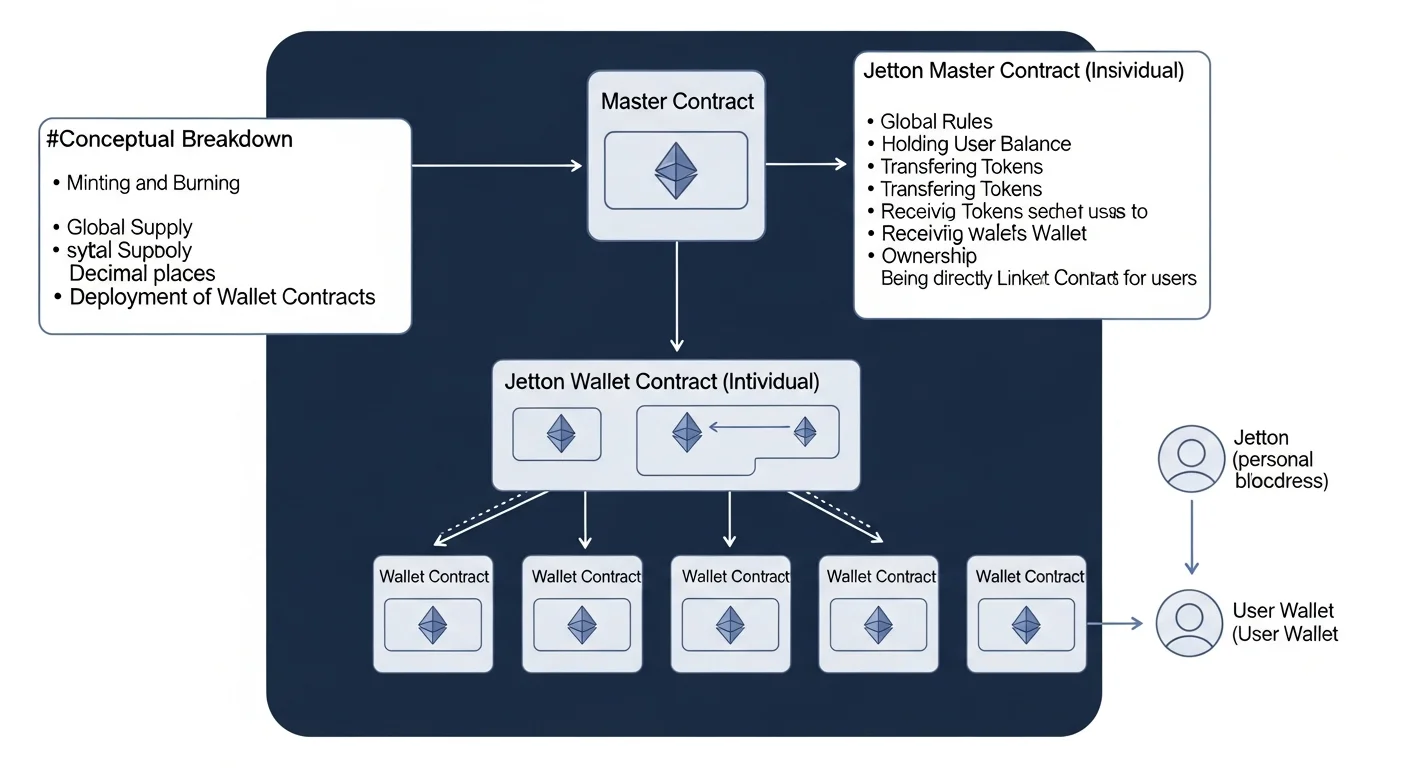
The Jetton master contract defines the token at the protocol level. It stores the supply, mint authority, metadata reference, and the rules for creating new wallet contracts. Each Jetton has exactly one master.
Wallet contracts
Each user who holds a Jetton has their own dedicated wallet contract for that Jetton. Their balance lives inside that wallet contract. When they send Jettons, their wallet contract sends a message to the recipient's wallet contract (creating it if needed). This split avoids a single global hot-spot contract that every transfer would touch.
Why TON does it this way
TON's execution model is asynchronous: contracts pass messages instead of making synchronous function calls. Splitting balances across per-user contracts maps cleanly to that model. Each transfer becomes a few independent messages between contracts, which can be processed in parallel across shardchains.
How a Jetton transfer actually works
From the user's perspective, sending a Jetton is one tap. Under the hood, several things happen.
Step-by-step under the hood
The sender's wallet UI broadcasts a message to the sender's Jetton wallet contract. That contract debits the sender's balance and forwards a message to the recipient's Jetton wallet contract. If the recipient's Jetton wallet does not exist yet, the message creates it. The recipient's wallet contract credits the new balance and (optionally) notifies the recipient's main TON wallet.
Why this matters for users
Most of this is invisible. Wallets like Tonkeeper handle the complexity automatically. The two practical implications are: you need a small TON balance to pay gas for the transfer, and a brand-new recipient who has never received that Jetton may briefly see a delay while their wallet contract is created.
Major Jettons in 2026
The Jetton ecosystem has grown into a serious token economy.
Stablecoins
USDT-TON is the largest Jetton by supply, with Tether issuing native USDT directly on TON. USDC has expanded across chains in 2026 with TON support depending on Circle's integration roadmap.
Tap-to-earn tokens
NOT (Notcoin), HMSTR (Hamster Kombat), DOGS, and several other tap-to-earn airdrops live as Jettons. We have a deeper dive in tap-to-earn games on TON.
DeFi and governance tokens
STON (STON.fi), DEDUST, and tokens from TON-native lending and liquid-staking protocols also use the Jetton standard. Many DeFi positions (LP tokens, LST tokens like tsTON or stTON) are Jettons too.
Jettons vs ERC-20 and TRC-20
The three standards solve the same problem with different mechanics.
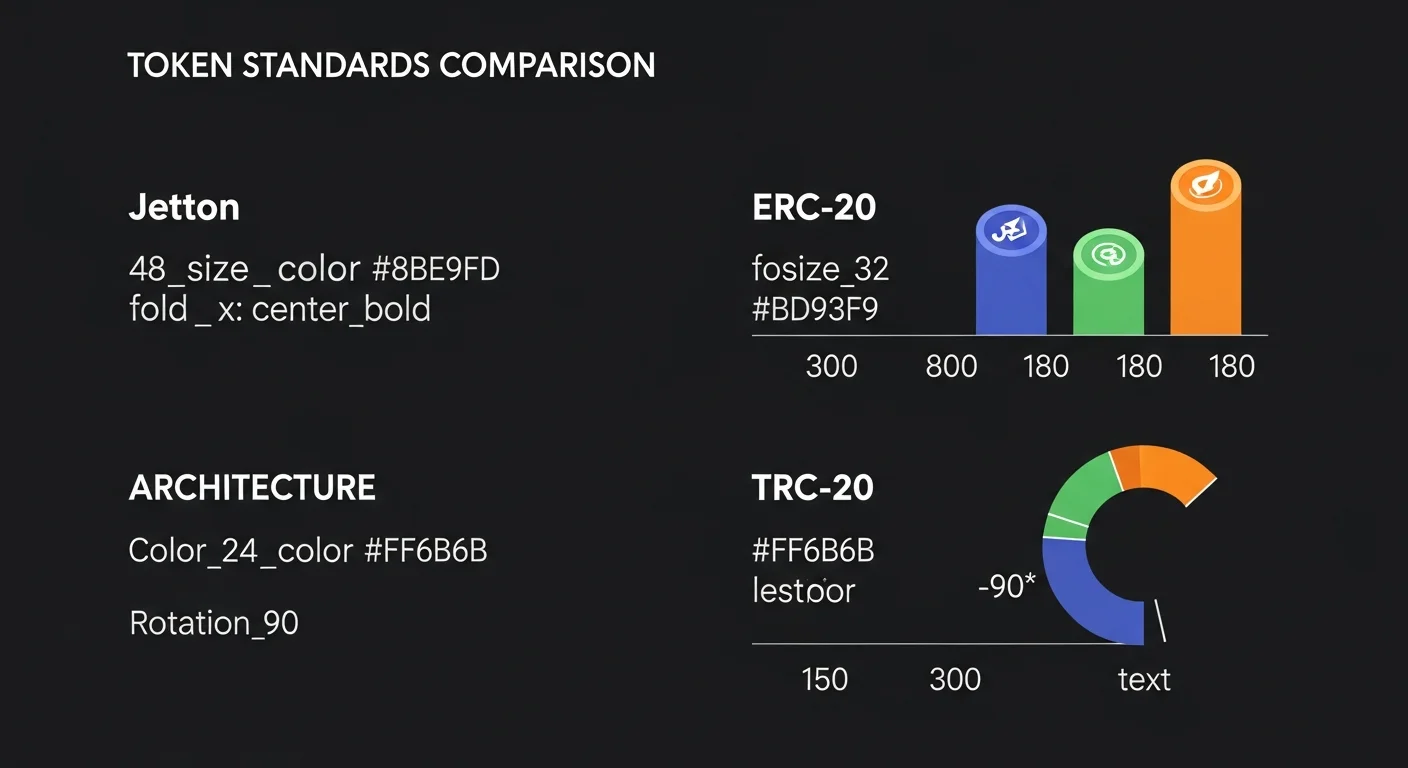
| Standard | Architecture | Typical fee | Address prefix |
|---|---|---|---|
| Jetton (TON) | Master + per-user wallet contracts | Sub-cent | EQ/UQ |
| ERC-20 (Ethereum) | Single contract for all balances | Several dollars on L1 | 0x |
| TRC-20 (Tron) | Single contract for all balances | Cents | T |
Risks and common mistakes
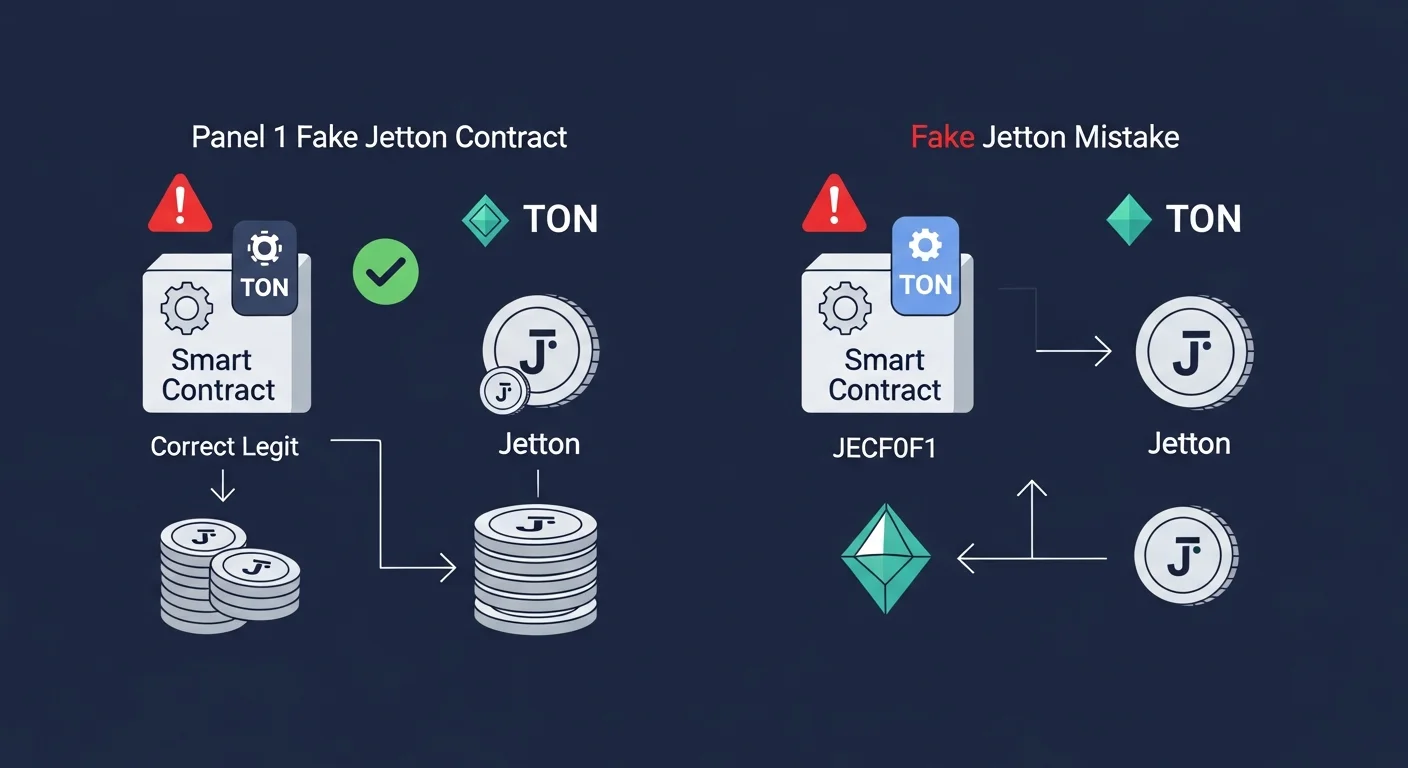
- Fake Jetton contracts: the only thing that uniquely identifies a Jetton is its master contract address. Verify before trading.
- Missing TON for gas: Jetton transfers cannot broadcast without a small TON balance.
- Sending to non-TON address: a 0x or T-prefixed destination is not a TON destination.
- Decimals confusion: different Jettons use different decimals; always check before pasting raw amounts.
- Stale wallet contracts: if a wallet contract is uninitialized, the first transfer can cost slightly more.
Practical workflow with Jettons
- Add a Jetton by master contract address, not by name.
- Always keep a small TON buffer for gas across all Jetton interactions.
- Send a small test first the first time you transfer a new Jetton to a new address.
- Verify on TONScan after the transfer to confirm the master contract matches.
- Use trusted DEXs (STON.fi, DeDust) for swaps; verify pool depth before slipping into illiquid pairs.
Frequently asked questions
Are Jettons the same as ERC-20?
They share the goal of being a non-native token standard, but the architecture differs. Jettons use a master plus per-user wallet contracts; ERC-20 uses a single contract.
Do I need TON to send Jettons?
Yes. Even though you are moving a Jetton, the network fee is paid in TON.
How do I add a new Jetton to my wallet?
Most modern TON wallets auto-detect new Jettons in your wallet. If you need to add one manually, paste the master contract address.
What does a Jetton wallet contract do?
It holds your balance for that Jetton and handles transfers in and out. Each user has their own wallet contract per Jetton.
Can a Jetton be moved to Ethereum?
Only through a bridge that issues a wrapped version on the destination chain. Native Jettons live on TON.
Final takeaway: Jettons map TON's asynchronous execution model into a clean token standard. The two-contract design is a feature, not a quirk: it scales with the network rather than creating a single global bottleneck. Verify master contracts, keep a TON gas buffer, and you can trade Jettons as confidently as any token on a more familiar chain.
Disclaimer: This guide is for educational purposes only and does not constitute investment, financial, legal, or trading advice.
Related Guides
- Not.Trade Safety Scoring: Detect TON Scam Jettons 2026
- How to Buy Jettons on TON Safely: Guide 2026
- What Is an ERC-20 Token: Complete Guide to Ethereum's Token Standard (2026)
- What Is an XRP ETF? Approval and Trading Guide 2026
- What are Runes? Bitcoin's New Token Standard Explained
- What Is ERC
Frequently Asked Questions
What are Jettons on TON?
Jettons are the standard for fungible tokens on The Open Network, similar in purpose to ERC-20 tokens on Ethereum. They let projects issue custom tokens that wallets and apps can recognize.
How does the Jetton master and wallet contract design work?
A Jetton uses a master contract that defines the token and individual Jetton wallet contracts that hold each user's balance. This sharded design spreads state across many contracts rather than one central ledger.
How are Jettons different from ERC-20 tokens?
ERC-20 tracks all balances in a single contract, while Jettons split balances across separate per-user wallet contracts that interact by passing messages. This reflects TON's design and affects how transfers and fees work.
Do you need TON to transfer Jettons?
Yes, you need some TON to pay the network fees when sending Jettons, since fees on the network are paid in TON. Keeping a small TON balance ensures your Jetton transfers can go through.