What Are Bridge Fees in Crypto? Cost Breakdown, Quotes and Hidden Charges (2026)
— By Tony Rabbit in Tutorials

Bridge fees in crypto explained: source gas, bridge tolls, relayer costs, destination gas, spreads and slippage. Learn why the quoted amount and the final received amount are not always the same.
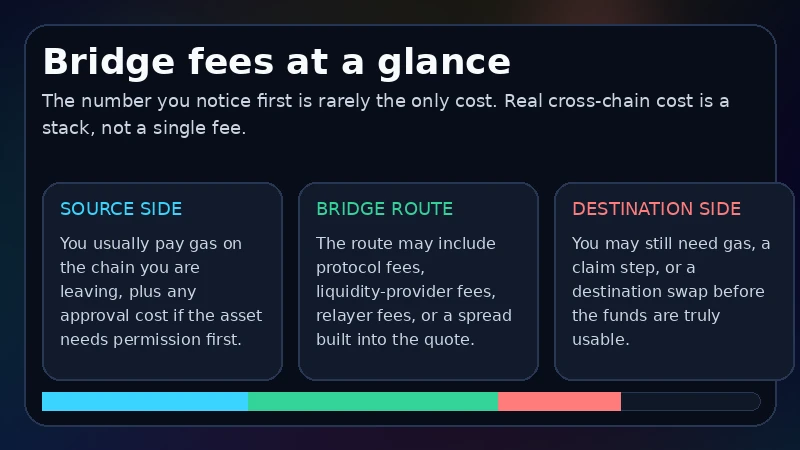
Bridge fees in crypto are the combined costs of moving assets from one chain to another. The important word there is combined. Beginners often ask what a bridge charges as if there were only one fee. In reality, a cross-chain transfer can include source-chain gas, approvals, protocol tolls, relayer or liquidity-provider costs, destination gas, and even swap spread if the route converts one asset into another on arrival.
That is why two bridge routes that look similar can produce noticeably different final outcomes. The sticker price is only part of the story. What matters is how much value leaves your wallet, how much usable value arrives on the other side, and what assumptions the route makes in between. This topic deserves its own page because cost intent is different from general bridge tutorials or bridge-risk explainers.
Quick answer
- Bridge fees are usually a stack of costs, not a single toll.
- The final amount received depends on gas, route design, protocol fees, spread, and destination-side requirements.
- To compare routes honestly, look at the net asset received, not only the headline fee.
Intent split
- This page is the bridge-cost guide: what users actually pay when moving value across chains.
- For the security and failure-mode side, read What Is Bridge Risk in Crypto?.
- For the workflow of moving assets step by step, read How to Bridge Crypto Between Chains.
What Bridge Fees Actually Include
At minimum, most bridge flows involve source-side gas and some form of route-level cost. If the token needs an approval first, that is another transaction and another fee. Depending on the design, the bridge may charge a protocol fee, compensate liquidity providers, or include relayer costs for message delivery and execution on the destination side. In some flows, the destination step may also need gas before the asset is truly usable.
The quote can still look simple in the interface, which is why users underestimate it. A smart bridge UI may bundle much of the route into one displayed estimate, but that does not remove the underlying components. Understanding those components matters because different routes optimize for different goals: lower cost, faster settlement, deeper liquidity, or simpler final asset delivery.
Why bridge costs confuse users so often
How This Topic Differs From Bridge-Risk and Bridge-Tutorial Pages
Bridge-fee content can cannibalize quickly if it tries to become a generic article about every cross-chain concept. The clean scope here is cost. Bridge-risk pages focus on custody, security, liquidity, and failure points. Bridge-aggregator pages focus on route-discovery tools. General bridge tutorials focus on how to complete the transfer. This page answers a narrower but highly practical question: what are you actually paying for?
That focus is useful for search intent too. Many users are not trying to learn how bridging works from zero. They already know the action and are trying to understand why one route is expensive, why the output amount looks smaller than expected, or why the quote changed. That is cost-intent, not workflow-intent.
How the bridge-fee page fits the cross-chain cluster
How to Compare Bridge Routes Properly
Start with the net asset received, not the top-line fee. A route that advertises a small protocol fee can still produce worse output if liquidity is thin, spread is wide, or destination steps add friction. Then ask whether the route lands you in the exact asset you need. A cheap route that arrives in a less useful representation may force another swap, which is another cost layer entirely.
Also consider the operational burden. If a route needs manual claiming or destination gas you do not already hold, the all-in cost is higher than the quote suggests. In practice, the best route is often the one that balances cost, speed, destination usability, and confidence, not simply the one with the smallest number on one line of the UI.
A better bridge-fee comparison workflow
Common Bridge-Fee Mistakes That Waste Money
Most bridge-fee mistakes come from focusing on the wrong number. Users stare at one visible fee field, ignore the destination requirements, and then feel surprised when the final amount is lower than expected. Others optimize for speed or convenience without realizing that they are paying a premium for that choice. Neither outcome is always wrong, but it should be intentional.
Mistakes worth avoiding
Frequently Asked Questions
Why do bridge fees seem so inconsistent?
Because the full cost depends on chain gas, route design, bridge type, liquidity conditions, and what asset representation you receive on arrival.
What is the difference between gas and the bridge fee?
Gas pays the chain for transactions. The bridge fee usually refers to route-level costs such as protocol, relayer, or liquidity-provider compensation.
Can an aggregator help lower bridge fees?
Often yes, because aggregators compare multiple routes. But you still need to judge net output and destination usability, not just the displayed fee.
Why is the final amount smaller than the quote I expected?
Approvals, spread, slippage, destination requirements, or a route change during execution can all affect the final net amount.
How can I reduce bridge costs safely?
Use the correct asset and chain pair, compare routes, avoid unnecessary hops, keep destination gas ready, and judge the transfer by total net output.
Related reading
Disclaimer: This article is for educational purposes only and not financial, legal, or tax advice. Bridge fees, route quotes, and destination requirements change constantly, so always verify the live route before moving funds.
Related Guides
- The Hidden Cost of a Round Trip Trade: Slippage, Gas, Failed Transactions and Fees
- How Much Does It Cost to Start a Meme Coin? Budget, Hidden Fees and Launch Math (2026)
- What Is a Wallet Cluster in Crypto? How Linked Wallets Reveal Hidden Control
- Ice Phishing Explained: Hidden Approval Drains
- Dark AMMs and Hidden Liquidity: Why Some DEX Activity Is Harder to Read