Telegram and Discord Crypto Scams: Common Patterns Explained
— By AliceOnChain in Tutorials

An operational security analysis decoding the structural engineering of cryptocurrency fraud on messaging networks, establishing a practical framework to identify and neutralize social engineering threats before wallet interaction.
Telegram and Discord Crypto Scams: Common Patterns
The architectural sovereignty of decentralized networks allows market participants to bypass traditional financial custodians, interacting directly with global liquidity layers. However, this absolute freedom places the entire burden of security and technical verification onto the individual user. While the underlying blockchain ledger remains mathematically secure against brute-force attacks, the communication channels where communities gather are heavily targeted by exploit networks.
Among these communication vectors, public messaging applications have become the primary staging grounds for high-yield wallet-draining campaigns. Gaining a precise diagnostic understanding of Telegram and Discord Crypto Scams: Common Patterns is an absolute prerequisite for shielding your digital assets from a catastrophic breach.
For active operators who track liquidity shifts or deploy capital using professional analytical dashboards, keeping your digital identity fortified across social spaces is just as critical as evaluating token smart contract safety.
The Telegram Landscape: Exploiting Visual Shortcuts and Identity Spoofing
Telegram’s decentralized group structure and mobile-first architecture make it a highly effective environment for large-scale social engineering. The fundamental vulnerability within this network stems from how user identities are visually shorthand on standard screen layouts.
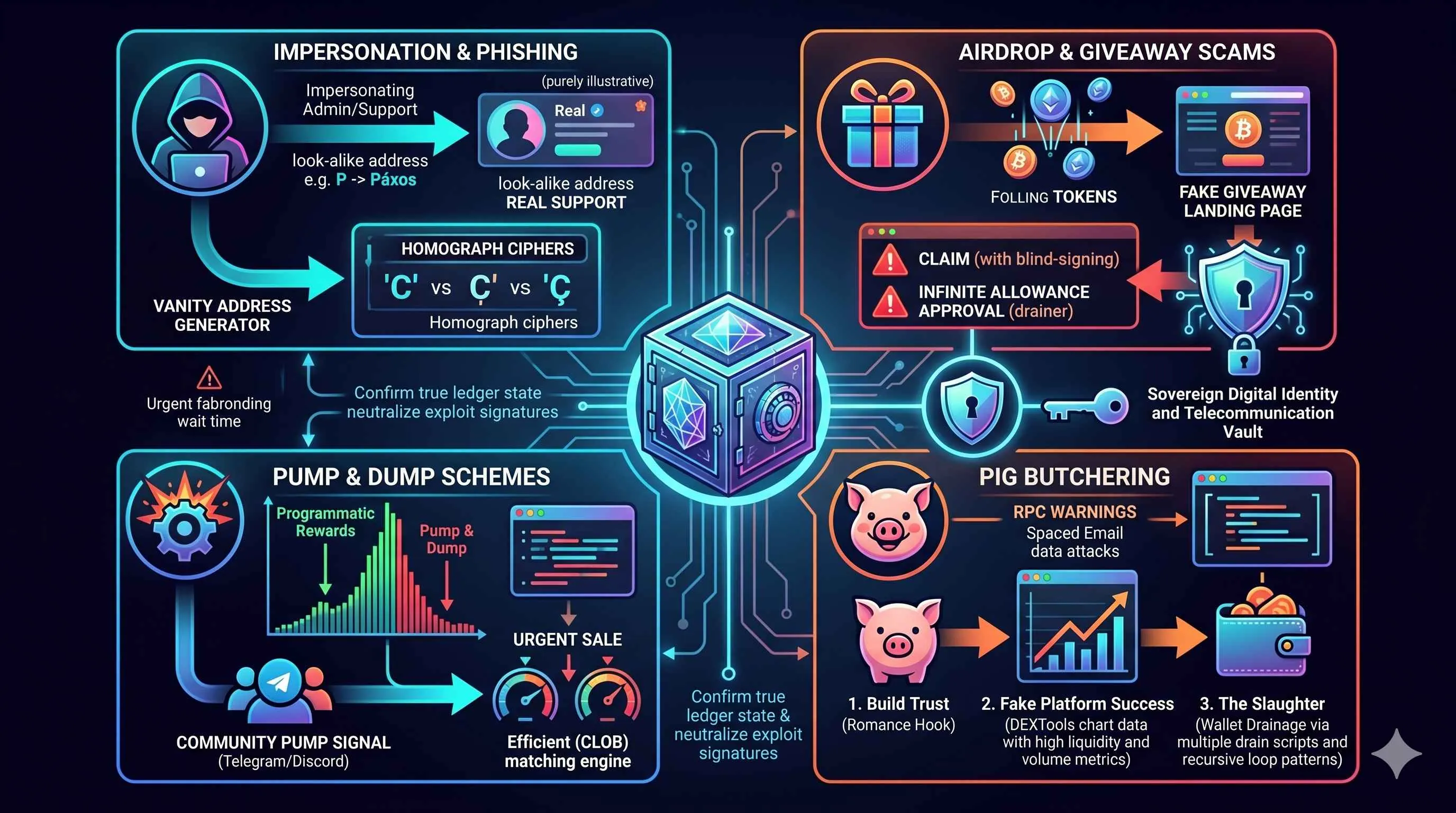
One of the most widespread patterns involves the administrative impersonation of trusted ecosystem figures, such as protocol developers, centralized exchange support staff, or prominent market analysts. Attackers utilize homograph and look-alike character substitutions to register handles that appear completely identical to a legitimate account banner at a glance.
A malicious actor might register a username where a lowercase letter is swapped with an identical-looking uppercase symbol from a different character set. The attacker then monitors public community chat logs, waits for a user to post a technical question, and initiates an unexpected direct message posing as official support.
These messages invariably focus on immediate account security updates or unverified token reward opportunities to bypass rational analysis. The intruder then guides the user toward an external web portal that prompts them to execute a transaction, resulting in a permanent misdirection of capital.
Discord Vulnerabilities: Malicious Bots and Server Takeovers
While Telegram fraud typically focuses on direct messaging deception, Discord attacks exploit the complex, hierarchical nature of community server permissions and automated plugins.
A primary vector involves deceptive interoperability through compromised or counterfeit verification bots. In this scenario, scammers either compromise an existing server administrator's account through session hijacking or establish a clone server under their own control. They configure a button that prompts users to verify their wallets to gain access to exclusive channels or hidden trading data.
Unlike standard, audited verification plugins, this malicious software triggers a transaction request that looks like a harmless connection test but is actually an infinite allowance approval or an automated permit signature command. Once signed by the user, the exploit group can programmatically drain native tokens directly from the connected hardware wallet or hot wallet.
Furthermore, exploit groups leverage the allure of unearned yield by promoting fake giveaway and airdrop allocations directly within flooded announcement channels. These campaigns use panic-inducing hooks, claiming that a specific event has limited allocation slots available, forcing users to bypass standard on-chain verification steps. If an ecosystem event or reward is not actively broadcasted on primary network block explorers or verified independent indexers, the promotion matches a textbook social engineering pattern.
Developing a Proactive Defense Framework Against Social Scams
Insulating your non-custodial wallet from messaging-based fraud requires shifting away from convenient visual shortlists and implementing strict verification workflows.
First, treat all unexpected direct messages across both networks as inherently hostile. Legitimate project founders, moderators, and support personnel will almost never initiate a private conversation to resolve a technical issue or offer exclusive investment allocations. Configure your privacy settings to completely block direct messages from users who do not share trusted, verified mutual contacts.
Second, bypass server-side verification links when interacting with decentralized applications. Instead of clicking hyperlinks embedded within chat messages or bot responses, manually navigate to official protocol repositories using pre-saved, audited bookmarks. If a community server claims a major infrastructure shift has occurred, verify the claims independently by consulting public block explorer announcements or secondary data indices.
Third, execute meticulous character-by-character validation during the wallet confirmation sequence. If a web interface prompted by a social message requests permissions to modify asset registries, check the exact parameters of the smart contract call before clicking the confirm button. Restricting allowances, utilizing dedicated, low-balance hot wallets for community testing, and enforcing hardware-locked authentication protocols ensures that your primary capital remains thoroughly insulated from deceptive manipulation.
Conclusion: Neutralizing Social Engineering with Technical Discipline
Mastering the mechanics of community-based exploitation means moving past surface-level branding and treating the social layer of web3 as a public, untrusted domain. The permissionless nature of decentralized finance means that technical vigilance is your final and most effective line of defense.
By eliminating reliance on unverified chat links, maintaining a position of systematic skepticism toward direct messages, and utilizing independent on-chain tools to audit any market event, you completely neutralize the psychological illusions used by automated exploit networks. In a fast-paced on-chain landscape, maintaining a rigorous verification routine ensures your private keys remain secure and your portfolio remains completely protected.
- How to Bridge Crypto Between Chains: Complete Cross-Chain Tutorial 2026
- How to Use 1inch for Swaps: Classic, Fusion and Limit Orders (2026)
- OKX Web3 Wallet Tutorial 2026: Multi-Chain Setup Guide
Disclaimer: This article is for informational purposes only and does not constitute investment advice, financial advice, trading advice, or any other kind of advice. DEXTools does not recommend buying, selling, or holding any cryptocurrency or token. Users should conduct their own research and consult with a qualified financial advisor before making any investment decisions. Cryptocurrency investments are volatile and high-risk. DEXTools is not responsible for any losses incurred.
Related Guides
- 7 Best Telegram Trading Bots 2026: Safe Picks, Scams to Avoid
- What Are Candlestick Patterns in Crypto? Trading Guide 2026
- How to Read Crypto Charts for Beginners: Candlesticks, Indicators and Patterns (2026 Tutorial)
- Candlestick Patterns Cheat Sheet: 35 Crypto Setups Explained (2026)
- Crypto Phishing Email Patterns: 10 Core Red Flags