SunSwap Tutorial: How to Swap Tokens on TRON's Top DEX (2026)
— By Tony Rabbit in Tutorials
SunSwap is the leading DEX on TRON. This tutorial walks through wallet connection, swapping tokens, providing liquidity, slippage settings, and how to avoid scam pairs.
SunSwap is the largest decentralized exchange on TRON. It runs the same automated market maker model that Uniswap pioneered on Ethereum, with a TRON-native asset list (TRX, USDT-TRC20, USDD, JST, SUN, BTT, and most TRC-20 tokens) and TRON-style fees. For most TRON users, it is the default place to swap tokens without going through a centralized exchange.
Quick answer: To swap on SunSwap, connect TronLink, choose the input and output tokens, set a sensible slippage tolerance, review the price impact, and confirm. Most major pairs settle in seconds for cents in fees. The biggest risks are scam token pairs that look real, low-liquidity pools where slippage is brutal, and signing approvals you do not understand.
- SunSwap is permissionless. Anyone can list a token, including bad actors. Always verify contract addresses.
- Slippage matters. Set it to a tight number on liquid pairs, slightly higher on thinner pairs.
- Price impact is the real cost. On low-liquidity pairs the swap rate moves against you mechanically.
- Approvals can be revoked. Use TRONSCAN to audit and remove old token approvals.
- LP positions earn fees. Adding liquidity is the other side of the trade and brings impermanent loss exposure.
What SunSwap is
SunSwap is an AMM-based DEX. It does not match buyers and sellers. Instead, traders swap against liquidity pools that are funded by other users called LPs (liquidity providers). Each pool contains two tokens in a specific ratio, and the price you get is set by the math of that pool.
Token pools and pair design
Each pool holds reserves of two tokens. When a trader buys one side, the pool ratio shifts and the price quoted to the next trader changes accordingly. This is why a small swap on a deep pool moves the price minimally, while a large swap on a thin pool moves the price sharply.
Fees and how LPs earn
Each swap pays a small fee to the pool, which is distributed to LPs based on their share. Pools with consistent volume can generate meaningful base yields purely from these fees. SunSwap also offers reward programs on certain pools, where additional SUN or other tokens are emitted to incentivize liquidity.
How to swap on SunSwap
Swapping is the most common use of SunSwap. Once you have a TRON wallet with TRX for energy, the flow takes seconds.
Connect TronLink
Open sunswap.com and click Connect Wallet. Choose TronLink. Verify the domain on the wallet's connection prompt. Phishing copies of major TRON dApps are common, and the domain check is the only reliable defense.
Choose tokens and amount
Pick the input token (the one you have) and the output token (the one you want). For new tokens not in the default list, you can paste a contract address. Always verify that contract address against an official source before swapping. Scam tokens use the same names and logos to trick traders into approving fake versions.
Slippage and price impact
Slippage is the maximum price movement you accept between submitting and executing. On liquid pairs like TRX/USDT, 0.1 to 0.5 percent is fine. On thin pairs, you may need 1 to 3 percent or higher, which means you should also question whether the swap is worth doing at all. Price impact is shown directly on the swap screen. Anything above 1 percent is a meaningful cost on a single swap.
Provide liquidity and earn fees
Beyond simple swaps, SunSwap lets users add liquidity to pools. The flow is straightforward, but the risks are different from a swap.
Add liquidity in a pair
Go to the Pool section, choose Add Liquidity, and select the two tokens. Deposit equal value of each side. The pool issues an LP token that represents your share. You earn a portion of the swap fees from that pool while you hold the LP token.
Impermanent loss in plain English
If the prices of the two pooled tokens diverge, the LP position underperforms a simple hold of both tokens. This is impermanent loss. It can be small on stable pairs and large on volatile pairs. Our deeper guide is at what is impermanent loss in DeFi.
Reward farms vs base pools
Some SunSwap pools include extra reward programs. The headline APY can look attractive, but the math depends on whether the reward token holds value, whether the underlying pair has impermanent loss exposure, and how concentrated the LP base is. Treat reward APY as variable, not as guaranteed income.
Risks every SunSwap user should know
SunSwap shares the typical AMM risks plus a few TRON-specific ones.
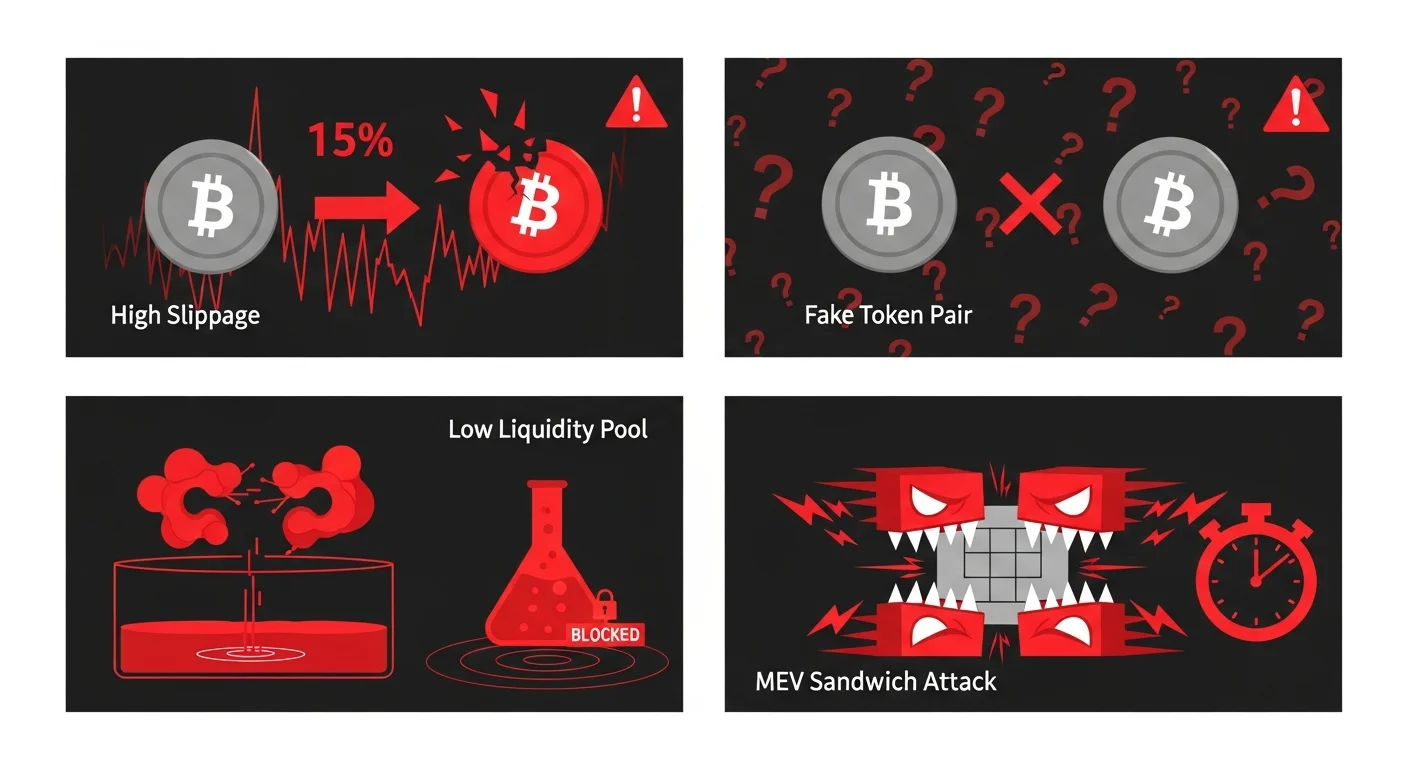
- Scam tokens with familiar names. Always verify contract addresses against official sources.
- Low-liquidity pools: apparently small swaps can move price meaningfully against you.
- MEV sandwich attacks: bots can front-run high-slippage trades and pocket the difference.
- Smart contract risk: SunSwap and its peripheral contracts have been audited but not rendered immune.
- Approval drift: old token approvals from past swaps can be exploited if they are not revoked.
SunSwap vs other TRON DEXs
| DEX | Stronger for | Main caution |
|---|---|---|
| SunSwap | Most TRON pairs, deepest liquidity | Scam token pairs, MEV on volatile swaps |
| JustSwap | Legacy AMM, some long-tail tokens | Lower TVL than SunSwap on most pairs |
| Aggregators | Best execution across pools | Extra contract layer, more approvals |
Practical SunSwap workflow
- Verify the contract address before swapping any unknown token. Never trust the name or logo alone.
- Use DEXTools to check pool depth and recent activity. A "live" token with no real volume is a flag.
- Set slippage tightly on liquid pairs. Loosen only when you understand why.
- Stake TRX for energy. Frequent swaps consume meaningful energy on TRON.
- Audit approvals monthly. Revoke anything you no longer use through TRONSCAN.
Frequently asked questions
Is SunSwap safe?
The protocol has been audited and operating for years, but DeFi protocols always carry smart contract and oracle risks, and the permissionless listing model means scam tokens exist alongside legitimate ones.
What is the SunSwap fee?
The standard pool fee is in line with mainstream AMMs (often 0.3 percent). Reward programs may add or modify yields on specific pools.
Can I swap from a centralized exchange directly to SunSwap?
You first need to withdraw to a TRON wallet (TRC-20). From there, connect to SunSwap and swap. There is no direct exchange-to-DEX rail.
Why is my swap showing a high price impact?
Most likely the pool you are using has low liquidity for the size of your swap. Lower the trade size or look for a deeper pool.
Can I provide liquidity in a single asset?
Standard SunSwap LPing requires two tokens. Single-asset routes exist on some interfaces by auto-splitting your input, but they ultimately deposit two tokens into the pool on your behalf.
Final takeaway: SunSwap is the workhorse DEX of TRON. Verify token addresses, set slippage with intent, watch price impact, and let DEXTools sanity-check pools before you swap. Adding liquidity unlocks fee yield, but always with impermanent loss as the cost of doing business.
Disclaimer: This guide is for educational purposes only and does not constitute investment, financial, legal, or trading advice. DeFi swaps are irreversible.
Related Guides
- What Is CoW Swap: Complete Intent-Based DEX & Protocol Guide (2026)
- What Is a Swap Router in Crypto? How DEX Routing Really Works (2026)
- Top 5 DEX Aggregators in 2026: Best Swap Tools for DeFi Traders
- How to Use Uniswap: Wallet Connect, Swap, Slippage and LP Basics (2026)
- How to Use Raydium on Solana: Swaps, Liquidity Pools and CLMM Guide (2026)
Frequently Asked Questions
What is SunSwap?
SunSwap is a decentralized exchange on the TRON network where users can swap tokens and provide liquidity. It operates using liquidity pools rather than a traditional order book.
How do I swap tokens on a TRON DEX?
You connect a TRON-compatible wallet, select the tokens you want to trade, set your slippage tolerance, and confirm the swap. You also need some TRX to cover the network resources for the transaction.
What is slippage and how should I set it?
Slippage is the allowed difference between the expected and actual price of your swap. Setting it too low may cause the trade to fail, while setting it too high can lead to a worse fill, so a modest value is usually safest.
How do I avoid scam tokens on a DEX?
Always verify the token's contract address from a trusted source, since anyone can create a token with a familiar name. Checking liquidity and holder distribution also helps you avoid fake or manipulated pairs.