What is GameFi? A Beginner’s Guide to Crypto Gaming
Walled-garden game publishers lock billions of dollars in player assets inside private databases. We break down how GameFi utilizes blockchain networks and utility NFTs to hand true economic rights back to gamers.
The Sovereign Digital Arcade: Escaping Walled-Garden Economies
- GameFi (the fusion of gaming and decentralized finance, re-engineers this relationship. By leveraging public blockchain rails, smart contracts, and non-fungible tokens (NFTs), crypto gaming replaces top-down corporate extraction with player-owned micro-economies. This guide breaks down the structural evolution from early experimental models to sustainable architectures, explores true asset portability, and charts the leading networks and genres defining the modern Web3 gaming landscape.
- For decades, traditional gaming has operated on a strict, one-way economic path. Players spend billions of dollars annually purchasing virtual currencies, expansion cosmetics, and rare items inside their favorite titles. However, the moment capital enters these games, it is locked forever inside the publisher’s private servers.
- Traditional players do not own their items; they merely rent digital access codes from centralized studios that can ban accounts, manipulate drop rates, or shut down servers at will, wiping out years of human effort and financial investment overnight.
1. Structural Evolution: Play-to-Earn (P2E) vs. Play-to-Own (P2O)
The initial iteration of the GameFi sector captured global headlines through primitive Play-to-Earn (P2E) frameworks. These early environments focused heavily on financial speculation, rewarding players with highly inflationary utility tokens for repetitive, low-skill grinding. Because these systems lacked robust utility sinks, their economies depended entirely on a continuous influx of new capital to absorb token emissions, leading to structural asset corrections when player growth slowed.
The modern gaming landscape has completed a fundamental reset, transitioning to Play-to-Own (P2O) and Play-and-Earn models.
Gameplay-First Development: Contemporary titles prioritize immersive graphics, engaging storylines, and high player retention over naked financial farming. The goal is to build games that people choose to play for entertainment, not merely as a full-time job.
Controlled Sink Dynamics: P2O economies use sophisticated token sinks (such as consuming utility tokens for item crafting, character breeding, cosmetic personalization, and tournament entry fees) to balance token print speeds with real economic demand.
2. The Pillar of Digital Sovereignty: True Asset Ownership
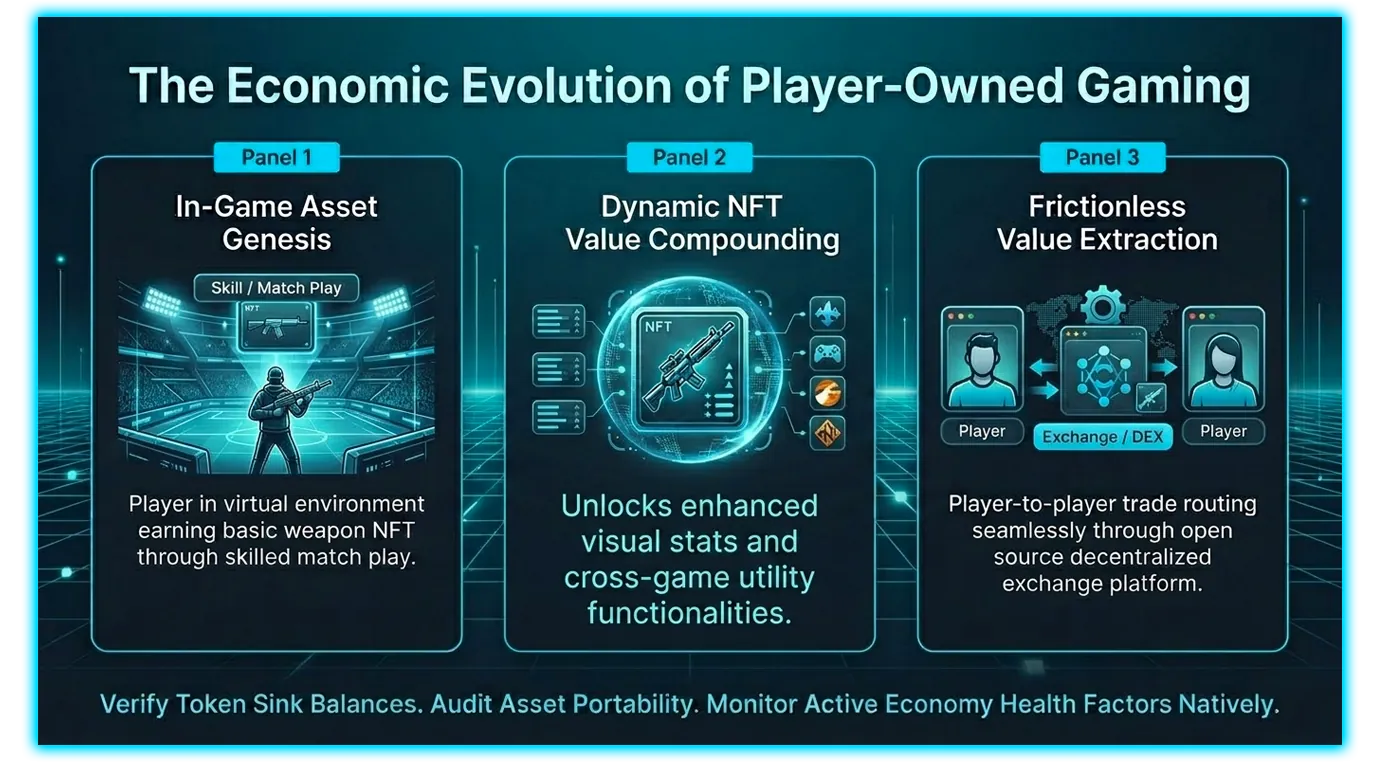
The technical core of GameFi lies in transforming intangible database rows into cryptographic property. When a player extracts a rare sword, lands a piece of virtual real estate, or breeds a unique companion in a Web3 game, that asset is minted as an on-chain NFT.
Sovereign Asset Separation: Because your items sit directly inside your private web3 wallet rather than on the game publisher's private server, the studio cannot unilateral confiscate, delete, or devalue your inventory.
This ownership primitive unlocks Cross-Game Interoperability. Because these items live on public ledgers like Ethereum, Ronin, or Immutable zkEVM, independent studios can build customized bridges that allow assets from one universe to unlock unique stats, cosmetic patterns, or secret access keys within entirely separate games, extending an item's real economic life far past its original software boundaries.
3. Top Genres and Dominant Ecosystem Maps
The Web3 gaming and GameFi landscape has branched into diverse genres running across optimized, ultra-low-fee execution networks. Networks like Ronin, Immutable, and opBNB process thousands of in-game micro-transactions for fractions of a cent, eliminating gas fee friction for active competitive loops.
Ecosystem and Genre Matrix
| Genre | Leading Network | Major Tokens |
| MMORPG / RPG | Ronin / opBNB | $AXS, $WOD, $PIXEL |
| TCG / Strategy | Immutable X | $GODS, $SPS |
| Metaverse | Ethereum | $SAND, $GALA |
| Action / OpenWorld | Immutable zkEVM | $ILV |
4. The Modern State of GameFi
The current era of crypto gaming has shed its early experimental skin to deploy highly advanced technologies designed to scale to hundreds of millions of mainstream users:
Telegram Mini-Games & Hyper-Casual Onboarding: Following the explosive growth of tap-to-earn apps and lightweight mini-games (like Egg Drop or Dropee), hyper-casual platforms serve as highly accessible entry points, onboarding millions of non-crypto natives into Web3 via quick, chat-native execution layers.
AI-Infused Agent Economies: Modern titles integrate advanced machine learning agents directly into active gameplay. AI agents act as sovereign network participants, managing automated guild resources, adjusting matchmaking balances dynamically, or operating as complex, evolving non-player characters (NPCs) that hold their own Web3 wallets.
Anti-Bot and Stablecoin Infrastructures: To protect in-game marketplaces from automated script farming (which can trigger asset inflation) studios deploy cryptographic fraud-detection systems alongside in-game stablecoin integrations to isolate local item values from open crypto market volatility.
Analyzing Market Parameters via DEXTools Telemetry
- Tracking the financial micro-economies of modern Web3 titles requires robust, unfiltered ledger data. Employing comprehensive decentralized analytical engines like DEXTools gives the gaming community an essential universal platform to track live gaming token dynamics, inspect asset pool liquidity depth, and review complex contract setups across every active public network.
- By utilizing core modules such as the Pair Explorer, monitoring early ecosystem launches on the Live New Pairs dashboard, and breaking down player transaction narratives with the Trade Story or Top Traders diagnostic trackers, technical allocators can audit localized volume trends, detect large institutional capital rotations via the Big Swap Explorer, and evaluate automated smart contract security rankings before initializing trades, keeping your secure hardware keys isolated from unverified market venues.
Disclaimer: This article is for informational purposes only and does not constitute investment advice, financial advice, trading advice, or any other kind of advice. DEXTools does not recommend buying, selling, or holding any cryptocurrency or token. Users should conduct their own research and consult with a qualified financial advisor before making any investment decisions. Cryptocurrency investments are volatile and high-risk. DEXTools is not responsible for any losses incurred.
Related Guides
- What Is Aethir (ATH)? The Decentralized GPU Cloud Powering AI and Gaming in 2026
- Top 5 GameFi Crypto Games to Watch in 2026
- Play-to-Earn vs Play-to-Own: GameFi Evolution Since 2021
Frequently Asked Questions
What is GameFi?
GameFi combines gaming with decentralized finance, using blockchain to give players ownership of in-game assets. It often blends gameplay with token rewards and tradable NFTs.
How does GameFi differ from traditional gaming?
In traditional games, in-game items are controlled by the publisher and locked inside their servers. GameFi records ownership on a blockchain, so players can typically hold, trade, or sell their assets outside the game.
What are play-to-earn games?
Play-to-earn games let players earn tokens or NFTs through gameplay that may have value outside the game. The earning potential depends on the game's economy, which can change over time.
Are NFTs important in GameFi?
NFTs are commonly used in GameFi to represent unique items, characters, or land that players truly own. Because they live on a blockchain, these assets can often be transferred between players or marketplaces.