NFT Royalties Explained: Why They Matter and Why They Broke
— By AliceOnChain in Tutorials

An analytical breakdown of the technical and economic factors that led to the collapse of enforceable NFT royalties, and how traders can use advanced on-chain tools to navigate shifting digital asset liquidity.
NFT Royalties Explained: Why They Matter and Why They Broke
The promise of web3 has long been anchored to equitable monetization for creators, a concept that becomes clear when you have traditional NFT royalties explained. When non-fungible tokens surged into mainstream consciousness, creator royalties were heralded as a revolutionary paradigm shift. For the first time, artists and builders could participate in the secondary market success of their work, capturing a percentage of every subsequent transaction in perpetuity. It was an economic model that transformed digital ownership and incentivized long-term ecosystem development.
However, as market cycles shifted and trading volume contracted, the foundational mechanisms upholding these creator fees began to fracture. What was once considered an immutable pillar of web3 culture quickly transformed into a battleground of economic incentives, exposing a critical vulnerability: secondary market digital royalties were never fully enforceable at the smart contract level. Instead, they relied on a delicate social consensus that collapsed under the pressure of intense marketplace competition.
Understanding the narrative behind these broken fees requires a deep dive into smart contract architecture, economic theory, and the shifting behavior of on-chain market participants. For traders and builders navigating the broader decentralized finance (DeFi) and non-fungible landscapes, this structural transition offers invaluable lessons in liquidity tracking, platform risk, and volatility management.
The Mechanics of Secondary Market Monetization
To truly have how NFT royalties work explained, one must first look at how they were originally implemented by early protocols. In the early stages of the non-fungible ecosystem, secondary market fees were largely abstract concepts. When a creator deployed a standard ERC-721 token contract, the code governed ownership transfer and metadata reference, but it lacked native, hardcoded parameters to compel a financial payment during an off-platform transfer.
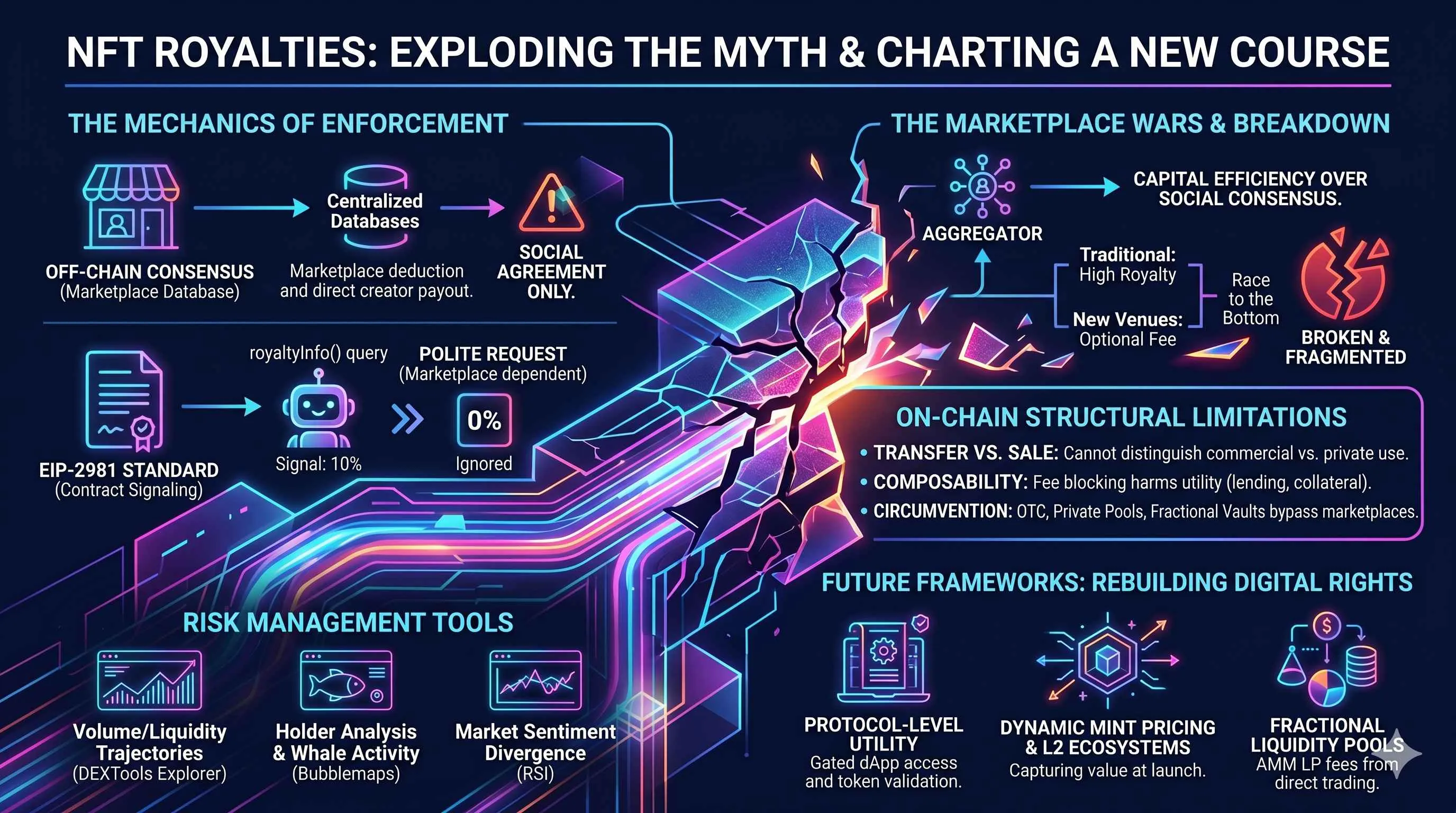
Instead, monetization relied heavily on off-chain cooperation. Major centralized marketplaces established internal databases that indexed collections and manually enforced a designated fee percentage, typically 2.5% to 10%, whenever an asset changed hands via their proprietary order books. When a trade cleared, the platform deducted the marketplace protocol fee and the creator fee before distributing the remaining capital to the seller.
This application-layer approach worked efficiently during periods of high market sentiment and abundant capital inflows. Creators reinvested these continuous revenue streams into utility development, community initiatives, and floor price support. However, because the fee deduction occurred at the interface level rather than the core protocol layer, the entire framework remained susceptible to alternative platforms willing to bypass the social agreement to capture market share.
The Standardized Approach: EIP-2981
Recognizing the fragmentation caused by platform-dependent implementations, the Ethereum community introduced EIP-2981, which is the official NFT Royalty Standard. This standard designed a unified way for token smart contracts to signal fee information. By implementing a simple asset-level query function, any marketplace could programmatically check the designated recipient address and the fractional fee percentage for a given asset.
While EIP-2981 improved interoperability across the ecosystem, it did not introduce absolute on-chain enforcement. The standard was explicitly designed as a signaling mechanism. It politely informed the executing smart contract or marketplace of the creator’s expectations, but it could not legally or technically prevent a marketplace from ignoring the data payload during execution. If a platform chose to execute a transfer via a customized exchange contract that set the payout to zero, the underlying asset contract would still permit the transfer of ownership.
The Marketplace Wars and the Breakdown of NFT Royalties Explained
The structural vulnerability of social enforcement became glaringly apparent during the hyper-competitive marketplace transition of late 2022 and 2023. As aggregate trading volume cooled, new decentralized paradigms emerged to cater specifically to yield-oriented, high-frequency traders. The focus shifted away from casual collecting toward financialized digital asset trading, where every basis point of execution slippage mattered.
Zero-fee trading platforms and aggressive aggregate marketplaces disrupted the status quo by making creator fees optional for the end user. By removing the 5% to 10% premium typically paid to creators, these platforms immediately offered a more capital-efficient venue for asset allocation. For short-term position traders managing volatility, bypassing these costs meant a significantly lower breakeven threshold on flipping activities.
This structural shift triggered a classic economic race to the bottom. Legacy platforms, which had previously captured dominant shares of on-chain volume, witnessed rapid liquidity migration. To protect their market positioning and prevent their user bases from eroding, these platforms were forced to alter their terms, reducing minimum fee requirements and transitioning to optional models. Within a matter of months, the predictable, recurring revenue model that had sustained some of the largest web3 brands evaporated, leaving the community seeking to have the demise of NFT royalties explained by market analysts.
On-Chain Structural Limitations: Why Hard Enforcement Fails
The core technical reason why secondary fees broke lies in the inherent design of public blockchains. A smart contract cannot inherently distinguish between a commercial sale and a benign wallet optimization transfer.
If a creator attempts to enforce fees strictly within the token’s transfer function, the code must intercept the transaction and demand a specific payment. However, if the contract blocks transfers that do not include a protocol fee, it severely compromises the composability and utility of the token. Users would be penalized for moving their own digital assets between their personal cold storage and hot wallets, or wrapping the asset to use as collateral in a decentralized lending protocol.
Furthermore, market participants can easily circumvent contract-level marketplace blocklists. Traders can utilize over-the-counter escrow contracts, private peer-to-peer pools, or fractionalized vaults to exchange asset exposure without triggering the restricted marketplace infrastructure. When an asset class becomes heavily financialized, capital naturally seeks the path of least resistance and maximum efficiency.
Risk Management Lessons for Modern On-Chain Traders
The trajectory we have seen with NFT royalties explained provides essential insights for anyone trading digital assets, whether dealing with non-fungible collections, decentralized protocol tokens, or volatile memecoin structures featuring transaction taxes. Volatility management and structural awareness are vital when liquidity can fragment instantly across multiple execution venues.
1. Monitoring Volume and Liquidity Trajectories
When structural changes occur within an asset ecosystem-such as a collection losing its primary revenue stream or a token adjusting its internal fee structures-price action and order-book depth react immediately. Traders must utilize advanced charting tools, such as the DEXTools Pair Explorer, to monitor real-time liquidity changes and volume trends. A sudden drop in volume on primary platforms, coupled with an increase in activity on alternative protocols, often precedes expanded price volatility and shifts in support/resistance zones.
2. Analyzing Holder Distribution and Whale Activity
The sustainability of any digital asset depends heavily on its underlying ownership structure. When a project's financial incentives break down, tracking holder distribution becomes a key metric for risk management. Utilizing deep data analytics, such as the holder analysis features and the integrated Bubblemaps view on DEXTools, allows market participants to identify clusters of interconnected wallets. If large whales begin executing coordinated distribution campaigns due to changing fundamental models, the resulting supply pressure often triggers significant downward price action.
3. Interpreting Market Sentiment via Technical Divergence
When structural fundamentals shift, technical analysis serves as an objective gauge of market psychology. For instance, if an asset experiences a steep price correction following a protocol alteration, observing momentum indicators like the Relative Strength Index (RSI) can help identify potential stabilization points. An RSI divergence-where the asset price prints a new local low while the underlying momentum indicator begins to trend upward-may indicate that selling exhaustion is approaching near institutional support zones, enabling traders to execute informed entries with strict stop-loss parameters.
Future Frameworks: Rebuilding Digital Property Rights
The web3 development ecosystem has not abandoned the concept of creator monetization, but the strategy is evolving away from relying on social compliance toward building sustainable on-chain incentives. Several alternative frameworks are currently being deployed to mitigate the loss of traditional structures:
Protocol-Level Utility and Gated Access: Teams are shifting focus toward tying real-time utility directly to active wallet validation. If an asset is purchased on an unapproved, fee-evading venue, the smart contract can flag that specific token ID, temporarily restricting access to associated dApps, staking rewards, or community standard protocols.
Dynamic Mint Pricing and L2 Ecosystems: Rather than relying entirely on downstream secondary market activity, creators are adjusting initial launch mechanics. This includes utilizing progressive Dutch auctions or capturing economic value through protocol transaction fees within dedicated Layer-2 application chains.
Fractionalized Liquidity Pools: By creating automated market maker liquidity positions where assets are paired with base currencies, creators can earn standard liquidity provider fees from trading activity directly, bypassing the traditional order-book architecture entirely.
Conclusion
The evolution of NFT royalties demonstrates that social consensus alone cannot withstand the pressures of competitive financial markets. When capital efficiency clashes with ideological ideals, market participants consistently optimize for lower costs and deeper execution liquidity.
For modern market participants, this serves as a powerful reminder of the importance of on-chain vigilance. By leveraging comprehensive analytical platforms like DEXTools to set custom price alerts, track liquidity pools, and evaluate holder dynamics, traders can remain agile ahead of structural market developments. Success in decentralized environments ultimately depends on understanding the underlying code, respecting market incentives, and managing risk objectively across every digital asset class.
CEX Deposit Pressure: How Exchange Inflows Can Signal Future Selling
Pair Explorer Data Trend Reversals: A Pro Trading Guide
Top 5 Whale Tracking Tools in 2026: Large Wallet Monitoring Across Chains
Disclaimer: This article is for informational purposes only and does not constitute investment advice, financial advice, trading advice, or any other kind of advice. DEXTools does not recommend buying, selling, or holding any cryptocurrency or token. Users should conduct their own research and consult with a qualified financial advisor before making any investment decisions. Cryptocurrency investments are volatile and high-risk. DEXTools is not responsible for any losses incurred.
The On-Chain Footprint: Identifying Royalty-Friendly Marketplaces
While the dream of universally enforced, creator-defined royalties has largely faded, the underlying mechanisms for their collection still exist on a technical level. The shift has moved from protocol-level enforcement to marketplace-level adherence. This means that discerning traders and creators must now actively identify and engage with platforms that choose to honor and facilitate royalty payments, rather than relying on a blanket expectation across the ecosystem.
Understanding the "why" behind a marketplace's decision to support royalties is crucial. It often stems from a commitment to a specific creator-centric ethos, a desire to differentiate themselves, or a strategic play to attract certain types of collections and artists. This commitment often translates into specific smart contract implementations or off-chain policies that define how secondary sales are processed and how fees are distributed.
Practical Steps for Royalty-Conscious Traders
- Examine Marketplace Documentation: Prioritize reading the terms of service and creator guides for any NFT marketplace you use. Explicit statements about royalty collection are key.
- Review Collection Smart Contracts: Some collections embed royalty logic directly within their contracts. While not universally enforced, this can signal creator intent and potential for future platform support.
- Monitor Marketplace Announcements: Platforms that value creator royalties often make public statements or updates when they implement or modify their royalty policies.
- Observe Transaction Data: For specific collections, track secondary sales on different marketplaces. Look for evidence of royalty payments being processed to the creator wallet through block explorers.
- Engage with Creator Communities: Creators often share their experiences and recommendations regarding marketplaces that successfully facilitate royalty payments.
Related Guides
- What Is a Liquidity Locker in Crypto? Why LP Locks Matter
- Liquidity Velocity: Why Fast LP Changes Matter More Than Total Liquidity
- Who Owns XRP? Founders, Ripple & Supply Dynamics
- DEX Net Inflows vs. Trading Volume: Capital Rotation?
- Telegram Stars and TON: How They Connect (Complete Guide 2026)
Frequently Asked Questions
What are NFT royalties?
NFT royalties are payments that a creator can receive each time their NFT is resold on the secondary market. They were intended to give creators ongoing revenue from their work.
Why did enforceable NFT royalties break down?
Royalties are often not enforced at the protocol level, so marketplaces could choose whether to honor them. Competition led some platforms to make royalties optional, which weakened reliable enforcement.
Are NFT royalties guaranteed?
No, whether a royalty is paid often depends on the marketplace and how the NFT is traded. Because enforcement varies, creators cannot assume royalties on every resale.
How can creators approach royalties today?
Creators can favor platforms or contract designs that better support royalty enforcement and stay aware of how different marketplaces handle them. Understanding the shifting market dynamics helps set realistic expectations.