Looping Strategies: How to Leverage Stablecoin Yields Safely

Multiplying highly correlated stablecoin values via credit loops maximizes capital efficiency but magnifies micro-depeg risks. We break down recursive lending structures, safe leverage limits, and liquidation defenses.
The Yield Maximization Flywheel: Capital Efficiency via Credit Loops
- Stablecoins form the bedrock of conservative digital asset portfolios, offering investors a reliable haven from open-market price volatility while capturing crypto-native yields. In basic lending setups, an investor simply deposits a tokenized dollar (like USDC or USDT) into a money market protocol to capture passive interest driven by borrower demand. While this approach carries low operational risk, the resulting base returns often hover in the modest single digits.
- Advanced capital allocators optimize this layout through Looping Strategies. By exploiting the high correlations and tight historical price parities between different dollar-pegged assets, traders use recursive supply-and-borrow mechanics to multiply their underlying principal exposure. This comprehensive guide outlines the structural mechanics of credit loops, evaluates strict safety limits, and provides the tactical execution frameworks needed to run capital-efficient stablecoin strategies without falling victim to cascading liquidations.
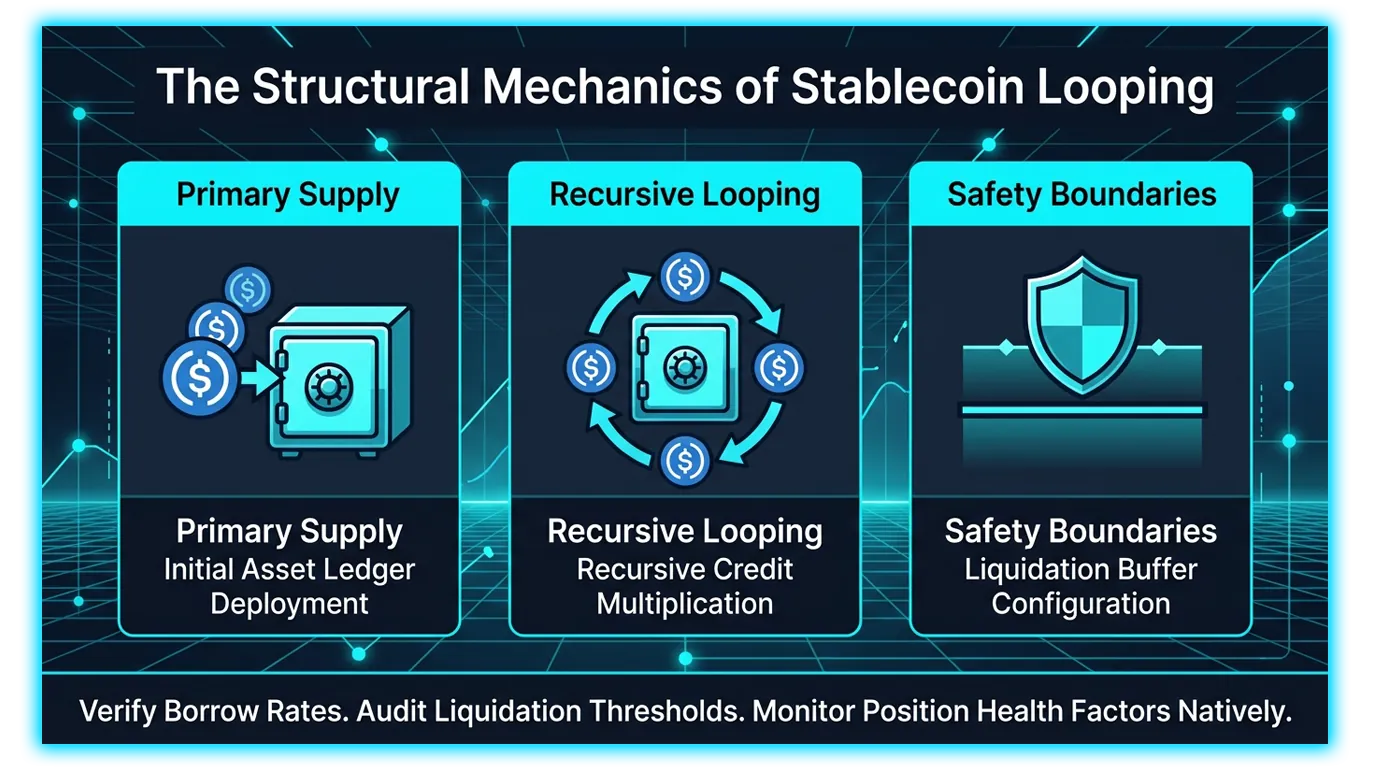
1. Core Architecture: The Recursive Supply and Borrow Framework
- At its structural layer, a looping strategy is a programmatic method of generating localized financial leverage straight inside a non-custodial money market.
- An investor constructs a credit multiplier by cycling capital through a repetitive implementation loop.This sequence represents a single "loop." By routing these steps manually or executing them atomically in a single block transaction using decentralized vault flash loans, an investor multiplies their total interest-earning collateral base far beyond their original out-of-pocket cash deposit.
2. Leverage Limits and the Principles of LTV
- The maximum scale of any credit loop is strictly dictated by a money market's Loan-to-Value (LTV) configuration. The LTV defines the maximum amount of debt a user can legally borrow against a specific collateral asset.
- To determine the theoretical maximum leverage multiplier achievable, you divide one by the difference between one and the Loan-to-Value ratio. In standard, multi-asset lending markets, stablecoin LTV factors are typically restricted to conservative thresholds to protect the protocol from volatile asset swings. However, modern money market protocols,including Aave’s Efficiency Mode (E-Mode) and Morpho V2’s isolated vaults, recognize that when the collateral asset and the borrowed asset are pegged to the same underlying currency, the risk of sudden price deviations is drastically minimized.
- Consequently, these networks elevate stablecoin-to-stablecoin LTV boundaries up to 90% or 95%. Under these optimized conditions, a ninety percent LTV ceiling mathematically allows a maximum leverage threshold of 10x your original principal capital, transforming a base four percent deposit yield into an amplified gross return before accounting for variable borrow fees.
3. Constructing a Bulletproof Liquidation Buffer
- While looping highly correlated assets mitigates standard directional market risk, executing at the absolute outer boundaries of a platform's leverage limits introduces severe vulnerabilities. A position's structural safety is measured in real-time by its Health Factor.
- The Health Factor represents the total value of your collateral multiplied by its specific liquidation threshold, divided by your total borrowed debt. If this health score drops below 1.0, an automated smart contract subroutine triggers an instant liquidation event, selling off a portion of your collateral at a discounted rate to clear the underlying debt.
- To execute a looping strategy safely, you must maintain an intentional Liquidation Buffer. Even though stablecoins strive to hold an exact dollar conversion parity, thin liquidity pools, oracle update latencies, or heavy centralized redemption flows can cause brief, transient micro-depegs where an asset trades momentarily below its target value on secondary markets.
- If you are operating a tight 10x loop with an optimized 95% liquidation threshold, a tiny 1.5% micro-depeg will instantly push your Health Factor below 1.0, triggering automated liquidations that permanently damage your principal capital. As a rule of thumb, conservative operators cap their active leverage around 4x to 5x to absorb temporary market pricing friction.
4. Stablecoin Real-World Execution Examples
Contemporary stablecoin loops generally focus on two primary implementation formats:
The Correlated Rate Loop (e.g., USDC / USDT on Morpho)
Traders deposit premium USDC into an isolated Morpho vault to borrow USDT, taking advantage of localized utilization imbalances where USDT borrow costs run lower than USDC deposit rewards. By looping this position 5x, investors compound the positive net interest margin safely.
The Passive Wrapper Stack (e.g., sUSDS / USDC on Aave)
Advanced strategies utilize structural yield-bearing stablecoins, such as Sky’s sUSDS or Ethena’s sUSDe (which cross-bounds delta-neutral basis trades). Users deposit sUSDS to capture its baseline organic savings rate, borrow vanilla USDC against it at a lower variable utilization rate, and loop the proceeds back into more sUSDS to build an amplified interest engine.
Shared Security Ecosystem Comparison
| Risk Parameter | Conservative Loop (3x - 4x) | Aggressive Loop (8x - 10x) |
| Typical Net APY | 8% - 12% variable | 18% - 25%+ volatile |
| Micro-Depeg Cushion | High (Absorbs ~5% swings) | Critical (Vulnerable to <1.5% moves) |
| Rate Inversion Risk | Low; easily wound down | High; requires active monitoring |
| Ideal Asset Pair | Blue-chip USDC / USDT lines | Yield wrappers (sUSDS, USDe) |
Universal On-Chain Forensics and Trading Telemetry via DEXTools
- Monitoring shifting borrow costs, evaluating underlying stablecoin asset concentrations, and tracking real-time de-peg parameters requires absolute data transparency. Utilizing advanced decentralized analytical and charting architectures like DEXTools gives market participants an essential universal engine to track live token behaviors, evaluate pool compositions, and inspect smart contract metrics across all public execution layers.
- By referencing independent forensic analytics through the Pair Explorer, technical allocators can check automated contract safety rankings, track massive institutional block reallocations via the Big Swap Explorer, and monitor shifting liquidity profiles inside decentralized exchange pools, providing the clear on-chain telemetry required to manage capital risk safely across the broader Web3 landscape.
Disclaimer: This article is for informational purposes only and does not constitute investment advice, financial advice, trading advice, or any other kind of advice. DEXTools does not recommend buying, selling, or holding any cryptocurrency or token. Users should conduct their own research and consult with a qualified financial advisor before making any investment decisions. Cryptocurrency investments are volatile and high-risk. DEXTools is not responsible for any losses incurred.
Related Guides
- What Is Leverage Trading in Crypto: Complete Guide for Beginners (2026)
- Top 5 Perpetual DEXs in 2026: Best Platforms for On-Chain Leverage Trading
- 10 Best Stablecoins 2026: Safety, Yields & Use Cases
- Where to Stake ETH: Top 2026 Platforms for High Yields
- Yield Farming Strategies, APY Quality and Risk Management (2026)