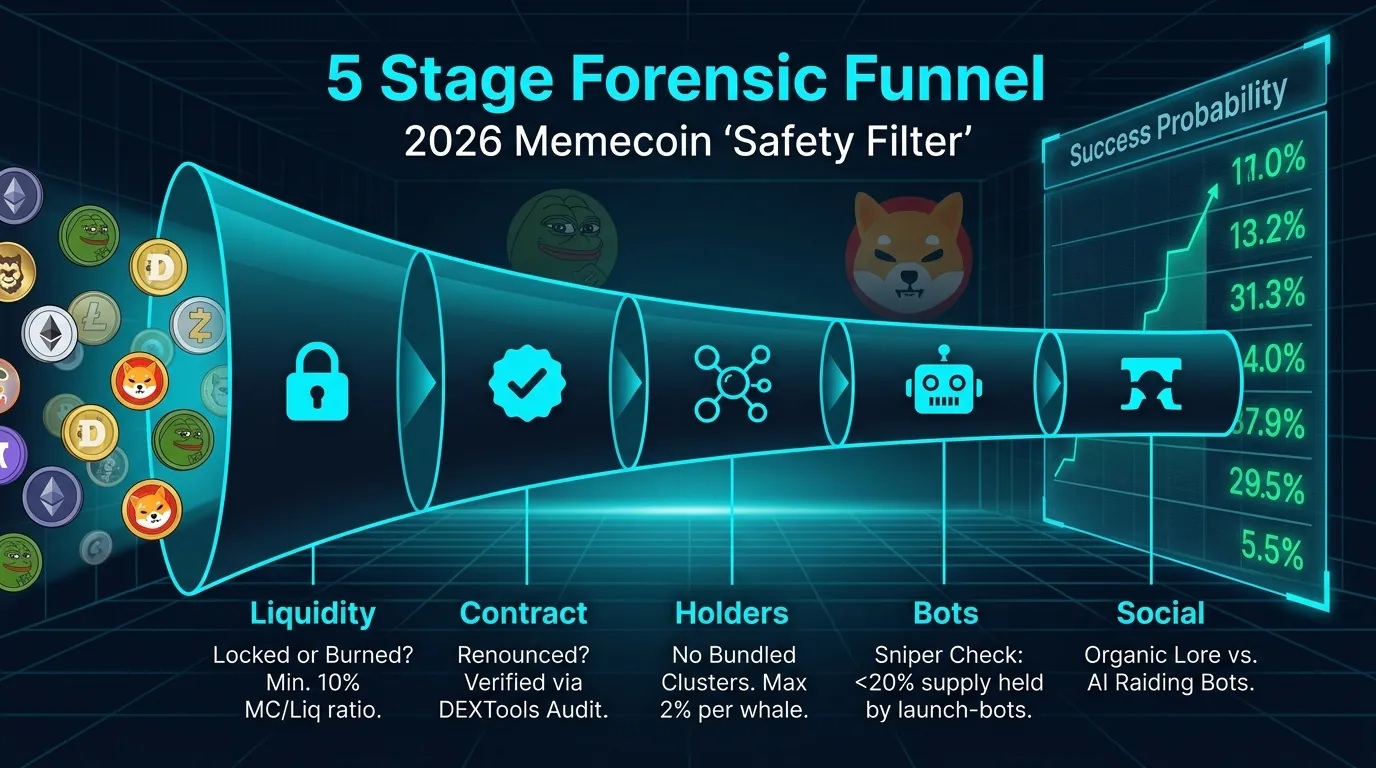
How to spot a good memecoin before it pumps: read on-chain forensics, identify whale bundles, and use key metrics to judge a token before buying in.
Agile Forensics: Identifying Memecoin Potential in the 2026 Market
As of May 14, 2026, the memecoin landscape has transitioned from "random viral imagery" to a sophisticated Attention and Game Theory Economy.
With the rise of the "AI Supercycle" and "Cult of Conviction" tokens, identifying a high-potential asset before a liquidity surge ("pump") requires more than just scrolling through social media. It requires on-chain forensic analysis.
In a market where autonomous AI agents manage their own marketing and retail users enter via biometric Smart Wallets on the Base network, the window to spot "Alpha" has shrunk to minutes. This guide provides a sober, probability-based framework for evaluating memecoin health using current 2026 standards.
1. Liquidity and Locked LP (The Floor)
Liquidity is the most critical metric with memecoins. Without sufficient liquidity, even a massive "pump" is impossible to exit. In 2026, we categorize liquidity into three risk tiers:
TON
Trading memecoins on TON? Not.Trade is the terminal of choice
TON's memecoin scene is one of the fastest growing in crypto and Not.Trade is the fastest terminal on TON for catching launches early. Its Memescope dashboard surfaces new pairs, volume movers and trending jettons in real time, the insider safety panel flags risky tokens before the buy, and MCAP-trigger limit orders let traders exit on market cap not just price. Multi-wallet sniping and MEV protection ship by default.
Burned LP: The LP tokens are sent to a "dead" address. This is the highest trust level as the liquidity can never be removed.
Locked LP (Long-term): Using protocols like Uncx or Team.Finance, liquidity is locked for months or years.
The "Thin Liquidity" Trap: In 2026, many "Agent-led" memes launch with very low liquidity to create artificial price spikes.
Forensic Tip: Check the Liquidity-to-Market-Cap Ratio. A healthy ratio is typically between 10% and 15%. If a coin has a $1M market cap but only $5,000 in liquidity, the slippage will make it impossible to sell during a volatile event.
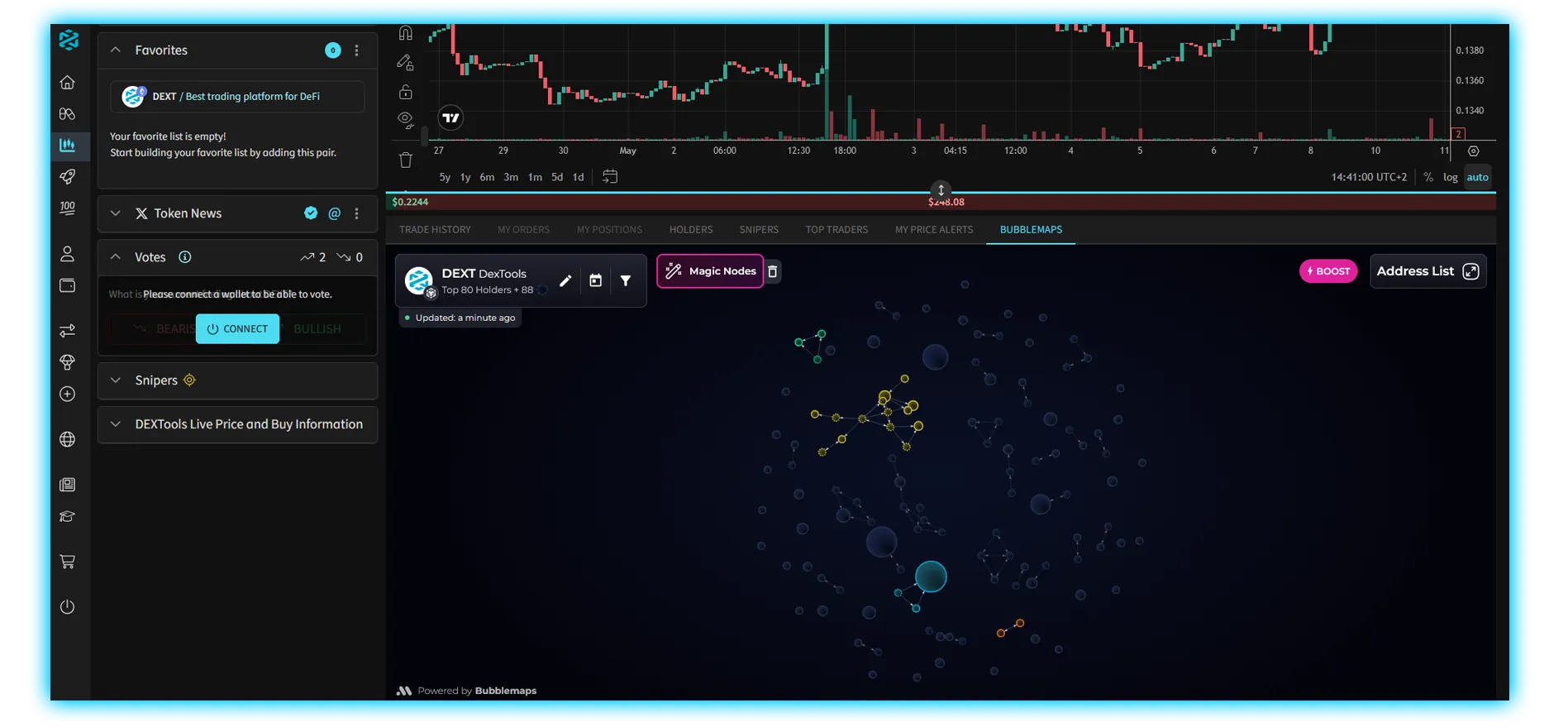
Bubblemaps in DEXTools2. Holder Distribution and "Bubble Maps"
Developers often hide their control by splitting tokens across hundreds of "sub-wallets." In 2026, high-risk launches exhibit a skewed accumulation pattern where the earliest buyers (often the dev) acquire a substantial portion of the supply using bundled accounts.
How to analyze distribution:
Top 10 Holders: No single entity (excluding the LP and CEXs) should hold more than 2-3% of the supply.
Bubble Map Clustering: Use 2026 visual tools to see if the top wallets are "interconnected" (receiving funds from the same source). If you see a "cluster" of 20 wallets that all bought at the same second, it is a Developer Bundle.
The "Cult" Metric: Look for "Dusting" patterns where thousands of small wallets hold the token, indicating organic community growth rather than whale dominance.
3. Dev Wallet and Sniper Forensics
The 2026 "MemeTrans" dataset has proven that the duration of a launchpad sale is a strong predictor of risk.High-risk launches tend to have shorter sale durations as bots and snipers "fill" the bonding curve instantly.
Sniper Saturation: Check the first 50 transactions. If they are all from Solana Sniper Bots or specialized AI-snipers, the token is likely "over-sniped." These bots will "dump" the moment the price hits a 2x or 3x, killing the momentum for manual traders.
Dev Activity: In the Voltaire/Base era, "Doxxed" devs often use AgentKit to prove they aren't just "Rug-bots." A dev who doesn't interact with the community or has a history of "Abandoned Contracts" on their wallet address is a significant red flag.
4. Social Momentum and "Lore" Strength
In 2026, social momentum is measured by Sentiment Integration rather than just "Follower Count."
Farcaster/Warpcast Sentiment: For Base-native memes, the Token-to-AI interaction sentiment is a leading indicator. Are users actually "tipping" $DEGEN or interacting with the meme's "Commandments"?
The "Cult of Conviction": Tokens that bridge digital speculation with physical identity (such as the "Gym-Fi" or "Leverage King" narratives) tend to have higher "diamond-hand" retention.
AI Lore Generation: Autonomous agents generate their own lore in real-time. If the AI agent is consistently gaining engagement and "Lore-bits" are being shared organically, the narrative is likely to sustain a pump.
Technical Trade-offs and Market Realities
Factor
Pros (The Upside)
Cons (The Risks)
Low Liquidity
Can lead to massive, parabolic price moves.
Extremely high slippage; susceptible to "Exit Scams."
Anonymous Dev
Allows for "pure" community lore (e.g., DOGE).
Zero accountability; high probability of rug pulls.
AI Management
24/7 marketing and automated buybacks.
AI "hallucinations" or bugs can cause flash crashes.
Social "Raiding"
Rapidly builds a "cult-like" following.
Often composed of "mercenary capital" that leaves instantly.
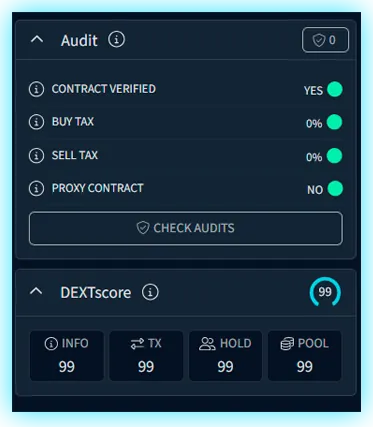
Audits and Score in DEXTools5. Verification via DEXTools
In the 2026 "Agentic Economy," DEXTools remains the industry standard.
Professional traders verify:
The DEXTscore (90+): A score below 90 on a 2026 launch is high-risk. The score now factors in "Sniper Concentration" and "Contract Renouncement."
Automated Audits: DEXTools provides a live view of the Audit Report. Check for "HoneyPot" checks and "Mint" functions.
Pool Explorer: Look for Liquidity Inflows. Are they small, organic buys from smart wallets, or large, suspicious "Flash-loan" buys?
To monitor the DeFi market in an agile and secure way in real-time and trade memecoins with the help of the best crypto tools, you can access DEXTools here.
Disclaimer: This article is for informational purposes only and does not constitute investment advice, financial advice, trading advice, or any other kind of advice. DEXTools does not recommend buying, selling, or holding any cryptocurrency or token. Users should conduct their own research and consult with a qualified financial advisor before making any investment decisions. Cryptocurrency investments are volatile and high-risk. DEXTools is not responsible for any losses incurred.
How do I know if a memecoin's liquidity is "truly" locked?
In 2026, always check the "Locker Contract" on DEXTools. If the liquidity is locked in a generic wallet, it can be "unlocked" by the dev at any time. Look for trusted third-party lockers like Uncx or Team.Finance.
What is a "Developer Bundle"?
It's a technique where a developer uses a script to buy their own token across dozens of different wallets at the exact moment of launch. This makes the "Holder Distribution" look decentralized when, in reality, one person controls 50% of the supply.
Why is Farcaster sentiment better than Twitter (X) followers?
In 2026, Twitter is heavily saturated with "Raiding Bots." Farcaster requires a "Warpcast" identity and often involves "Tipping" ($DEGEN), which requires actual capital. It is a much higher-fidelity signal of real human (or high-quality AI) interest.
Can a 2026 AI-agent meme "rug" me?
Yes. While the AI agent (like $SKYAI) might be autonomous, the smart contract permissions are often still held by a human developer. If the developer hasn't renounced the contract, they can "mint" new tokens or pull the liquidity regardless of what the AI "says" on social media.
What is the "sweet spot" for a DEXTscore?
For a new memecoin (less than 24 hours old), you want to see a DEXTscore above 90. Anything lower usually indicates a technical vulnerability, such as a high "buy tax" or a hidden "mint" function that could be used to dilute the supply.