Is Ethereum a Good Investment in 2026?

Analyze the factors shaping Ethereum’s value in 2026, including market trends, network upgrades, and its role as a leading digital asset in the crypto ecosystem.
A Deep Dive into the Post-Pectra Market
Ethereum is no longer just a playground for experimental decentralized apps; it is a global, institutional-grade settlement layer. However, as with any asset in the volatile digital economy, deciding if ETH is a "good buy right now" requires a careful look at the current fundamentals, the shifting competitive landscape, and the macro-economic environment of 2026.
The Value Proposition: Why ETH is an Institutional Favorite
- By April 2026, Ethereum has solidified its position as the "Triple Point" asset. It serves as a capital asset (through staking), a consumable asset (as gas for transactions), and a store of value (due to its deflationary burn mechanism).
- The primary driver for institutional interest in 2026 is the successful implementation of the Pectra upgrade. This update introduced EIP-7251, which increased the Maximum Effective Balance for validators from 32 ETH to 2,048 ETH.
- This allowed large banks and hedge funds to consolidate their staking operations, making it much easier for them to treat ETH as a high-yield digital bond. When you combine this with the spot ETH ETFs that have been trading for nearly two years, the "Should I buy ETH?" question for many large-scale investors has shifted to "How much should we allocate?"
Pros: The Arguments for Buying Ethereum Today
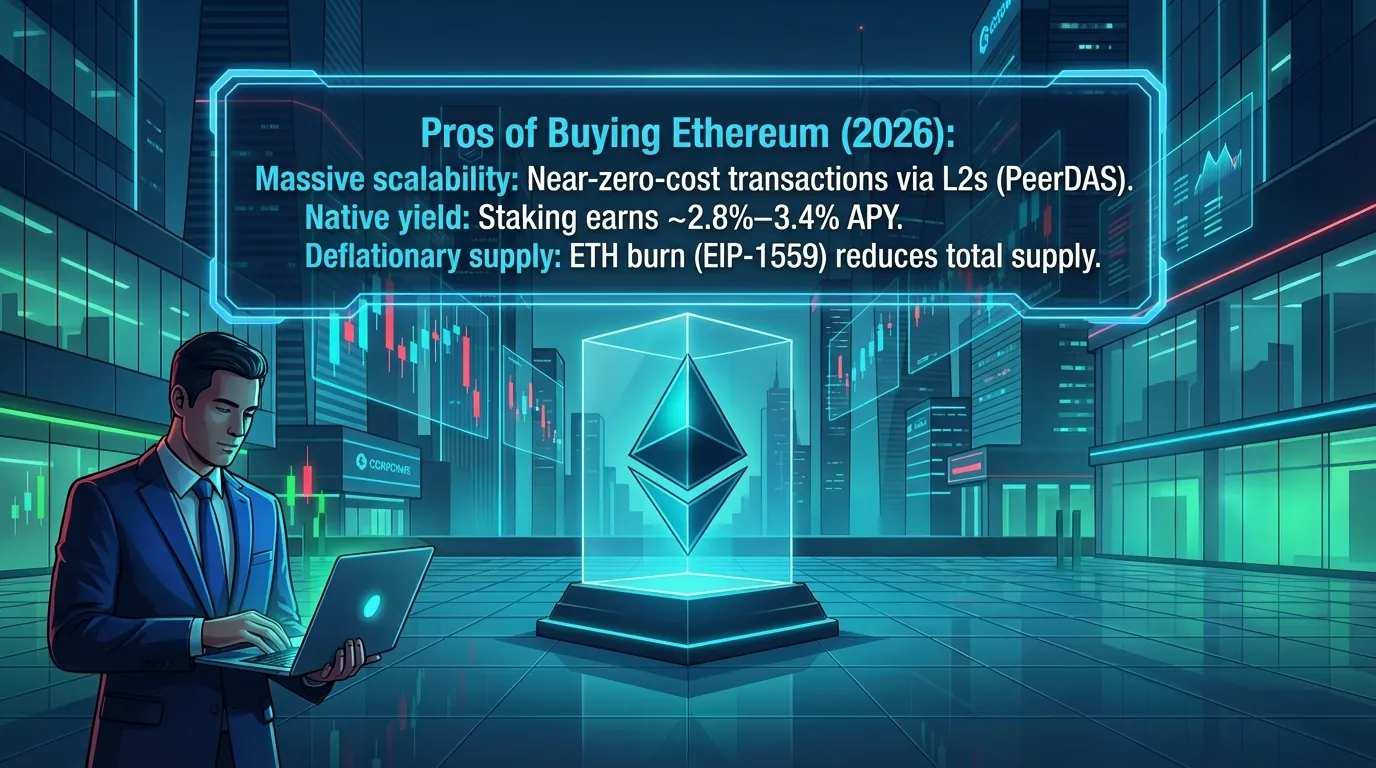
The bullish case for Ethereum in early 2026 rests on three pillars: scaling, yield, and scarcity.
1. Massive Scaling via PeerDAS
The Fusaka upgrade, completed in late 2025, introduced Peer Data Availability Sampling (PeerDAS). This technology has supercharged the network's ability to handle "blobs," which are specialized data spaces for Layer 2 (L2) networks like Base, Arbitrum, and Optimism. Consequently, while the Ethereum Mainnet remains the secure foundation, the cost of transacting on L2s has dropped to near-zero. This has brought millions of new users into the ecosystem without clogging the main chain.
2. Real Yield in a Digital World
Unlike many other digital assets, ETH offers a native yield. By staking your ETH, you currently earn approximately 2.8% to 3.4% APY. In a 2026 financial environment where investors are hungry for reliable returns that are not tied to traditional fiat inflation, this "internet bond" yield is a massive draw.
3. The Deflationary "Burn"
Thanks to EIP-1559, a portion of every transaction fee is destroyed. During periods of high network activity, more ETH is burned than is created, making the asset deflationary. This creates a constant upward pressure on price as the total supply of ETH continues to shrink.
Cons: The Risks of Investing in ETH
No investment is without its pitfalls, and Ethereum in 2026 faces significant challenges that any potential buyer must consider.
1. Competitive Pressure from "High-Speed" Monoliths
While Ethereum has won the modularity war, monolithic chains like Solana (powered by Firedancer) still compete fiercely for retail attention. Solana’s ultra-low latency and single-layer simplicity appeal to certain high-frequency trading and gaming sectors that find Ethereum’s multi-layered (L1/L2) approach too fragmented or complex.
2. Regulatory Uncertainty
Although ETH has gained significant clarity through the ETF approval process, global regulations regarding decentralized finance (DeFi) and liquid staking are still in flux. Any sudden crackdown on staking protocols or DeFi interfaces could lead to temporary price volatility.
3. Technical Complexity
The transition to a multi-layered ecosystem means that users must often "bridge" assets between different networks. For a new investor, the risk of sending funds to the wrong chain or interacting with a malicious smart contract remains a significant barrier to entry compared to traditional stock market investing.
Is ETH a Good Buy Right Now? Analyzing the Metrics
To determine if ETH is a "good buy" on April 10, 2026, professional traders often look at the ETH/BTC ratio and the Total Value Locked (TVL) in the ecosystem.
Currently, the TVL across Ethereum and its Layer 2s has reached all-time highs, signaling that the network is being used more than ever. If the price of ETH has not kept pace with this growth in usage, it may indicate that the asset is undervalued.
Example Scenario:
Suppose the price of ETH is currently $4,500. An investor looks at the data and sees that the amount of ETH burned last month was higher than the amount issued. Simultaneously, they see that a major global bank has just announced it will settle its internal cross-border payments on an Ethereum L2. For this investor, these fundamental growth signals suggest that ETH is a strong buy, regardless of short-term price fluctuations.
How to Invest: A 2026 Strategy
If you decide that Ethereum is a buy, there are three primary ways to enter the market in 2026:
Direct Spot Purchase: Buying the asset on a centralized exchange (CEX) like Coinbase or Kraken. This is the simplest method for beginners.
Liquid Staking Tokens (LSTs): Buying tokens like stETH or rETH. These represent staked ETH and allow you to earn the 3%+ yield automatically while keeping your funds liquid and tradable.
Exchange-Traded Products (ETPs/ETFs): For those who prefer to invest through a traditional brokerage account, ETH ETFs offer exposure without the need to manage digital keys.
The Role of Staking in Your Decision
One of the biggest factors in the "Should I buy ETH?" debate is your willingness to stake. In 2026, holding "naked" ETH (unstaked) is often seen as leaving money on the table. If you are a long-term investor, staking provides a "cushion" against price drops. If the price of ETH remains flat for a year, a staker still ends the year with 3% more ETH than they started with. This compounding effect is a powerful tool for building wealth in the digital age.
Summary of Key Points
Technological Edge: The Pectra and Fusaka upgrades have made Ethereum the most scalable and secure modular blockchain in 2026.
Institutional Demand: Spot ETFs and the increased 2,048 ETH validator limit have made ETH a staple in institutional portfolios.
Yield Potential: Staking provides a reliable 2.8% to 3.4% APY, acting as a "digital bond."
Deflationary Supply: The network burns a portion of fees, which can lead to a shrinking total supply during high usage.
Market Risks: Competition from monolithic chains and ongoing regulatory shifts remain the primary concerns for investors.
Investment Methods: Users can choose between centralized exchanges, liquid staking on decentralized platforms, or traditional ETFs.
Decision Factor: Whether ETH is a buy right now depends on your time horizon and your belief in the continued dominance of the modular blockchain roadmap.
Deciding whether Ethereum is the right investment for you requires a balance of market data and personal risk tolerance. As the network continues to evolve post-Pectra, staying informed with real-time analytics is the only way to trade with certainty.
To explore the Ethereum ecosystem further and find the best opportunities to trade or stake your assets securely, we invite you to use the Ethereum dashboard on DEXTools. It offers the most up-to-date market insights and contract security audits, helping you to trade safely in the 2026 digital economy. Monitor the trends and trade with confidence here.
Disclaimer: This article is for informational purposes only and does not constitute investment advice, financial advice, trading advice, or any other kind of advice. DEXTools does not recommend buying, selling, or holding any cryptocurrency or token. Users should conduct their own research and consult with a qualified financial advisor before making any investment decisions. Cryptocurrency investments are volatile and high-risk. DEXTools is not responsible for any losses incurred.
Related Guides
- Bitcoin vs Ethereum: Complete Investment Comparison 2026
- How to Spot a Good Memecoin Before It Pumps
- Bitcoin vs Gold: Store of Value Compared (2026)
- What Was the Ethereum Merge: Complete Retrospective Guide (2026)
- What Is viem: TypeScript Clients, Transports and Ethereum App Logic (2026)
Frequently Asked Questions
Is Ethereum a good investment in 2026?
As of April 2026, Ethereum has matured technologically and is seen as a strong investment due to its position as a 'Triple Point' asset, but potential investors should consider the current fundamentals and market conditions.
What are the benefits of investing in Ethereum?
The main benefits of investing in Ethereum include its massive scaling capabilities, the ability to earn yield through staking, and its deflationary nature due to the burning of transaction fees.
What risks should I consider before investing in Ethereum?
Investors should be aware of competitive pressures from other blockchains, regulatory uncertainties surrounding decentralized finance, and the technical complexities of navigating a multi-layered ecosystem.
How does Ethereum's staking work?
Ethereum allows users to stake their ETH, earning an annual percentage yield (APY) of approximately 2.8% to 3.4%, making it an attractive option for those seeking reliable returns.
What upgrades have impacted Ethereum's investment potential?
The Pectra and Fusaka upgrades have significantly enhanced Ethereum's scalability and institutional appeal, allowing for larger staking operations and improved transaction efficiency.