DEXTools for Crypto Journalists: How to Verify a Token Story Before Publishing
— By Whatsertrade in Tutorials

Crypto moves fast. A token can trend on social media, pump on-chain, and appear in dozens of conversations before anyone checks whether the story is real. For c
Crypto moves fast. A token can trend on social media, pump on-chain, and appear in dozens of conversations before anyone checks whether the story is real.
For crypto journalists, analysts, newsletter writers, and content creators, speed matters. But accuracy matters more.
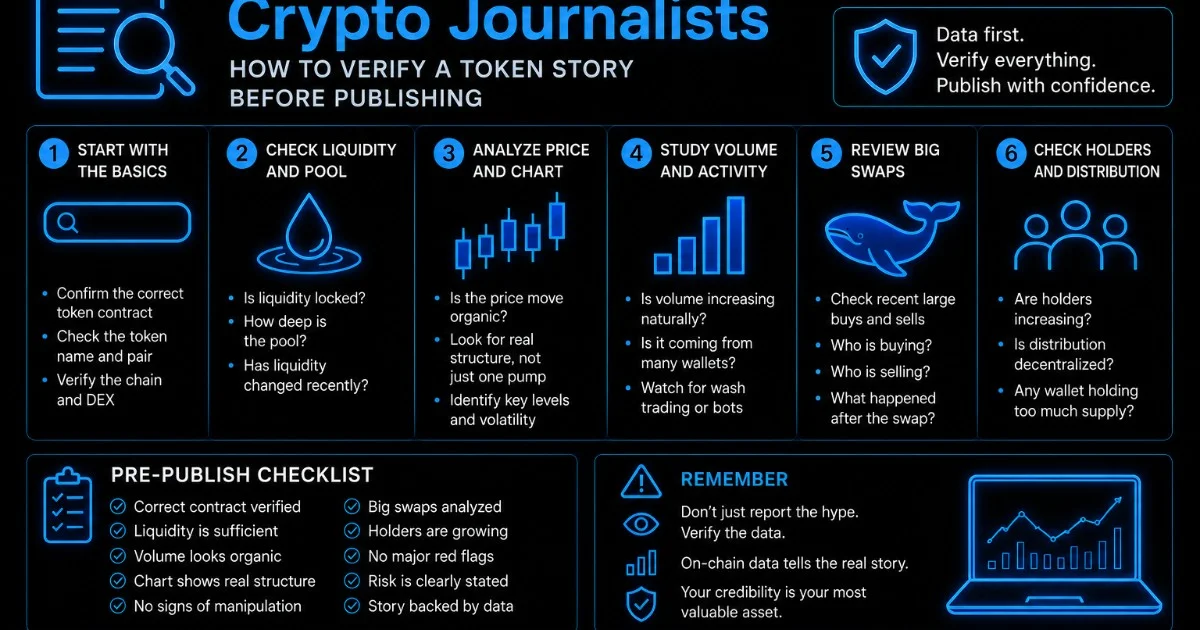
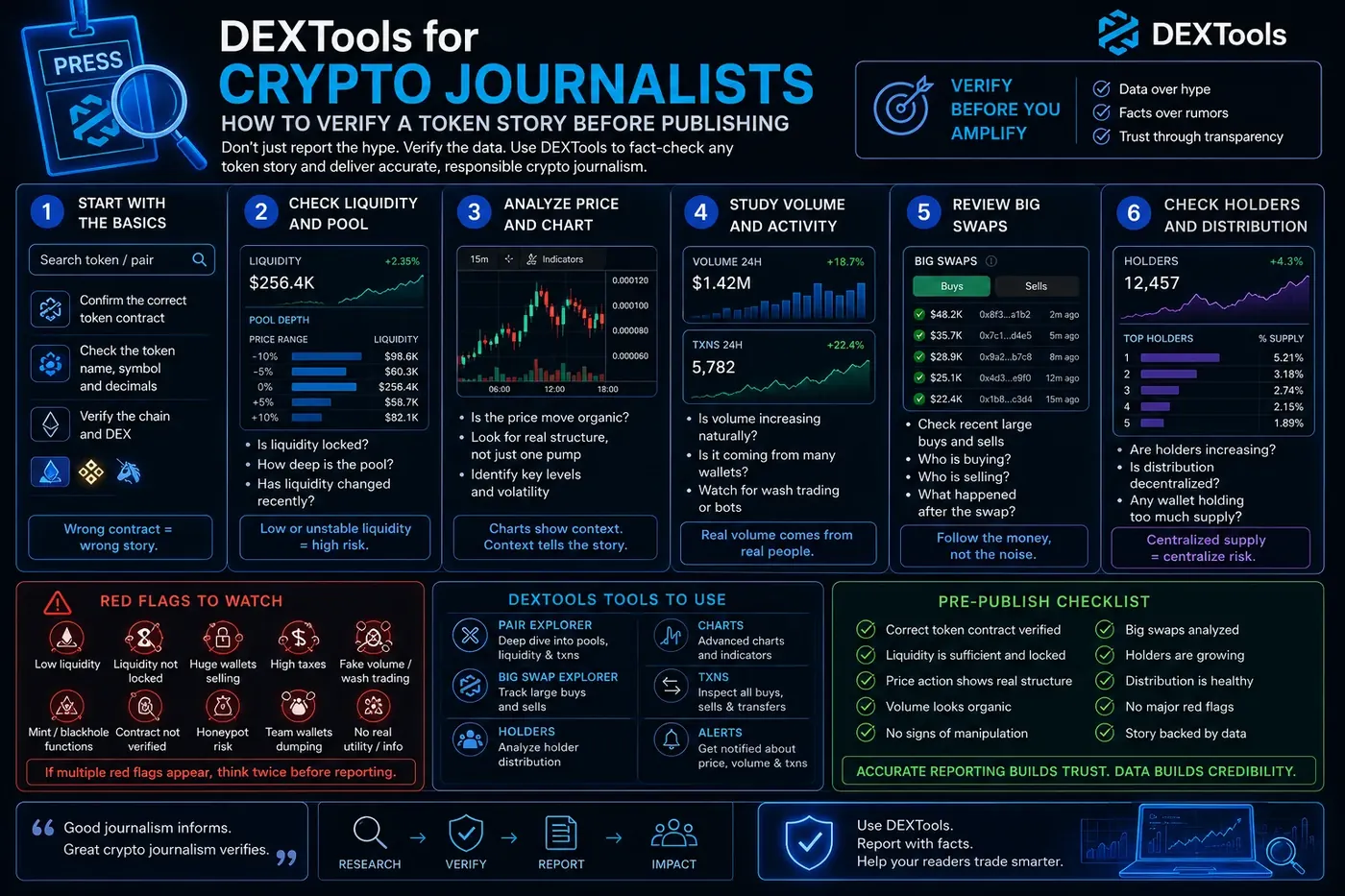
DEXTools can help writers verify token activity before publishing. Instead of relying only on social media claims, journalists can use real-time decentralized exchange data to understand what is actually happening in the market.
This guide explains how crypto writers can use DEXTools to research token stories with more confidence.
Why Token Stories Need Verification
Many crypto stories begin with a simple claim:
A token is pumping.
A whale is buying.
A new project is gaining traction.
A memecoin is going viral.
A community is forming around a narrative.
These claims may be true, partially true, or completely misleading. Social media can exaggerate market activity, and promotional posts often leave out important context.
Before writing about a token, journalists should verify the data behind the narrative.
Start With the Token Page
The token page on DEXTools can give writers a first view of price action, liquidity, volume, transactions, and market behavior.
Before publishing, check:
- Is the token actively trading?
- Has price moved recently?
- Is there enough liquidity?
- Is volume real or concentrated?
- Are buyers and sellers balanced?
- Does the chart support the story being told?
If an article says a token is gaining momentum, the chart and transaction activity should support that claim.
Check Liquidity Before Calling a Token Significant
A token may show a large price move, but that does not always mean it has meaningful market strength.
Low liquidity can make small trades look dramatic. A token can double in price with limited capital if the pool is thin. For journalists, this matters because a small move in a weak pool should not be framed the same way as strong market demand.
Before describing a token as surging, trending, or gaining traction, check whether liquidity supports the move.
A price increase with strong liquidity is more meaningful than a price increase in a tiny pool.
Look at Volume Quality
Volume is one of the most commonly reported metrics in crypto, but volume alone can be misleading.
A token may show high volume because many traders are buying and selling. It may also show high volume because a small group of wallets is creating repeated activity.
When researching a token story, compare volume with transaction patterns and holder behavior.
Healthy volume usually appears across multiple wallets and develops over time. Suspicious volume may appear suddenly, come from a small number of wallets, or disappear quickly after the token gets attention.
Watch Big Swaps Carefully
Large transactions can become headlines, but they require careful interpretation.
A big buy may suggest confidence. It may also be a strategic move to create attention before selling. A big sell may signal fear, but it may also be normal profit taking.
Journalists should avoid treating whale activity as automatic proof of a trend.
When covering big swaps, add context:
- Was the token already trending before the swap?
- Did the big swap move the price significantly?
- What happened after the transaction?
- Did other wallets follow organically?
- Did early holders sell into the move?
The transaction is the headline. The context is the story.
Compare Social Hype With On-Chain Reality
Many token narratives begin on social platforms. A community may claim that a project is exploding, but DEXTools can help verify whether the market agrees.
If a token is going viral online, check whether:
- Liquidity is increasing.
- Volume is rising naturally.
- The chart is holding key levels.
- New wallets are participating.
- Selling pressure is manageable.
If social hype is strong but on-chain activity is weak, the story should be written carefully.
A good article does not only repeat the narrative. It tests the narrative.
Avoid Overstating Market Moves
Crypto headlines often exaggerate. This can mislead readers and damage credibility.
Instead of writing that a token is “exploding” or “taking over DeFi,” use precise language based on observable data.
For example:
“Token X saw increased trading activity during the past session.”
“Token X recorded a sharp price move, although liquidity remains limited.”
“Large swaps contributed to short-term volatility.”
“Early trading data suggests growing attention, but the market remains highly speculative.”
This type of language is more accurate and more professional.
Build a Pre-Publishing Checklist
Before writing about a token, use this checklist:
- Confirm the correct token contract.
- Review the token chart on DEXTools.
- Check liquidity and pool depth.
- Review recent transactions.
- Look for large buys or sells.
- Compare volume with holder growth.
- Watch whether early wallets are selling.
- Check whether social hype matches trading data.
- Avoid making price predictions.
- Clearly describe risk and uncertainty.
This process can help writers avoid promoting weak or misleading narratives.
Why DEXTools Matters for Crypto Content
Crypto journalism is becoming more data-driven. Readers do not only want opinions. They want context, verification, and clear explanations.
DEXTools gives writers access to live decentralized exchange data that can strengthen articles, newsletters, reports, and market commentary.
Used properly, it can help journalists move beyond hype and write stories that reflect what is actually happening on-chain.
Final Thoughts
Crypto stories can move faster than the facts. That is why verification is essential.
DEXTools helps crypto journalists analyze token activity before publishing. By checking liquidity, volume, big swaps, chart structure, and transaction behavior, writers can avoid repeating misleading claims and produce stronger market coverage.
How to Check if a Token Can Actually Be Sold Before Buying (2026) How to Read Liquidity Pool Data Before Buying a Token (2026) How to Check Buy and Sell Tax Before Buying a Token (2026) Whale Buy or Exit Liquidity? How to Read Big Swaps Without Blindly Copying WhalesBeyond the Surface: Deconstructing Liquidity Pool Integrity
While DEXTools provides immediate insights into a token's liquidity, a truly diligent journalist understands that raw numbers alone do not tell the full story. The composition and stability of a token's liquidity pool (LP) are critical indicators of its long-term viability and the potential for manipulation. A deep dive into these aspects can reveal hidden risks or underlying strengths that a cursory glance might miss, protecting your publication's reputation and your readers' trust.
For instance, a seemingly large LP can be misleading if a significant portion of it consists of the project's native token or volatile assets. Such a setup makes the pool highly susceptible to impermanent loss and can be easily drained or manipulated by bad actors. Conversely, a pool primarily paired with stablecoins or established blue-chip cryptocurrencies suggests a more robust and resilient foundation, reflecting a project's commitment to stability.
Assessing LP Health and Risk Factors
- Examine the pairing asset: Is it a stablecoin (USDT, USDC), a major cryptocurrency (ETH, BNB), or another volatile, potentially illiquid token? Stablecoin pairings generally indicate lower risk.
- Check for LP lock status: Verify if the LP tokens are locked in a reputable locker. Unlocked LP tokens present an immediate rug-pull risk, as the developers can withdraw liquidity at any time.
- Analyze LP concentration: Identify if a few addresses hold a disproportionate amount of the LP tokens. High concentration can signal centralized control and potential for manipulation.
- Investigate LP history: Look for significant, sudden additions or removals of liquidity. Erratic movements can indicate instability or an attempt to inflate/deflate price.
- Consider LP token ownership: Determine if the LP tokens are held by a burn address, a multisig wallet, or a single developer address. Burned or securely managed LP tokens are preferable.
- Assess the ratio of LP to market cap: A very low LP relative to the token's market cap can make it highly volatile and susceptible to large price swings from even small trades.
Related Guides
- How to Verify Token Safety Before Buying: A Pre-Buy Crypto Checklist
- How to Verify a Token Contract Before Trading (2026)
- What Is Story Protocol (IP)? Programmable Intellectual Property L1 Guide 2026
- How to Verify a Smart Contract Onchain: Step-by-Step 2026
- Wallet Security Checklist: 10 Must-Do Steps Before Holding
Frequently Asked Questions
What is DEXTools and how does it help verify crypto token stories?
DEXTools is a blockchain data and trading platform. It provides real time data, charting tools, and analytics for various decentralized exchanges (DEXs). Journalists can use DEXTools to examine a token's liquidity, trading volume, holder distribution, and smart contract details to assess its legitimacy and potential risks.
How can I check a token's liquidity on DEXTools?
On DEXTools, navigate to the token's trading pair page. Look for the 'Liquidity' section, which displays the total value of assets locked in the token's liquidity pool. High liquidity generally indicates a more stable and less manipulable market, while low liquidity can signal a scam or illiquid asset.
What are common red flags to look for when analyzing a token on DEXTools?
Red flags include extremely low liquidity, a very small number of holders controlling a large percentage of the supply (whale concentration), sudden price spikes followed by crashes (pump and dump patterns), and a lack of verifiable information about the project team. Also, be wary of tokens with a 'honeypot' indicator, meaning you can buy but not sell.
How do I verify a token's smart contract details using DEXTools?
On the token's DEXTools page, you can often find a direct link to the smart contract on the respective blockchain explorer (e.g., Etherscan, BSCScan). Review the contract for unusual functions, such as the ability for the deployer to mint unlimited tokens, pause trading, or blacklist holders, which are common in scam tokens.