Compare the Real Cost of Crypto Swaps Before Trading
— By Whatsertrade in Tutorials

Crypto swaps come with hidden costs beyond just gas fees. Learn how to compare and optimize your swaps to ensure you're making cost-effective trades.
A lot of crypto traders think they know the cost of a swap because they can see the gas fee.
That is only part of the story.
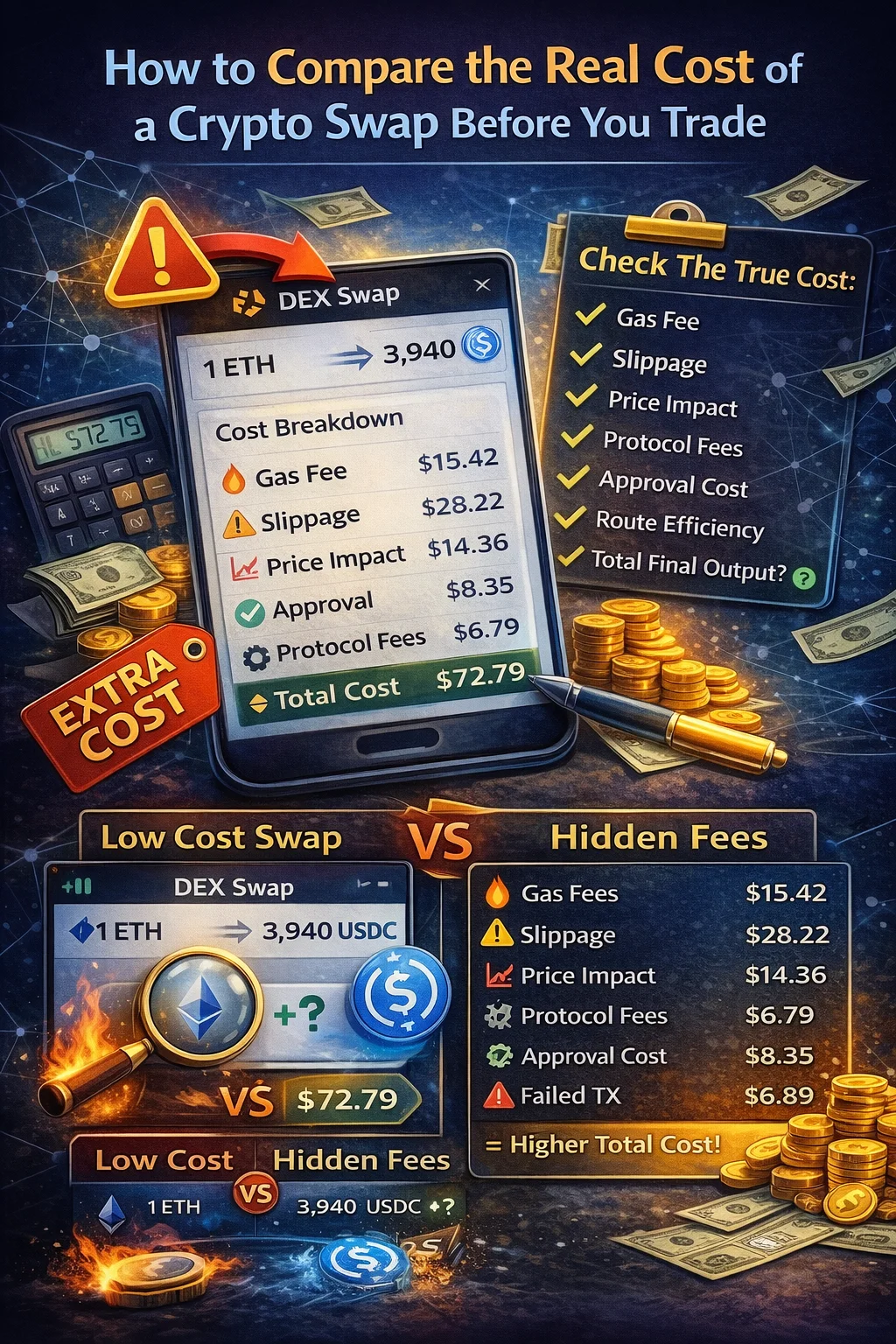
The real cost of a crypto swap includes much more than one visible number. It can include slippage, price impact, protocol fees, spread, failed transaction costs, approval costs, and even the hidden cost of trading into weak liquidity.
That is why two swaps of the same token can produce very different results, even if the input amount looks similar.
Learning how to compare the real cost of a crypto swap before you trade can save you money, help you avoid bad entries, and improve your overall execution.
In this guide, you will learn what the real cost of a crypto swap actually includes, how to compare swaps properly, and what to check before you hit confirm.
What Is the Real Cost of a Crypto Swap?
The real cost of a crypto swap is the total amount you lose to execute the trade, beyond the simple amount you intended to swap.
That total cost can include:
- gas fees
- slippage
- price impact
- protocol or platform fees
- approval transaction costs
- spread between expected and actual execution
- failed transaction costs
- hidden costs from poor liquidity
Most users only look at one piece of that puzzle. Smart traders compare the full picture.
Why the Displayed Rate Is Not the Full Story
A swap screen may show a token price or expected output, but that is not always what you will actually receive.
The displayed number often reflects ideal conditions before execution. Once the swap goes through, the final result can change because of liquidity depth, volatility, fee structure, and the route used to fill the trade.
That means the best looking quote is not always the cheapest trade.
A swap can look cheap at first and still cost more once all layers are included.
The Main Costs You Need to Compare
To understand the real cost of a crypto swap, you need to break the trade into parts.
1. Gas fees
Gas is the network fee paid to process the transaction.
Gas matters a lot because it affects every swap, especially on busy networks.
A small trade can become inefficient if the gas fee is too high relative to the size of the trade.
For example:
- a swap on Ethereum during congestion may be expensive
- the same type of swap on a lower cost chain may be much cheaper
- a multi step route may use more gas than a simpler route
Gas is usually the easiest cost to see, but it is not always the biggest one.
2. Slippage
Slippage is the difference between the expected price and the price you actually get when the trade executes.
Slippage increases when:
- liquidity is thin
- the market is moving fast
- the trade size is too large for the pool
- the token is volatile
- the slippage setting is too wide
A lot of traders focus on gas and ignore slippage, even though slippage can cost much more than the network fee.
3. Price impact
Price impact is the effect your own trade has on the market price.
This matters most in smaller pools or illiquid tokens.
If your order is large compared with available liquidity, your trade pushes the price against you during execution.
That means the swap itself becomes more expensive because of your size.
Price impact is especially important when trading:
- meme coins
- fresh launches
- long tail tokens
- pairs with low liquidity
- pools with weak depth
4. Protocol fees
Many platforms charge a built in swap fee.
This may come from:
- the liquidity pool
- the DEX
- the aggregator
- the route used to complete the swap
A platform can have low gas but higher internal fees. Another can have better routing but charge more for convenience.
That is why comparing only the interface is not enough.
5. Approval costs
Before swapping some tokens, you may need to approve the token first.
That approval is a separate on chain transaction and usually costs gas.
If this is your first time trading that token on that platform, the real cost of the swap may include:
- approval gas cost
- swap gas cost
For small trades, this can make a major difference.
6. Failed transaction cost
Sometimes a swap fails because:
- slippage tolerance was too low
- gas settings were poor
- the market moved too fast
- the route became invalid
- the token had unstable liquidity
If the transaction fails, you may still lose gas.
That cost is often ignored when traders estimate execution.
7. Spread and routing inefficiency
In some cases, the best swap route is not the most obvious one.
A weak route can result in:
- worse execution
- higher price impact
- more fees
- lower final output
This matters when comparing a direct swap against a routed swap through one or more intermediary assets.
The route affects the real cost more than many beginners realize.
Why Small Trades and Large Trades Need Different Thinking
The real cost of a crypto swap changes depending on trade size.
Small trades
For smaller swaps, gas and approvals often matter most. A trade may not be worth making if the fixed cost is too high.
Large trades
For larger swaps, price impact and slippage often matter more. Even if gas looks reasonable, bad liquidity can make the trade very expensive.
That means a good setup for a small swap may be terrible for a large one.
How to Compare the Real Cost of a Crypto Swap Step by Step
The best way to compare swaps is to slow down and review the full cost before confirming.
Step 1: Check the network fee
Start with the visible gas cost.
Ask:
- how expensive is the network right now
- is the gas high relative to the trade size
- would a later time or another chain reduce cost
This gives you the baseline cost, not the total cost.
Step 2: Check the expected output
Look at how much of the token you are expected to receive.
Then compare this across platforms or routes.
Do not stop at the first quote.
Step 3: Check slippage tolerance
Look at the slippage setting and ask whether it makes sense for the token and market conditions.
A higher slippage setting may increase the chance the swap goes through, but it also gives more room for worse execution.
A lower slippage setting may protect price, but it can also lead to a failed transaction.
The right balance depends on the asset and the market.
Step 4: Check price impact
If the interface shows price impact, pay close attention.
High price impact is a warning sign that:
- liquidity may be weak
- your size may be too large
- execution may be much worse than expected
If price impact looks high, consider reducing size or splitting the trade.
Step 5: Check whether approval is required
If approval is needed, include that cost in your comparison.
A swap with a good quote may still be more expensive overall if it requires an approval and another platform does not.
Step 6: Compare routes, not just platforms
Sometimes the difference is not the platform itself but the route used.
Check whether:
- the trade is direct
- the swap uses one hop or several
- the route passes through a major liquid asset
- the route increases fees or price impact
Better routing can materially reduce total cost.
Step 7: Compare the final effective cost
At the end, ask the only question that matters:
After all visible and hidden costs, where do I actually get the best execution?
That is the real comparison.
A Simple Formula to Think About Swap Cost
You can think about the real cost of a crypto swap like this:
Real swap cost = gas + approvals + slippage + price impact + protocol fees + failed transaction risk
You do not need to calculate it with perfect mathematical precision every time. But you do need to think through each part before trading.
Common Mistakes When Comparing Crypto Swaps
A lot of users lose money on swaps because they compare the wrong things.
Looking only at gas
A trade with lower gas can still be worse if slippage and price impact are much higher.
Ignoring approval cost
This matters a lot for first time swaps, especially on smaller trade sizes.
Using too much size in one trade
A large trade through weak liquidity can create expensive price impact.
Accepting a wide slippage setting without noticing
This increases execution risk and can make you receive less than expected.
Not comparing final output
The best looking interface is not always the cheapest route.
Trading during unstable conditions
Fast moving markets can make execution much worse than the quote you first saw.
How to Lower the Real Cost of a Crypto Swap
Once you understand where the cost comes from, you can improve execution.
Trade when network activity is calmer
This can reduce gas.
Use liquid pairs
Higher liquidity usually means lower price impact and better execution.
Avoid oversized orders
Split the trade if needed.
Compare routes before confirming
A better route can reduce slippage and improve output.
Be careful with volatile tokens
Fast moving assets create bigger execution gaps.
Watch approval requirements
For small trades, the approval cost may make the swap inefficient.
Use realistic slippage settings
Too high is risky. Too low can cause failure. Choose based on the asset and conditions.
When a Swap Is Not Worth Taking
Sometimes the smartest trade is no trade.
A swap may not be worth taking when:
- gas is too high relative to trade size
- price impact is too large
- slippage risk is elevated
- liquidity is too weak
- approval cost makes the trade inefficient
- the route is too complex
- the market is moving too fast to estimate execution well
Skipping a bad trade is part of good trading.
Real Cost Example in Simple Terms
Imagine you want to swap into a token and you see what looks like a good quote.
At first glance, it seems cheap.
But then you notice:
- gas fee is higher than expected
- approval is required
- price impact is moderate
- slippage setting is wide
- the route uses multiple hops
Suddenly the trade is no longer as cheap as it looked.
That is exactly why comparing the real cost of a crypto swap matters. The visible rate is only one layer.
Best Habits Before Every Swap
Build these habits into your trading process:
- check the full network cost
- compare expected output across routes
- review slippage carefully
- watch price impact
- include approval cost
- avoid rushing in volatile conditions
- think in total cost, not just visible fee
These small habits can improve results over time.
Final Thoughts
Learning how to compare the real cost of a crypto swap before you trade is one of the most useful habits in crypto.
Gas is important, but it is only one part of the execution cost. Slippage, price impact, protocol fees, approvals, and route quality all affect what you actually receive.
That means the cheapest looking trade is not always the cheapest real trade.
The goal is not just to make swaps. The goal is to make efficient swaps.
When you start comparing the full cost instead of the visible headline number, you trade with more clarity, lose less to avoidable inefficiency, and make better decisions before every swap.
FAQ
What is the real cost of a crypto swap?
The real cost of a crypto swap is the total cost of execution, including gas, slippage, price impact, protocol fees, approval costs, and other hidden trading costs.
Is gas the biggest cost in a swap?
Not always. In many cases, slippage or price impact can cost more than gas.
Why is price impact important?
Price impact shows how much your own trade moves the market against you, especially in low liquidity pools.
What is the difference between slippage and price impact?
Slippage is the difference between expected and actual execution. Price impact is the effect your order size has on the market price.
Why do some swaps cost more than expected?
They may include hidden costs such as high slippage, weak routing, approval transactions, or poor liquidity.
Should I include approval cost when comparing swaps?
Yes. Approval cost is part of the real cost, especially for first time token swaps.
How can I reduce the real cost of a crypto swap?
You can lower cost by trading during calmer network conditions, using more liquid pairs, comparing routes, avoiding oversized orders, and using smart slippage settings.
How to Bridge Crypto Between Chains: Complete Cross-Chain Tutorial 2026 How to Use 1inch: Complete DEX Aggregator Swap Tutorial (2026) How to Use OKX Web3 Wallet: Complete Multi-Chain Wallet Tutorial (2026)Frequently Asked Questions
What is the real cost of crypto swaps?
The real cost of crypto swaps includes trading fees, network fees (gas fees), and potential slippage. These can vary significantly between platforms.
How do trading fees impact the cost?
Trading fees are typically a percentage of the transaction value charged by the exchange or platform. Higher trading fees directly increase the overall cost of a swap.
What are network fees in crypto swaps?
Network fees, also known as gas fees, are paid to miners or validators to process and secure transactions on a blockchain. These fees fluctuate based on network congestion.
What is slippage and how does it affect cost?
Slippage occurs when the price of an asset changes between the time an order is placed and executed. It can result in receiving fewer tokens than expected, increasing the effective cost.
How can I minimize the cost of crypto swaps?
To minimize costs, compare trading fees across different platforms, monitor network fees to trade during less congested times, and use limit orders to mitigate slippage.
Related Guides
- What Is an Atomic Swap? How Cross-Chain Swaps Work
- How to Trade on Raydium: Solana Swaps, Entries and Execution Guide (2026)
- How to Verify a Token Contract Before Trading (2026)
- How to Analyze Solana Meme Coins Before Trading: On-Chain Risk Checklist (2026)
- Kaito vs Cookie.fun vs LunarCrush: Which Crypto Analytics Tool Is Best?