What Is OKB? The OKX Exchange Token Powering X Layer Explained in 2026
— By Tony Rabbit in Tutorials
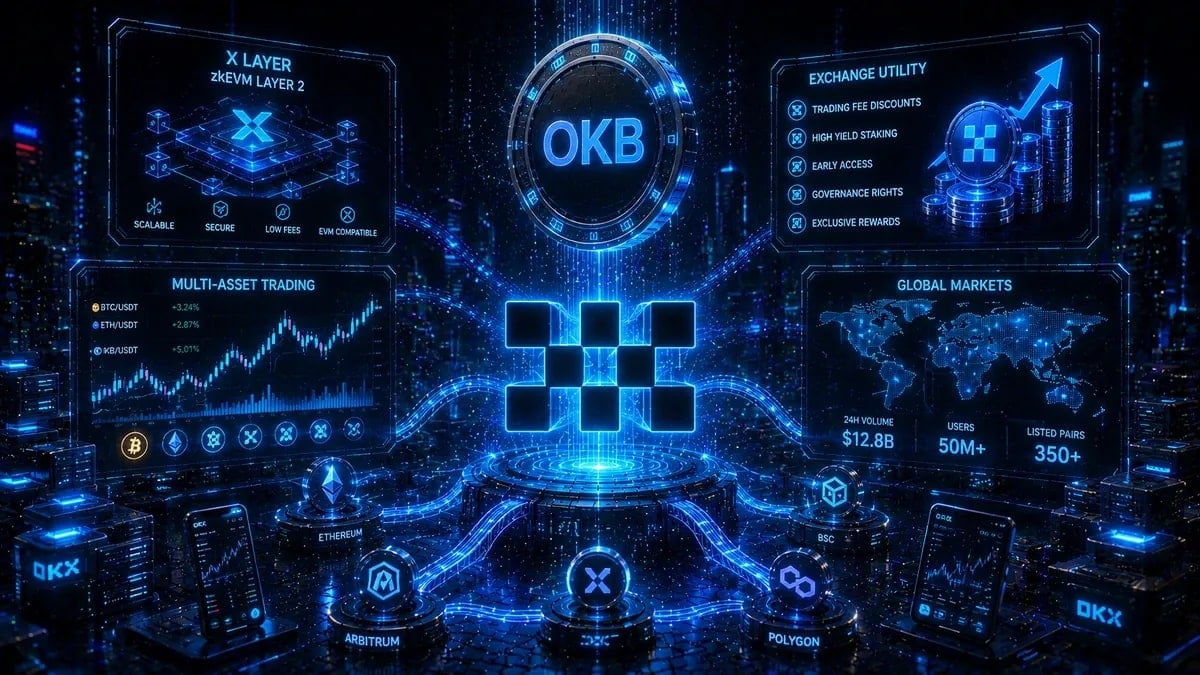
Complete 2026 guide to OKB, the OKX exchange utility token. Covers Star Xu's founding story, the historic 2024 burn that cut supply to 21 million, X Layer Polygon CDK zkEVM gas utility, OKX Jumpstart IEO allocations, OKB Chain to X Layer migration, fee tier discounts, OKX Wallet and DEX aggregator integration, comparison vs BNB, BGB, HT and CRO, 2022 US exit and the real risks holders should price in.
What Is OKB? The OKX Exchange Token Powering X Layer Explained in 2026
Most people meet OKB the same way. They open the OKX app, notice a different ticker pinned at the top of the asset list, and wonder why the exchange keeps showing it to them. The short answer is that OKB is the keystone of an economy OKX has been building since 2017. In 2026 it sits at the intersection of three stories: an exchange utility token that pays fee discounts, a gas token for a Polygon CDK zkEVM Layer 2 called X Layer, and the asset behind one of the largest supply burns in centralized exchange history.
If you have followed BNB on Binance, BGB on Bitget, HT on Huobi or CRO on Crypto.com, you already understand the shape of the OKB thesis. Exchange tokens turn the flywheel of platform usage into something holders can capture through fee rebates, burns, IEO access and expanding utility. What makes OKB unusually interesting is the combination of an aggressive monetary policy, a real Layer 2 rollup that uses OKB as gas, and a regulatory posture that pulled out of the United States in 2022 and then refused to look back.
This guide walks you through every angle of OKB. Where the token came from, who Star Xu is, what the 2024 historic burn actually did to circulating supply, how X Layer evolved out of the original OKB Chain, what the fee tier table really looks like, how OKB stacks up against BNB and the rest of the exchange-token cohort, and the honest list of risks before you click buy.
FEATURED SNIPPET
OKB is the utility token of OKX, one of the largest cryptocurrency exchanges in the world. Launched in 2017 by OKX founder Star Xu, OKB is an ERC-20 asset that is also native to X Layer, the Polygon CDK powered zkEVM Layer 2 formerly known as OKB Chain. Holders use OKB for trading fee discounts, OKX Jumpstart IEO allocations, OKX wallet and DEX aggregator features, X Layer gas, and governance. In a historic move in early 2024, OKX permanently burned around 65 million OKB, reducing the maximum supply to roughly 21 million tokens. OKB is not available to US persons after OKX exited the US market in 2022.
What Is OKB in Plain English
Strip away the jargon and OKB is two things at once. It is a centralized exchange utility token, similar to BNB on Binance, that lowers your trading fees, unlocks early access to token launches and gives loyalty perks. It is also a Layer 2 gas token. When OKX launched the original OKB Chain in 2022 and later rebranded and re-architected it into X Layer using Polygon's chain development kit in 2024, OKB became the native asset users pay to send transactions, deploy contracts and bridge assets across the zkEVM rollup. Most exchange tokens stop at the fee discount. OKB pushes through into being actual on-chain gas for an L2 with real liquidity.
The other piece worth absorbing up front is the supply story. OKB followed the standard buy-and-burn playbook for years, with quarterly burns funded from OKX revenues. Then in early 2024 OKX did something nobody else in the category had done at that scale. It burned the entire unissued allocation, taking the maximum supply from roughly 300 million OKB down to about 21 million OKB in a single transaction. That move repriced OKB overnight and changed how the market thinks about its scarcity.
OKB is exactly what it looks like, an exchange-aligned token with utility that grows whenever OKX adds a new product. The serious question is whether OKB can hold its value during the slow periods between catalysts, and whether the regulatory and concentration risks priced in today are accurate. That is what the rest of this article unpacks.
OKX Exchange: Where OKB Lives and Why That Matters
You cannot understand OKB without first understanding OKX. The exchange was founded as OKCoin in 2014 in Beijing. After the 2017 Chinese ICO ban pushed operators offshore, the team rebranded the international arm as OKEx with offshore headquarters. In 2022 the company simplified to OKX, dropping the EX suffix. Today OKX serves more than fifty million registered users across spot, derivatives, copy trading, earn products, NFT marketplace, a self-custody wallet and a multi-chain DEX aggregator.
OKX has consistently ranked in the global top five exchanges by spot volume and top three by derivatives open interest. That distribution is the most important context for OKB. The funnel is simple. Spot and derivatives fees generate revenue. A portion of that revenue is used to buy OKB on the open market and burn it. As supply shrinks against a stable or growing user base, each remaining OKB has a proportionally larger claim on the platform's utility surface.
The exchange runs an unusually broad product portfolio. OKX Wallet is a self-custody mobile and browser extension that supports more than seventy chains, including Bitcoin, Ethereum, Solana, BNB Chain, Polygon, Arbitrum, Base, TON and X Layer itself. OKX DEX is a multi-chain aggregator that routes orders across hundreds of liquidity pools. OKX Jumpstart is an IEO platform that gives OKB holders priority allocation in vetted new token sales. All three plug into OKB, which is what makes the token a genuine utility asset.
Star Xu and the Founding of OKX
OKX was founded by Mingxing Xu, who goes by Star Xu in English-language materials. He launched OKCoin in 2014 after working in Chinese internet companies and seeing how Bitcoin trading was scaling in Asia. Xu has kept a low public profile, but the OKX product organization carries his fingerprints in its rapid iteration cycle. The exchange shipped a unified trading account before most peers, launched a self-custody wallet years before rivals followed, and committed to a full Layer 2 build with X Layer rather than relying on a partner chain.
Xu has talked publicly about wanting OKX to be both a centralized gateway and a Web3 infrastructure provider. OKB is the bridge between those two worlds. On the centralized side it functions as a loyalty and fee instrument. On the Web3 side it is a gas asset and governance unit for X Layer. OKB is not a securities-style claim on OKX itself, and OKX has been careful to frame it as a utility asset throughout its lifecycle.
OKX has weathered operational stress events that exchanges only get tested on once a cycle. In late 2020 the exchange paused withdrawals temporarily after a multi-signature key holder became unavailable, an event resolved without user losses. In the aftermath OKX moved aggressively on proof-of-reserves attestations, becoming one of the earliest large exchanges to publish on-chain Merkle-tree proofs. That history matters because OKB's utility floor depends on the exchange remaining solvent and operational.
OKB Timeline: From 2017 Launch to 2026 X Layer Era
The OKB story spans a decade of crypto cycles, regulatory shifts and product pivots. Mapping it out makes the 2024 historic burn and the X Layer migration feel less like sudden moves and more like the inevitable result of pressure that had been building for years.
Star Xu founds OKCoin in Beijing as a spot exchange focused on the Chinese Bitcoin market. The company becomes one of the early large Asian crypto venues alongside Huobi and BTCC.
China bans ICOs and pressures exchanges. The international arm reorganizes as OKEx with offshore headquarters and launches OKB as an ERC-20 utility token to anchor the new exchange ecosystem and pay fee discounts.
First buy-and-burn cycle begins. OKEx commits a portion of spot trading fees to quarterly OKB burns, modeled loosely on the BNB tokenomics that Binance had introduced the previous year.
A temporary withdrawal pause exposes operational risk around private-key custody. The team responds by accelerating proof-of-reserves and key management upgrades that become industry templates.
OKEx rebrands to OKX and exits the US market entirely, citing regulatory clarity concerns. American users are offboarded, and OKB becomes unavailable to US persons. The original OKC EVM chain begins evolving into what will eventually become X Layer.
OKX executes a historic burn, removing the entire unissued OKB allocation and dropping the maximum supply from roughly 300 million to approximately 21 million tokens. The market reprices OKB on the news and the token reaches new all-time highs.
X Layer mainnet launches as a Polygon CDK powered zkEVM Layer 2, with OKB as the native gas token. The new rollup replaces the legacy OKB Chain and inherits its bridges and dApp ecosystem over a structured migration window.
OKX DEX aggregator and OKX Wallet integrate X Layer natively, giving OKB holders one-tap access to bridging, swapping and yield strategies across the new L2. Total value locked on X Layer climbs into the hundreds of millions.
OKB governance authority migrates progressively to X Layer, with on-chain voting beginning for fee parameters, validator selection and treasury allocation across the rollup ecosystem.
OKB stands as a top-tier exchange token with one of the tightest float profiles in the category, deep integration across OKX centralized and Web3 products, and a maturing X Layer ecosystem powered by Polygon CDK and aggLayer interoperability.

OKB Utility Tier Benefits on OKX
The clearest reason to hold OKB if you actively trade on OKX is the tiered utility ladder. Holding more OKB and locking it for longer time horizons unlocks better fee rates, higher Jumpstart allocations and a deeper suite of Web3 perks. The three big buckets users care about most are trading fee discounts on spot and derivatives, priority allocation in OKX Jumpstart IEO sales, and bonus rates on OKX Earn yield products. The tier system is meant to reward sticky users and align the most active traders with the long-term success of the platform.
Fee Discounts
Active traders who hold OKB on OKX receive automatic spot and derivatives maker and taker fee discounts that scale with tier. Combined with VIP volume tiers, the savings can compound into a material rebate for high-turnover desks and copy-trading leaders.
Jumpstart Allocation
OKX Jumpstart IEO sales allocate tokens to participants based on a snapshot of their OKB holdings during a fixed pre-sale window. Larger and longer-held OKB balances receive proportionally larger allocations in each launch.
Web3 Perks
OKB holders get fee waivers and routing priority on the OKX DEX aggregator, gas sponsorships on X Layer for select transactions, and bonus yield rates on OKX Earn products that pair OKB with stablecoins or major Layer 1 assets.
The exact percentage discounts and Jumpstart formulas are adjusted by OKX periodically, so anyone optimizing seriously should check the official fee schedule before committing capital. The point of the tier structure for OKB holders is not the absolute number, it is the direction. Every time OKX adds a new product, OKB tends to receive a utility hook into it, which is the slow compounding mechanism that makes a long-term hold thesis plausible. Holders who simply trade and never lock OKB still capture the fee discount, but the multi-year compounders tend to be users who lock OKB for the higher tiers and harvest both the discount and the Jumpstart upside together.
The Buy-and-Burn Tokenomics Engine
Buy-and-burn is the headline mechanism that makes OKB structurally interesting. The model is simple. OKX takes a defined portion of its spot trading fee revenue, uses it to buy OKB on the open market every quarter, and permanently sends the purchased tokens to a burn address no human controls. The supply that started at the 2017 launch allocation has been ticking downward ever since.
In economic terms this is not a dividend. OKB does not distribute cash. The buy-and-burn shrinks the denominator. If you hold the same number of OKB while total supply falls, your percentage ownership of the network rises. In strong cycles OKB tends to outperform the buy-and-burn pace because demand catalysts (X Layer growth, Jumpstart launches, volume surges) stack on top of supply pressure. In quiet markets the burn provides a slow base rate of support other exchange tokens without the mechanism do not have.
What changed everything in early 2024 was that OKX took an axe to the unissued portion of supply. The original schedule allocated roughly 300 million OKB across various buckets, with hundreds of millions still locked years after launch. Rather than continue the drip-burn, the team executed a single transaction that destroyed the entire unissued allocation. Roughly 65 million OKB went up in one on-chain event, and the maximum supply was redefined at approximately 21 million tokens. That turned OKB from a token with a long supply emission tail into something closer to a hard-capped scarce asset.
The market reaction was immediate. OKB repriced sharply on the news. For long-term holders the burn was a clean signal that OKX was willing to give up future flexibility for tighter scarcity. For new buyers it meant the price they paid was being measured against a much smaller denominator than the headline number from a year earlier.
X Layer: From OKB Chain to Polygon CDK zkEVM
X Layer is where OKB stops being a pure exchange token and starts being a real Layer 2 asset. The lineage is worth tracing because the names changed several times. In 2020 OKEx launched OKChain, a Tendermint-based independent chain. In 2022 the team pivoted to EVM compatibility with what became OKB Chain or OKC. By late 2023 the limits of the standalone chain model were obvious. Liquidity was fragmenting across hundreds of chains, and the strongest Ethereum scaling narrative had shifted decisively toward zero-knowledge rollups settling back to mainnet.
OKX responded by partnering with Polygon Labs to rebuild the chain as a zkEVM Layer 2 using the Polygon Chain Development Kit. The new rollup was branded X Layer and launched on mainnet in April 2024. X Layer is a zkEVM that posts validity proofs back to Ethereum, inheriting mainnet security while offering low fees and high throughput. Because it is built on Polygon CDK, X Layer can interoperate with other CDK chains through the aggLayer interoperability framework. The Polygon POL, CDK and aggLayer explainer goes deeper on the underlying technology.
OKB is the gas token for X Layer. Every transaction, contract deployment, bridge interaction and DEX swap pays fees in OKB. That gives the token an organic, non-discretionary demand floor that scales with X Layer usage. The more dApps deploy, the more users bridge in, the more swaps execute, the more OKB gets pulled out of circulation into gas spending. A portion of the gas paid is structurally absorbed through fee burns and validator rewards, adding another deflationary lever on top of the quarterly buy-and-burn. For a deeper look the X Layer OKX zkEVM guide covers the architecture in depth.

The migration from the legacy OKB Chain to X Layer was handled in a structured way. OKX provided bridges for assets, migration paths for token contracts, and incentive programs for developers porting dApps to the new zkEVM environment. By late 2024 the bulk of meaningful activity had moved to X Layer, and the old OKB Chain was deprecated for new deployments. That kind of clean L1-to-L2 cutover is rare across the industry and was made possible because OKX controlled both source and destination environments through the OKB token and exchange product surface.
OKX Jumpstart: IEO Allocations and OKB Demand
OKX Jumpstart is one of the clearest demand catalysts for OKB. The platform runs IEOs for vetted new tokens, and the allocation rule is straightforward. Participants hold OKB during a snapshot period, and their share of the IEO pool is proportional to their snapshot balance versus the total balance of all eligible participants. Larger and longer-held positions earn larger pieces. Some launches add layered requirements like minimum thresholds, KYC tiers, or jurisdiction controls.
The mechanism creates a recurring liquidity sink for OKB. Every time OKX schedules a Jumpstart launch, holders move OKB onto the exchange and lock it for the snapshot window. New buyers often acquire OKB specifically to participate. The supply pulled out of the float during these windows can be material for oversubscribed launches. After the snapshot, OKB unlocks but a portion of the buyers retain their balances for the next Jumpstart, gradually thickening the long-term holder cohort.
From a holder perspective Jumpstart is closer to a structured product than pure speculation. Returns depend on listing price relative to IEO price, allocation size, and post-listing dynamics. Some launches have produced significant first-day returns. Others opened below the IEO price. Treating Jumpstart as recurring optionality on top of the OKB hold is closer to the right frame. The DeFi guide covers the broader context Jumpstart sits inside.
OKX Wallet and DEX Aggregator: Where OKB Plugs Into Web3
The OKX Wallet is a self-custody product supporting more than seventy chains, including all major EVM rollups, Bitcoin, Solana, TON, Cosmos chains and X Layer natively. OKB holders get fee waivers and gas sponsorships on selected X Layer activities, plus priority access to new chain integrations. The wallet acts as the on-ramp for users moving from the centralized exchange into Web3, with OKB at the center as both fee token and loyalty marker.
OKX DEX is a multi-chain aggregator that routes orders across hundreds of liquidity venues. Rather than holding inventory, the aggregator scans Uniswap, Curve, Balancer, PancakeSwap and many smaller pools across chains, finds the optimal execution path, and bundles the trade. OKB holders receive reduced aggregator fees, scaling with their balance. The Uniswap decentralized exchange guide covers the underlying AMM model that aggregators sit on top of.
The wallet and DEX aggregator together expand OKB's utility surface beyond the centralized exchange and create on-chain demand vectors that scale with Web3 adoption rather than just exchange revenue. That diversification is one of the underappreciated strengths of OKB versus exchange tokens confined to the centralized venue. To understand the standard OKB uses on Ethereum, the ERC-20 token standard guide is the canonical reference.
OKB vs BNB vs BGB vs HT vs CRO: The Exchange Token Cohort
OKB does not exist in a vacuum. Several other major exchange tokens compete for the same investor mindshare, each with their own variations on the buy-and-burn, fee discount and Web3 integration template. Understanding how OKB stacks up against BNB, BGB, HT and CRO is the cleanest way to see why it earned its position in the top tier of the category.

BNB is the canonical reference in the category. Binance launched BNB in 2017 with a 200 million max supply, and the tokenomics evolved through several burn programs and the BEP-95 real-time fee burn on BNB Chain. BNB is the gas token of BNB Smart Chain and powers Binance Launchpad, fee discounts and a sprawling DeFi and gaming ecosystem. BNB has the deepest liquidity in the category. Its scale also creates regulatory exposure that has visibly stressed the asset during US enforcement cycles. The BNB and BNB Chain guide walks through that history.
BGB is Bitget's exchange token, which has grown as Bitget's derivatives and copy-trading business scaled. BGB uses a similar buy-and-burn model but lacks a fully fledged Layer 2 like X Layer. HT is Huobi Token, which historically held the third cohort position but has lost ground after various rebrands left the underlying exchange in a weaker position. CRO is Crypto.com's token, with a strong consumer brand and card payments integration but a more complex tokenomics history including the controversial 2021 supply burn that retroactively reduced max supply.
OKB stands out on three factors. First, the post-burn float of approximately 21 million OKB is dramatically tighter than BNB's ~150 million circulating supply, BGB's larger float and HT's much larger supply. Per-token scarcity is higher on OKB than any peer at comparable exchange scale. Second, OKB has a real productive Layer 2 in X Layer, not rebranded marketing but an actual zkEVM rollup with Polygon CDK lineage. Third, OKX continues to ship aggressive product roadmaps that add new utility hooks to OKB. The flip side is that OKX exited the US in 2022, so OKB has less addressable US retail demand than BNB or CRO. That trade-off matters for some investors and is meaningless for others.
OKB Staking and Locking Benefits
OKB holders have several layered ways to earn yield or unlock higher tiers by committing tokens for fixed periods. Inside OKX, the Earn product line lets users lock OKB into structured savings with defined APYs, from flexible deposits at lower rates to longer fixed-term commitments at higher rates. Yield is typically denominated in OKB itself, compounding the position over time.
On the Web3 side, OKB can be deployed in liquidity provision on X Layer DEXes, used as collateral in lending markets where supported, or staked in protocols that integrated OKB rewards. Because OKX actively curates partnerships with X Layer dApps, yield opportunities tend to be more concentrated and observable than the long tail of pools on chaotic chains. The staking crypto guide covers fundamentals of evaluating yield, lock-up terms and protocol risk before committing capital.
The single most important point about staking OKB is the same that applies across all crypto yield. Yield is compensation for risk, and the higher the rate, the more carefully you should inspect what risk you are absorbing. Centralized OKX Earn products carry exchange counterparty risk. On-chain staking carries smart contract risk. Liquidity provision carries impermanent loss risk on top. Stacking yield strategies without understanding what each layer is doing is how holders end up surprised in a drawdown.
Regulatory Landscape: Why OKX Left the United States in 2022
In 2022 OKX made the decision to fully exit the US market. American users were offboarded, withdrawals processed, and the platform stopped accepting new US accounts. The move came when US regulatory posture toward foreign exchanges had hardened sharply, and the cost of operating ambiguously had risen to a level that no longer made commercial sense for an exchange whose user base was overwhelmingly outside the US. OKX leadership framed the exit as clean separation rather than retreat, and has not signaled any near-term plan to re-enter.
For OKB holders this has direct consequences. The token is not listed on US-regulated exchanges, US users cannot access OKX products or Jumpstart launches, and OKB liquidity inside the US is limited to self-custody wallets via cross-border bridges. The flip side is that OKX has been able to ship product aggressively without the regulatory drag that slowed some US-facing competitors, serving sophisticated traders across Europe, Asia, Latin America and the Middle East.
The broader regulatory environment in 2026 is still uneven. The EU's MiCA framework has provided a structured rulebook for European crypto activity, and OKX has worked through MiCA-aligned licensing in supported markets. Hong Kong has implemented its virtual asset trading platform licensing regime, with OKX participating. The US remains the most uncertain piece. Anyone holding OKB should treat regulatory developments as a primary risk factor. The how to spot a rug pull guide applies more to small tokens than exchange-issued assets like OKB, but its diligence framework is still useful.
The Real Risks Behind Holding OKB
No honest guide to an exchange token would skip the risk inventory. OKB has structural strengths, but it also carries a specific set of risks that holders should price into their position sizing.
First, exchange counterparty risk. OKB is not fully decentralized. Its utility floor depends on OKX continuing to operate as a solvent exchange. If OKX suffered a major operational failure, regulatory shutdown or solvency event, the OKB utility surface would collapse immediately. The 2020 withdrawal pause response shows OKX takes operational risk seriously, but no exchange is immune from the stress events that have damaged peers.
Second, regulatory concentration risk. OKX is regulated primarily outside the US, and any major shift in EU, UK, Hong Kong or other key jurisdictions could pressure the exchange and the token. The regulatory perimeter is dynamic and what looks safe today may not tomorrow.
Third, X Layer execution risk. The Polygon CDK zkEVM architecture is sound and the migration went smoothly, but Layer 2 ecosystems are competitive. OKB's role as gas only matters if X Layer continues to attract real users, liquidity and developer activity. If X Layer fails to differentiate against the dozens of other rollups, the OKB gas demand vector weakens.
Fourth, OKX product lifecycle concentration. Because so much OKB utility is tied to OKX-controlled products (Jumpstart, Earn, wallet, DEX aggregator), changes directly affect demand. Deprecating a product, changing tier thresholds, or restructuring incentives can move the token even when nothing changes in the broader market.
Fifth, security hygiene risks. Phishing attacks against OKX users have been observed in every cycle, address poisoning is a real threat to anyone moving OKB on-chain, and self-custody mistakes have cost users far more than market drawdowns ever have. The guide to avoiding address poisoning scams is required reading for anyone holding OKB in self-custody on X Layer or Ethereum.
OKB: Pros and Cons at a Glance
PROS
Post-burn supply of approximately 21 million is extremely tight for an exchange token
Real Layer 2 gas utility through X Layer Polygon CDK zkEVM
Quarterly buy-and-burn from exchange revenue keeps supply pressure constant
Multi-product utility across OKX wallet, DEX aggregator and Jumpstart
OKX is a top-five global exchange with deep liquidity and strong proof of reserves
Aggressive product roadmap continually adds new utility hooks
Cleaner regulatory footprint outside the US than several peers
CONS
Not available to US persons since 2022 exchange exit
Centralized exchange counterparty risk concentrated in OKX
X Layer must compete in a crowded rollup market for sustained demand
Utility depends on OKX product decisions that can change unilaterally
Liquidity outside OKX is thinner than for BNB or CRO
Regulatory environment in major jurisdictions remains dynamic
Tier benefits require holding meaningful balances over time
Best Practices for Holding and Using OKB in 2026
If you are going to hold OKB, the habits you build around it determine how much structural upside you actually capture. The token rewards patient holders and punishes panic-driven trading the same way most exchange tokens do.
Size the position relative to its role. If you are an active OKX trader optimizing fee discounts, calibrate your OKB position to the tier you want to maintain, not to a speculative price target. If you are holding OKB as a long-term thesis on OKX as a business, size it as you would any single-stock equivalent, with the understanding that exchange-specific concentration risk is real.
Use the OKX product surface that applies to you. Holders who participate in Jumpstart, deploy into Earn, route trades through the DEX aggregator and use X Layer extract dramatically more value than holders who sit passively. Product utility compounds quietly and pushes your effective return above headline token performance.
Hold OKB in self-custody if possible. Exchange utility still applies when OKB is held inside OKX, but holding the bulk of a long-term position in self-custody reduces counterparty risk and gives direct access to X Layer apps. OKX Wallet is one option; hardware wallets like Ledger and Trezor that support ERC-20 are another. The DexTools complete guide shows how to track OKB price, liquidity and on-chain flows from a neutral data source.
Take partial profits during euphoric runs. OKB has periodic sharp upside moves driven by burn announcements, product launches and broader cycles. Trimming during those moves and reaccumulating in quiet periods consistently outperforms pure buy-and-hold for tokens in this category. Stay current on regulatory and product news directly from OKX channels rather than second-hand summaries from random Twitter accounts.
Frequently Asked Questions About OKB
What is OKB?
OKB is the utility token of OKX, one of the largest centralized cryptocurrency exchanges in the world. It is an ERC-20 token that is also native to X Layer, the Polygon CDK powered zkEVM Layer 2 rollup launched by OKX. OKB holders receive trading fee discounts, OKX Jumpstart IEO allocations, OKX Wallet and DEX aggregator perks, and use OKB as gas on X Layer.
Why did OKX burn 65M OKB in 2024?
In early 2024 OKX permanently burned approximately 65 million OKB by destroying the entire unissued portion of the original token allocation. The move reduced the maximum supply from roughly 300 million to approximately 21 million tokens. The goal was to align long-term holder incentives, simplify the tokenomics, and signal a commitment to a tighter scarcity profile. The market reacted with a sharp repricing of OKB on the news.
What is X Layer?
X Layer is the Layer 2 zero-knowledge EVM rollup launched by OKX in April 2024. It is built using the Polygon Chain Development Kit, settles validity proofs back to Ethereum mainnet, and uses OKB as its native gas token. X Layer evolved out of the earlier OKB Chain and connects to other Polygon CDK rollups through the emerging aggLayer interoperability framework.
Who founded OKX?
OKX was founded by Mingxing Xu, who goes by Star Xu in English-language materials. He launched the original OKCoin exchange in Beijing in 2014, which evolved into OKEx and then OKX. Xu remains involved in the strategic direction of the company and has been a long-term advocate for both centralized exchange infrastructure and Web3 self-custody products.
Is OKB available in the United States?
No. OKX exited the US market in 2022 and OKB is not listed on US-regulated exchanges. US persons cannot use OKX products including Jumpstart, Earn, the DEX aggregator inside the OKX app, or any tier-based fee benefits. OKB can still technically be held in self-custody by anyone, but US users have very limited liquidity access for it inside their own jurisdiction.
How is OKB different from BNB?
BNB and OKB both function as exchange utility tokens with buy-and-burn mechanics, fee discounts and Layer 2 gas utility. The main differences are scale and structure. BNB has a larger circulating supply and a substantially larger market cap, with utility centered on BNB Chain and Binance Launchpad. OKB has a much tighter post-burn float of approximately 21 million tokens, utility centered on X Layer (a zkEVM Layer 2) and OKX Jumpstart, and is not available to US persons. The two tokens often correlate but respond to different idiosyncratic catalysts.
What discounts does OKB give on trading fees?
OKB provides tiered fee discounts on both spot and derivatives trading inside OKX. The exact discount percentage depends on the OKB tier the user qualifies for, which is determined by held OKB balance and total trading volume. Discounts stack with VIP volume tier benefits, so high-volume traders who also hold OKB receive layered savings. Exact percentages change periodically and should be verified on the OKX fee schedule.
What is OKX Jumpstart?
OKX Jumpstart is the initial exchange offering platform run by OKX. New tokens are launched to the public through Jumpstart sales, and allocation is distributed proportionally to participants based on their OKB holdings during a defined snapshot window. Larger and longer-held OKB positions receive larger allocations. Jumpstart is one of the most consistent demand catalysts for OKB across cycles.
Where can I buy OKB?
OKB is available on OKX directly and on a number of other centralized exchanges outside the United States. It also trades on decentralized exchanges via its ERC-20 contract on Ethereum and its native form on X Layer. Bridges connect OKB between Ethereum mainnet and X Layer for self-custody users. Always verify the contract address from a reliable source like CoinGecko, CoinMarketCap or the official OKX documentation before transacting on a DEX.
Is OKB a good investment in 2026?
OKB has structural strengths that include a very tight post-burn supply, real Layer 2 gas utility through X Layer, an active product roadmap and a strong exchange parent in OKX. It also carries clear risks including exchange counterparty exposure, regulatory concentration outside the US, and L2 competition for X Layer. Whether OKB fits any specific portfolio depends on the holder's jurisdiction, risk tolerance, and view on the centralized exchange sector. This article is educational and is not financial advice.
What are the main risks of OKB?
The main risks are exchange counterparty risk concentrated in OKX, regulatory shifts in key non-US jurisdictions like the EU and Hong Kong, X Layer competitive risk in a crowded rollup market, OKX product lifecycle risk (utility changes that affect demand), and standard crypto security risks like phishing and address poisoning. Position sizing should reflect these factors.
How does the buy-and-burn mechanism work?
OKX dedicates a portion of its spot trading fee revenue every quarter to buying OKB on the open market and then sending the purchased tokens to a burn address that no human controls. The burned tokens are permanently removed from circulation, gradually shrinking the supply over time. Holders benefit because each remaining OKB represents a slightly larger share of the network. The 2024 historic burn was a one-time discretionary event in addition to the quarterly buy-and-burn cycle.
Closing Thoughts on OKB in 2026
OKB is one of the cleaner examples of how an exchange token can grow beyond its origin story. What started in 2017 as a standard ERC-20 utility asset has evolved into the gas token of a Polygon CDK zkEVM rollup, the access key to a global IEO platform, the loyalty currency of a top-five centralized exchange, and the asset behind one of the most dramatic supply burns in the history of the category. None of those individual properties are unique. The combination, anchored by a roughly 21 million post-burn float, is what gives OKB its position in the tier of exchange tokens worth taking seriously.
If you take one thing away from this guide, let it be that OKB is best understood as a productive utility instrument inside a tightly integrated product ecosystem. Treating it like a pure speculative bet on OKX's stock price misses the slow compounding from product utility, Jumpstart allocations, X Layer gas demand and the buy-and-burn engine. Treating it like a guaranteed appreciator misses the very real risks around exchange counterparty exposure, regulatory shifts and Layer 2 competition. The honest middle ground is that OKB rewards users who actually use the OKX ecosystem and punishes passive holders who never touch the products that make the token valuable in the first place.
In 2026 the OKB thesis is more concrete than it has ever been. X Layer is live and growing. The historic burn is done and priced in. The product roadmap continues to add utility. The exchange continues to ship. Whether that translates into outperformance against BNB, BGB and the rest of the cohort over any given six month window is a market question with no clean answer. But the structural foundation is the most credible it has been in the token's history, and any holder who understands the risks and uses the products thoughtfully has a reasonable basis for participating in whatever comes next.
Related Guides
- OKX Exchange Tutorial 2026: Trading + Fee Discount Guide
- What Is Ocean Protocol (OCEAN)? The Decentralized Data Marketplace Powering AI in 2026
- What Is io.net? The Decentralized GPU Network Powering AI on Solana in 2026
- What Is Aethir (ATH)? The Decentralized GPU Cloud Powering AI and Gaming in 2026
- OKX Tutorial: Wallet, DEX, and Earn Products Explained
- What Is FTT (FTX Token)? From Top