Understanding Stablecoin Redemption Mechanisms
— By Whatsertrade in Analysis

Explore how stablecoin redemption mechanisms maintain pegs and ensure trust, liquidity, and stability in digital finance.
What Is a Stablecoin Redemption Mechanism? How Pegs Actually Hold
Key Takeaways
- Why Stablecoin Redemption Matters
- How a Stablecoin Redemption Mechanism Works
- What Happens When a Stablecoin Loses Its Peg
- Why Some Pegs Are Stronger Than Others
- Risks in Stablecoin Redemption
- Final Thoughts on Stablecoin Redemption Mechanisms
A stablecoin redemption mechanism is the system that allows a stablecoin holder, or an authorized participant, to exchange a stablecoin for the asset backing it. This process is one of the main reasons a stablecoin can stay close to its target price, usually one US dollar.
Many people think a stablecoin stays stable simply because the market agrees that it should. In reality, a stablecoin peg is much stronger when there is a real mechanism that connects the token to redeemable value.
Why Stablecoin Redemption Matters
A stablecoin works best when market participants trust that the token can be turned back into the underlying asset. That trust supports the peg.
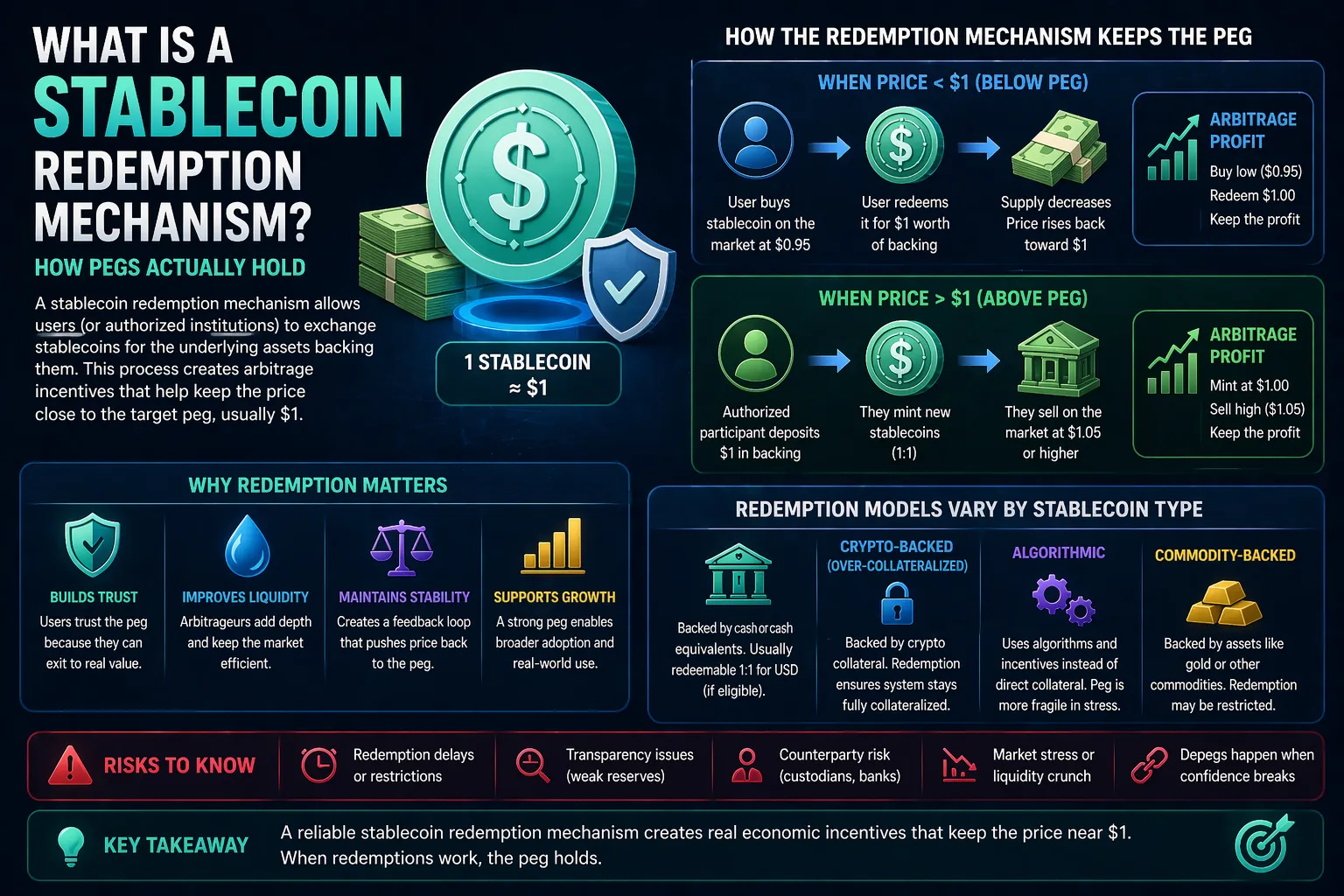
If a stablecoin trades below one dollar, traders may buy it at a discount and redeem it for full value. That creates demand in the market and helps the price move back up. If a stablecoin trades above one dollar, new tokens may be issued against collateral and sold into the market, increasing supply and helping the price move back down.
This arbitrage loop is a core part of how many stablecoins hold their peg.
How a Stablecoin Redemption Mechanism Works
The exact structure depends on the type of stablecoin. In some systems, users deposit dollars or dollar equivalent assets to mint new stablecoins, then redeem them later for the same value. In other systems, only certain participants can directly mint and redeem at scale.
Either way, the redemption mechanism links the token to something outside the token itself. That link gives the market a reason to defend the peg because deviations create arbitrage opportunities.
Without redemption, price stability becomes much more dependent on confidence alone.
What Happens When a Stablecoin Loses Its Peg
If a stablecoin starts trading below its target price and the redemption process is working well, arbitrageurs step in. They buy the discounted token, redeem it for full backing value, and profit from the difference. This tends to pull the price back toward the peg.
If redemption is blocked, delayed, or unclear, that stabilizing force becomes weaker. In that case, the peg can break more easily because the market has less reason to believe the token is worth its target value.
Why Some Pegs Are Stronger Than Others
Not all stablecoin pegs are equally strong. A peg tends to be more credible when redemptions are simple, collateral is transparent, and market participants trust the system.
A peg tends to be weaker when access is limited, backing is uncertain, or the redemption process depends on fragile assumptions. This is why stablecoin design matters so much. The label stablecoin does not automatically guarantee stability.
Risks in Stablecoin Redemption
Redemption systems can face stress during market panic, liquidity shortages, or questions about reserve quality. If too many users want out at once, the redemption process may come under pressure. If users are not sure what backs the stablecoin, confidence can fade quickly.
That is why a stablecoin redemption mechanism is not just a technical detail. It is one of the foundations of trust.
Final Thoughts on Stablecoin Redemption Mechanisms
A stablecoin redemption mechanism is one of the main reasons a peg can hold in real markets. It gives the token a path back to underlying value and creates incentives for arbitrageurs to keep the price close to target.
For crypto users, understanding redemption is essential. A stablecoin is only as reliable as the system that supports its price. In the end, the peg is not held by marketing. It is held by mechanism, trust, and liquidity.
How to Bridge Crypto Between Chains: Complete Cross-Chain Tutorial 2026 How to Use 1inch: Complete DEX Aggregator Swap Tutorial (2026) How to Use OKX Web3 Wallet: Multi-Chain DeFi Hub Guide (2026)Frequently Asked Questions
Q: How do stablecoin redemption mechanisms work?
A: Stablecoin redemption mechanisms allow users to exchange their stablecoins for the underlying collateral or an equivalent value. This process helps maintain the stablecoin's peg to its reference asset.
Q: What are common types of stablecoin redemption mechanisms?
A: Common types include direct redemption for fiat currency, redemption for other cryptocurrencies, or algorithmic mechanisms that adjust supply and demand.
Q: Why are robust redemption mechanisms important for stablecoins?
A: Robust redemption mechanisms are crucial for maintaining user confidence and the stablecoin's price stability. They provide an assurance that the stablecoin can be converted back to its underlying value.
Q: What role does collateral play in stablecoin redemption?
A: Collateral provides the backing for stablecoins and is the asset against which stablecoins can be redeemed. The quality and accessibility of collateral are key to effective redemption.
Q: What are the risks associated with stablecoin redemption mechanisms?
A: Risks can include illiquidity of collateral, operational failures, regulatory changes, or a lack of transparency regarding the redemption process and underlying assets.